 Skip to content
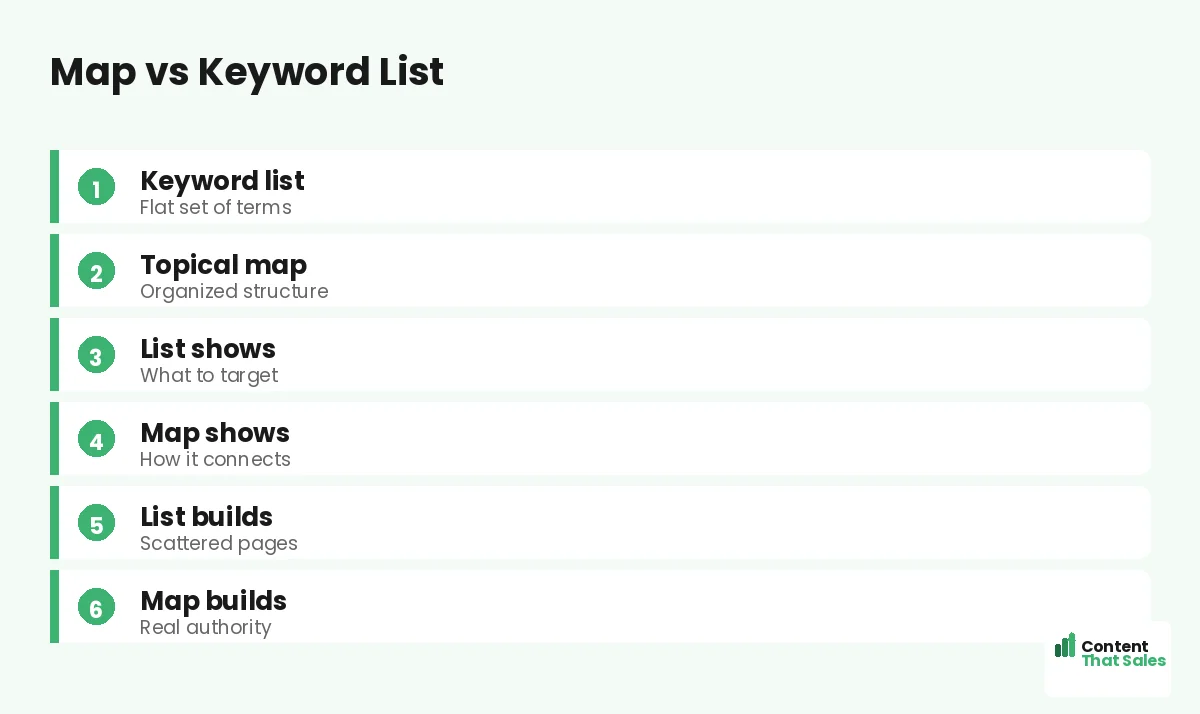
Topical maps vs keyword lists is a debate that comes up whenever people plan SEO content, and the winner is clear for building real authority. A keyword list is a flat set of terms to target. A topical map organizes those terms into a connected structure of pillars and clusters that builds expertise. A list tells you what to target; a map tells you how it all fits together. For lasting SEO results, the map wins. This guide explains why.
Keyword lists are not useless, they are a starting point. But on their own they lead to scattered, disconnected pages that never add up to authority. A topical map takes those keywords and turns them into a strategy. That structural difference is everything.
Below, we walk through what each one is, the key differences, and why a topical map wins for SEO that lasts.

What a Keyword List Is
A keyword list is a flat collection of search terms you want to rank for. It tells you what people search and roughly how often, giving you targets. But it is just a list, with no structure, no relationships, and no plan for how the pages connect.
Keyword lists are easy to produce and useful for spotting opportunities. The problem is they stop there. A list of terms does not tell you how to organize content or build authority, it leaves the hardest, most important strategic work undone.
What a Topical Map Is
A topical map takes the same underlying keyword research and organizes it into a connected structure, pillars and clusters that cover a subject completely. It tells you not just what to target but how the pages relate and reinforce each other.
This structure is what builds authority. Learning how a topical map works shows it is far more than a list, it is a strategy that turns scattered keywords into complete, connected coverage that search engines reward.
The Core Difference
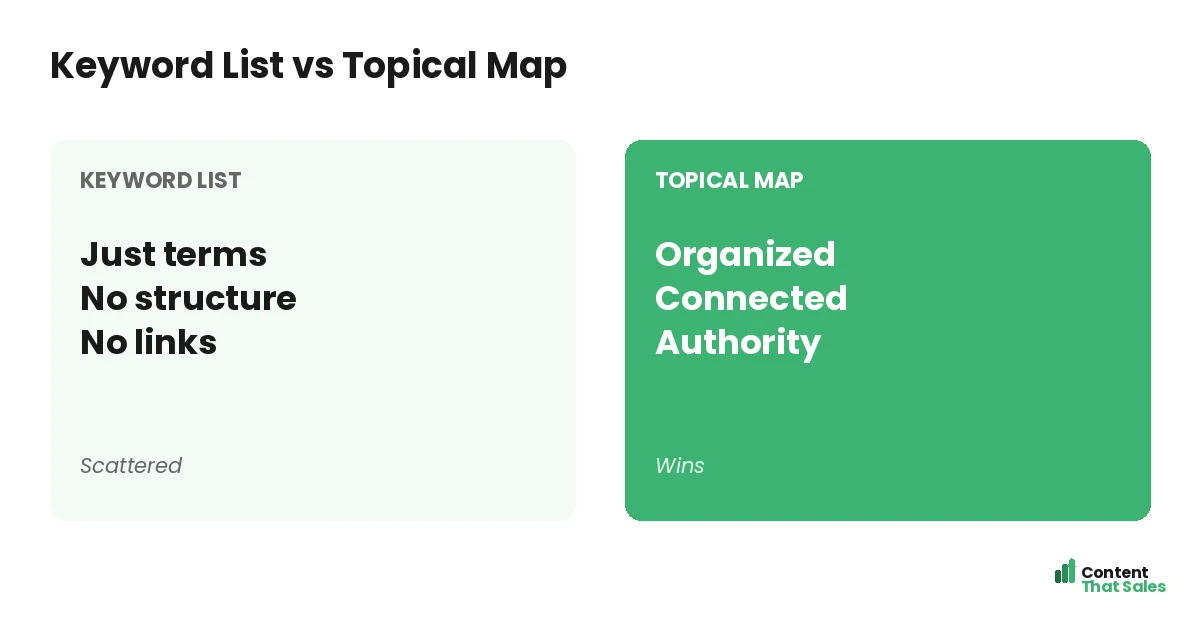
The core difference is structure. A keyword list is flat, just terms. A topical map is organized, terms grouped into clusters under pillars, connected by links. One is raw material; the other is a finished plan built from that material.
This difference is huge for results. Writing from a flat list produces disconnected pages. Writing from a map produces a connected body of content that signals expertise. The structure is what transforms keywords into authority, and it is what a list lacks.
Why Structure Matters for SEO
Search engines reward complete, connected coverage of a subject, not isolated pages. A topical map delivers exactly that, organized, interlinked content that demonstrates expertise. A keyword list, with no structure, leads to scattered pages that never signal authority.
Structure is the difference between content that ranks and content that does not. It shows search engines how your pages relate and that you cover a subject fully. This is why a map, which provides structure, beats a list, which does not.
The Cannibalization Problem
A flat keyword list often leads to cannibalization, multiple pages targeting similar terms and competing with each other. Without structure, it is easy to create overlapping pages that split your ranking power and confuse search engines about which to rank.
A topical map prevents this by assigning each term to one page and grouping related ones into clusters. Properly clustering keywords means each page has a distinct job. Knowing how to cluster keywords for a topical map solves the overlap a raw list creates.
Did you know?
A keyword list of 200 terms can become 200 competing pages or 40 strong, connected ones. The difference is whether you have a map organizing them.
The Internal Linking Advantage
A topical map includes a plan for how pages link together; a keyword list does not. This linking is part of what builds authority, connecting related pages so they reinforce each other and spread ranking power across your site.
A list gives you no guidance on linking, leaving your pages isolated. A map maps the connections between pillar and cluster pages, turning individual pages into a reinforcing network. This structural advantage is something a flat list simply cannot provide.
The Coverage Advantage
A topical map ensures complete coverage of a subject; a keyword list does not. A map is built to cover every subtopic, while a list is just whatever terms you happened to collect, often with gaps you never notice until a competitor fills them.
Complete coverage is the foundation of authority. Since readers scan more than they read, a map also ensures each page serves a clear need within full coverage, rather than chasing isolated keywords with no bigger picture.
When a Keyword List Still Helps
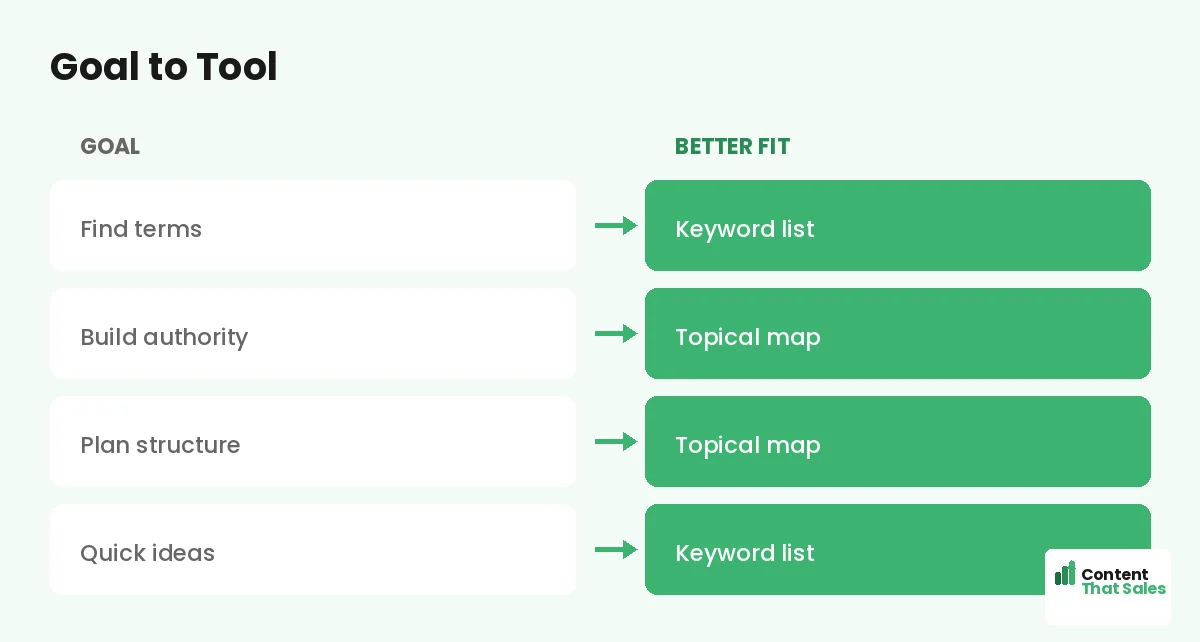
Keyword lists are not worthless, they are a useful input. Keyword research feeds the map, providing the raw terms you organize into structure. The point is not to skip keyword research but to go beyond a flat list into a connected map.
Use keyword research as a starting ingredient, then build the map from it. A list alone is incomplete; a list organized into a map is powerful. The two are stages of the same process, not competing alternatives, with the map as the finished product.
Put It All Together
In topical maps vs keyword lists, the map wins for SEO. A keyword list is a flat set of terms; a topical map organizes them into connected, complete coverage that builds authority. Structure, linking, and coverage are what a list lacks and a map provides.
Keyword research still matters as an input, but a flat list is not a strategy. Turn your keywords into a map, and you transform scattered targets into a powerful, authority-building plan. For lasting results, always choose the map.
From List to Map in Practice
Turning a flat list into a map is a practical process, not magic. You start with your keyword research, then group related terms, assign each group to a page, organize those pages under pillars, and plan the links between them. The result is a structure where every keyword has a home and a purpose.
The grouping step is where most of the value is created, because that is when scattered terms become coherent clusters. The same work you do to find cluster topics turns a raw list into the building blocks of a map. Simple, clear pages keep winning, and since easy reading lifts engagement, organizing your keywords this way also leads to pages that genuinely serve readers rather than just chasing terms.
How Content That Sales Helps
Turning keyword research into a real map takes skill. That’s where we come in. At Content That Sales, we take the keywords and build them into a connected topical map, organized, clustered, and linked, that actually builds authority.
You get a strategy, not just a list. We research, cluster, and map, often organized in a topical map template for clarity, and can write the content too. The result is keywords transformed into a powerful, authority-building plan.
Ready to Go Beyond a List?
Now you know why topical maps beat keyword lists: structure, linking, and complete coverage build authority that a flat list never will. So why settle for a list of terms when a map turns them into real rankings?
Let’s turn your keywords into a map. Book your free consultation now. Call us at 8801631988589 or email service@contentthatsales.com. Let’s transform scattered terms into a connected strategy that ranks and lasts.
Frequently Asked Questions About Maps and Keyword Lists
What is the difference between a topical map and a keyword list?
A keyword list is a flat set of terms to target. A topical map organizes those terms into connected pillars and clusters that build complete coverage and authority.
Which is better for SEO?
A topical map. Its structure, linking, and complete coverage build authority, while a flat list leads to scattered, disconnected pages that never signal expertise.
Are keyword lists useless?
No. Keyword research is a useful input that feeds the map. The point is not to skip it but to go beyond a flat list into an organized map.
Why does structure matter so much?
Search engines reward complete, connected coverage, not isolated pages. Structure shows how your pages relate and that you cover a subject fully.
What is cannibalization?
When multiple pages target similar terms and compete with each other. A flat list invites this; a map prevents it by giving each page a distinct keyword.
How does a map help with linking?
A map plans how pages connect, turning them into a reinforcing network that spreads ranking power. A keyword list gives no linking guidance at all.
How do I turn a list into a map?
Cluster related keywords by topic and intent, assign one per page, group them under pillars, and plan the links. That structure is the map.
Can Content That Sales help?
Yes. We turn keyword research into a connected, clustered, linked topical map and can write the content too. Reach out for a quick quote.