 Skip to content
Knowing how to cluster keywords for a topical map is the skill that turns a messy keyword list into an organized content plan. Clustering means grouping related keywords that share a topic and intent so each group becomes one page. Done well, it prevents overlap, gives every page a clear focus, and forms the structure of your map. This guide walks through how to cluster keywords step by step so your map is built on solid groupings.
Keyword clustering is where raw research becomes strategy. A flat list of terms tells you what to target; clustering tells you how to organize those terms into pages and pillars. That organization is what makes a topical map work.
Below, we walk through how to gather, group, and assign keywords into clusters that form a clean, effective map.

What Keyword Clustering Is
Keyword clustering is grouping related search terms that share the same topic and intent so they can be served by a single page. Instead of one page per keyword, you create one page per cluster of closely related keywords, which is how real pages rank.
Clustering reflects how search works, a single page can rank for many related terms. Building a topical map on clusters rather than individual keywords means each page targets a group of related searches, which is both efficient and effective.
Why Clustering Matters
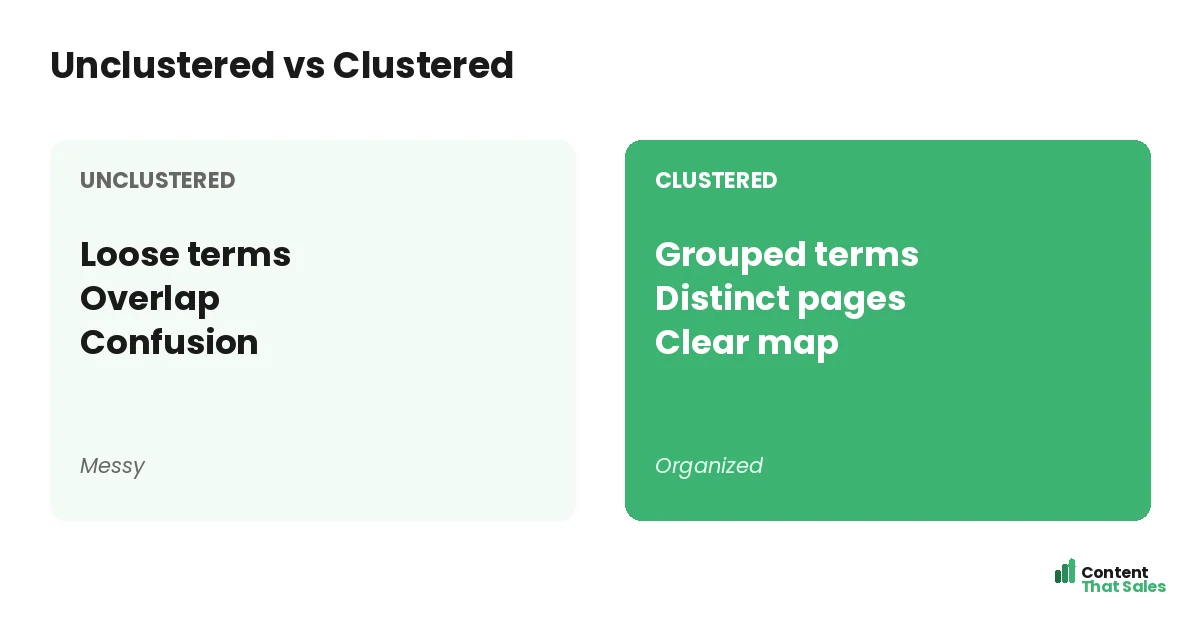
Clustering matters because it prevents you from creating many thin, overlapping pages. Without it, you might write a separate page for every keyword, even near-identical ones, splitting your ranking power. Clustering groups those terms so one strong page serves them all.
This is the difference between a strategic map and a chaotic one. Proper clustering turns a keyword list into organized pages, avoiding the overlap that a flat list causes. It is the core skill that makes a topical map coherent and effective.
Step 1: Gather Your Keywords
Start by gathering a full list of keywords related to your topic. Use keyword tools, search results, related searches, and questions to collect every relevant term. The more complete your list, the better your clusters will be, so be thorough here.
This raw list is your material. It should include broad terms, specific long-tail phrases, and questions. Gathering widely now means you capture the full range of how people search your topic, giving you everything you need to form complete clusters.
Step 2: Group by Topic
Next, group keywords that cover the same topic. Terms describing the same thing, even with different wording, belong together. This first pass organizes your messy list into rough thematic groups, the beginnings of your clusters and pages.
Look for keywords that a single page could naturally answer together. Group synonyms, variations, and closely related phrasings. This grouping is the heart of clustering and where you start to see your cluster topics take shape from the raw list.
Step 3: Group by Intent
Within your topic groups, check search intent. Keywords on the same topic but with different intent, say, learning about something versus buying it, belong on different pages. Splitting by intent ensures each page serves one clear goal.
Intent is what finalizes your clusters. Two terms can share a topic but need different pages if searchers want different things. Since readers scan more than they read, matching each cluster to one intent ensures the page delivers exactly what searchers expect.
Step 4: One Cluster Per Page
Each finished cluster should map to one page. This ensures every page targets a distinct group of related searches with one clear intent, preventing overlap. The rule is simple: one cluster, one page, one job, no two pages competing.
This one-to-one mapping is what keeps your map clean. If two clusters feel too similar, merge them; if one cluster covers two intents, split it. The goal is a set of distinct clusters, each ready to become a focused, non-competing page.
Did you know?
A single well-built cluster page can rank for dozens of related keywords at once, which is why clustering beats writing one thin page per individual term.
Step 5: Pick a Primary Keyword
For each cluster, choose a primary keyword, the main term the page targets, usually the one with the best mix of demand and relevance. The others become secondary terms the page also covers. This gives each page a clear main focus.
The primary keyword anchors the page and guides its title and focus. The secondary terms enrich it. Picking a clear primary for each cluster ensures every page has one main target while still capturing the related searches in its group.
Step 6: Map Clusters to Pillars
Finally, organize your clusters under pillars, grouping related clusters into the broad themes of your map. This turns your clusters into a full structure, pillars supported by their clusters, which is the shape of a complete topical map.
Mapping clusters to pillars gives your map its hierarchy. Then plan the connections between pillar and cluster pages so they link together. Simple, clear pages keep winning, and since easy reading lifts engagement, plan each clustered page to be clear and useful.
Put It All Together
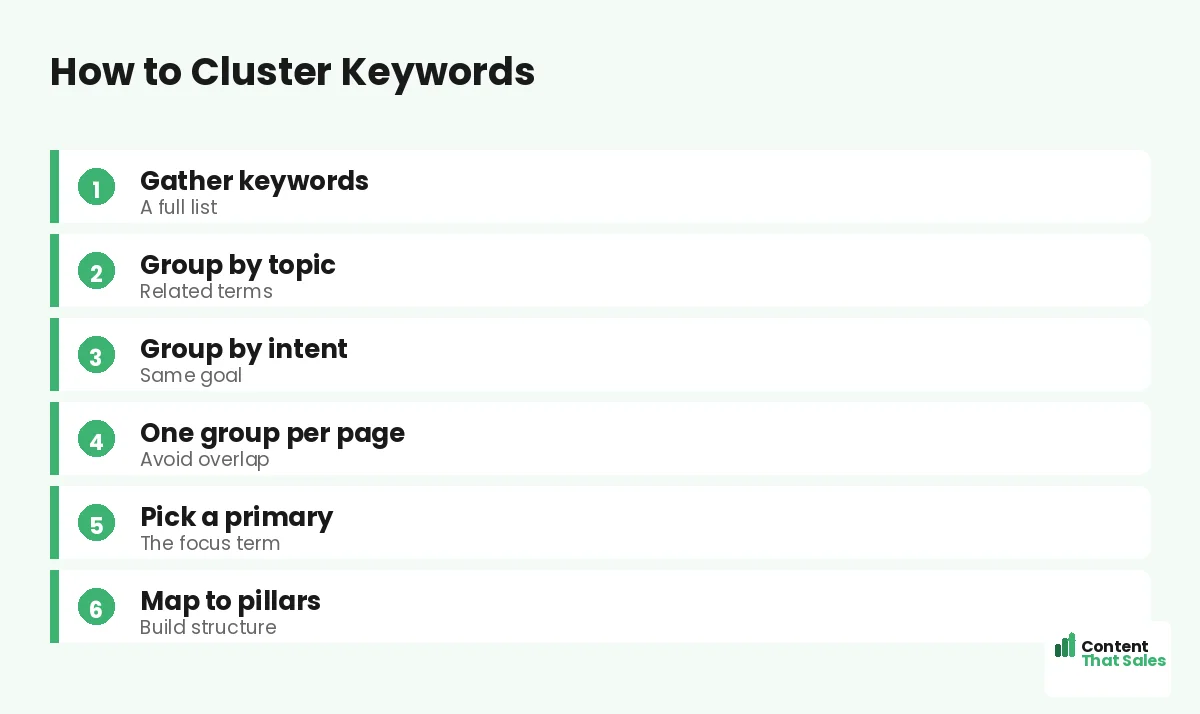
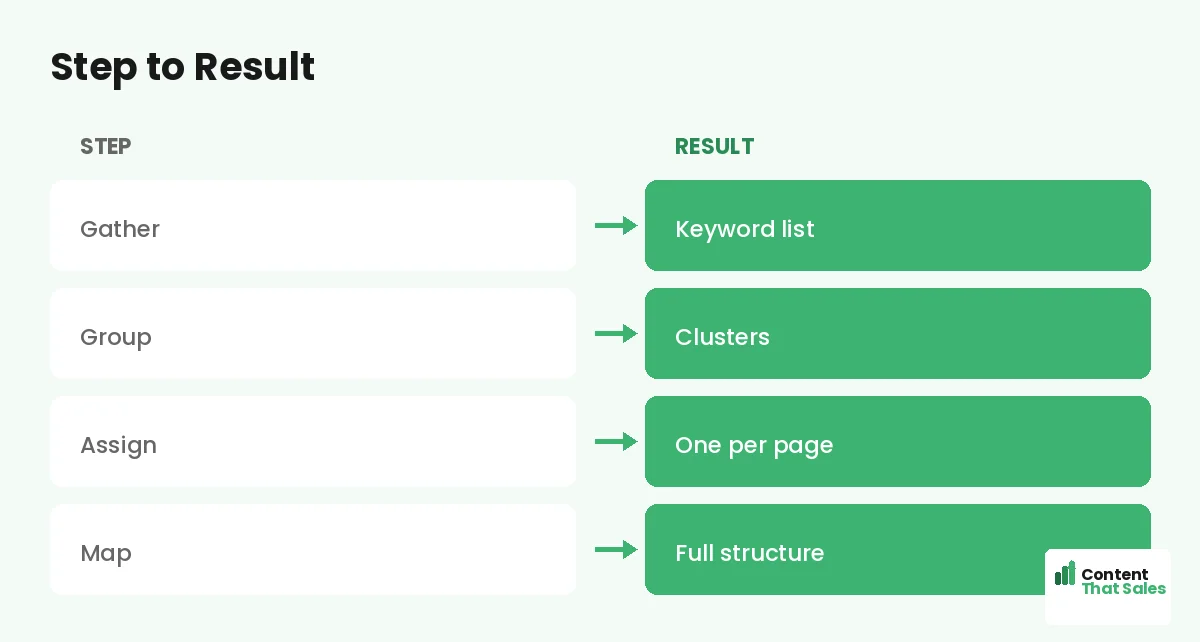
To cluster keywords for a topical map: gather your keywords, group by topic, then by intent, map one cluster per page, pick a primary keyword for each, and organize clusters under pillars. The result is a clean, structured map.
Clustering is what turns a flat keyword list into organized pages and a real map. It prevents overlap, gives each page a clear focus, and forms your structure. Master clustering, and you master the foundation of an effective topical map.
Clustering Is Why Maps Beat Lists
Clustering is the exact step that separates a real topical map from a plain keyword list. A list leaves you with hundreds of individual terms and no plan; clustering turns those terms into a manageable set of focused pages, each targeting a group of related searches. That transformation is where the strategic value lives.
This is the core reason a map outperforms a list for SEO. If you have ever wondered about topical maps vs keyword lists, clustering is the answer, it is the work that converts raw terms into structure, prevents cannibalization, and gives every page a distinct purpose. Skip clustering and you are left with a list; do it well and you have the foundation of a map that builds authority and avoids your own pages competing with each other.
How Content That Sales Helps
Clustering keywords well takes experience and judgment. That’s where we come in. At Content That Sales, we gather your keywords, cluster them by topic and intent, and map them into a clean structure ready to build content from.
You get organized clusters, not a messy list. We research, cluster, and map, often organized in a topical map template for clarity, and can write the content too. The result is a map built on solid, well-formed keyword groupings.
Ready to Cluster Your Keywords?
Now you know how to cluster keywords for a topical map: gather, group by topic and intent, one cluster per page, pick a primary, and map to pillars. So why leave your keywords as a messy list when clustering turns them into a real map?
Let’s cluster your keywords together. Book your free consultation now. Call us at 8801631988589 or email service@contentthatsales.com. Let’s turn raw keywords into organized clusters that build a winning map.
Frequently Asked Questions About Keyword Clustering
What is keyword clustering?
Grouping related keywords that share a topic and intent so they can be served by one page. Instead of one page per keyword, you create one page per cluster.
Why cluster keywords?
To avoid creating many thin, overlapping pages. Clustering groups related terms so one strong page serves them all, preventing split ranking power.
How do I start?
Gather a full keyword list, then group terms by topic, then split those groups by intent. Each final group becomes one page in your map.
What is the role of intent?
Intent finalizes clusters. Two terms on the same topic but with different intent need different pages, so splitting by intent ensures each page serves one goal.
What is a primary keyword?
The main term a cluster page targets, usually with the best mix of demand and relevance. The other terms become secondary keywords the page also covers.
How many keywords per cluster?
As many as one page can naturally serve together with one intent. A good cluster page can rank for dozens of related terms at once.
How do clusters become a map?
Map each cluster to a page, then organize related clusters under pillars and plan the links. That structure of pillars and clusters is your topical map.
Can Content That Sales help?
Yes. We gather, cluster, and map your keywords into a clean structure, and can write the content too. Reach out for a quick quote.