 Skip to content
Learning how to build a topical map for SEO is the difference between publishing random posts and building a site that owns its subject in Google’s eyes. A topical map is a structured plan of every topic and subtopic you will cover, organized into clusters, so you build complete authority instead of scattered, thin content. This complete guide walks you through every step, from picking your core topic to planning the order you publish.
Search engines reward sites that cover a subject thoroughly and connect their pages logically. A topical map gives you exactly that: a blueprint for full coverage, clear structure, and smart internal linking. Build one and you stop guessing what to write and start building real topical authority.
Below, we walk through what a topical map is, the steps to build one, and how to turn it into a content plan that ranks.

What a Topical Map Is
A topical map is a structured plan of all the content you will create around a core subject. It lists your main topic, every subtopic, and how they group into clusters, so your site covers the subject completely rather than in scattered pieces.
Think of it as the blueprint for your content. If you want to learn more first, our guide on what a topical map is covers the basics. Here, we focus on the practical steps to build one from scratch.
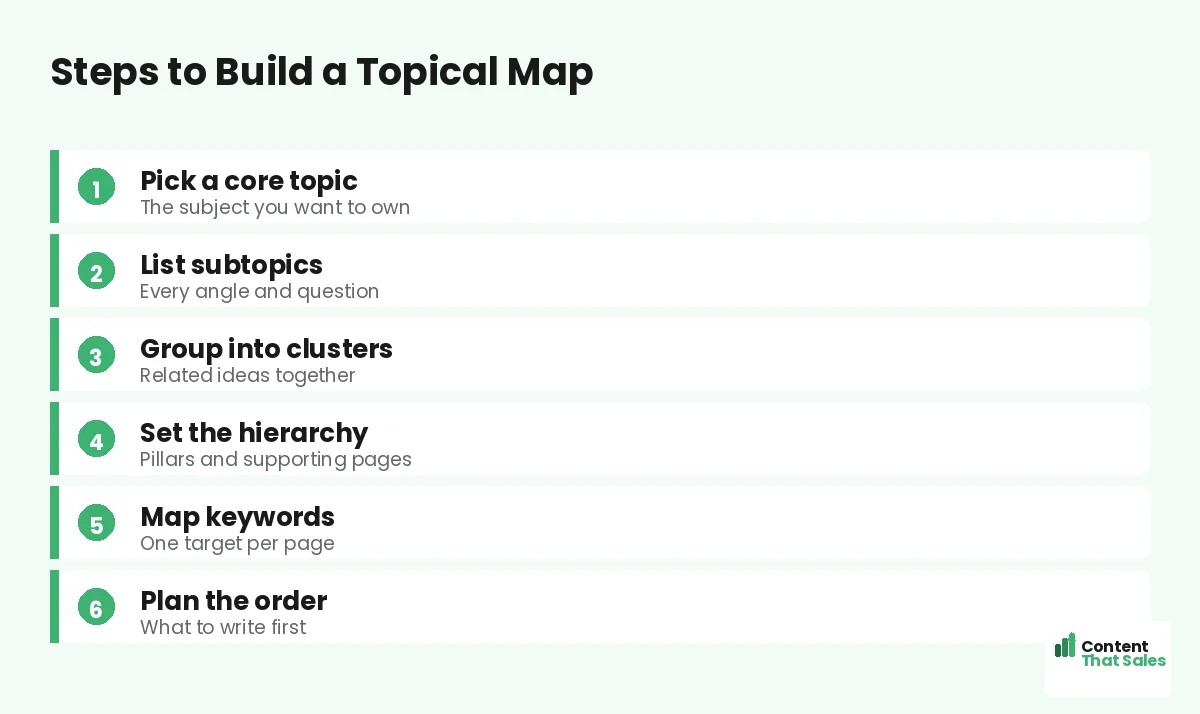
Step 1: Choose Your Core Topic
Start by defining the one core topic you want your site to be known for. This is the broad subject at the center of your map, like “email marketing” or “home fitness.” Everything else will branch from this central theme.
Pick a topic that fits your business and that you can cover deeply. A focused core topic is easier to dominate than a broad one. The narrower and clearer your center, the stronger the authority you can build around it.
Step 2: List Every Subtopic
Next, brainstorm every subtopic under your core theme. Think of the questions your audience asks, the problems they face, and the angles they search for. Aim for completeness, you want to capture the whole subject, not just the obvious parts.
Use keyword research, competitor sites, and customer questions to find subtopics. The goal is a long, thorough list. Each subtopic will eventually become a page, so the more complete your list, the more fully your map covers the topic.
Step 3: Group Subtopics Into Clusters
Now organize your subtopics into clusters of related ideas. Each cluster is a group of pages that cover one part of your core topic in depth. Clustering turns a messy list into a clear, logical structure.
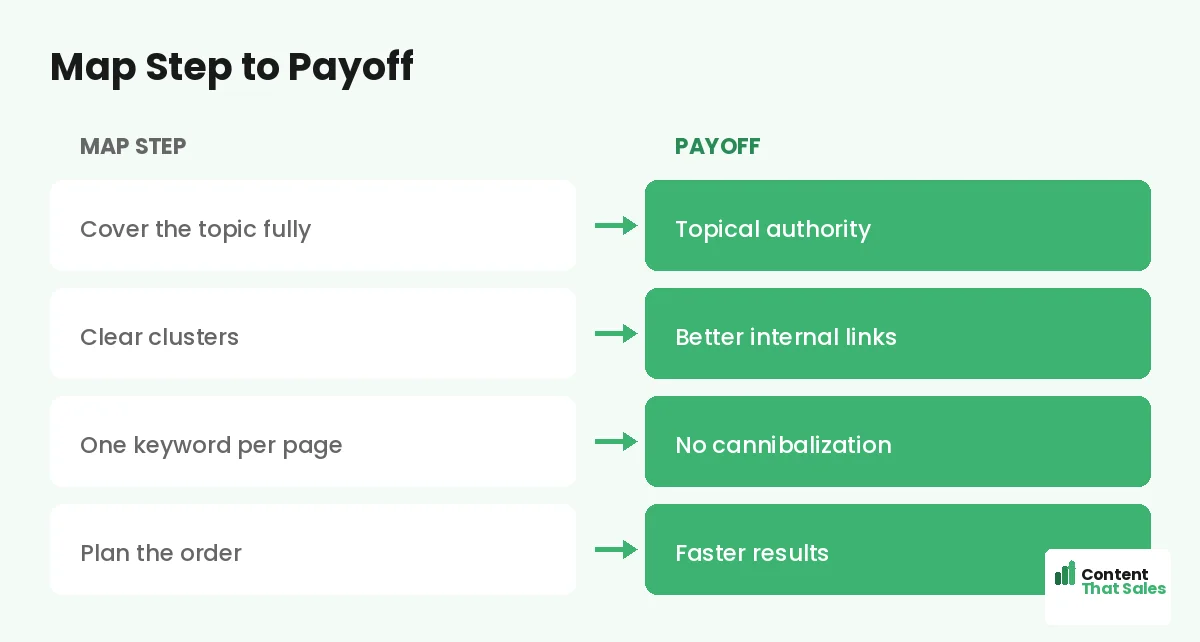
For example, under “email marketing,” one cluster might be “list building” and another “email design.” Grouping related pages makes internal linking natural and signals to Google that you cover each area thoroughly, which builds authority cluster by cluster.
Step 4: Set the Hierarchy
Within each cluster, set a hierarchy: a pillar page that gives the broad overview, and supporting pages that dive deep into each subtopic. The pillar links to its supporting pages, and they link back, forming a tight, connected structure.
This pillar-and-cluster shape is the backbone of a topical map. The pillar covers the cluster broadly; the support pages go deep on specifics. Together they show search engines you own that part of the topic from every angle.
Step 5: Map Keywords to Pages
Assign a primary keyword to each page so every page has a clear target and no two pages compete for the same term. This keyword mapping prevents cannibalization, where your own pages fight each other in the rankings.
One page, one main keyword, plus related terms it naturally covers. Clear keyword assignment keeps your map focused and your pages distinct, so each one can rank for its own search instead of diluting the others.
Step 6: Plan the Publishing Order
Finally, decide what to write first. A smart order is to publish a pillar page, then its supporting pages, completing one cluster before moving to the next. Finishing clusters builds authority faster than scattering posts across the whole map.
Prioritize clusters by value and opportunity, the ones closest to your offer or with the best ranking chances. Since readers scan more than they read, plan clear, focused pages that each fully answer their subtopic.
Did you know?
Completing one full cluster usually builds authority faster than publishing scattered posts, because Google sees thorough coverage of one area rather than thin coverage of many.
Why a Topical Map Builds Authority
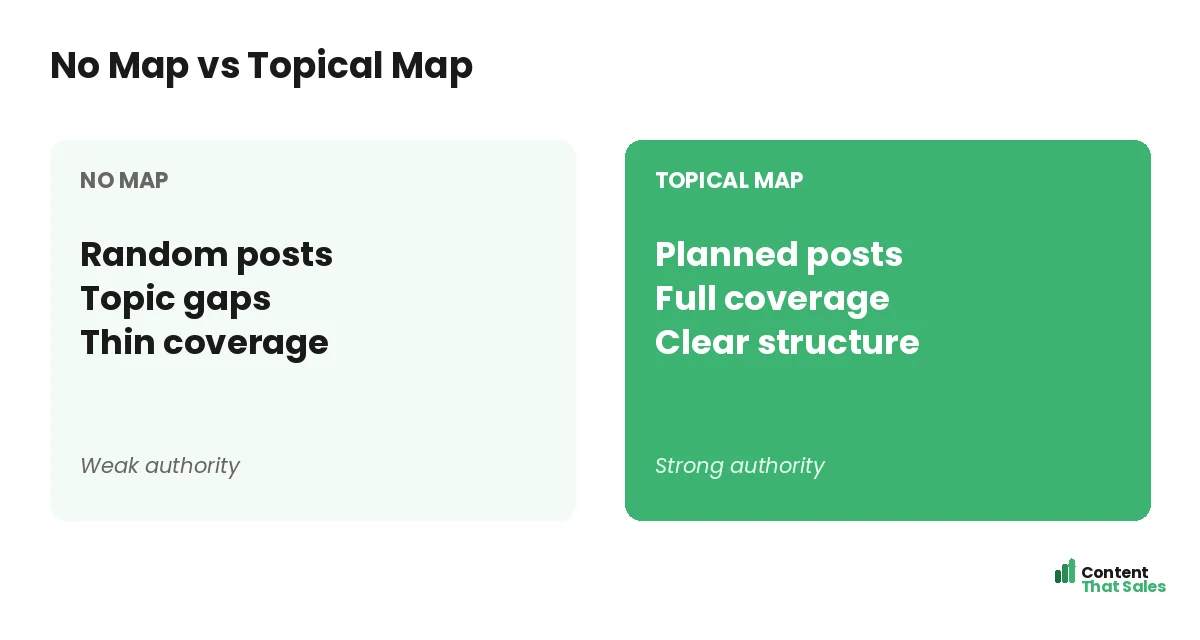
A topical map builds topical authority because it proves to Google that you cover a subject completely and connect your pages logically. Full coverage plus smart internal links signals genuine expertise, which earns higher rankings across the whole topic.
Without a map, you publish in gaps and overlaps, and your authority stays thin. With one, every page reinforces the others. The map turns a pile of posts into a connected body of work that ranks far better than the sum of its parts.
Use the Right Tools
You can build a topical map in a spreadsheet, a mind map, or a dedicated tool. The format matters less than the thinking. What you need is a clear view of your core topic, subtopics, clusters, hierarchy, and keyword assignments in one place.
Whatever tool you choose, keep the map living. Update it as you publish, find new subtopics, and spot gaps. A topical map is not a one-time document; it is the evolving plan that guides your content for years.
Map vs Keyword List
A topical map is not just a keyword list. A list is flat; a map is structured around topics and their relationships. The map decides what to cover and how it connects, while keywords are assigned to pages within it.
The two work together. For the distinction in detail, see our breakdown of a topical map vs a keyword map. In short, topics give you strategy and structure; keywords give you the specific targets for each page.
Turn the Map Into Content
A map is only valuable once you write the pages. Take each entry and create a focused, thorough article that fully answers its subtopic. Link it to its pillar and related pages so the cluster forms a connected web of content.
Quality matters as much as coverage. Each page should genuinely help the reader, since pages that fully satisfy a search are the ones that rank on Google. A map of thin pages will not build authority; a map of strong pages will.
Keep the Map Updated
Search topics evolve, so your map should too. Revisit it regularly to add new subtopics, fill gaps you find in the rankings, and refresh older clusters. A living map keeps your coverage complete as your subject and audience change.
Simple, clear content keeps winning, since easy reading lifts engagement. Update the map, keep writing strong pages, and your topical authority compounds. The map is the strategy; consistent, quality publishing is what makes it pay off.
Put It All Together
To build a topical map for SEO, choose a focused core topic, list every subtopic, group them into clusters, set a pillar-and-support hierarchy, map keywords to pages, and plan the publishing order. Then write strong pages and link them well.
The result is full coverage, clear structure, and the topical authority that ranks. A topical map turns scattered effort into a connected strategy. Build one, work it cluster by cluster, and your site grows into the authority on its subject.
How Content That Sales Helps
We build topical maps and the content that fills them. That’s where we come in. At Content That Sales, we plan your map, cluster your topics, and write the pages that build real authority and rank.
You share your core topic and goals. We map the full structure, assign keywords, and write strong, connected pages cluster by cluster. The result is a site that covers its subject completely and climbs the rankings.
Ready to Build Your Topical Map?
Now you know how to build a topical map for SEO: pick a core topic, list subtopics, cluster them, set the hierarchy, map keywords, and plan the order. Full coverage builds authority. So why keep publishing scattered posts?
Let’s build your map and the content that ranks. Book your free consultation now. Call us at 8801631988589 or email service@contentthatsales.com. Let’s turn your topic into authority and traffic.
Frequently Asked Questions About Building a Topical Map
What is a topical map?
A structured plan of every topic and subtopic you will cover around a core subject, organized into clusters, so your site builds complete authority rather than scattered content.
How do I start building one?
Choose one focused core topic, then brainstorm every subtopic your audience searches for. Group those subtopics into clusters and set a pillar-and-support hierarchy.
What is a cluster?
A group of related pages that cover one part of your core topic in depth, usually a pillar overview page plus supporting pages that dive into specifics.
Why map keywords to pages?
To give each page a clear target and prevent cannibalization, where your own pages compete for the same term. One page, one primary keyword.
What order should I publish in?
Complete one cluster at a time, pillar first, then its support pages. Finishing clusters builds authority faster than scattering posts across the whole map.
Is a topical map just a keyword list?
No. A list is flat; a map is structured around topics and their relationships. The map sets strategy and structure, then keywords are assigned within it.
How often should I update the map?
Regularly. Add new subtopics, fill ranking gaps, and refresh older clusters. A living map keeps your coverage complete as your subject evolves.
Can Content That Sales build my map?
Yes. We plan your topical map, cluster your topics, and write the connected pages that build authority and rank. Reach out for a quick quote.