 Skip to content
If you have heard the term but wondered exactly what is a topical map and why it matters for SEO, the short answer is this: a topical map is a structured plan of every topic and subtopic your site will cover around a central subject, and it matters because Google rewards sites that cover a subject completely and connect their pages logically. This guide gives you a clear definition, shows how a topical map works, and explains why it has become essential for ranking.
Modern SEO is less about chasing single keywords and more about proving expertise across a whole subject. A topical map is how you plan that expertise on purpose, so your content builds authority instead of sitting as scattered, disconnected posts.
Below, we define a topical map, break down its parts, explain why it boosts rankings, and show when you should use one.

A Simple Definition
A topical map is a structured plan of all the content you will create around one core subject. It maps your central topic, every subtopic beneath it, and how those subtopics group into clusters. In short, it is the blueprint for covering a subject completely.
Rather than publishing posts as ideas strike, you work from a map that ensures full coverage and clear structure. It pairs naturally with a strong content plan, and if you want the practical version, see our guide on how to build a topical map.
The Parts of a Topical Map
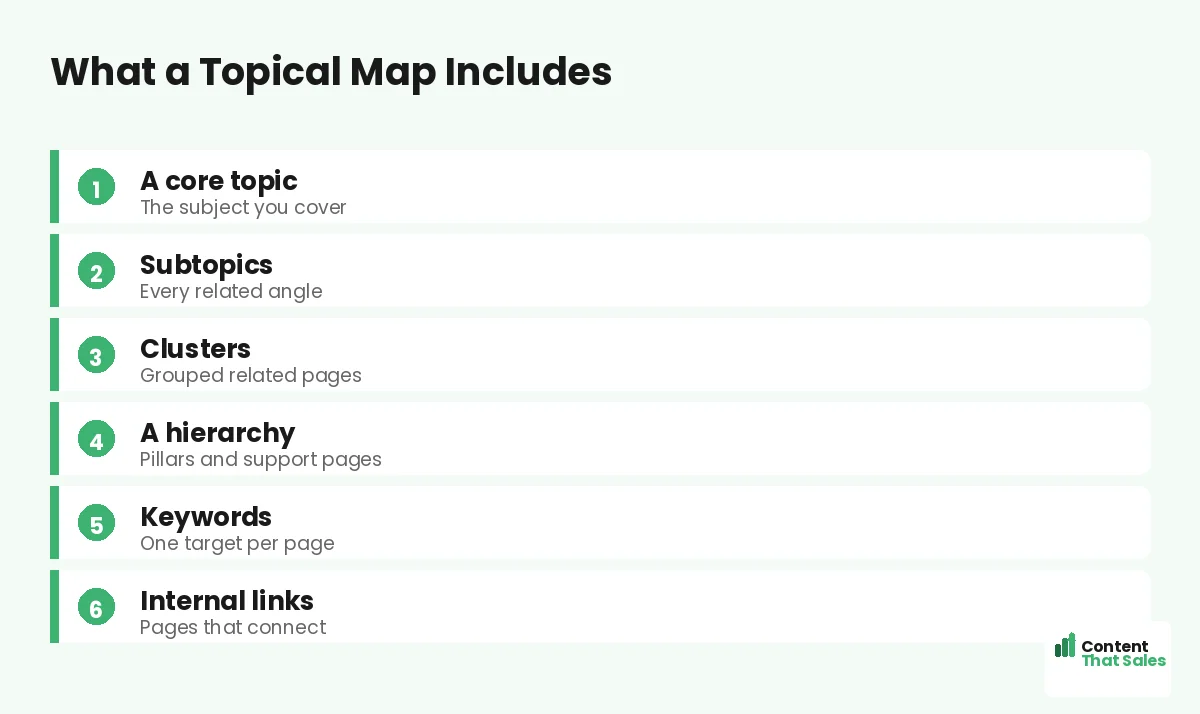
A topical map has a few key parts. At the center is your core topic. Branching from it are subtopics, every angle and question within the subject. Those subtopics group into clusters, and within each cluster sit a pillar page and supporting pages.
Each page is also assigned a keyword and connected to related pages through internal links. Together, these parts form a connected web of content that covers the subject from every angle, which is exactly what builds authority.
How a Topical Map Works
A topical map works by organizing your content around topics and their relationships, not isolated keywords. You decide what to cover, how it groups, and how pages link together. Then you publish cluster by cluster, completing the subject piece by piece.
As you fill in the map, your site signals to Google that it covers the subject thoroughly. The internal links between related pages reinforce that signal. The map turns a pile of posts into a structured body of work search engines can understand and trust.
Why It Matters for SEO
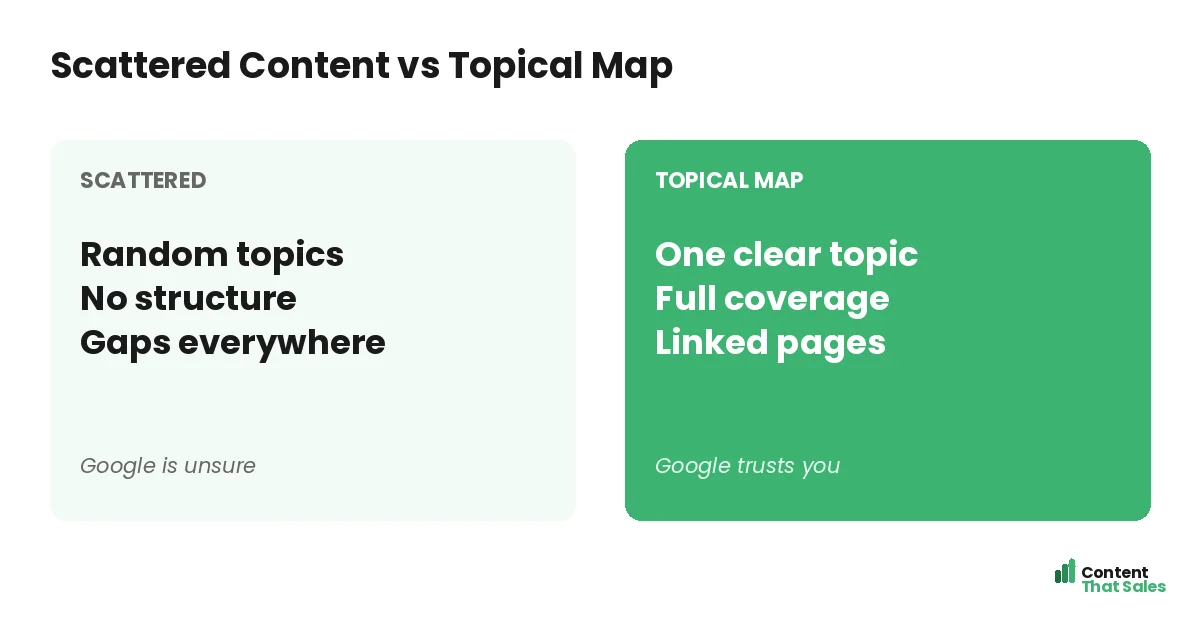
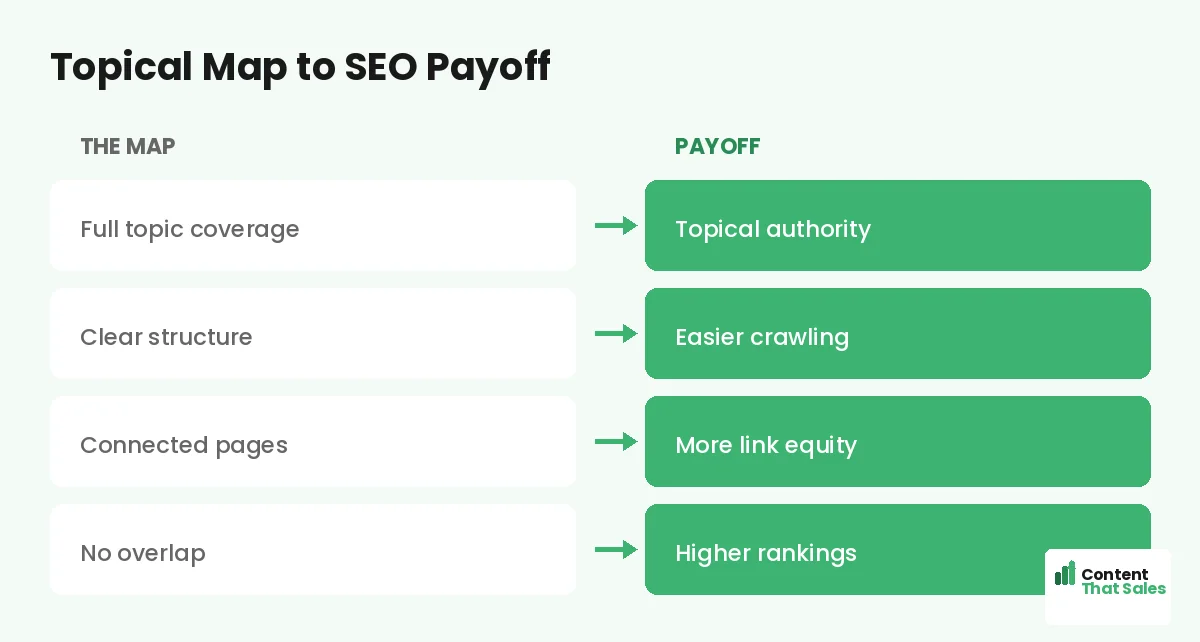
A topical map matters because it builds topical authority, Google’s sense that you are an expert on a subject. When you cover a topic completely and link your pages well, search engines see genuine expertise and reward it with higher rankings.
This is the heart of modern SEO. To go deeper, see our explainer on topical authority. The map is how you build that authority deliberately, rather than hoping scattered posts somehow add up to expertise in Google’s eyes.
Topical Maps and Topical Authority
Topical authority is earned by covering a subject so thoroughly that you become a go-to source. A topical map is the plan that gets you there. Without the map, your coverage has gaps and overlaps; with it, every page strengthens the whole.
Google increasingly favors depth over breadth. A site that covers one subject completely outranks a site that touches many subjects shallowly. The topical map is your tool for choosing depth on purpose and building authority that lasts.
Better Internal Linking
A topical map naturally improves your internal linking. Because pages are grouped into clusters with a pillar and supporting pages, the links between them are obvious and logical. Pillars link to support pages, and support pages link back and to each other.
Strong internal linking spreads authority across your site and helps Google understand your structure. Since readers scan more than they read, clear links also help visitors find related content, keeping them engaged longer.
Did you know?
Google increasingly favors depth over breadth, so a site that covers one subject completely often outranks a larger site that touches many subjects shallowly.
No More Content Gaps or Overlap
Two common SEO problems are content gaps, missing subtopics, and content overlap, where pages compete for the same keyword. A topical map solves both. It shows you the whole subject, so you spot gaps, and it assigns one keyword per page, so nothing overlaps.
This is a quiet but powerful benefit. Gaps mean missed traffic; overlap means your own pages cannibalize each other. The map gives you a bird’s-eye view that keeps your coverage complete and your pages distinct.
When Should You Use a Topical Map?
You should use a topical map any time you are serious about ranking for a subject. New sites use it to plan from the start. Established sites use it to find gaps and organize existing content. Any site competing in search benefits from one.
It is especially valuable when a subject is competitive, since depth and authority are what win. If you publish regularly and want that effort to compound rather than scatter, a topical map is the structure that makes it pay off, especially if you are just starting out with topical maps.
Map vs Calendar vs Hub
A topical map is often confused with other tools. It is not a content calendar, which schedules when you publish, and it is not a content hub, which is the live set of linked pages on your site. The map is the underlying plan that informs both.
Think of the map as the strategy, the calendar as the timeline, and the hub as the published result. For the distinction in detail, see our comparison of a topical map vs a content calendar. Each plays a different role.
Quality Still Matters
A topical map plans coverage, but coverage alone does not rank. Each page on the map must be genuinely useful and thorough, since pages that fully satisfy a search are the ones Google rewards. A map of thin pages will not build authority.
So treat the map as the plan and quality as the execution. Simple, clear content keeps winning, since easy reading lifts engagement. The map ensures you cover everything; strong writing ensures each page earns its rank.
Put It All Together
A topical map is a structured plan of every topic and subtopic your site covers around a core subject, organized into clusters with a clear hierarchy and keyword assignments. It matters because it builds the topical authority Google rewards.
With a map, you cover subjects completely, link pages logically, avoid gaps and overlap, and turn scattered posts into a connected strategy. For any site serious about ranking, understanding and using a topical map is no longer optional.
How Content That Sales Helps
We turn topical maps into rankings. That’s where we come in. At Content That Sales, we plan your topical map, organize your clusters, and write the thorough, connected pages that build authority on your subject.
You share your core topic and goals. We map the full subject, assign keywords, and create the content that covers it completely. The result is a site that proves its expertise to Google and climbs the rankings.
Ready to Build Your Authority?
Now you know what a topical map is and why it matters: it is the structured plan that builds the topical authority Google rewards. Scattered posts rarely rank. So why not plan your coverage on purpose?
Let’s map your subject and build your authority. Book your free consultation now. Call us at 8801631988589 or email service@contentthatsales.com. Let’s turn your topic into rankings and traffic.
Frequently Asked Questions About Topical Maps
What is a topical map?
A structured plan of every topic and subtopic your site covers around a core subject, organized into clusters with a hierarchy and keyword assignments, to build complete authority.
Why does a topical map matter for SEO?
It builds topical authority, Google’s sense that you are an expert. Covering a subject completely and linking pages well earns higher rankings across the topic.
What are the parts of a topical map?
A core topic, subtopics, clusters, a pillar-and-support hierarchy within each cluster, keyword assignments per page, and internal links connecting related pages.
How does it improve internal linking?
Clusters group related pages with a pillar and support pages, so links between them are logical. Pillars link to support pages, and they link back.
How does it prevent content gaps and overlap?
The map shows the whole subject, so you spot missing subtopics, and it assigns one keyword per page, so your pages do not compete with each other.
When should I use a topical map?
Any time you are serious about ranking for a subject, whether planning a new site or organizing an existing one, especially in competitive topics.
Is a topical map the same as a content calendar?
No. The map is the strategy of what to cover; a calendar schedules when to publish; a content hub is the live set of linked pages. Each is different.
Can Content That Sales help?
Yes. We plan your topical map and write the connected pages that build authority and rank. Reach out for a quick quote.