 Skip to content
If topical maps feel intimidating, this guide to topical maps for beginners shows you exactly where to start, without the jargon or overwhelm. A topical map is simply a plan of the topics and subtopics your site will cover, and you can build your first one with nothing more than a focused subject and a list of questions. Start small, keep it simple, and grow from there.
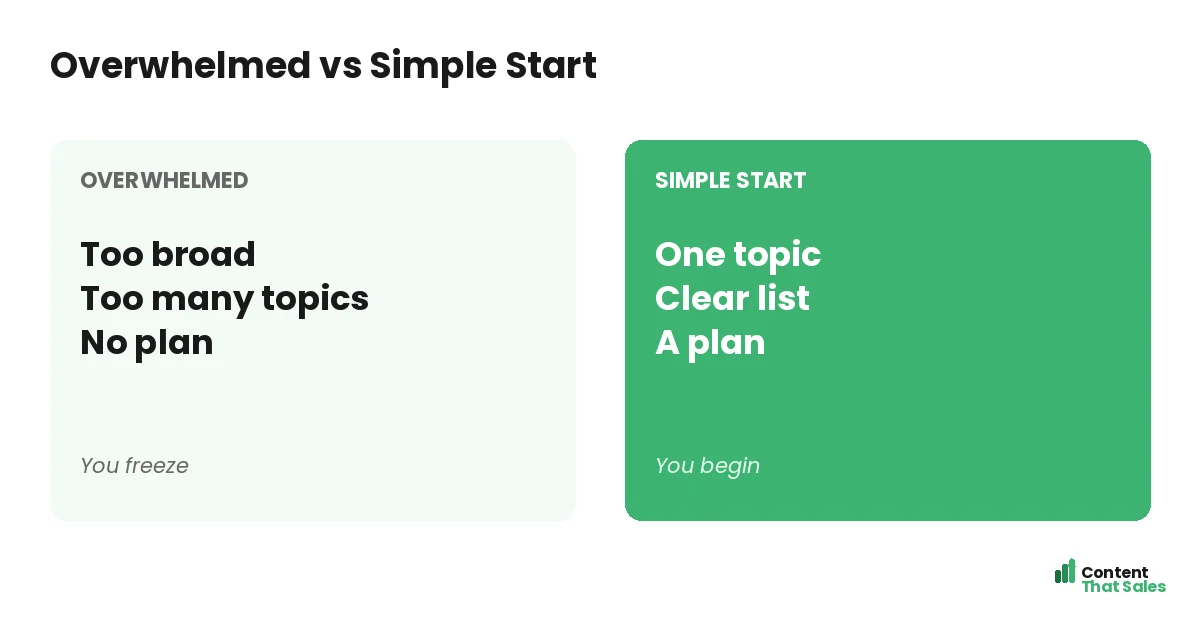
Many beginners freeze because they try to map an entire industry at once. The secret is the opposite: pick one narrow topic, cover it well, and expand later. This guide breaks the process into small, doable steps so you can build your first map today.
Below, we walk through where to start, the simple first steps, and how to grow your map over time without getting overwhelmed.

Start Small, Not Broad
The biggest beginner mistake is starting too broad. Trying to map an entire industry leads to a sprawling, unfinishable list. Instead, choose one narrow topic you can genuinely cover well. A focused start is far easier to complete and to rank, especially once you understand what a topical map is.
For the full method later, see our guide on how to build a topical map. But as a beginner, your only job right now is to pick one tight topic and build a simple map around it. Depth beats breadth every time.
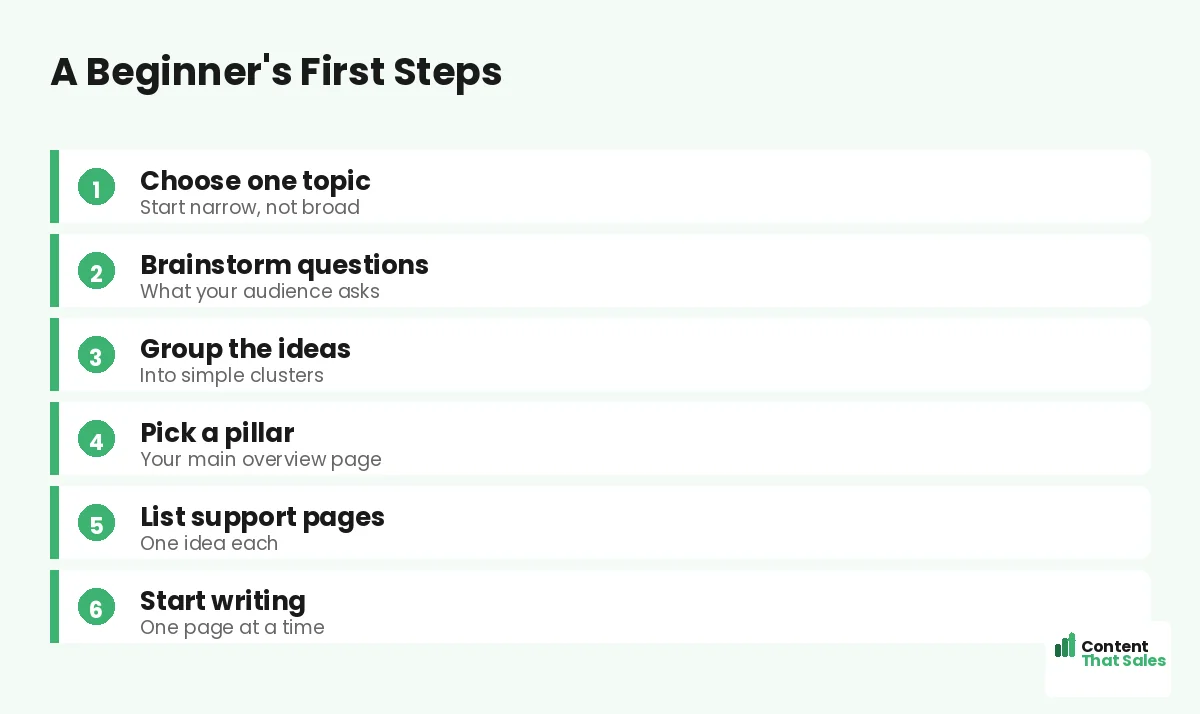
Step 1: Choose One Focused Topic
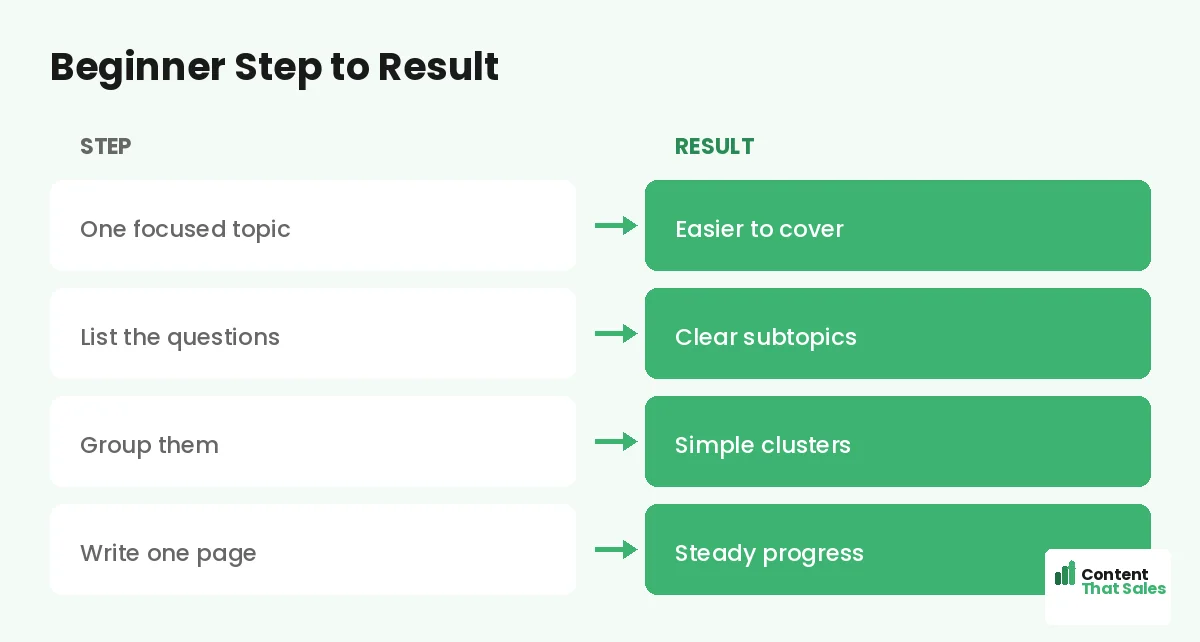
Pick a single subject that matters to your business and that you can write about deeply. Not “marketing,” but something like “email newsletters.” A narrow topic is easier to cover completely, which is what builds authority for beginners.
Resist the urge to be comprehensive about everything. One well-covered topic outperforms ten half-covered ones. Choose the subject closest to what you sell or know best, and make that your starting point. You can always add more topics later.
Step 2: Brainstorm the Questions
Once you have a topic, list every question your audience might ask about it. What do they want to know? What problems do they face? Each question is a potential page. This list becomes the raw material for your map.
Use your own knowledge, customer emails, and a quick look at what competitors cover. Do not filter yet, just capture everything. Since readers scan more than they read, each page should answer one clear question they actually search for.
Step 3: Group the Ideas
Now group your questions into a few simple clusters of related ideas. If your topic is email newsletters, one cluster might be “growing your list” and another “writing the emails.” Grouping turns a long list into a clear structure.
Do not overthink this. Three or four clusters are plenty for a first map. The goal is just to see how your ideas relate, so you can cover each area in a focused way rather than jumping around randomly.
Step 4: Pick a Pillar Page
For your topic, choose one broad overview page, your pillar. It covers the whole subject at a high level and links out to your more detailed pages. The pillar is the anchor that ties your cluster together.
For “email newsletters,” your pillar might be a complete beginner’s guide to email newsletters. It introduces the subject and points readers to deeper pages. Every supporting page will link back to this pillar, forming a simple, connected structure.
Step 5: List Your Supporting Pages
Under the pillar, list the supporting pages, one for each question or subtopic. Each goes deep on a single idea, like “how to write a subject line” or “the best time to send.” Together they cover the topic thoroughly.
This pillar-and-support shape is the core of a topical map, and it is beginner-friendly. One overview page plus several focused pages, the pillar-and-cluster framework, is a complete, simple map. You now have a clear plan for what to write, without any overwhelm.
Did you know?
Beginners who cover one narrow topic completely often outrank those who spread thin across many topics, because Google rewards depth and full coverage.
Step 6: Start Writing, One Page at a Time
With your simple map ready, start writing, one page at a time. Begin with the pillar, then work through the supporting pages. Finishing your small cluster gives you a complete, connected set of content that builds real authority.
Do not rush to add more topics. Complete this one first. Steady progress on a focused map beats scattered posts across many subjects. One finished cluster is a stronger foundation than a dozen half-started ones.
Keep It Simple at First
As a beginner, resist adding complexity. You do not need fancy tools or a giant map. A short list of clusters, a pillar, and supporting pages is enough. You can use a simple spreadsheet or even a notebook to start.
Complexity comes later, once you are comfortable. For now, simplicity is your friend. A small, finished map teaches you more than a huge, unfinished one. Get one cluster done, see the results, and let confidence grow from there.
Grow the Map Over Time
Once your first cluster is done, you can expand. Add a new cluster under the same topic, or branch into a related topic. Each new cluster widens your coverage and strengthens your topical authority, building on the foundation you already have.
This is how a small beginner map grows into a full one. You are not building it all at once; you are growing it cluster by cluster. Over months, those finished clusters add up to deep, authoritative coverage of your subject.
Connect Your Pages
As you publish, link your pages together. Supporting pages link to the pillar and to each other where relevant. These internal links help readers navigate and show Google how your content connects, reinforcing your authority on the topic.
Linking is part of what makes a topical map work, not just a pile of posts. Even a simple beginner map benefits from clear internal links. Connect every new page to the cluster, and your small map becomes a real, structured web of content.
Put It All Together
Topical maps for beginners come down to a simple path: choose one focused topic, brainstorm the questions, group them into a few clusters, pick a pillar, list supporting pages, and write them one at a time. Keep it small and finish it.
Then grow, cluster by cluster, linking your pages as you go. Simple, clear content keeps winning, since easy reading lifts engagement. Start small, complete your first map, and build your authority one finished cluster at a time.
How Content That Sales Helps
We make starting easy. That’s where we come in. At Content That Sales, we help beginners plan a simple, focused topical map and write the first cluster of pages that build authority from day one.
You share your topic and goals. We map a beginner-friendly structure, pick the pillar, and write the connected pages. The result is a clear first map and content that ranks, without the overwhelm of doing it alone.
Ready to Start Your First Map?
Now you know where to start with topical maps: one focused topic, a few clusters, a pillar, supporting pages, written one at a time. Small and finished beats big and abandoned. So why not map your first topic today?
Let’s plan your first map and start building authority. Book your free consultation now. Call us at 8801631988589 or email service@contentthatsales.com. Let’s turn your topic into traffic, step by step.
Frequently Asked Questions About Topical Maps for Beginners
Where do I start with a topical map?
Choose one narrow, focused topic you can cover well, then brainstorm every question your audience asks about it. That list becomes your first map.
Why start narrow instead of broad?
A broad topic is impossible to cover fully and leads to overwhelm. One narrow topic covered completely builds authority faster and is easier to finish.
What is a pillar page?
A broad overview page that covers your whole topic at a high level and links out to detailed supporting pages. It anchors your cluster together.
How many clusters do I need to start?
Just one. A single pillar with several supporting pages is a complete beginner map. Finish it before adding more clusters or topics.
Do I need special tools?
No. A simple spreadsheet or even a notebook works. As a beginner, keep it simple and focus on the thinking, not the tool.
How do I grow my map?
Once your first cluster is done, add a new cluster under the same topic or branch into a related one. Grow cluster by cluster over time.
Should I link my pages?
Yes. Link supporting pages to the pillar and to each other. Internal links help readers and show Google how your content connects.
Can Content That Sales help beginners?
Yes. We plan a simple, focused map and write the first cluster of pages that build authority, without the overwhelm. Reach out for a quick quote.