 Skip to content
A clear topical map creation process turns a daunting task into a repeatable set of steps. Instead of staring at a blank page, you move through defined stages: define your topic, research demand, set your pillars, build clusters, map keywords, plan links, and review. Follow the process and you end up with a complete, connected map every time. This guide walks through each step so you can build a strong topical map from start to finish.
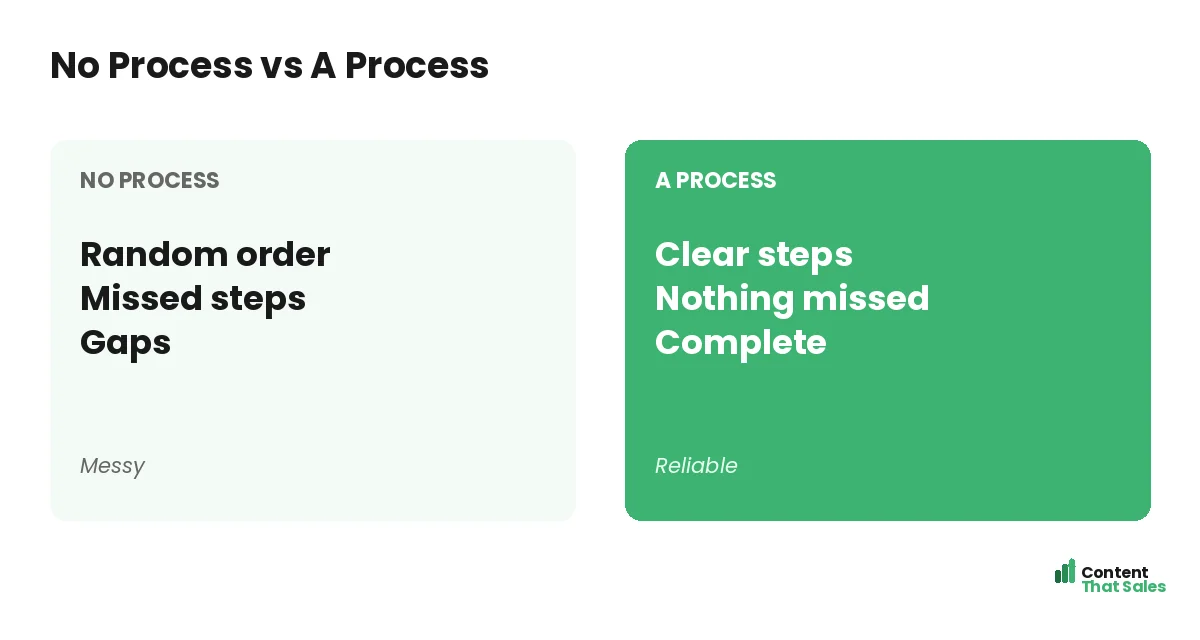
A process matters because it ensures nothing gets missed and the work stays organized. Building a map without one leads to gaps and random order. With a clear sequence, each step builds on the last toward a finished, usable map.
Below, we walk through the full step-by-step process for creating a topical map you can act on.

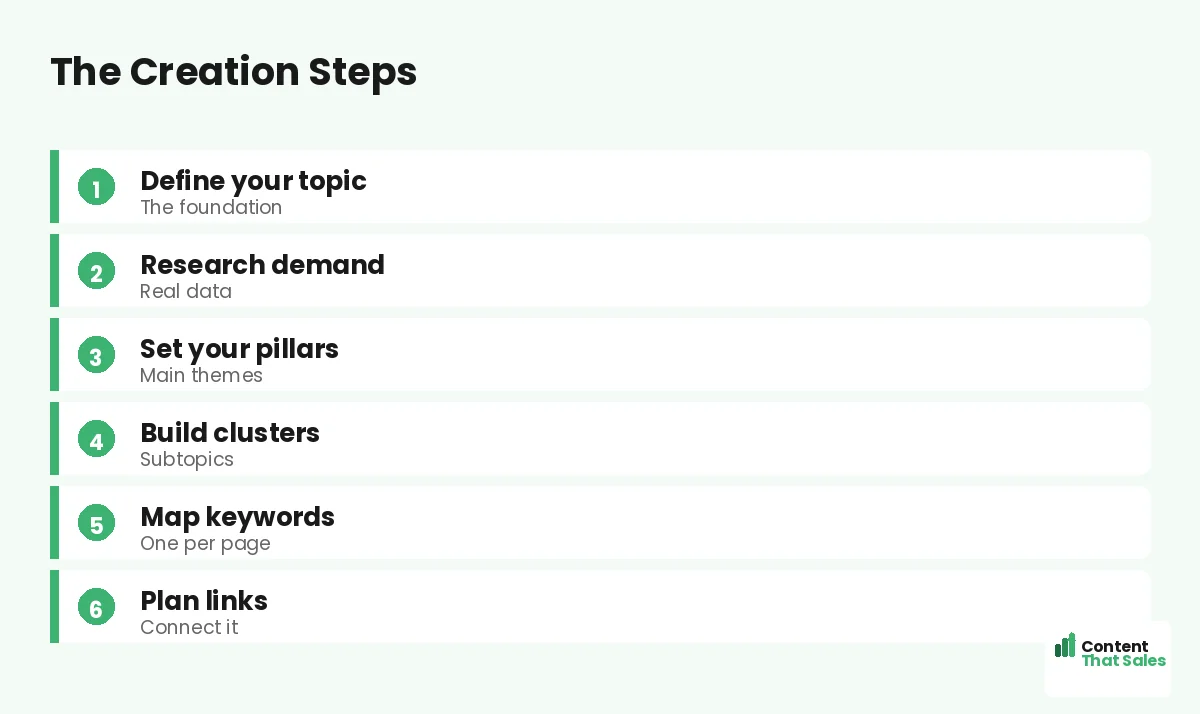
Step 1: Define Your Topic
Start by defining your main topic clearly, the single subject your site is about. This is the foundation everything builds on. A specific, well-chosen topic keeps the whole map focused and ensures every page connects back to one clear subject.
Your topic should be narrow enough to own but broad enough to support many pages. Getting this right first is essential, since the entire topical map grows from it. Spend time here before moving on to research.
Step 2: Research Real Demand
Next, research what people actually search about your topic. Use search data, results pages, and related queries to find real demand. This grounds your map in reality, ensuring you plan pages people genuinely want rather than topics you assume matter.
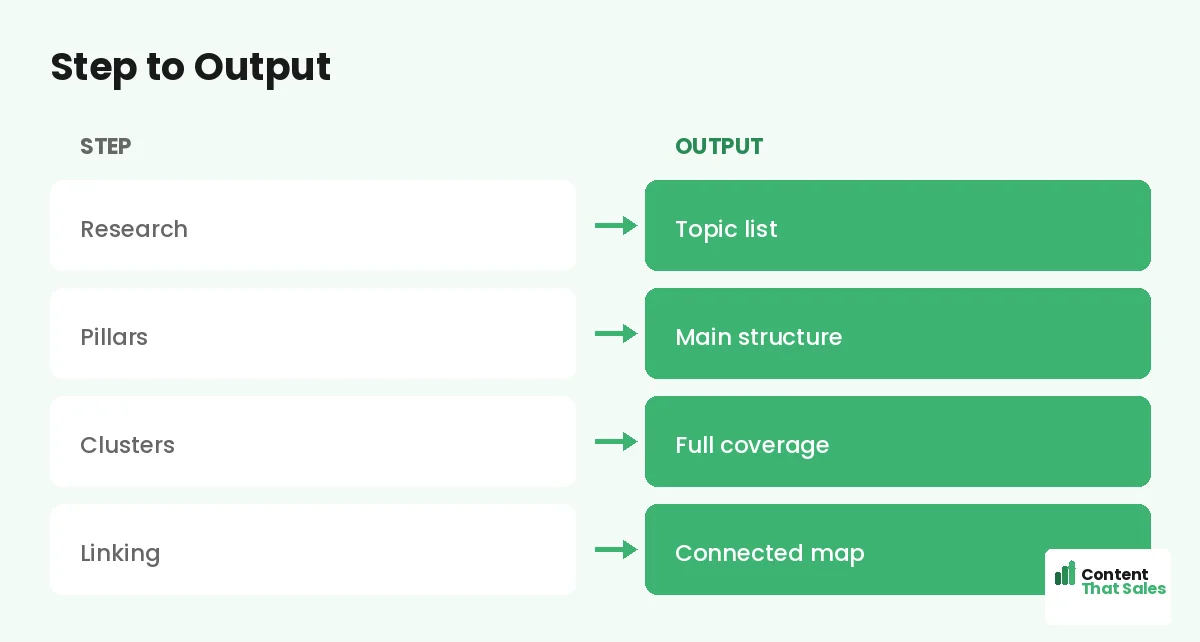
Research is what separates a strong map from a guess. It reveals the subtopics, questions, and terms your audience cares about. This evidence shapes every later step, so thorough research here pays off across the whole map you build.
Step 3: Set Your Pillars
From your research, identify your pillars, the major subtopics under your main topic. These are the big themes your content will cover, each broad enough to support a cluster of related pages. Pillars give your map its main structure.
Choose a handful of strong pillars that together cover your subject. They become the main branches of your map. Getting the pillars right creates a clear framework that the rest of your clusters and pages will hang from logically.
Step 4: Build Your Clusters
Under each pillar, build clusters, the specific pages covering one narrow subtopic each. This is where your map gains depth, with many focused pages supporting each pillar. Thorough clusters are what make your coverage complete and authoritative.
Use your research to find cluster topics for each pillar. List every subtopic, question, and angle worth a page. The more complete your clusters, the more fully your map covers the subject, which is what builds authority.
Step 5: Map Keywords to Pages
Assign a target keyword to each page, the term it should rank for. This gives every page a clear focus and prevents overlap. Mapping keywords turns your list of topics into a targeted plan where each page has a defined job.
Proper keyword mapping is essential. Knowing how to cluster keywords for a topical map ensures each page targets one distinct search and your pages do not compete. This step makes your map actionable rather than just a set of topics.
Step 6: Note Search Intent
For each page, note the search intent, what the reader wants. Informational, commercial, or transactional, intent guides how each page should be written to satisfy searchers. Capturing it now ensures your content serves real needs, not just keywords.
Intent turns targeting into direction. Since readers scan more than they read, knowing each page’s intent helps you plan content that delivers the answer fast. This step keeps your eventual pages aligned with what searchers actually need.
Did you know?
Most map mistakes come from skipping steps, jumping to writing before research or keyword mapping. Following the full process in order is what prevents gaps and overlap.
Step 7: Plan Your Internal Links
Plan how your pages link together, which clusters connect to their pillars and how related pages cross-link. This turns your list of pages into a connected structure that builds authority and helps readers and search engines navigate your content.
Linking is what makes a map work as a system. Map the connections between pillar and cluster pages so each page reinforces the others. Planning this now means you build the connections from the start rather than retrofitting them later.
Step 8: Review and Finalize
Finally, review the whole map for balance, completeness, and overlap. Are pillars evenly covered? Are clusters complete? Any gaps or duplicates? A final review catches problems before you write, when they are still easy to fix.
This review turns a draft into a finished map. Simple, clear pages keep winning, and since easy reading lifts engagement, check that each planned page is set up to be clear and useful. Once reviewed, your map is ready to act on.
Put It All Together
The topical map creation process is: define your topic, research demand, set pillars, build clusters, map keywords, note intent, plan links, and review. Each step builds on the last, taking you from a blank page to a complete, connected map.
Following the process ensures nothing gets missed and the work stays organized. Build it once this way, and you have a repeatable method for any topic. A clear process is what turns map-building from daunting into doable.
Make the Process Repeatable
The real power of having a process is that you can run it again and again. Once you have worked through these steps for one topic, you can apply the exact same sequence to a new subject, a new section of your site, or an expansion into an adjacent area. The steps do not change; only the inputs do.
This repeatability is what lets you scale content without chaos. Each time you follow the process, you produce a complete, connected map built to the same standard, so quality stays consistent no matter who runs it. Document the steps as a simple checklist, and anyone on your team can follow them. Over time, a repeatable process turns map-building from a one-off project into a reliable system you can lean on whenever you need to plan more content.
How Content That Sales Helps
Following the full process well takes time and skill. That’s where we come in. At Content That Sales, we run the entire creation process for you, research, pillars, clusters, keywords, intent, and linking, delivering a finished, ready-to-use map.
You skip the work and get the result. We handle every step, often organized in a topical map template for clarity, and can write the content too. The result is a complete map built the right way, start to finish.
Ready to Follow the Process?
Now you know the step-by-step topical map creation process: define, research, set pillars, build clusters, map keywords, note intent, plan links, and review. Follow it and you get a complete map every time. So why not start with step one today?
Let’s build your map the right way. Book your free consultation now. Call us at 8801631988589 or email service@contentthatsales.com. Let’s turn a clear process into a complete, connected map for your site.
Frequently Asked Questions About the Process
What is the topical map creation process?
A repeatable set of steps: define your topic, research demand, set pillars, build clusters, map keywords, note intent, plan links, and review. Each builds on the last.
Where do I start?
With defining your main topic clearly. It is the foundation everything builds on, so a specific, well-chosen topic keeps the whole map focused.
Why research before building?
Research grounds your map in real demand, so you plan pages people actually search for rather than topics you assume matter. It shapes every later step.
What are pillars and clusters?
Pillars are the major subtopics under your main topic; clusters are the specific pages beneath each pillar. Together they form your map’s structure.
Why map keywords to pages?
So each page has a clear focus and targets one distinct search, preventing overlap. Keyword mapping turns a list of topics into an actionable plan.
Why plan links during creation?
So you build connections from the start. Planning links turns your pages into a connected structure that builds authority, rather than retrofitting it later.
Why review at the end?
To catch gaps, overlaps, and imbalance before you write, when they are easy to fix. The review turns a draft into a finished, usable map.
Can Content That Sales help?
Yes. We run the entire process and deliver a finished map, and can write the content too. Reach out for a quick quote.