 Skip to content
Understanding how Google evaluates topical authority helps you build content that actually ranks. Google does not have a single authority score, instead it reads signals across your site, how completely you cover a subject, how deep and useful your pages are, how they link together, and how relevant and consistent your content is. Send those signals clearly, and Google treats you as an expert. This guide explains the signals and how to send them.
Topical authority is not a number you can see, it is an outcome of many signals working together. Knowing what Google looks for lets you build a strategy aimed directly at those signals rather than guessing.
Below, we walk through the main signals Google weighs and how to make each one strong on your site.

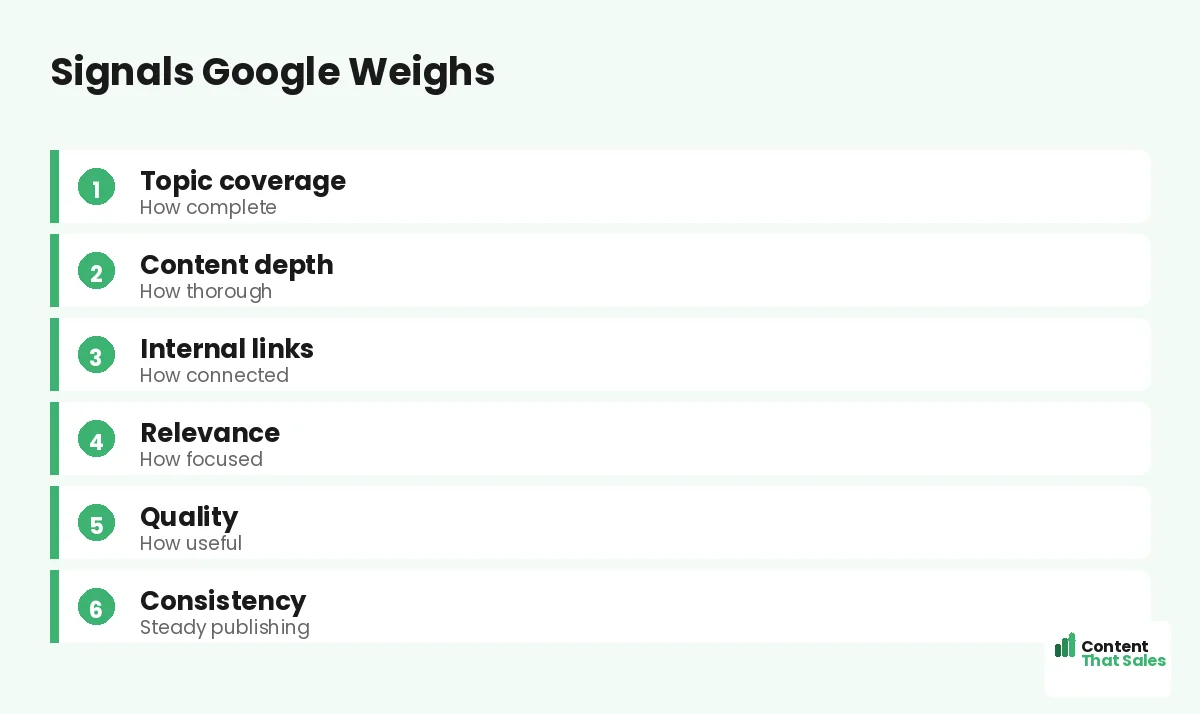
Google Has No Single Authority Score
It is a myth that Google assigns one topical authority number. Instead, it reads many signals across your content and combines them. Authority is the result of these signals, not a metric you can check in a dashboard somewhere.
This matters because it means you build authority by improving the underlying signals, not by chasing a score. Understanding what topical authority is shows why a content strategy aimed at these signals is the right approach.
How Complete Your Coverage Is
The strongest signal is coverage. When you have quality pages addressing every important subtopic, Google sees that you cover the whole subject, not just fragments. Complete coverage is the clearest evidence of genuine expertise on a topic.
This is exactly what a topical map delivers. By planning and covering every subtopic, you send Google the completeness signal directly. Gaps in coverage, by contrast, tell Google your expertise is partial and incomplete.
How Deep Your Pages Are
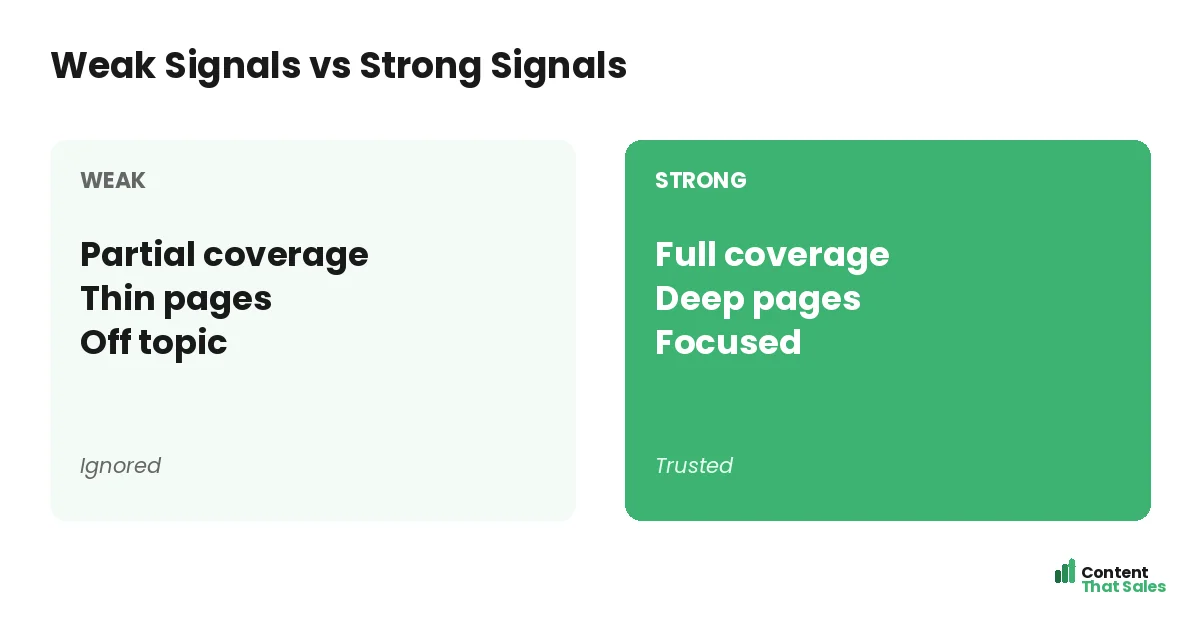
Google rewards depth. A thorough page that fully answers a query and its related questions signals more expertise than a shallow one. Depth across many pages multiplies the effect, showing you understand the subject in detail, not superficially.
Aim to make each page genuinely complete for its subtopic. Thin pages weaken your authority even when they fill a slot. Depth, combined with breadth, is what convinces Google your site is a real expert worth ranking.
How Your Pages Link Together
Google follows internal links to understand how your content connects and to spread authority between pages. A well-linked site shows clear structure and relationships, helping Google see your coverage as a coherent body of expertise rather than scattered pages.
Strong connections between pillar and cluster pages send a powerful structural signal. Linking related pages tells Google they belong together, reinforcing your authority on the topic they share and helping every page rank better.
How Relevant and Focused You Are
Google weighs how focused your site is on its subject. A site tightly centered on one topic sends a clearer expertise signal than one covering many unrelated subjects. Relevance and focus tell Google exactly what you are an authority on.
Staying on topic concentrates your signals. Off-topic pages dilute your focus and confuse Google about your expertise. Since readers scan more than they read, keep each page clearly focused on serving its specific search.
Did you know?
Google’s own guidance emphasizes helpful, people-first content. Topical authority is largely a byproduct of consistently being the most useful, complete answer on your subject.
How Quality and Helpfulness Factor In
Google’s systems favor helpful, high-quality content. Pages that genuinely serve searchers, accurate, clear, and useful, signal trustworthiness. Quality is woven through everything Google evaluates, so it underpins your authority as much as coverage and depth do.
Focus on being the most useful answer for each query. Helpful content earns engagement and trust, which reinforce your authority. Quality is not separate from authority, it is a core part of how Google decides who to rank.
How Consistency Over Time Matters
Google observes your site over time. Consistent publishing of quality, on-topic content signals an active, committed authority. Sporadic or abandoned content sends a weaker signal. Steady effort tells Google you are a reliable, ongoing source on your subject.
Consistency does not mean rushing, it means steady, sustained quality. A site that keeps covering and improving its topic builds authority that compounds. Google rewards the long-term commitment that complete, maintained coverage demonstrates over months and years.
How to Send These Signals
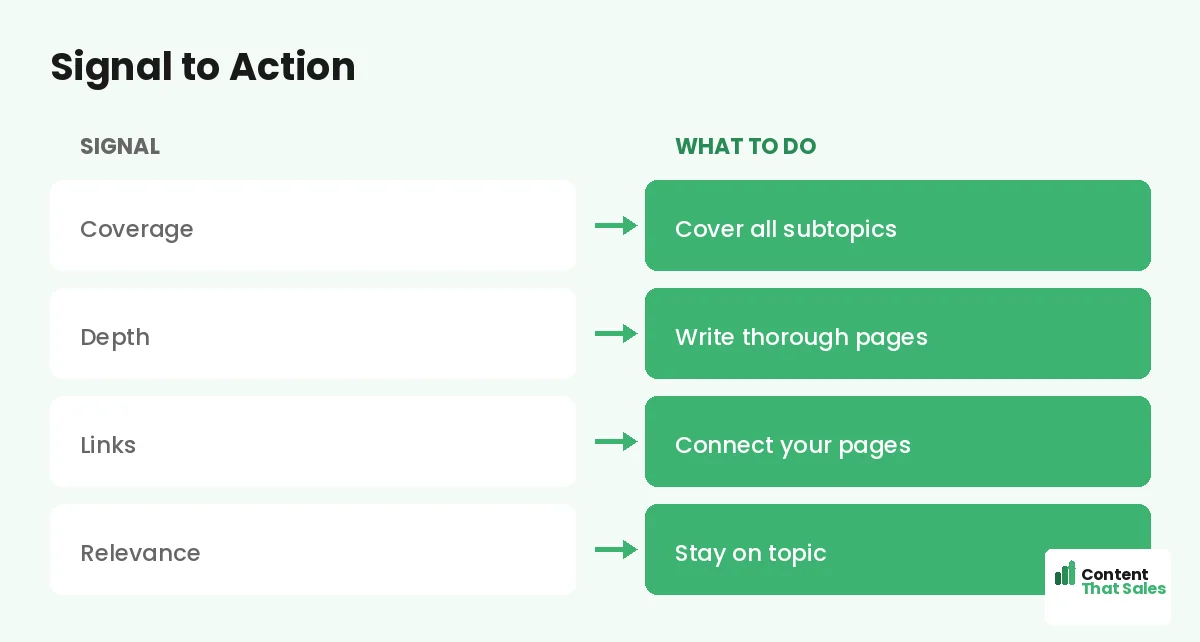
To send Google the right signals, cover your subject completely, write deep pages, link them well, stay focused, keep quality high, and publish consistently. A topical map organizes all of this into one coherent, signal-rich strategy.
Doing these together is what builds authority. Simple, clear pages keep winning, and since easy reading lifts engagement, make each page clear and useful while you build out your complete, connected coverage.
Put It All Together
Google evaluates topical authority through signals: how complete your coverage is, how deep your pages are, how they link together, how focused and relevant you are, how helpful your content is, and how consistent you are over time.
There is no single score to chase, only signals to strengthen. Cover your subject completely, go deep, link well, stay focused, keep quality high, and publish steadily. Do that, and Google recognizes you as an authority.
How EEAT Fits the Picture
Google’s quality guidelines lean heavily on EEAT, experience, expertise, authoritativeness, and trust. These are not separate from topical authority; they are part of how Google judges whether your content deserves to rank. Showing real experience and expertise on your subject reinforces the same authority signals your coverage and depth already send.
In practice, this means more than just writing many pages. Clear authorship, accurate information, and genuine first-hand knowledge all strengthen how Google views your site. The connection runs deep, which is why it helps to understand how EEAT and topical authority connect and to build both together rather than treating them as separate goals.
What This Means for Your Strategy
Because Google combines so many signals, the smart move is to build a strategy that strengthens all of them at once rather than optimizing for any single factor. A topical map does exactly that, it drives complete coverage, encourages depth, organizes internal links, and keeps your site focused on one subject.
Trying to game one signal in isolation rarely works and can backfire. Building genuinely complete, deep, well-connected, helpful content is both what Google rewards and what serves your readers. When your strategy aligns the two, authority follows naturally, and it tends to hold up through algorithm changes because it is built on substance rather than tricks.
How Content That Sales Helps
Sending Google all the right signals takes a coordinated strategy. That’s where we come in. At Content That Sales, we build your map, write deep pages, link them, and keep quality high, so your site sends every authority signal clearly.
You get content built for how Google actually works. We plan the coverage, produce the depth, and connect it, often organizing it in a topical map template for clarity. The result is content Google recognizes as authoritative.
Ready to Send the Right Signals?
Now you know how Google evaluates topical authority: through coverage, depth, links, focus, quality, and consistency. There is no score to game, only signals to strengthen. So why not build content that sends them all clearly?
Let’s build authoritative content together. Book your free consultation now. Call us at 8801631988589 or email service@contentthatsales.com. Let’s turn complete, connected, quality coverage into the signals Google rewards.
Frequently Asked Questions About Google and Authority
Does Google have a topical authority score?
No single score. Google reads many signals, coverage, depth, links, focus, quality, and consistency, and combines them. Authority is the result, not a metric you can check.
What is the strongest signal?
Complete coverage. Quality pages addressing every important subtopic show Google you cover the whole subject, which is the clearest evidence of expertise.
Why does depth matter?
A thorough page that fully answers a query signals more expertise than a shallow one. Depth across many pages shows you understand the subject in detail.
How do internal links help?
Google follows them to understand how your content connects and to spread authority. Well-linked pages show coherent structure and reinforce your expertise.
Does staying on topic matter?
Yes. A focused site sends a clearer expertise signal. Off-topic pages dilute your focus and confuse Google about what you are actually an authority on.
How does quality factor in?
Google favors helpful, high-quality content. Pages that genuinely serve searchers signal trust, which underpins authority as much as coverage and depth.
Why does consistency matter?
Google observes your site over time. Steady publishing of quality, on-topic content signals an active, committed authority that compounds over months and years.
Can Content That Sales help?
Yes. We build content that sends every authority signal clearly, coverage, depth, links, and quality. Reach out for a quick quote.