 Skip to content
Knowing how to validate a topical map before writing content saves you from wasting effort on pages that will not work. Validation means checking, before you write a single word, that each planned page targets real demand, has clear intent, does not overlap with others, and fits your coverage. Catching problems at the map stage is far cheaper than discovering them after you have written dozens of pages. This guide walks through how to validate a map step by step.
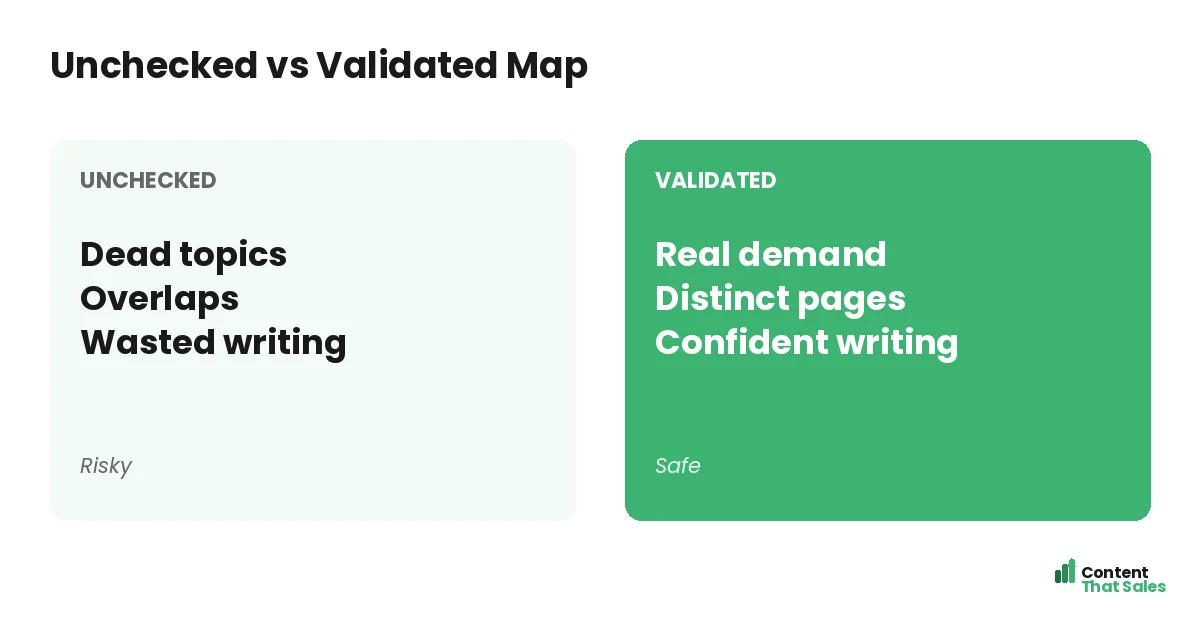
A map can look complete and still be flawed, full of topics no one searches, overlapping pages, or gaps. Validation is the quality check that catches these issues while they are still easy and cheap to fix.
Below, we walk through what to validate, how to check each thing, and how to fix problems before you start writing.

Why Validation Matters
Writing content is expensive in time and money, so writing from a flawed map wastes both. Validation catches problems, dead topics, overlaps, gaps, before you invest in writing. It is a cheap step that prevents costly mistakes down the line.
A map is a plan, and plans should be checked before execution. Validating your topical map ensures the foundation is solid before you build on it. Skipping this step risks writing pages that never rank or that compete with each other.
Validate Real Search Demand
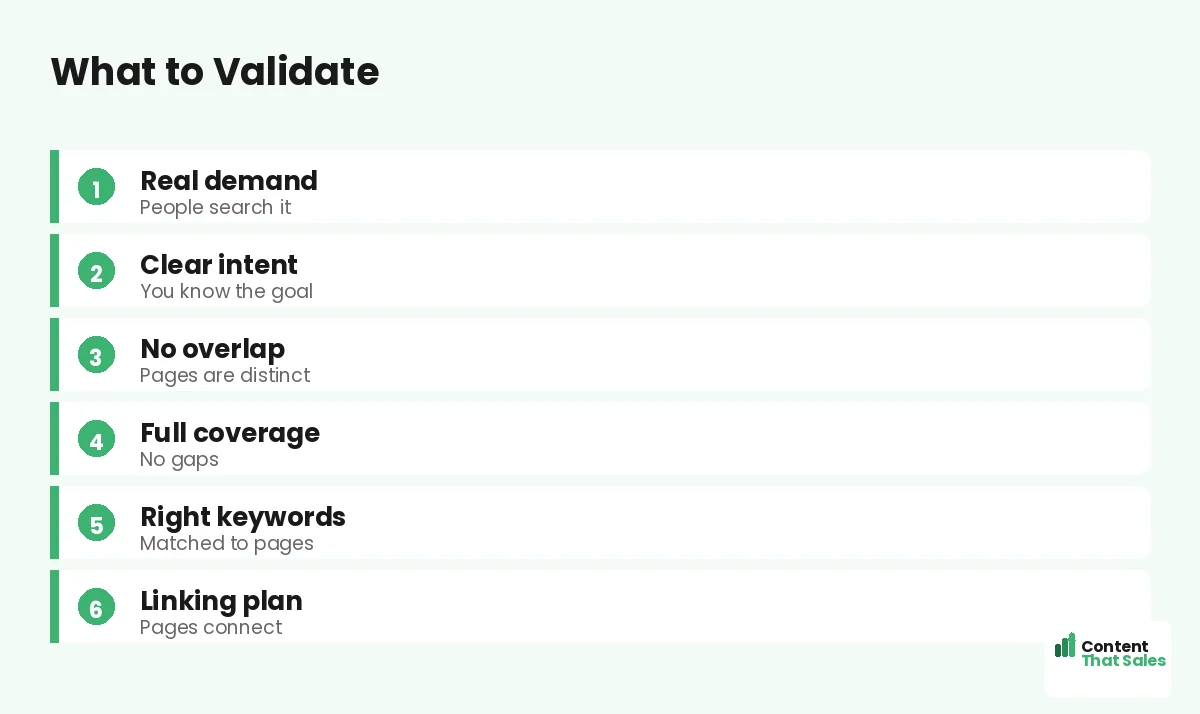
First, confirm each planned page targets real demand, that people actually search for it. A page with no search volume will not bring traffic no matter how well written. Check your keywords against real data to weed out dead topics.
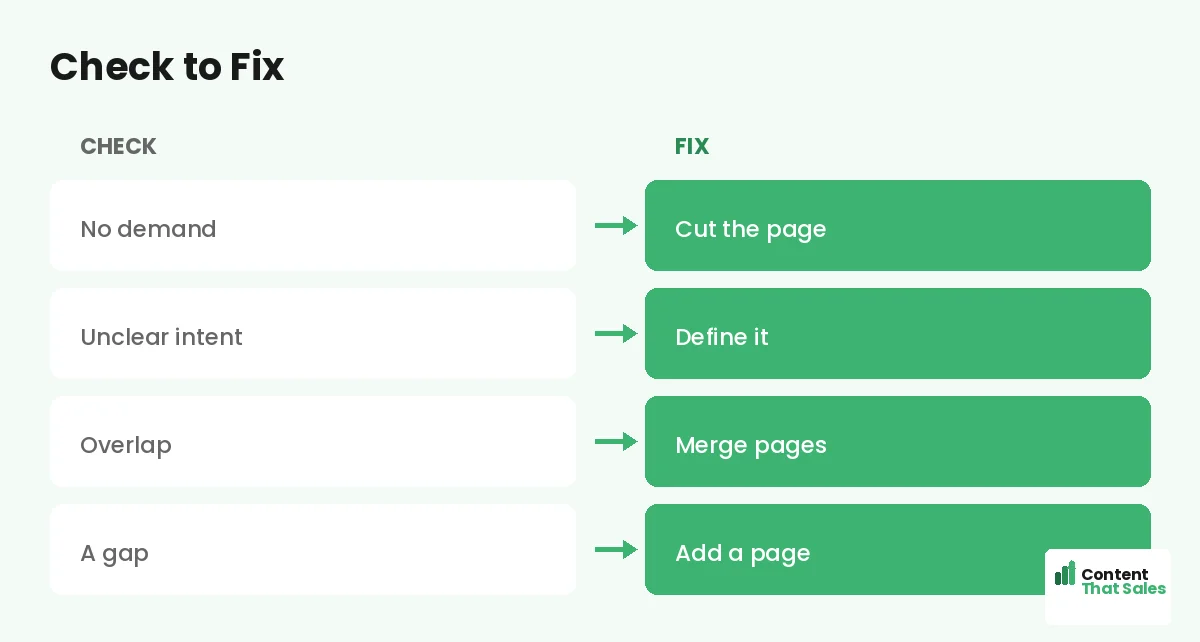
This is the most important validation. Pages targeting searches no one makes are wasted effort. If a planned page has no demand, cut it or merge it. Validating demand ensures every page you write has an audience waiting for it.
Validate Search Intent
For each page, confirm you understand the search intent, what the reader wants. If the intent is unclear or mixed, the page will struggle to satisfy searchers. Clear intent for every page is essential before you start writing.
Check that each page targets one clear intent and that you know how to satisfy it. Since readers scan more than they read, knowing intent lets you plan a page that delivers fast. Unclear intent is a signal to refine the page before writing.
Check for Keyword Overlap
Validate that no two pages target the same keyword or intent. Overlapping pages compete with each other and confuse search engines, splitting your ranking power. Spotting overlap before writing lets you merge or refocus pages so each has a distinct job.
Overlap is common in maps built quickly. Review your keyword assignments and look for duplicates or near-duplicates. Where you find them, decide which page owns the term and refocus the others. Each page should target one unique search.
Confirm Complete Coverage
Validate that your map covers the subject fully, with no obvious gaps. A map missing important subtopics leaves holes competitors can fill. Check that each pillar has enough clusters and that no key area is left out before you start writing.
Look for thin pillars and missing angles. Where you find gaps, work to find cluster topics that fill them. Confirming complete coverage at the map stage ensures you build a thorough, authoritative resource rather than a partial one.
Validate Keyword Mapping
Check that each page has the right target keyword assigned, one that matches the page’s purpose and has real demand. Mismatched or missing keyword assignments mean pages without clear focus, so validate that every page is properly mapped before writing.
Good keyword mapping is what makes a map actionable. Confirm each page targets one appropriate term and that the assignments make sense across the map. This validation ensures your writing phase starts with clear, correct targets for every page.
Did you know?
Fixing a problem at the map stage takes minutes; fixing it after writing twenty pages can mean rewrites, redirects, and lost time. Validation is the cheapest insurance in SEO.
Validate the Linking Plan
Check that your map includes a sound plan for how pages link together. Every page should connect to its pillar and related pages. Validating the linking plan ensures you will build a connected structure, not a set of isolated pages.
Confirm the connections between pillar and cluster pages are planned before you write. A map with no linking plan produces orphaned pages. Validating this now means your content will form a reinforcing network from the moment you publish.
Fix Problems Before Writing
Validation only helps if you act on it. For each problem found, fix it now, cut dead topics, clarify intent, merge overlaps, fill gaps, and correct keyword assignments. Resolving these at the map stage is far cheaper than after writing.
Work through your findings and update the map until it passes every check. Simple, clear pages keep winning, and since easy reading lifts engagement, a validated map sets you up to write clear, useful pages with confidence.
Put It All Together
To validate a topical map before writing: check real demand, confirm intent, spot keyword overlap, ensure complete coverage, validate keyword mapping, and check the linking plan. Then fix every problem at the map stage, before you write.
Validation is cheap insurance against expensive mistakes. A validated map means every page you write targets real demand with clear intent and a distinct job. Spend a little time validating, and you save a lot of wasted writing.
Where Validation Fits in the Workflow
Validation is not a separate project, it is the natural last step of building your map. After you have defined your topic, researched demand, set pillars, built clusters, mapped keywords, and planned links, validation is the quality gate before writing begins. It catches anything the earlier steps let slip through.
Fitting it into your routine is simple if your map-building already follows a clear sequence. Using a consistent step-by-step topical map process means validation always happens at the same point, right before content production. Build the habit of running these checks every time, and you will never start writing from a shaky foundation. Over many maps, that one habit saves an enormous amount of wasted work and keeps your content consistently aimed at real demand.
How Content That Sales Helps
Validating a map well takes a careful, trained eye. That’s where we come in. At Content That Sales, we build and validate your map, checking demand, intent, overlap, coverage, and linking, so it is solid before any writing begins.
You start writing with confidence, knowing the foundation is sound. We research, build, and validate, often organized in a topical map template for clarity, and can write the content too. The result is a validated map that will not waste your effort.
Ready to Validate Your Map?
Now you know how to validate a topical map before writing: check demand, intent, overlap, coverage, keywords, and linking, then fix problems first. Validation is cheap insurance. So why risk writing from a flawed map when a quick check prevents it?
Let’s validate your map together. Book your free consultation now. Call us at 8801631988589 or email service@contentthatsales.com. Let’s make sure your map is solid before you invest in writing.
Frequently Asked Questions About Validating a Map
What does it mean to validate a topical map?
Checking, before you write, that each page targets real demand, has clear intent, does not overlap with others, fits your coverage, and is properly linked.
Why validate before writing?
Writing is expensive, so catching problems at the map stage saves far more than fixing them after writing dozens of pages. Validation is cheap insurance.
What is the most important check?
Real demand. A page targeting searches no one makes is wasted effort, so confirming each page has an audience is the top validation priority.
How do I check for overlap?
Review your keyword assignments for duplicates or near-duplicates. Where two pages target the same term, merge or refocus so each has a distinct search.
How do I confirm coverage?
Look for thin pillars and missing angles. Where you find gaps, find cluster topics to fill them so your map covers the subject fully.
Why validate the linking plan?
To ensure you will build a connected structure, not isolated pages. Confirming links are planned means your content forms a network from the start.
What do I do with problems I find?
Fix them at the map stage, cut dead topics, clarify intent, merge overlaps, fill gaps, and correct keywords, before you write a single page.
Can Content That Sales help?
Yes. We build and validate your map so it is solid before writing, and can write the content too. Reach out for a quick quote.