 Skip to content
Internal linking for topical authority is the connective tissue that turns a pile of pages into a connected body of work Google recognizes as expertise. Links spread authority between pages, show how your content relates, and help both readers and crawlers navigate your site. Done well, internal linking is one of the most powerful and underused levers in SEO. This complete guide explains why it matters and how to do it right.
You can publish great content and still underperform if your pages sit unconnected. Internal links are what tie your topical map together, concentrating authority around your pillars and signaling the depth of your coverage. They are not optional; they are essential.
Below, we cover what internal links do, the principles of linking for authority, and the practices and mistakes that decide whether your linking helps or hurts.

Why Internal Linking Builds Authority
Internal links pass authority between your pages and tell Google how they relate. When your pages link together around a topic, they form a connected cluster that signals expertise. This is how internal linking directly builds topical authority.
It is the activation step for your whole structure. A topical map plans the coverage, but internal links are what connect it into a body of work. Without them, even complete coverage sits as disconnected, weaker pages.
What Internal Links Do
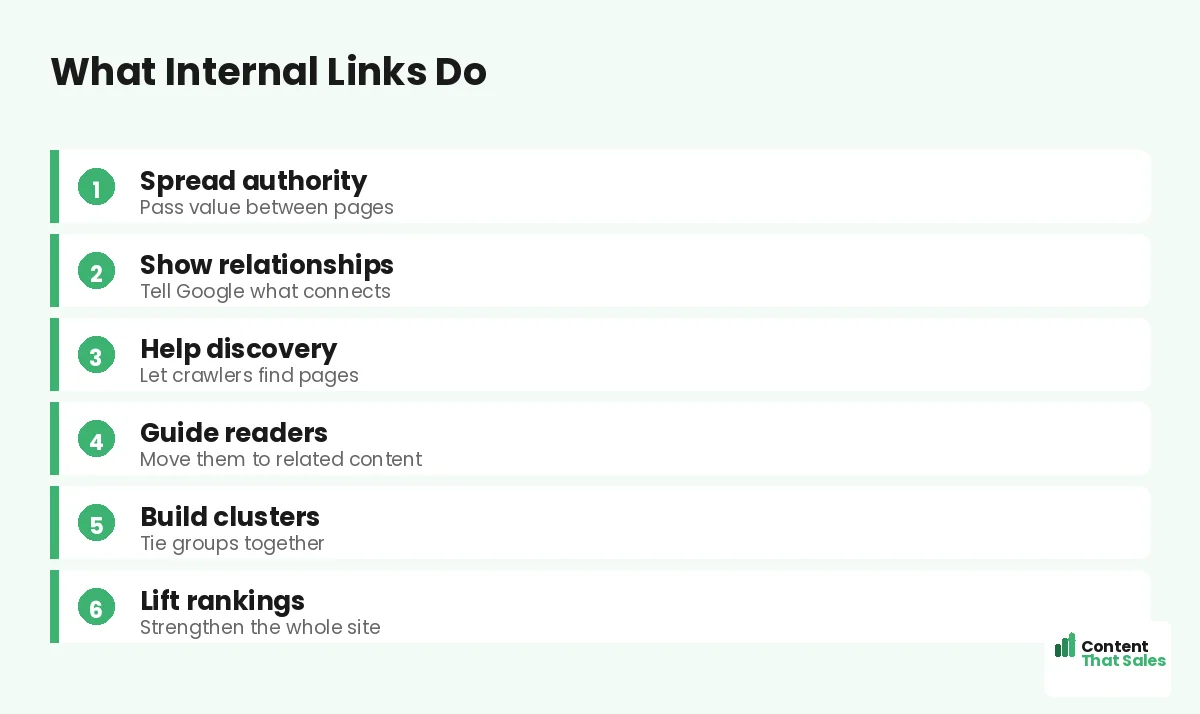
Internal links do several jobs at once. They spread authority across pages, show topic relationships to Google, help crawlers discover pages, and guide readers to related content. Each link is both an SEO signal and a navigation aid.
Because they do so much, links are a high-leverage investment. A well-linked site ranks better and keeps readers longer. Understanding the multiple jobs links do helps you place them with purpose rather than scattering them randomly.
Link Within Topic Clusters
The core principle is to link within topic clusters. Connect your pillar to its cluster pages, cluster pages back to the pillar, and related clusters to each other. This concentrates authority around the topic and forms a tight, connected group.
For the specifics of this, see our guide on how to connect pillar and cluster pages. Linking within clusters is what makes each group rank as a unit, the heart of internal linking for topical authority.
Use Descriptive Anchor Text
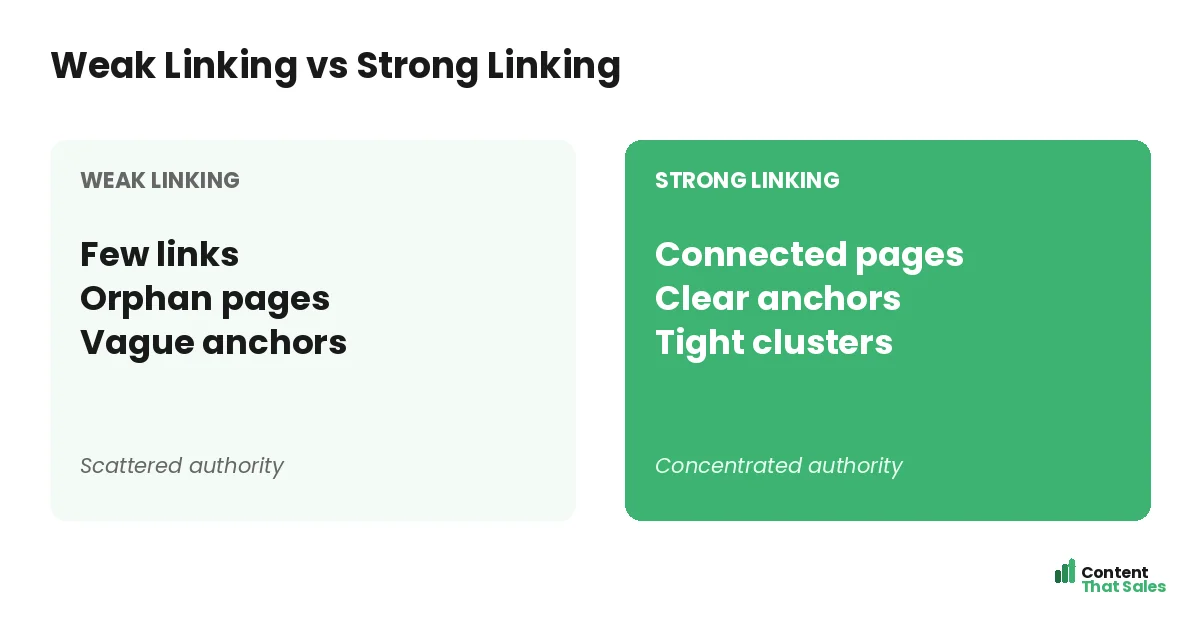
Anchor text, the clickable words, should describe the page it links to. Descriptive anchors tell readers and Google what to expect and reinforce the topic relationship. Vague anchors like click here waste the signal a link could send.
Vary your anchors naturally rather than repeating the same exact phrase, which can look manipulative. For the full approach, see our guide on anchor text strategy for topical maps. Smart anchors make every link work harder.
Place Links in the Content
Where you place a link affects its value. Links within the body content, woven into relevant text, carry more weight and get followed more than links stuck in footers or sidebars. Put your important internal links in the content itself.
Since readers scan more than they read, a contextual link at the right moment is far more useful than a buried one. Place links where they genuinely help the reader continue their journey.
Eliminate Orphan Pages
An orphan page has no internal links pointing to it. Orphans are hard for Google to find and value, and they sit outside your authority flow. Every page should have links in, so it is connected to the rest of your site.
Check that all your pages, especially newer ones, are linked from relevant places. Orphans waste good content. Connecting every page ensures all your work contributes to your topical authority instead of being stranded and unseen.
Did you know?
Internal links are one of the few ranking factors you fully control, so a strong internal linking strategy can lift a whole cluster without any new backlinks.
Link With Relevance
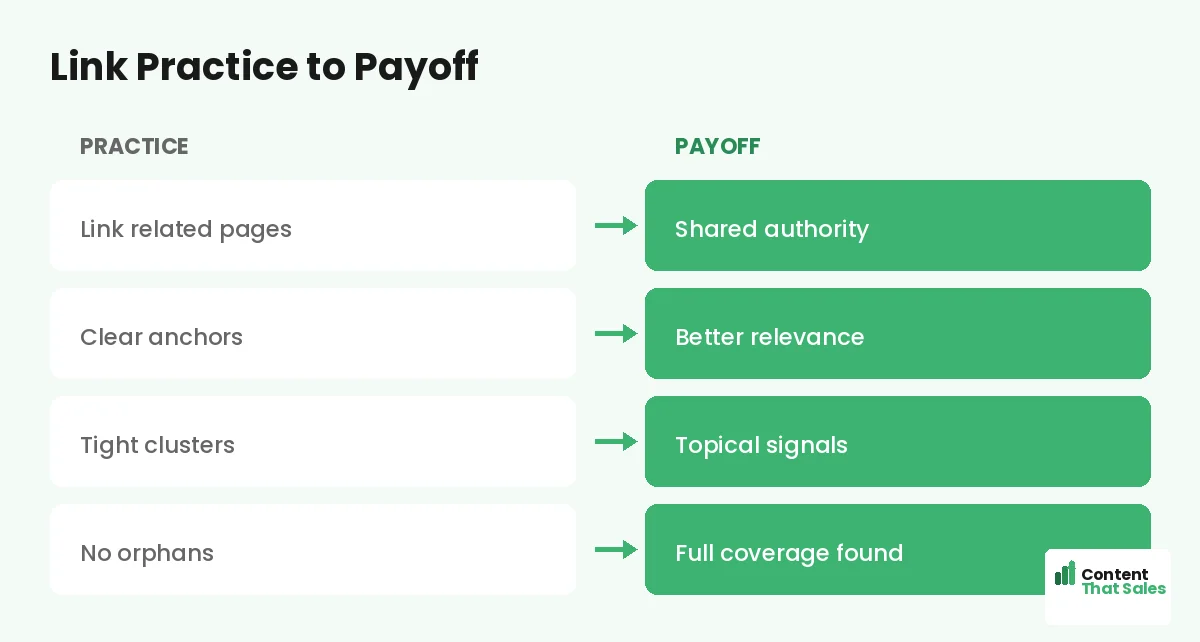
Link pages because they are genuinely related, not just to add links. Relevant links help readers and reinforce real topic relationships; irrelevant ones dilute the signal and confuse Google. Quality and relevance beat sheer quantity every time.
Before adding a link, ask whether it truly helps the reader and reflects a real connection. Purposeful, relevant links build a clean web of meaning. A site linked by relevance rather than randomness sends far stronger topical signals.
Mind Your Link Depth
Link depth is how many clicks it takes to reach a page from your homepage or main hubs. Important pages should be reachable in a few clicks. Pages buried deep are harder for Google to find and value, weakening their contribution.
Use your pillars and main pages to keep important content shallow in the structure. A well-linked topical map naturally keeps pages reachable, since clusters connect to pillars and pillars to the site. Mind depth so no key page is stranded.
Audit Your Internal Links
Internal linking is not set-and-forget. As your site grows, links can break, pages can become orphaned, and structure can drift. Regularly audit your internal links to catch and fix these issues, keeping your linking strong over time.
For the process, see our guide on running an internal link audit for a topical map. A periodic audit keeps your authority flowing and your clusters connected as you publish more content.
Avoid Over-Linking
More links is not always better. Stuffing a page with too many internal links dilutes the value each one passes and can overwhelm readers. Link only where it genuinely helps, keeping each page’s links purposeful and manageable.
Aim for a sensible number of relevant links per page, not as many as possible. A few strong, relevant links beat dozens of weak ones. Over-linking is as much a mistake as under-linking; balance and relevance are what matter.
Common Linking Mistakes
The frequent mistakes are clear: orphan pages, vague anchors, irrelevant links, over-linking, and links buried outside the content. Each weakens your linking. Avoiding them is often as impactful as adding more links in the first place.
Simple, clear content keeps winning, since easy reading lifts engagement, and clean linking supports that. Steer clear of these mistakes, and your internal linking strengthens rather than undermines your topical authority.
Put It All Together
Internal linking for topical authority means linking within clusters, using descriptive anchors, placing links in content, eliminating orphans, linking by relevance, minding depth, and avoiding over-linking. Together these turn pages into a connected, authoritative body of work.
Links are the connective tissue of your topical map, and one of the few ranking levers you fully control. Plan them, build them as you write, and audit them over time. Strong internal linking is what makes your coverage add up to authority.
How Content That Sales Helps
We build the internal linking that creates authority. That’s where we come in. At Content That Sales, we plan and build the links across your topical map, connecting clusters, using smart anchors, and eliminating orphans.
You share your content and structure. We design the linking, write the connected pages, and audit the result. The outcome is a tightly linked site where authority flows and your coverage adds up to genuine topical authority.
Ready to Strengthen Your Linking?
Now you have a complete guide to internal linking for topical authority: link within clusters, use smart anchors, kill orphans, and avoid the mistakes. Links are the lever you control. So why leave your pages disconnected?
Let’s connect your content into real authority. Book your free consultation now. Call us at 8801631988589 or email service@contentthatsales.com. Let’s turn your pages into a connected, ranking whole.
Frequently Asked Questions About Internal Linking
Why does internal linking build authority?
Links pass authority between pages and show Google how they relate. Pages linked around a topic form a connected cluster that signals expertise, building topical authority.
What do internal links do?
They spread authority across pages, show topic relationships, help crawlers discover pages, and guide readers to related content, acting as both SEO signals and navigation.
How should I link within clusters?
Link the pillar to its clusters, clusters back to the pillar, and related clusters to each other. This concentrates authority and forms a tight, connected group.
What anchor text should I use?
Descriptive phrases that name the linked page’s topic, varied naturally. Avoid vague anchors like click here, which waste the signal a link could send.
What is an orphan page?
A page with no internal links pointing to it. Orphans are hard to find and sit outside your authority flow, so every page should have links in.
Can I have too many internal links?
Yes. Stuffing a page with links dilutes the value each passes and overwhelms readers. Link only where it helps, keeping links purposeful and relevant.
Should I audit my internal links?
Yes. As your site grows, links break and pages get orphaned. Regular audits catch and fix these issues, keeping your linking strong over time.
Can Content That Sales help?
Yes. We plan and build the internal links across your topical map, connecting clusters and eliminating orphans so authority flows. Reach out for a quote.