 Skip to content
A smart anchor text strategy for topical maps makes every internal link work harder, because the words you link with tell readers and Google what the target page is about. Descriptive, varied, natural anchor text strengthens the topic signals between your pages; vague or spammy anchors waste them or even cause harm. This guide explains how to choose anchor text that reinforces your clusters and stays safe.
Anchor text is easy to overlook, yet it is part of what makes internal linking effective. Each anchor is a small label that describes a connection. Get your anchors right across a topical map, and you reinforce the relationships that build authority.
Below, we cover what good anchor text does, the principles of anchor strategy, and the mistakes that weaken or endanger your linking.

What Anchor Text Is
Anchor text is the clickable words of a link. When you link from one page to another, the anchor text is what the reader sees and clicks. It describes, in a few words, what the linked page is about, both for readers and for search engines.
In a topical map, anchor text labels the connections between your pages. It is part of how internal linking builds topical authority. Good anchors make those connections clear; poor ones leave them vague.
Describe the Target Page
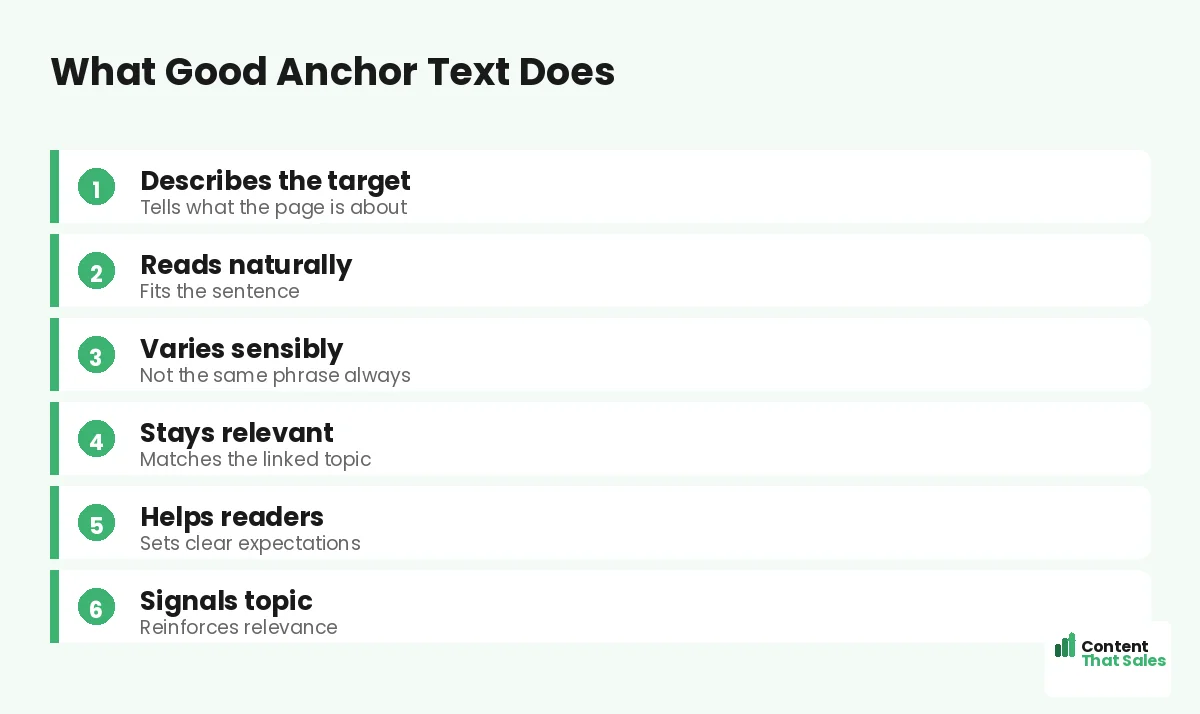
The first rule of anchor text is to describe the page you are linking to. The anchor should tell the reader what they will find if they click, and tell Google what the target page is about. Descriptive anchors reinforce the topic relationship.
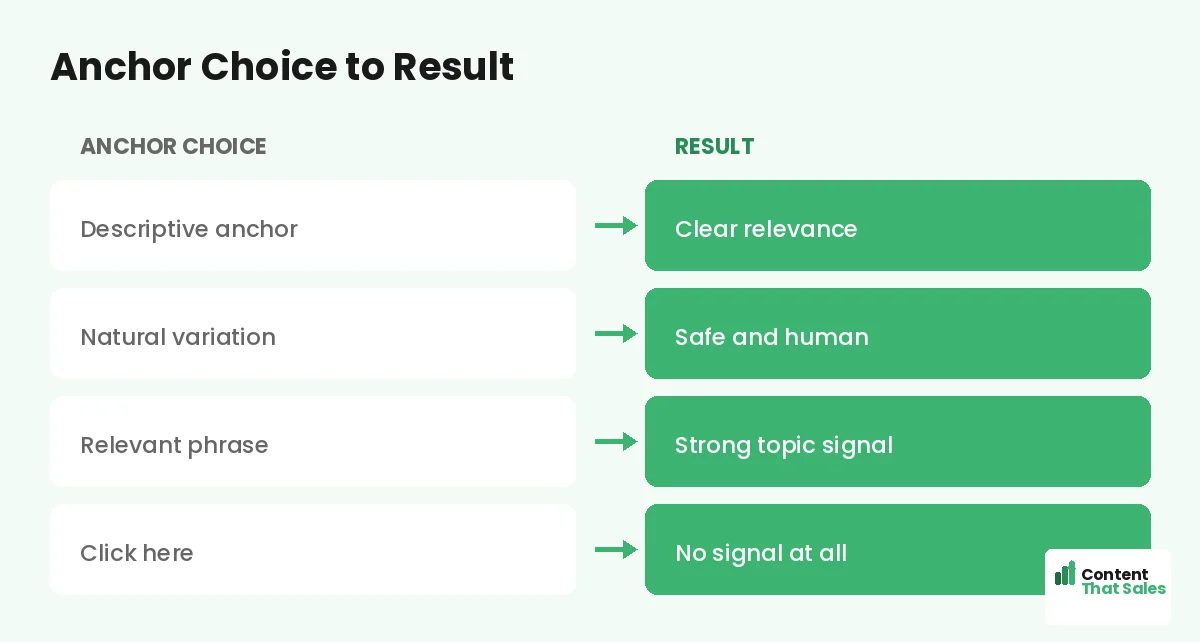
For example, link to a page about email subject lines with anchor text like email subject line tips, not click here. Descriptive anchors set clear expectations and pass a relevant signal. Every anchor is a chance to reinforce what the linked page covers.
Keep It Natural
Anchor text should read naturally within the sentence. Forcing an exact keyword that does not fit the flow reads awkwardly and can look manipulative. The best anchors feel like a natural part of the writing while still describing the target.
Write the sentence first, then make the relevant words the link. Since readers scan more than they read, a natural anchor that flows with the text is more likely to be noticed and clicked than a clunky, forced one.
Vary Your Anchors
Do not use the exact same anchor text every time you link to a page. Vary it naturally, using different phrasings that all describe the target. This looks more natural to Google and covers more of the ways people describe the topic.
For one pillar, you might link with several related phrases across different cluster pages. This variation avoids the over-optimized look of identical anchors everywhere and reinforces the topic from multiple angles. Natural variety is the goal.
Avoid Over-Optimization
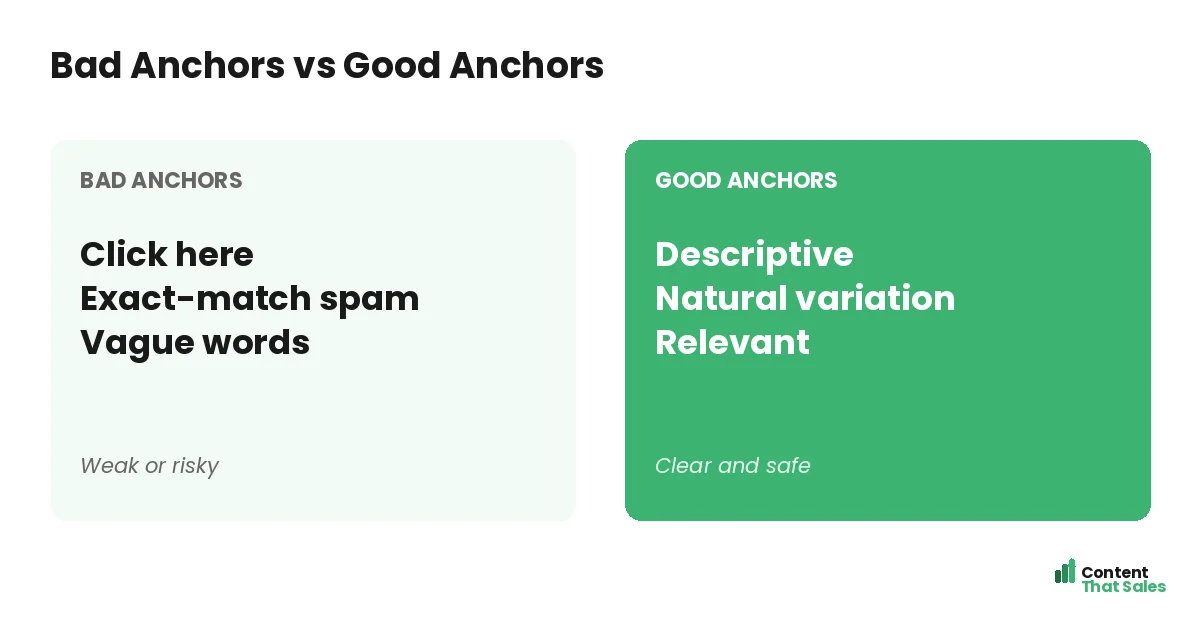
Stuffing the exact same keyword-rich anchor into every link can look manipulative and risks looking spammy to Google. Over-optimized anchor text, especially repeated exact-match phrases, is a pattern to avoid. Natural, varied anchors are both safer and more effective.
The fix is simple: write for readers first. If your anchors describe the target naturally and vary sensibly, you will not over-optimize. Trying to game anchors with repeated exact matches is a risk that good, natural writing avoids entirely.
Match the Anchor to the Topic
Each anchor should be relevant to the page it links to. The words should reflect the linked page’s actual topic, reinforcing the connection. A mismatch, anchor text that does not match the target, confuses readers and weakens the signal.
This relevance is built in when you link related pages within a cluster, since the anchor naturally describes a related subtopic. Keeping anchors matched to their targets is part of a sound approach to connecting pillar and cluster pages and strong internal linking overall.
Did you know?
Repeating the exact same keyword-rich anchor on every link can look manipulative, while natural, varied anchors are both safer and more effective at signaling topic.
Avoid Vague Anchors
The opposite mistake is vague anchor text, words like click here, read more, or this page. These say nothing about the target and waste the signal a link could send. They also fail readers, who cannot tell where the link leads.
Replace vague anchors with descriptive ones. Instead of read more, use the topic name. This small change improves both usability and SEO. Vague anchors are a missed opportunity on every link; descriptive ones make each link count.
Anchor Text for Pillar Links
When cluster pages link up to a pillar, the anchor should describe the pillar’s broad topic. This reinforces the pillar’s relevance for that subject across all its cluster links. Consistent, descriptive anchors to the pillar help concentrate its authority.
Vary the phrasing across cluster pages, but keep each anchor clearly about the pillar topic. This supports how you link cluster pages to pillars. The right anchors make those upward links pass a strong, relevant signal.
Anchor Text for Cluster and Sibling Links
For links between cluster pages or from the pillar down to clusters, the anchor should describe the specific subtopic of the target. Since each cluster covers a narrow topic, the anchor can be precise, naming exactly what that page is about.
These specific anchors help readers find the exact detail they want and reinforce each cluster’s focus for Google. Precise, descriptive anchors on cluster links are just as important as the broad anchors used for pillar links.
Write for Readers First
The simplest anchor text strategy is to write for readers first. If your anchors describe where the link goes, fit naturally in the sentence, and vary sensibly, you will satisfy Google automatically. Reader-friendly anchors are also search-friendly, and they support the topical authority your links are meant to build.
Stop thinking of anchors as keyword slots to optimize and start thinking of them as helpful labels. When you write anchors that genuinely help readers know where a link leads, you naturally get the descriptive, varied, relevant anchors Google rewards.
Review Your Anchors in an Audit
As part of a link audit, review your anchor text. Look for vague anchors to fix, over-optimized exact matches to vary, and mismatches to correct. Cleaning up anchors across your map strengthens your internal linking without adding a single new link.
Simple, clear content keeps winning, since easy reading lifts engagement, and clear anchors are part of that. A periodic anchor review, alongside your link audit, keeps your anchor strategy sharp as your map grows.
Put It All Together
An anchor text strategy for topical maps means describing the target page, keeping anchors natural, varying them sensibly, avoiding over-optimization and vague phrases, and matching each anchor to its target. Write for readers, and the SEO follows.
Good anchors reinforce the connections that build authority across your map. Use descriptive, varied, relevant anchors on every link, broad ones for pillars, precise ones for clusters, and review them in your audits. Strong anchors make strong internal linking.
How Content That Sales Helps
We write the anchors that strengthen your links. That’s where we come in. At Content That Sales, we craft descriptive, natural, varied anchor text across your topical map, reinforcing the connections that build authority.
You share your content and structure. We write the pages and their links with anchors that describe each target, vary sensibly, and stay relevant. The result is internal linking that sends strong, safe topic signals throughout your map.
Ready to Sharpen Your Anchors?
Now you know an anchor text strategy for topical maps: describe the target, keep it natural, vary it, avoid over-optimization and vague phrases, and write for readers. Good anchors make every link count. So why waste them on click here?
Let’s strengthen your links with smart anchors. Book your free consultation now. Call us at 8801631988589 or email service@contentthatsales.com. Let’s make every internal link work harder.
Frequently Asked Questions About Anchor Text
What is anchor text?
The clickable words of a link. It describes, in a few words, what the linked page is about, both for readers and for search engines, labeling the connection.
What makes good anchor text?
It describes the target page, reads naturally in the sentence, varies sensibly across links, and matches the linked page’s topic. Descriptive and natural is the goal.
Should I vary my anchor text?
Yes. Using different phrasings that all describe the target looks more natural to Google and covers more ways people describe the topic, avoiding an over-optimized look.
What is over-optimization?
Stuffing the same keyword-rich anchor into every link. It can look manipulative and spammy. Natural, varied anchors are both safer and more effective.
Why avoid vague anchors?
Words like click here say nothing about the target and waste the signal a link could send. They also fail readers, who cannot tell where the link leads.
What anchors should I use for pillar links?
Anchors that describe the pillar’s broad topic, varied across cluster pages. This reinforces the pillar’s relevance and helps concentrate its authority.
How do I keep anchors safe and effective?
Write for readers first. Describe where the link goes, fit it naturally, and vary it. Reader-friendly anchors are automatically search-friendly.
Can Content That Sales help?
Yes. We craft descriptive, natural, varied anchors across your topical map, reinforcing the connections that build authority. Reach out for a quick quote.