 Skip to content
Understanding how topical maps build topical authority fast is the key to a content strategy that actually ranks. A topical map gives search engines complete, connected, focused coverage of your subject, exactly the signals they use to decide who is an authority. Instead of scattered posts that never add up, a map makes every page reinforce the others. This guide explains how that works and why it speeds up your rise.
Topical authority is search engines recognizing you as an expert on a subject. A topical map is the most direct way to earn that recognition, because it is built to send every signal of expertise at once.
Below, we walk through exactly how a topical map builds authority, and why it does so faster than publishing without one.

What Topical Authority Means
Topical authority is when search engines see your site as a trusted expert on a subject. Sites with it rank more easily across many related terms, even competitive ones, because the engine trusts their depth and expertise on that topic.
It is earned through complete, high-quality coverage. Learning what topical authority is shows why a map matters: authority comes from covering a subject fully, and a map is the plan that gets you there.
Coverage Signals Expertise
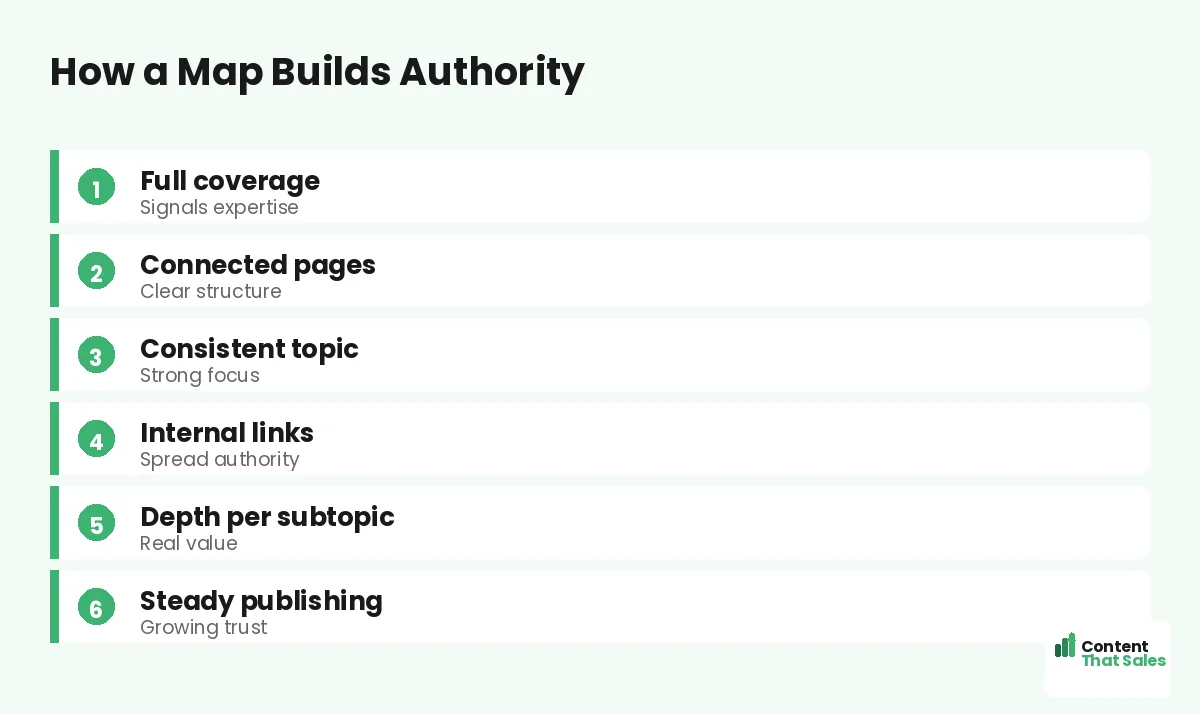
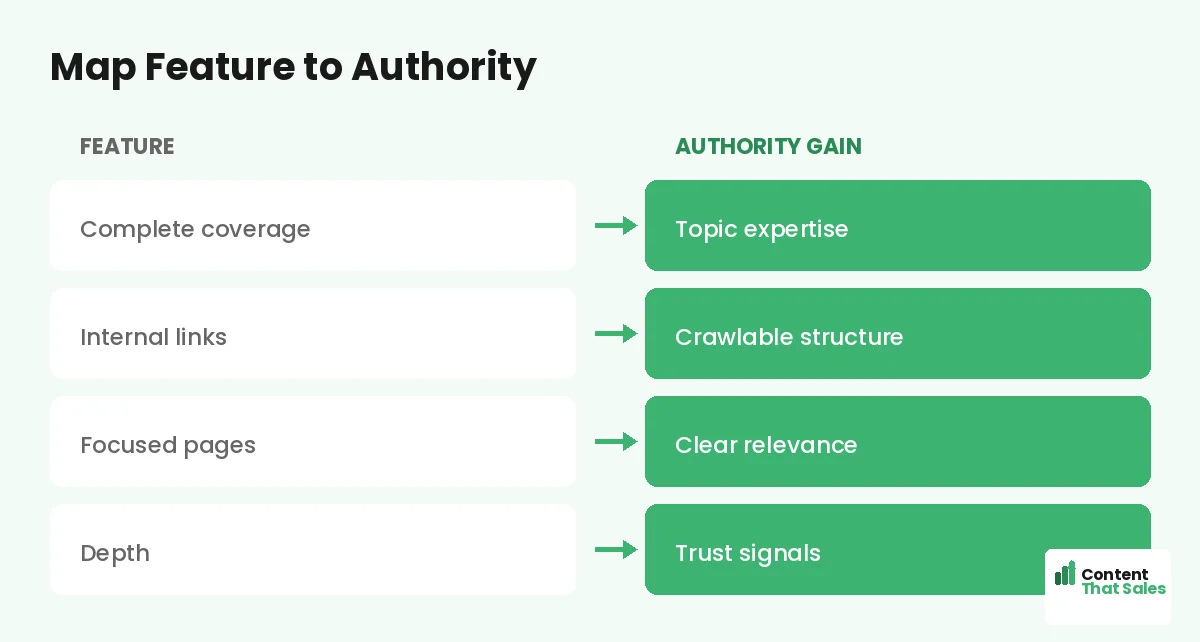
The biggest authority signal is complete coverage. When you have a page for every important subtopic, search engines see that you address the whole subject, not just pieces. A topical map is designed to deliver exactly this completeness.
A topical map plans coverage of every angle of your topic. Working through it means you systematically cover the subject, which is the clearest way to signal genuine expertise and earn authority over time.
Structure Makes Sense to Search Engines
A map organizes your content into a clear structure of pillars and clusters. This organization helps search engines understand how your pages relate and what your site is about, making your expertise easy to recognize and trust.
The pillar-and-cluster framework gives your content a logical shape. Broad pillars supported by focused clusters mirror how knowledge is organized, so search engines can map your expertise clearly rather than guessing from scattered pages.
Internal Links Spread Authority
A map’s internal links connect related pages, passing authority between them and showing search engines how your content fits together. This linking turns individual pages into a reinforcing network where each page strengthens the others.
Strong connections between pillar and cluster pages are central to how a map builds authority. Links spread ranking power across your site and guide search engines through your expertise, making the whole far stronger than its parts.
Focus Beats Scattered Posting
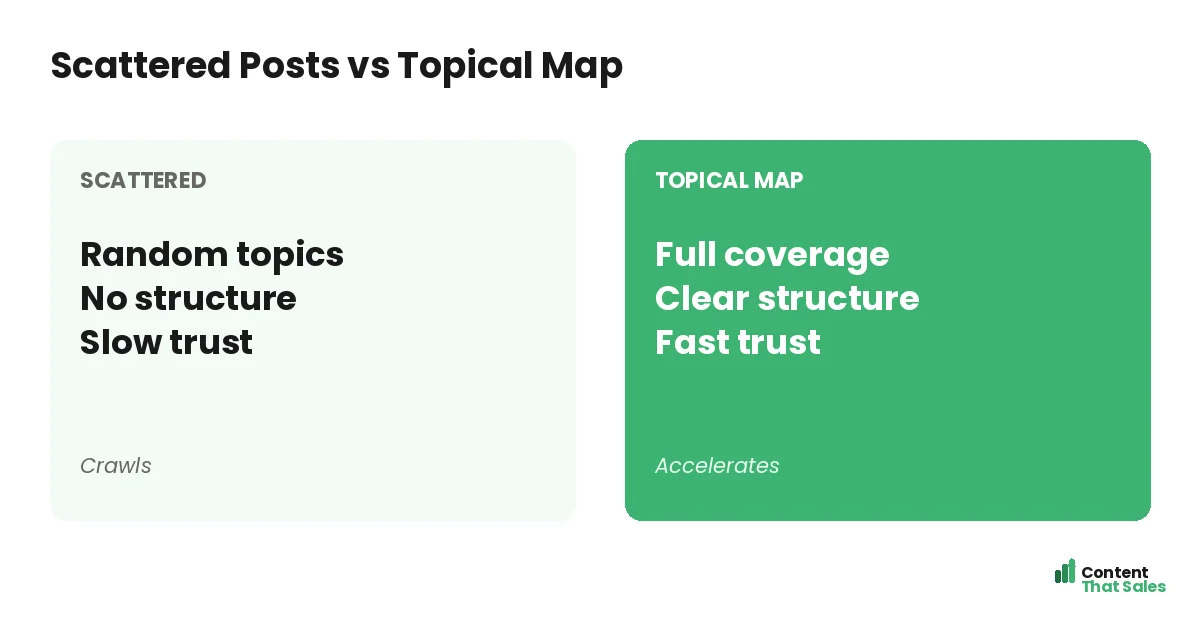
Scattered posts on random topics never build authority because they send no clear signal of expertise. A map keeps every page focused on your subject, so all your effort compounds into authority on one topic instead of being diluted.
Focus is the difference between content that ranks and content that does not. A map ensures everything you publish reinforces the same subject, concentrating your signal. This focus is why a map builds authority faster than aimless publishing.
Depth Builds Trust
A map encourages depth, a thorough page for each subtopic rather than shallow overviews. Deep, useful pages earn trust from both readers and search engines, and trust is the foundation of authority. Depth across many pages multiplies that effect.
Quality depth matters as much as breadth. Since readers scan more than they read, make each deep page clear and well-structured. Depth plus clarity across your map builds the trust that authority is made of.
Did you know?
Once a map reaches a critical mass of coverage, new pages on the same topic often rank faster, because your site has already earned the engine’s trust on that subject.
Why a Map Builds Authority Fast
A map speeds things up because every page works toward the same goal. Instead of scattered efforts, your coverage, structure, links, and depth all reinforce one subject at once. This concentration is what accelerates your rise to authority.
Authority compounds. As your coverage grows and pages link together, the whole site gets stronger, and new pages benefit from that strength. A map sets up this compounding from the start, which is why it works fast.
The Compounding Effect
The real power of a map is compounding. Each page adds to your coverage, links strengthen the network, and authority grows. Past a tipping point, your established authority helps new pages rank quickly, accelerating your results over time.
This is why maps beat scattered posting in the long run. The structure turns each page into an investment that makes the next one easier. Simple, clear pages keep winning, and since easy reading lifts engagement, clarity compounds too.
Put It All Together
Topical maps build authority fast by delivering complete coverage, clear structure, connected internal links, tight focus, and real depth, all the signals search engines use to recognize expertise, working together at once.
Scattered posts cannot compete because they send no clear signal. A map concentrates your effort on one subject so it compounds into authority. Build and work through a map, and you build authority faster than any other approach.
How Long It Takes to See Results
A topical map builds authority faster than scattered posting, but it is still not instant. Search engines need time to crawl your pages, see the connections, and trust your growing coverage. In the early weeks you are laying groundwork, and the biggest gains usually come once you reach a meaningful share of your planned coverage.
The encouraging part is that the curve steepens. Early pages may rank slowly, but as your coverage and links grow, momentum builds, and later pages tend to rank faster on the trust you have already earned. Patience in the first phase pays off with accelerating results, which is exactly why a map beats publishing without a plan over any serious time horizon.
Common Mistakes That Slow Authority
A few mistakes can blunt how fast a map builds authority. Leaving pages thin, skipping internal links, drifting off-topic, and covering subtopics only partially all weaken the signals that drive authority. Each one chips away at the focus and completeness a map is supposed to deliver.
Avoiding these is straightforward once you know them. Keep every page deep and useful, link each one into your structure, stay tightly on your subject, and finish your coverage rather than leaving clusters half-built. Steering clear of these mistakes lets your map send the clean, strong signals that earn authority as fast as possible.
How Content That Sales Helps
Building authority fast takes a well-planned map and consistent execution. That’s where we come in. At Content That Sales, we build your map, write deep pages for every subtopic, and connect them to build your authority quickly.
You get authority without managing the details. We plan the coverage, produce the depth, and link it all together, often organizing it in a topical map template for clarity. The result is faster, stronger ranking across your topic.
Ready to Build Authority Fast?
Now you know how topical maps build authority fast: coverage, structure, links, focus, and depth working together and compounding over time. So why keep posting at random when a map could speed up your rise to authority?
Let’s build your authority together. Book your free consultation now. Call us at 8801631988589 or email service@contentthatsales.com. Let’s turn complete, connected coverage into rankings that grow faster than you expect.
Frequently Asked Questions About Maps and Authority
How do topical maps build authority?
By delivering complete coverage, clear structure, connected links, tight focus, and real depth, all the signals search engines use to recognize expertise, at once.
What is topical authority?
When search engines see your site as a trusted expert on a subject, so you rank more easily across many related terms, even competitive ones.
Why is coverage so important?
Complete coverage is the biggest authority signal. A page for every subtopic shows you address the whole subject, not just pieces, proving expertise.
Why do internal links matter?
They spread authority between related pages and show search engines how your content connects, turning individual pages into a reinforcing network.
Why not just publish posts as I go?
Scattered posts send no clear signal of expertise. A map keeps every page focused on one subject, so your effort compounds into authority instead of diluting.
Why does a map work fast?
Because every page works toward the same goal at once, your signals concentrate. Past a tipping point, established authority helps new pages rank quickly.
What is the compounding effect?
Each page adds coverage and links that strengthen the whole site, so new pages rank more easily over time. A map sets up this compounding from the start.
Can Content That Sales help?
Yes. We build your map, write deep pages, and connect them to build authority fast. Reach out for a quick quote.