 Skip to content
A topical map tree structure organizes your content like a family tree: a root topic at the top, main branches for major subtopics, sub-branches for narrower ones, and leaves for individual pages. It is the framework of choice for large, layered subjects with many levels, because it keeps even a vast amount of content organized and navigable. This practical walkthrough shows you how the tree works and how to build one step by step.
When a subject has natural layers, topics within topics within topics, a flat structure falls apart. The tree handles that complexity gracefully, giving every page a clear place in the hierarchy and a logical path of links up and down. Let’s walk through it.
Below, we cover the parts of a tree structure, how the levels map to page types, how to build one, and when the tree is the right choice.

What a Tree Structure Is
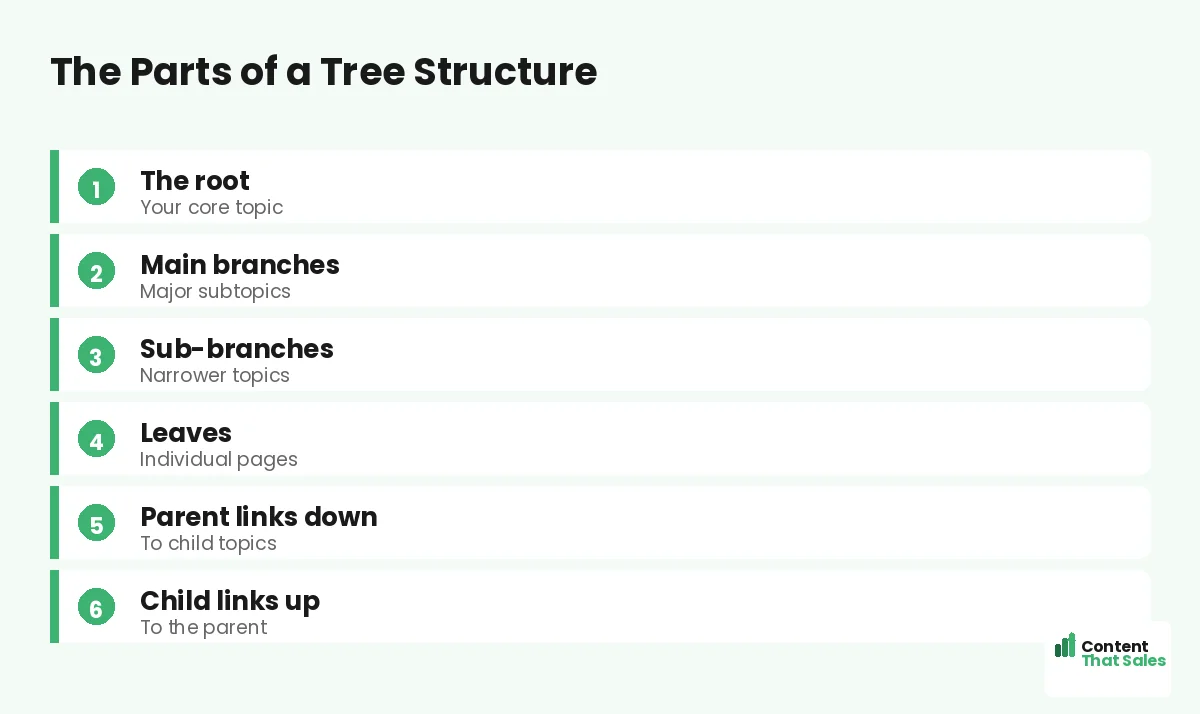
A tree structure arranges your topics into branching levels. At the top sits the root, your core topic. From it grow main branches, the major subtopics. Those split into sub-branches, and finally into leaves, the individual pages. Each level narrows the focus.
It is one of several proven structures. For the wider view, see our guide on topical map frameworks. The tree is the one to reach for when your subject has many layers that a simple pillar-and-cluster setup cannot cleanly hold.
The Root: Your Core Topic
The root is the single core topic at the top of the tree, the subject your whole site is built around. Everything branches from it. Defining a clear root is essential, since the entire structure grows from this one central point.
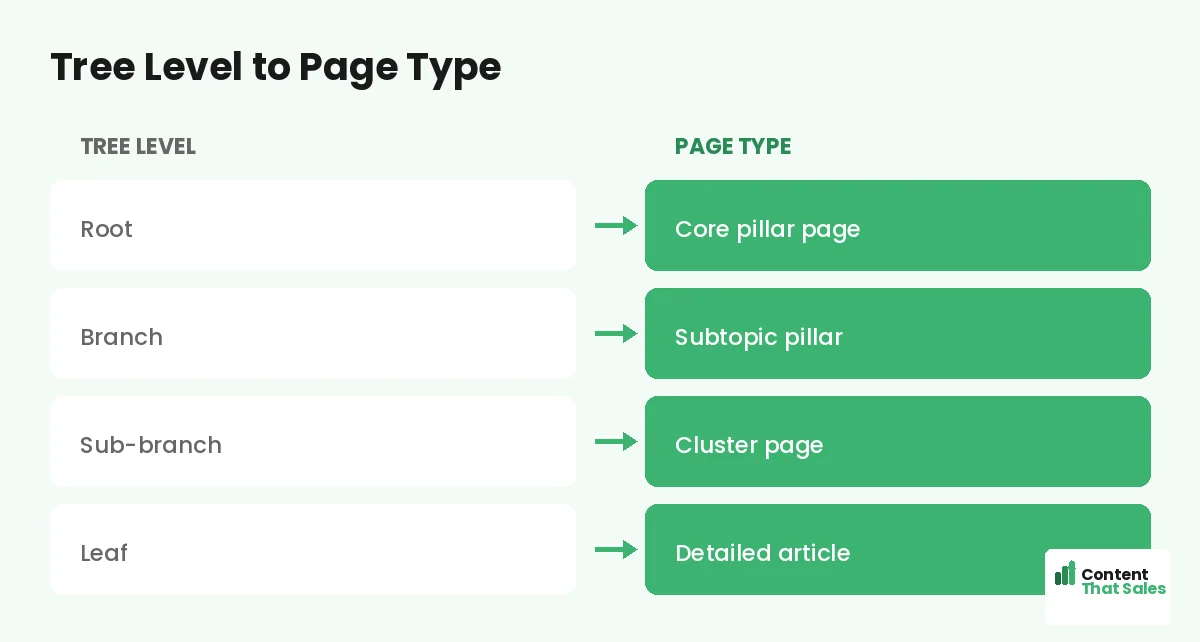
The root usually becomes your main pillar page, the broad overview of the whole subject. For help choosing it, see our guide on defining your core topic for a topical map. A strong root anchors a strong tree.
The Main Branches
From the root grow the main branches, the major areas of your subject. Each branch is a significant subtopic broad enough to contain its own sub-branches and pages. The branches divide your subject into its biggest logical sections.
Each main branch often becomes a subtopic pillar, an overview of that section that links down to its own cluster. The branches are the first level of organization, splitting a large subject into manageable, meaningful chunks you can build out one at a time.
The Sub-Branches
Sub-branches grow from the main branches, breaking each major area into narrower topics. This is where a tree shows its power: it can keep dividing a subject into finer levels as deeply as the subject genuinely warrants, without losing structure.
Each sub-branch groups related pages under its parent branch. For complex subjects, you may have several levels of sub-branches. The key is that each level narrows the focus logically, so every topic sits clearly beneath its broader parent.
The Leaves: Individual Pages
Leaves are the individual pages at the ends of the branches, the detailed articles that fully answer a specific subtopic. They are the most specific, in-depth content in the tree, where searchers find precise answers to narrow questions.
Most of your actual content lives in the leaves. Since readers scan more than they read, each leaf should fully and clearly answer its specific topic. The branches organize; the leaves deliver the depth.
How the Levels Link
Linking in a tree follows the structure: parents link down to their children, children link up to their parents, and siblings at the same level link across where relevant. This mirrors the hierarchy and spreads authority logically through the tree.
The result is a clear flow of link equity from the root down to the leaves and back. This structured linking helps Google understand the relationships and helps readers navigate from broad to specific and back. The links make the tree a connected whole.
Did you know?
A tree structure can hold thousands of pages without becoming chaotic, because every page has a clear parent and place, which is why large sites rely on it.
How to Build a Tree Step by Step
Start with the root, your core topic. List the main branches, the major areas of the subject. Under each branch, list the sub-branches and the leaf pages. Work top down, dividing the subject into finer levels until you reach individual pages.
This top-down approach keeps the structure logical. For the broader process, see our guide on how to build a topical map. Build one branch fully before moving to the next, so each section becomes complete coverage.
When to Use a Tree Structure
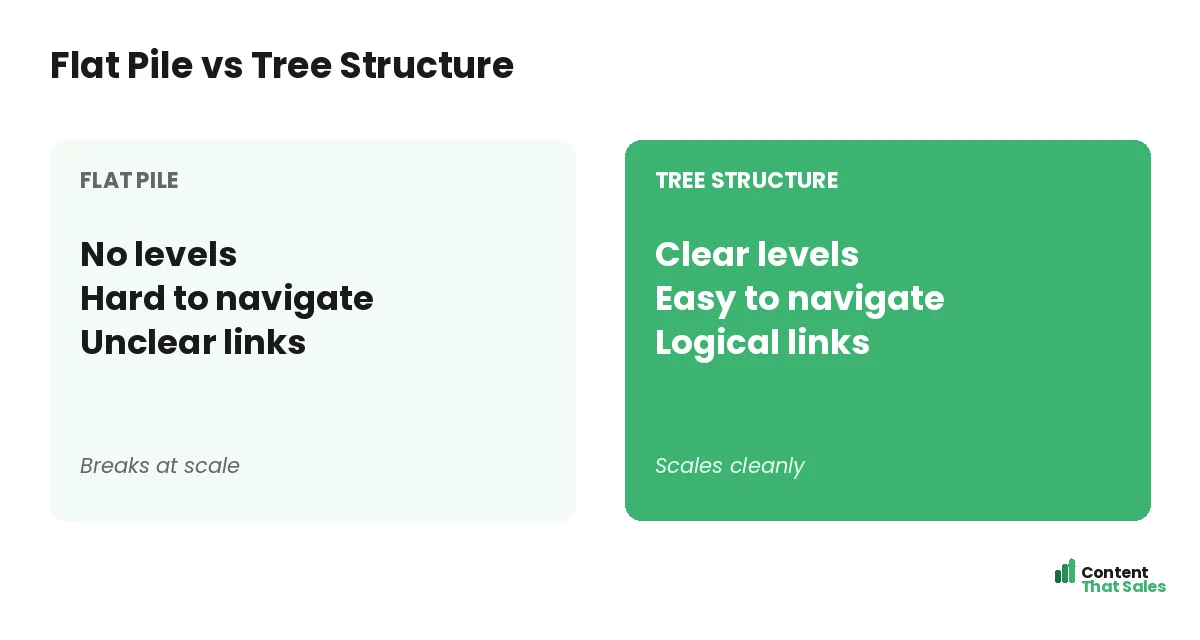
The tree shines for large, deep subjects with many natural layers, big publishers, comprehensive resources, or sites covering a broad field thoroughly. When topics nest within topics across several levels, the tree keeps it all organized.
For a smaller, focused subject, a simpler pillar-and-cluster or hub-and-spoke setup is enough. Use the tree when your subject genuinely has depth and layers. Matching the structure to the subject’s complexity keeps your map both complete and navigable.
Keep the Tree Balanced
A good tree is reasonably balanced, with branches of similar depth where the subject allows. If one branch has dozens of pages and another has one, the lopsided one may be too broad to be a branch or too thin to stand alone. Adjust the levels.
Balance keeps the tree navigable and signals even coverage. It also reveals gaps, a branch that is thin may need more pages, and overstuffed branches may need splitting. Reviewing balance keeps your structure healthy as it grows.
Avoid Going Too Deep
The tree can divide endlessly, but do not nest deeper than your subject and demand justify. Too many levels make content hard to find and pages thin. Add a level only when there are genuinely several narrower topics that each deserve a page.
Match the depth to real demand, the same discipline as judging topical map depth. A tree should be as deep as the subject warrants and no deeper. Keep levels meaningful, and the structure stays clean and useful.
Put It All Together
A topical map tree structure organizes content into a root, branches, sub-branches, and leaves, with links flowing up and down the hierarchy. It keeps large, layered subjects navigable and gives every page a clear place and connection.
Build it top down, keep it balanced, and do not nest deeper than demand warrants. Simple, clear content keeps winning, since easy reading lifts engagement. For a big, layered subject, the tree turns complexity into a clean, rankable structure.
How Content That Sales Helps
We structure big subjects into clean trees. That’s where we come in. At Content That Sales, we design your tree structure, organize the branches and leaves, and write the connected pages that keep a large subject navigable and ranking.
You share your subject and goals. We map the root, branches, and leaves, set the linking, and produce the content level by level. The result is a large, layered subject organized into a clean tree that both readers and Google can follow.
Ready to Structure Your Subject?
Now you know how a topical map tree structure organizes layered subjects into a root, branches, and leaves, all logically linked. For big subjects, it turns chaos into clarity. So why let a large topic sprawl without structure?
Let’s build your tree and organize your subject. Book your free consultation now. Call us at 8801631988589 or email service@contentthatsales.com. Let’s turn complexity into a structure that ranks.
Frequently Asked Questions About Tree Structures
What is a topical map tree structure?
A way of organizing topics into branching levels: a root core topic, main branches for major subtopics, sub-branches for narrower ones, and leaves for individual pages.
What is the root?
The single core topic at the top of the tree, the subject your whole site is built around. Everything branches from it, and it usually becomes your main pillar.
What are leaves?
The individual pages at the ends of branches, the detailed articles that fully answer a specific subtopic. Most of your actual content lives in the leaves.
How does linking work in a tree?
Parents link down to children, children link up to parents, and siblings link across where relevant. This mirrors the hierarchy and spreads authority logically.
When should I use a tree structure?
For large, deep subjects with many natural layers. For a smaller, focused subject, a simpler pillar-and-cluster or hub-and-spoke setup is enough.
How do I keep the tree balanced?
Aim for branches of similar depth where the subject allows. A lopsided branch may be too broad to be one branch or too thin to stand alone.
Can a tree be too deep?
Yes. Do not nest deeper than demand justifies. Add a level only when several narrower topics each genuinely deserve their own page.
Can Content That Sales help?
Yes. We design your tree, organize the branches and leaves, and write the connected pages that keep a large subject navigable and ranking. Reach out for a quote.