 Skip to content
One of the trickiest questions in content planning is topical map depth: how deep should you go? Go too shallow and you leave gaps that cost you authority; go too deep and you create thin pages no one searches for. The right depth means covering every real question your audience asks, one page each, and stopping where genuine demand ends. This guide shows you how to find that balance.
Depth is where many topical maps go wrong. Some stop at the obvious topics and miss the long tail; others force pages on subtopics no one cares about. The goal is complete coverage of what matters, without padding the map with pages that add nothing.
Below, we explore how to balance depth and breadth, how to know when a subtopic deserves a page, and how to recognize when you have gone deep enough.

Why Depth Matters
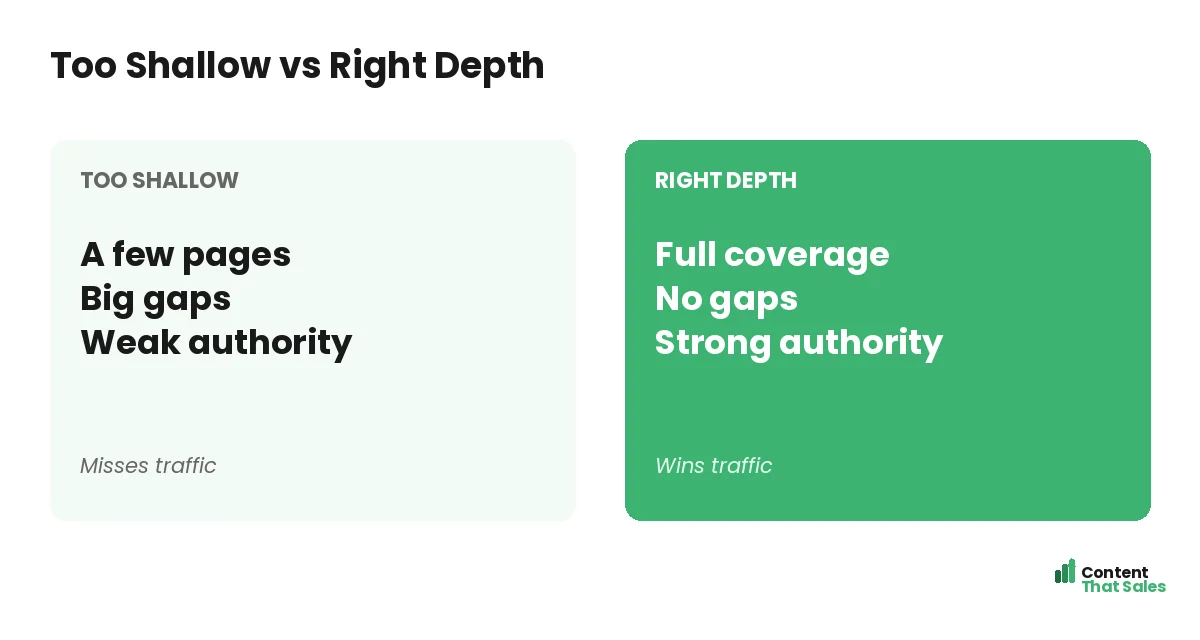
Depth determines whether you build real authority. Covering a subject completely, every meaningful question and angle, signals the topical authority Google rewards. Covering only the surface leaves gaps that tell Google your coverage is incomplete, which limits your rankings.
But depth has a limit. Beyond genuine demand, extra pages add no value and can dilute your map. The skill is going deep enough to be thorough without going so deep you create pages no one needs. If you need the basics, see what a topical map is.
Cover Every Real Question
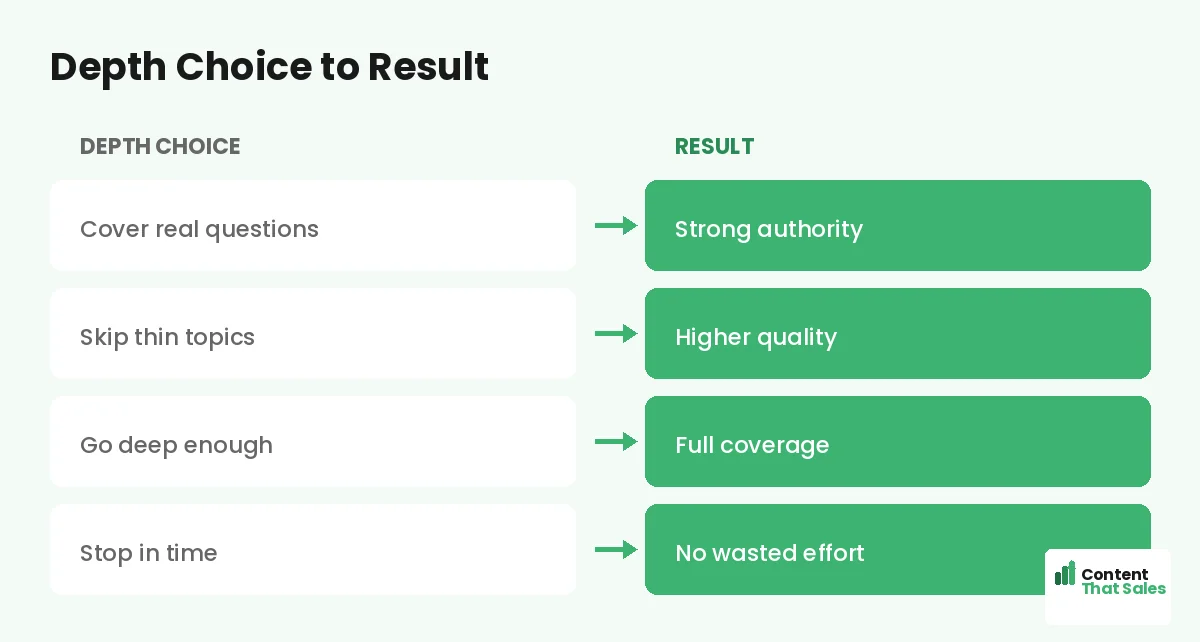
The core rule of depth is simple: if people search for it, cover it. Every real question or subtopic in your subject deserves its own page. This is how you achieve the complete coverage that builds authority and captures the long tail.
Go beyond the obvious topics to the specific questions and edge cases your audience actually asks. Those deeper pages often face less competition and capture motivated searchers. Covering every real question is the heart of going deep enough.
Let Search Demand Guide Depth
The best guide to depth is real search demand. If people search a subtopic, it warrants a page. If no one searches it, forcing a page there adds thin content without traffic. Let demand, not guesswork, decide how deep each branch goes.
Use keyword research to find the real questions and their variations. Genuine demand marks where depth pays off. This keeps your map focused on pages that can actually rank and attract visitors, rather than padding for the sake of it.
One Subtopic, One Page
A good depth rule is one distinct subtopic per page. If a subtopic is meaningfully different and searched on its own, it deserves its own page. If two ideas are really the same search, combine them rather than splitting into thin duplicates.
This keeps each page focused and distinct, which helps both readers and rankings. Since readers scan more than they read, a page that fully answers one subtopic serves them better than a shallow page trying to cover several.
Avoid Thin Pages
Going too deep often produces thin pages, pages so narrow there is little to say and little demand. Thin pages hurt more than help, signaling low quality and diluting your authority. Every page must justify itself with real value and real demand.
Before adding a page, ask whether it can stand on its own with useful content and an audience. If not, fold it into a broader page instead. Avoiding thin pages keeps your map strong, where each page earns its place.
Do Not Force Topics
Resist the urge to add pages just to look comprehensive. If a subtopic has no real demand or nothing useful to say, forcing it weakens your map. Coverage should reflect what people actually search, not an artificial checklist of every possible angle.
Completeness means covering the real subject fully, not inventing pages to hit a number. A focused map of genuinely useful pages beats a bloated one padded with filler. Quality and relevance set the true boundary of how deep to go.
Did you know?
Thin pages created just to look comprehensive can lower your authority, so the right depth covers real demand and stops where genuine search interest ends.
Know When to Stop
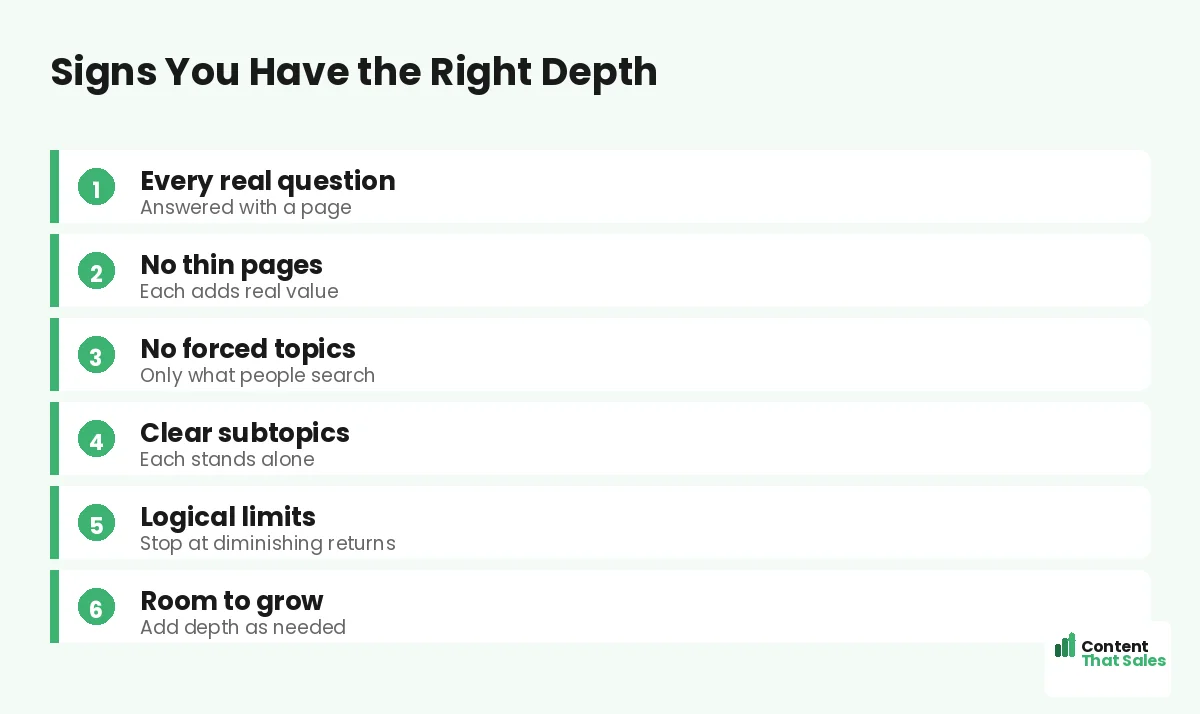
You have gone deep enough when you have covered every real question and adding more would mean thin or unsearched pages. That is the point of diminishing returns. Stopping there keeps your map complete without wasting effort on pages that will not perform.
Watch for the signs: subtopics with no search data, ideas that overlap existing pages, angles you are inventing rather than finding. When you hit those, you are at the right depth. Completeness, not infinity, is the goal.
Leave Room to Grow
The right depth today is not fixed forever. As your subject evolves and new questions emerge, you can add depth where new demand appears. A map at the right depth is complete for now, with room to deepen as the subject grows.
Revisit your map periodically to add pages for new questions and trends. This keeps your depth matched to current demand over time. Depth is a moving target, and a living map adjusts to stay complete as the search landscape shifts.
Balance Depth With Breadth
Depth works alongside breadth. Breadth is how many subtopics you cover; depth is how thoroughly you cover each. A strong map balances both, covering the full range of subtopics and going deep enough on each to be genuinely useful.
Do not sacrifice one for the other. A map that is broad but shallow covers many topics thinly; one that is deep but narrow misses whole areas. Aim for broad coverage with real depth, the combination that powers a strong topical map strategy and builds lasting authority.
Depth and Cluster Structure
Depth shows up in your cluster structure. A pillar page covers a subtopic broadly; supporting pages go deeper on specifics. The number of supporting pages reflects how deep that cluster goes, driven by how many real subtopics it contains, a key decision in any guide on how to build a topical map.
Let each cluster go as deep as its real demand warrants, no deeper. Simple, clear content keeps winning, since easy reading lifts engagement. Match each cluster’s depth to its genuine subtopics, and your structure stays both complete and lean.
Put It All Together
Topical map depth is about balance: cover every real question with one focused page each, let search demand guide how deep you go, avoid thin or forced pages, and stop at the point of diminishing returns. Then leave room to grow as demand shifts.
Go deep enough to be thorough, but no deeper than real demand supports. That balance, complete coverage without padding, is what builds authority efficiently. Match your depth to what people actually search, and your map stays both strong and lean.
How Content That Sales Helps
We get the depth right for you. That’s where we come in. At Content That Sales, we research real demand, map every question worth covering, and write the pages that go deep enough to build authority without padding.
You share your subject and goals. We find the real subtopics, set the right depth per cluster, and write the focused pages that earn rankings. The result is a map that is thorough where it counts and lean where it should be.
Ready to Get the Depth Right?
Now you know how to judge topical map depth: cover every real question, let demand guide you, avoid thin pages, and stop at diminishing returns. Too shallow misses traffic; too deep adds dead weight. So why not aim for the balance that ranks?
Let’s map your subject at the right depth. Book your free consultation now. Call us at 8801631988589 or email service@contentthatsales.com. Let’s build coverage that is complete, not bloated.
Frequently Asked Questions About Topical Map Depth
How deep should a topical map go?
Deep enough to cover every real question your audience searches, one focused page each, and no deeper. Stop where genuine search demand ends.
How do I know if a subtopic deserves a page?
If it is meaningfully distinct and searched on its own, give it a page. If two ideas are really the same search, combine them to avoid thin duplicates.
What guides the right depth?
Real search demand. If people search a subtopic, cover it; if no one does, a page there adds thin content without traffic. Let demand decide.
What is a thin page?
A page so narrow there is little to say and little demand. Thin pages signal low quality and dilute authority, so each page must earn its place.
Can a map be too deep?
Yes. Forcing pages on unsearched subtopics adds dead weight and can lower authority. Completeness means covering real demand, not every possible angle.
How do I know when to stop?
When every real question is covered and adding more would mean thin or unsearched pages. That point of diminishing returns is the right depth.
How does depth relate to breadth?
Breadth is how many subtopics you cover; depth is how thoroughly each is covered. A strong map balances both, broad coverage with real depth.
Can Content That Sales help?
Yes. We research demand, map every question worth covering, and write pages at the right depth to build authority without padding. Reach out for a quote.