 Skip to content
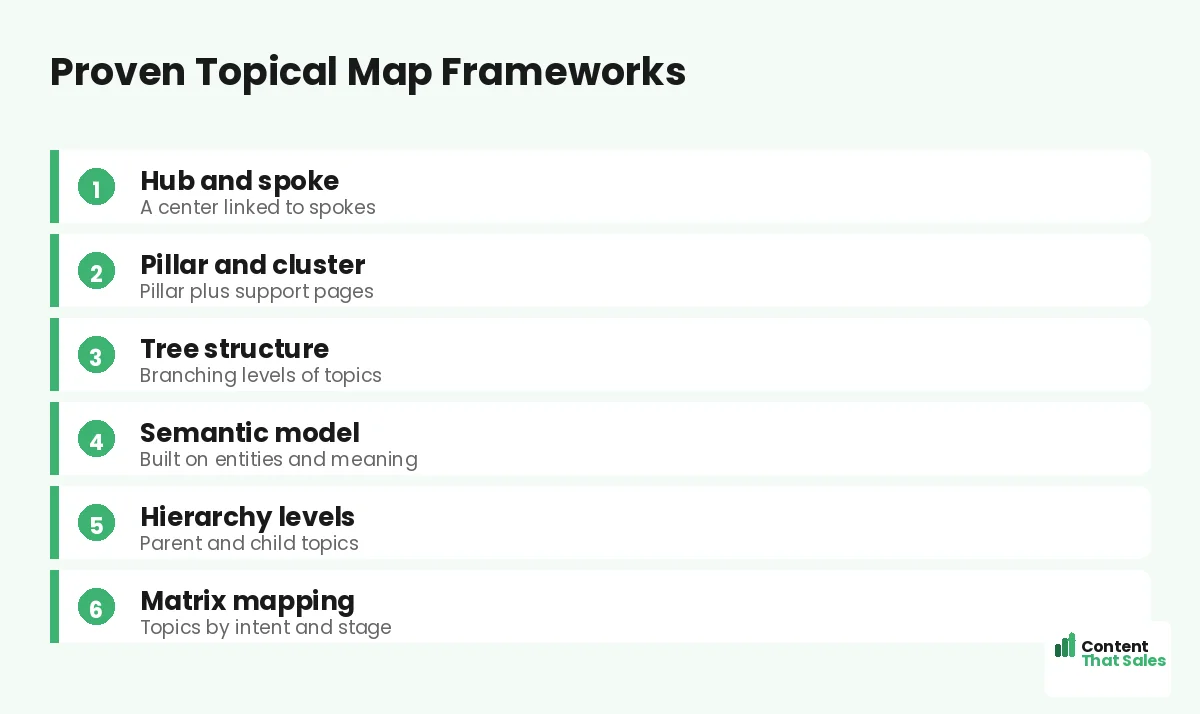
Choosing among topical map frameworks that actually work saves you from a messy, hard-to-scale map and gives your content a clear structure that ranks. The most proven frameworks, hub and spoke, pillar and cluster, tree structures, and semantic models, each organize your subject in a logical way. The right one depends on your subject and goals. This guide breaks down the frameworks that work and helps you pick the best fit.
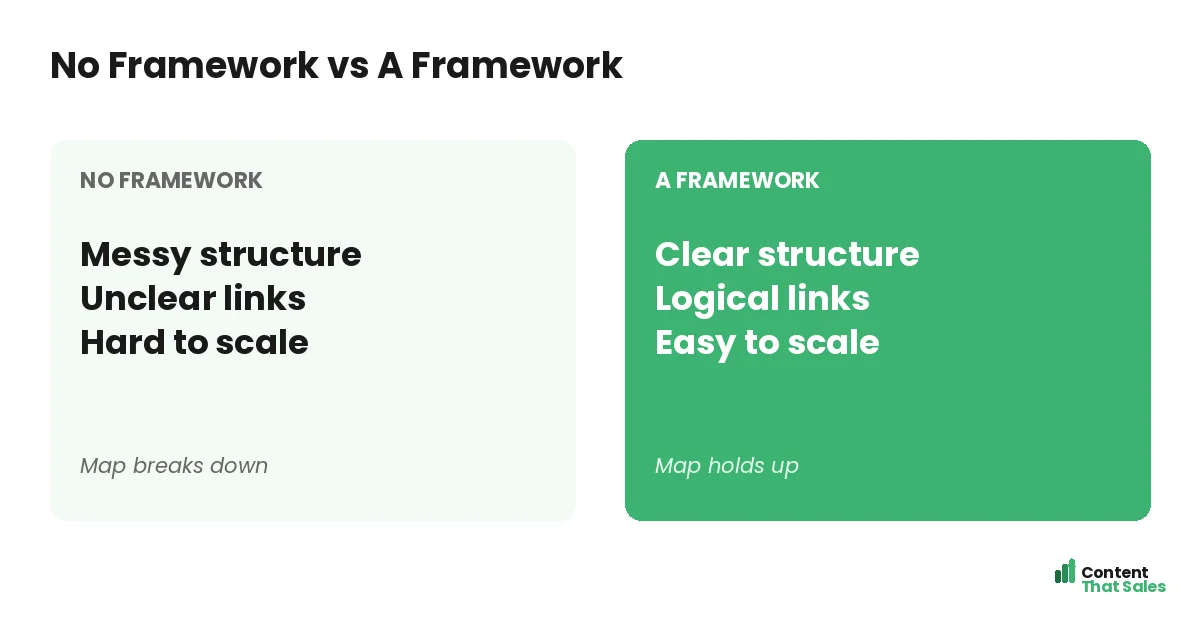
A framework is the skeleton of your topical map. Without one, pages pile up with no clear relationships, and your map becomes impossible to manage or scale. With a proven framework, every page has a place and a connection, which is exactly what builds authority.
Below, we walk through the main topical map frameworks, how each works, and which fits different subjects and sites.

Why You Need a Framework
A framework gives your topical map structure. It defines how pages relate, how they link, and how the subject breaks down. Without one, you get a scattered pile of pages with no clear hierarchy, which is hard to scale and weak for SEO.
The right framework makes your map logical for both readers and search engines. It is the difference between an organized library and a heap of books. If you need the basics first, see our guide on what a topical map is.
The Pillar-and-Cluster Framework
The most popular framework is pillar and cluster. A pillar page covers a broad topic, and cluster pages dive deep into its subtopics, all linked together. The pillar links to each cluster page, and they link back, forming a tight, connected group.
This framework fits most content sites because it is simple, scalable, and proven. It maps cleanly onto how topics naturally break down. For a deeper look, see our guide on the pillar-and-cluster framework. It is the default for good reason.
The Hub-and-Spoke Framework
Hub and spoke is closely related: a central hub page connects to spoke pages that each cover a specific angle in depth. The hub links to spokes, spokes link back, and spokes link to each other, concentrating authority around one topic.
This framework shines for focused, single topics where you want to dominate one area. For the full method, see our guide on the hub-and-spoke framework. It is excellent for building deep authority on a tight subject.
The Tree Structure
A tree structure organizes topics into branching levels: a root topic, main branches, and sub-branches down to individual pages. It suits large, deep subjects with many layers, where topics nest within topics across several levels.
The tree is powerful for complex subjects, like big publishers or comprehensive resources. It maps parent and child topics clearly, so even a vast subject stays organized. When your subject has natural layers, a tree structure keeps the whole thing navigable.
The Semantic Model
The semantic framework organizes content around entities and meaning rather than just keywords. It maps how concepts relate, the people, places, things, and ideas within a subject, mirroring how search engines understand topics today.
This is a more advanced approach, suited to SEO-savvy teams aiming for deep topical authority. It focuses on covering a subject the way a knowledge graph would, by relationships and meaning. For sophisticated sites, semantic mapping can be a powerful edge.
The Hierarchy Approach
A hierarchy framework arranges topics into clear parent-and-child levels, broad topics at the top, narrower ones beneath. It is similar to a tree but emphasizes the levels of importance and specificity, guiding both structure and internal linking.
Hierarchies help you decide which pages are pillars and which are supporting, and how authority should flow. Since readers scan more than they read, a clear hierarchy also helps visitors grasp your structure and navigate it easily.
Did you know?
Most frameworks share the same core idea, a central page linked to deeper supporting pages, so the best one is simply the shape that fits your subject most naturally.
The Matrix Approach
A matrix framework maps topics across two dimensions, such as buyer intent and funnel stage, or audience and use case. It ensures you cover every combination, which is useful when your subject varies along more than one axis.
Matrix mapping is great for businesses serving multiple audiences or stages, since it surfaces gaps you might miss with a simple hierarchy. By plotting topics on a grid, you ensure complete coverage across every meaningful combination of dimensions.
How to Choose Your Framework
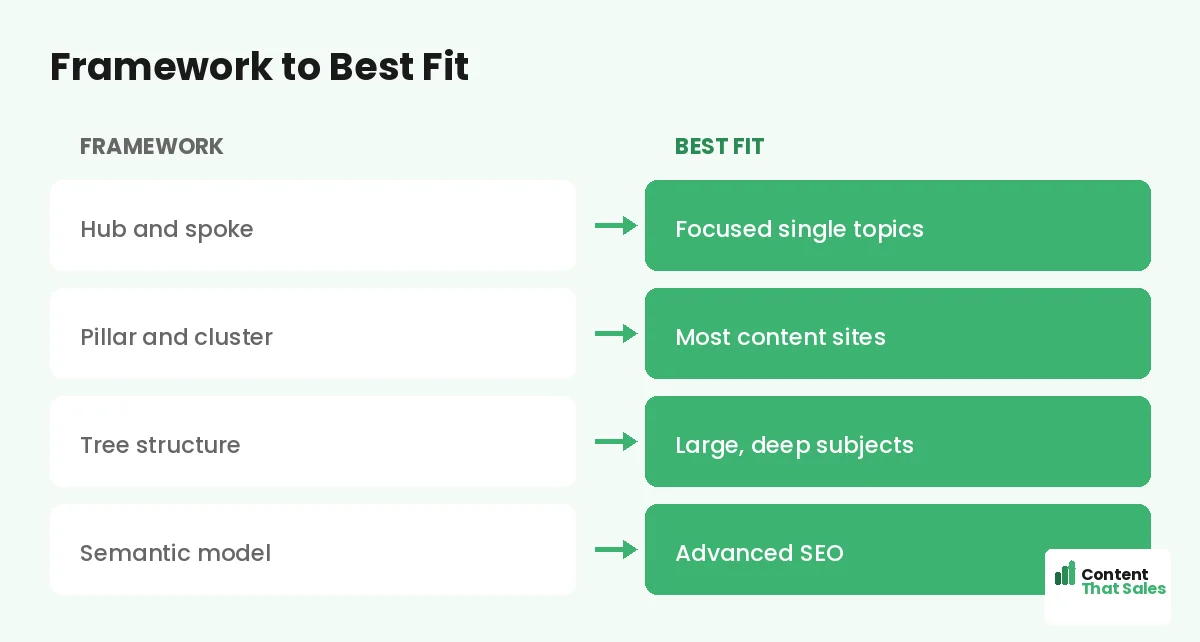
Pick the framework that fits your subject. Hub and spoke suits focused single topics. Pillar and cluster fits most content sites. Tree structures handle large, layered subjects. Semantic and matrix models suit advanced or multi-dimensional needs.
Most sites do well starting with pillar and cluster, then layering in other approaches as they grow. The frameworks overlap, so you can mix them. The goal is a clear structure that fits how your subject naturally breaks down, the backbone of any solid topical map strategy.
Frameworks Share Common DNA
Notice that all these frameworks share the same core idea: a central page connected to deeper supporting pages, with logical internal links. Whether you call it hub and spoke, pillar and cluster, or a tree, the principle is consistent, structure plus connection.
This means you do not need to agonize over the perfect label. Pick the framework whose shape matches your subject, and apply the shared principles of clear hierarchy and tight linking. The structure matters more than the name you give it.
Apply the Framework Consistently
Whatever framework you choose, apply it consistently across your map. Mixing structures randomly creates confusion. A consistent framework makes your map predictable, easy to scale, and clear to both readers and search engines.
Simple, clear content keeps winning, since easy reading lifts engagement. Consistency in structure supports consistency in quality. Choose your framework, apply it everywhere, and your map stays organized as it grows.
Put It All Together
The topical map frameworks that actually work, hub and spoke, pillar and cluster, tree structures, semantic and matrix models, all give your content a clear, scalable structure. They share the same DNA: a central page linked to deeper supporting pages.
Choose the framework that fits your subject, apply it consistently, and your map becomes organized and authoritative. Most sites start with pillar and cluster and grow from there. The right framework turns a pile of pages into a structure that ranks.
How Content That Sales Helps
We pick and apply the right framework for you. That’s where we come in. At Content That Sales, we choose the framework that fits your subject, structure your map around it, and write the connected pages that build authority.
You share your subject and goals. We select the best framework, design the structure, and produce the linked pages that rank. The result is a topical map with a clear, scalable shape, not a confusing pile of posts.
Ready to Structure Your Map?
Now you know the topical map frameworks that actually work and how to choose among them. The right structure makes your map scalable and authoritative. So why let your content pile up without a clear framework?
Let’s choose your framework and build your map. Book your free consultation now. Call us at 8801631988589 or email service@contentthatsales.com. Let’s give your content a structure that ranks.
Frequently Asked Questions About Topical Map Frameworks
Why do I need a framework for my topical map?
A framework gives your map structure, defining how pages relate and link. Without one, pages pile up with no hierarchy, which is hard to scale and weak for SEO.
What is the most common framework?
Pillar and cluster: a broad pillar page linked to deeper cluster pages on its subtopics. It is simple, scalable, and fits most content sites.
How is hub and spoke different?
It is closely related, a central hub linked to deep spoke pages on specific angles. It shines for focused single topics where you want to dominate one area.
When should I use a tree structure?
For large, deep subjects with many layers, where topics nest within topics across several levels, like big publishers or comprehensive resources.
What is a semantic framework?
An advanced approach organizing content around entities and meaning, mapping how concepts relate, mirroring how search engines understand topics today.
Do the frameworks overlap?
Yes. They share the same core idea, a central page linked to deeper supporting pages, so you can mix them and the structure matters more than the name.
How do I choose?
Pick the framework whose shape fits your subject. Most sites start with pillar and cluster and layer in others as they grow. Apply it consistently.
Can Content That Sales help?
Yes. We choose the right framework for your subject, structure your map, and write the connected pages that rank. Reach out for a quick quote.