 Skip to content
The hub-and-spoke topical map framework is one of the simplest and most powerful ways to structure content for SEO: a central hub page covers a topic broadly, and spoke pages each dive deep into one angle, all tightly linked together. This concentrates authority around a single subject and makes your coverage easy to navigate. This guide explains how hub and spoke works, why it builds authority, and when to use it.
The name says it all, like a wheel, a central hub connects to spokes radiating outward. The hub gives the overview; the spokes provide the depth. Together they form a tight cluster that signals deep expertise on one topic to both readers and search engines.
Below, we walk through the parts of the framework, how the linking works, why it concentrates authority, and the situations where hub and spoke is the right choice.

What Hub and Spoke Is
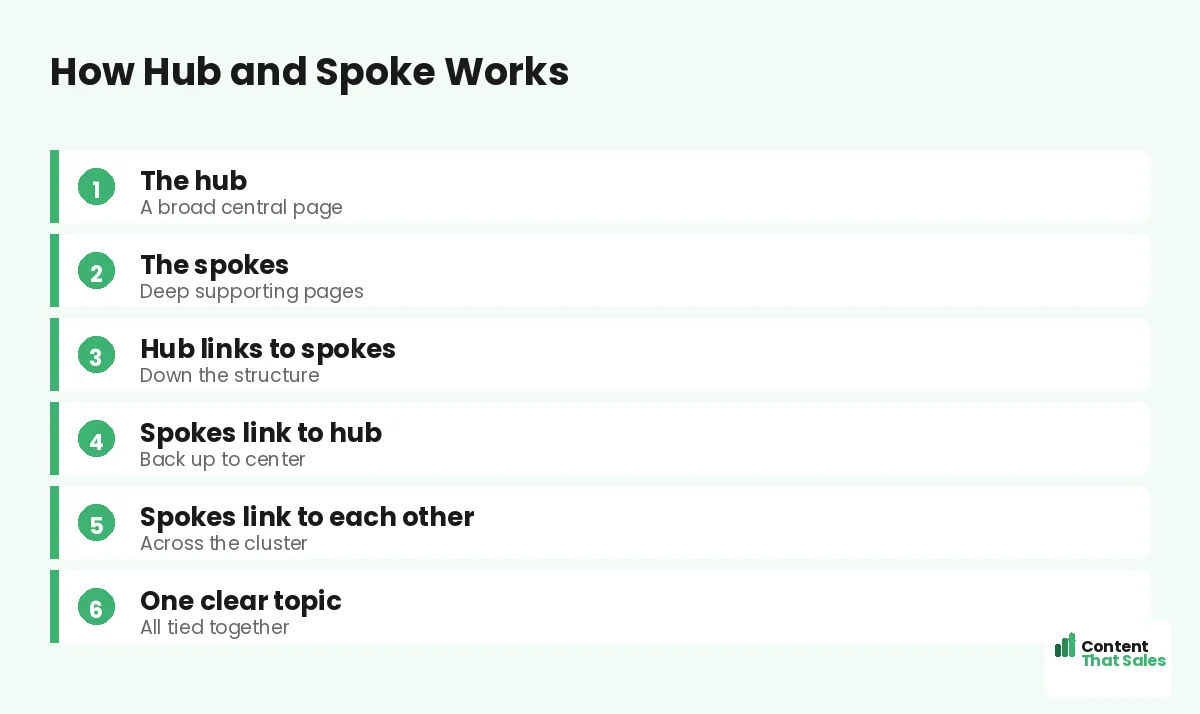
Hub and spoke is a content framework with a central hub page and multiple spoke pages. The hub covers a topic at a broad level; each spoke covers one specific subtopic in depth. All the spokes connect to the hub and to each other.
It is one of several proven structures, closely related to pillar and cluster. For the wider view, see our guide on topical map frameworks. Hub and spoke is the framework to reach for when you want to dominate one focused topic.
The Hub Page
The hub is your central page, a broad overview of the whole topic. It introduces the subject, summarizes the key areas, and links out to every spoke. The hub is the anchor that ties the cluster together and the main page you want to rank.
A strong hub gives readers the big picture and points them to deeper pages for specifics. It targets the broad topic keyword, while spokes target narrower terms. The hub is the front door to your topic, welcoming and comprehensive.
The Spoke Pages
Spokes are the supporting pages, each covering one specific subtopic in real depth. Where the hub is broad, spokes are narrow and thorough. Each spoke fully answers its angle, capturing searches the hub only touches on.
Spokes are where you go deep. A spoke might cover one question, one method, or one use case completely. Together, the spokes cover the whole topic in detail, while the hub keeps them organized. This division of broad and deep is the framework’s strength.
How the Linking Works
Linking is the heart of hub and spoke. The hub links down to every spoke. Each spoke links back up to the hub. And spokes link across to related spokes. This tight web of links is what makes the framework so effective.
These links spread authority throughout the cluster and show Google the pages belong together. Since readers scan more than they read, the links also help visitors move from the overview to the depth they need and back.
Why It Concentrates Authority
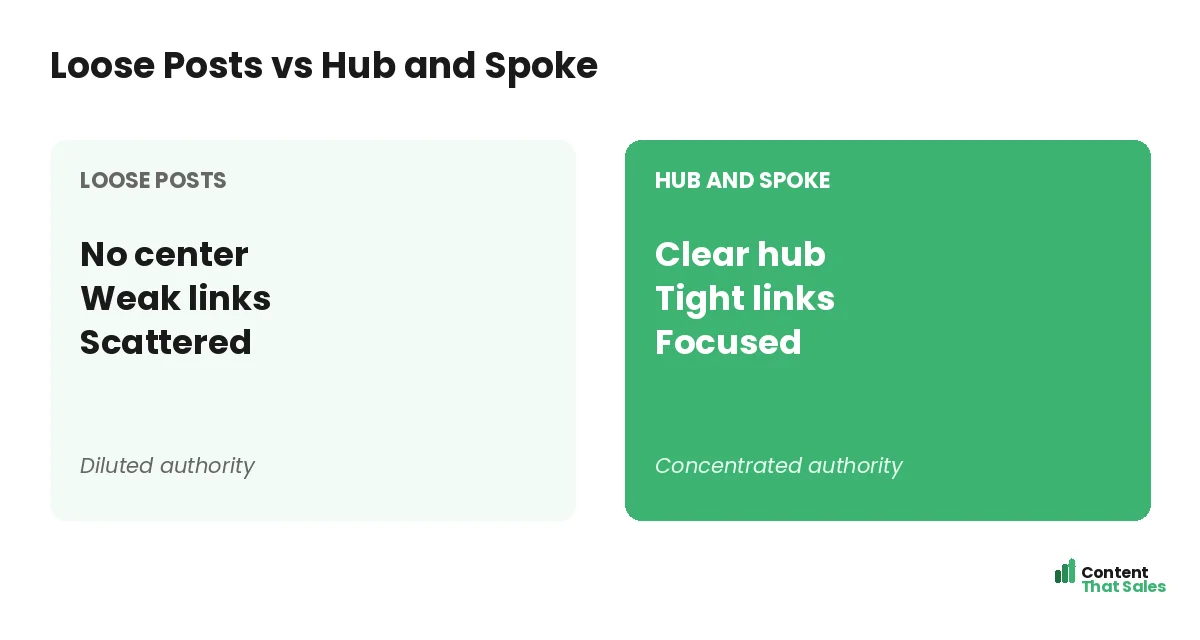
Hub and spoke concentrates authority around one topic. Because all the pages link tightly together and focus on a single subject, the cluster sends a strong, unified signal to Google that you are an expert on that topic.
This focus is the framework’s superpower. Instead of authority scattering across unrelated pages, it pools around the hub. The result is that the whole cluster, hub and spokes alike, ranks better than the same pages would in isolation, which is how you build real topical authority.
Hub and Spoke vs Pillar and Cluster
Hub and spoke and pillar and cluster are nearly the same idea with different names. Both have a central broad page linked to deeper supporting pages. The terms are often used interchangeably, and the principles, structure plus tight linking, are identical.
If there is a nuance, hub and spoke often emphasizes a tighter, more focused single-topic cluster. For the related approach, see our guide on the pillar-and-cluster framework. In practice, choose whichever framing helps you build a clear, connected structure.
Did you know?
The tight internal linking in a hub-and-spoke cluster can lift the rankings of every page in it, because the pages share authority instead of competing alone.

When to Use Hub and Spoke
Hub and spoke shines when you want to dominate one focused topic. It is ideal for a single subject with several clear subtopics, where you can build a tight cluster that owns that space. The framework concentrates effort where it has the most impact.
It also suits a clear content campaign or a key topic central to your business. When you need to be the obvious authority on one subject, hub and spoke is the structure that gets you there fastest, by focusing everything on that topic.
When Another Framework Fits Better
Hub and spoke is less suited to very large, multi-layered subjects with many levels of subtopics. For those, a tree structure or a broader pillar-and-cluster network handles the complexity better. Hub and spoke is best for focused, single-topic clusters.
If your subject branches into many sub-subjects, you might use multiple hub-and-spoke clusters linked together, one per major area. Match the framework to your subject’s shape: hub and spoke for focus, larger structures for breadth and depth.
Building a Hub-and-Spoke Cluster
To build one, start with the hub: a broad overview of your topic. Then list the spokes, every subtopic that deserves a deep page. Write the hub and spokes, and link them tightly, hub to spokes, spokes to hub, spokes to each other.
This is the practical core of building any topical map cluster. For the full process, see our guide on how to build a topical map. A hub-and-spoke cluster is often the first cluster a focused site builds.
Keep the Cluster Tight
The power of hub and spoke comes from focus, so keep the cluster tight. Every spoke should relate clearly to the hub’s topic. Adding unrelated pages dilutes the signal. A focused, well-linked cluster concentrates authority; a loose one scatters it.
Simple, clear content keeps winning, since easy reading lifts engagement. Keep your spokes on-topic and your links tight, and the cluster works as one authoritative unit. Discipline in focus is what makes the framework deliver.
Put It All Together
The hub-and-spoke topical map framework pairs a broad central hub with deep, focused spokes, all tightly linked, hub to spokes, spokes to hub, spokes to each other. This concentrates authority around one topic and makes your coverage easy to navigate.
Use it to dominate a focused subject, keep the cluster tight, and link it well. Closely related to pillar and cluster, hub and spoke is a simple, proven structure. Build one, and you turn a single topic into a cluster that ranks as a unit.
How Content That Sales Helps
We build hub-and-spoke clusters that rank. That’s where we come in. At Content That Sales, we plan your hub, write the spokes, and link them tightly so your cluster concentrates authority and dominates its topic.
You share your focus topic and goals. We design the hub-and-spoke structure, write the broad hub and the deep spokes, and connect them. The result is a tight, authoritative cluster built to own your subject in search.
Ready to Build a Hub-and-Spoke Cluster?
Now you know the hub-and-spoke topical map framework: a broad hub, deep spokes, and tight links that concentrate authority on one topic. Focus wins. So why scatter your content when a tight cluster can dominate a subject?
Let’s build your hub-and-spoke cluster. Book your free consultation now. Call us at 8801631988589 or email service@contentthatsales.com. Let’s turn one focused topic into authority and rankings.
Frequently Asked Questions About Hub and Spoke
What is the hub-and-spoke framework?
A content structure with a central hub page covering a topic broadly and spoke pages each diving deep into one subtopic, all tightly linked together.
What is the hub page?
The central overview page that introduces the topic, summarizes the key areas, and links to every spoke. It targets the broad topic keyword and anchors the cluster.
What are spoke pages?
Supporting pages that each cover one specific subtopic in depth, targeting narrower terms the hub only touches on. Together they cover the topic in detail.
How does the linking work?
The hub links to every spoke, each spoke links back to the hub, and spokes link to related spokes. This tight web spreads authority across the cluster.
Why does it concentrate authority?
Because all pages link tightly and focus on one subject, the cluster sends a strong, unified expertise signal, lifting the whole group’s rankings.
How is it different from pillar and cluster?
It is nearly the same idea with a different name. Hub and spoke often emphasizes a tighter, focused single-topic cluster, but the principles are identical.
When should I use hub and spoke?
When you want to dominate one focused topic with several clear subtopics. For very large, multi-layered subjects, a tree or broader structure fits better.
Can Content That Sales help?
Yes. We plan your hub, write the spokes, and link them tightly so your cluster concentrates authority and ranks. Reach out for a quick quote.