 Skip to content
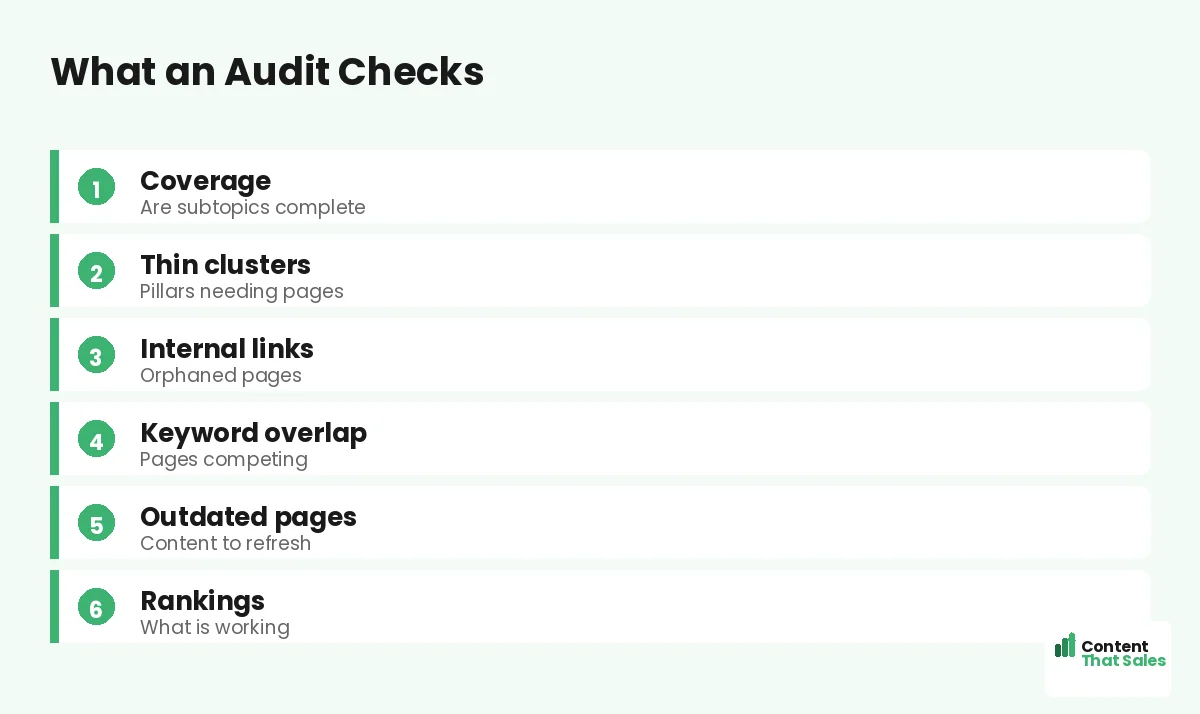
Learning how to audit your existing topical map is how you keep it strong as your content grows. An audit checks your coverage for gaps, finds thin clusters, spots orphaned pages, catches keyword overlap, and flags outdated content. The result is a clear list of fixes that strengthen your authority. This guide walks through exactly how to audit a topical map, step by step, so nothing important slips through the cracks.
A topical map is never truly finished. As you publish, gaps appear, pages age, and links break. A regular audit catches these problems so your map keeps building authority instead of quietly losing ground.
Below, we walk through what to check in an audit, how to do it, and how to turn your findings into a clear plan of fixes.

Why Audit Your Topical Map
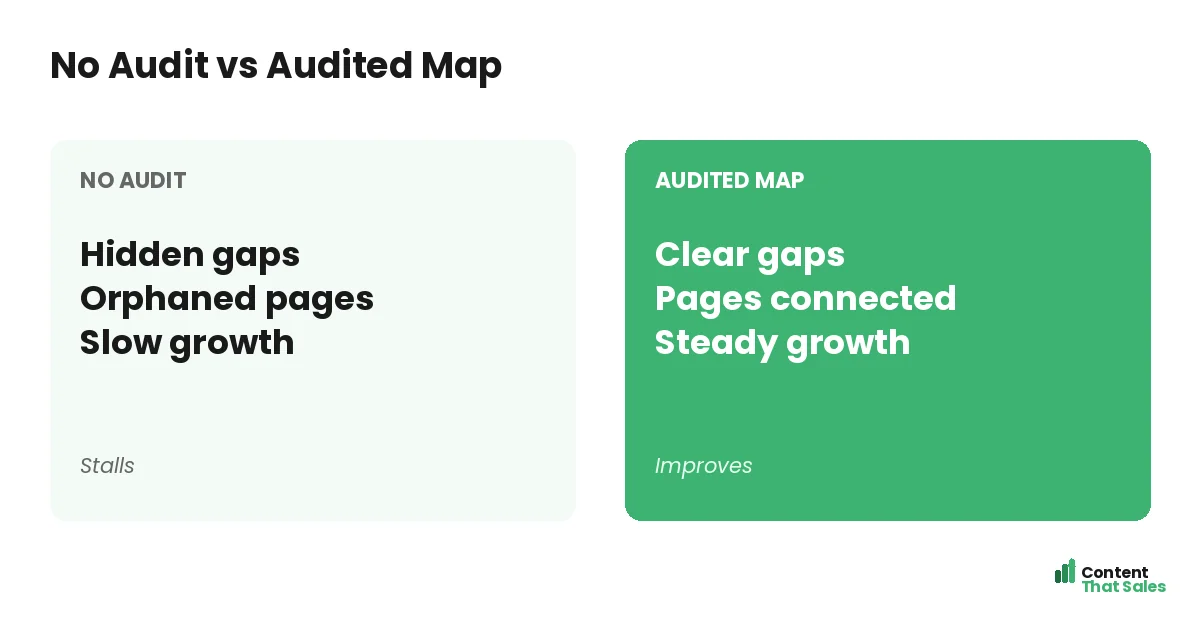
As your content grows, problems creep in, gaps you never filled, pages that drift off-topic, links that break. Without an audit, these issues stay hidden and slow your growth. An audit makes them visible so you can fix them.
A regular review keeps your topical map healthy and complete. It is the maintenance step that turns a one-time plan into a living asset, ensuring your coverage stays strong as your topic and competition evolve.
Start With Your Coverage
Begin by comparing your published pages against your full map. Which planned pages exist, and which are still missing? This shows your true coverage and reveals the gaps where your authority is incomplete and needs attention.
Coverage is the foundation of authority, so this is the first thing to check. List every planned page and mark its status. The missing ones become priority candidates as you work to complete your pillar-and-cluster structure.
Find Thin Clusters
Look for pillars with too few cluster pages beneath them. A thin cluster signals incomplete coverage of that subtopic, which weakens your authority there. These pillars need more pages to fully cover their part of your topic.
Thin clusters are common as maps grow unevenly. Spotting them tells you where to focus next. Use the audit to identify which pillars need depth, then plan to find cluster topics that round them out.
Check for Orphaned Pages
Orphaned pages, those with no internal links pointing to them, weaken your structure and are hard for search engines to find. The audit should catch every page that is not properly linked into your map and flag it for connection.
Every page should be woven into your map. Finding orphans lets you fix them by adding the right connections between pillar and cluster pages. A well-linked map spreads authority and keeps readers moving through your content.
Spot Keyword Overlap
Check whether multiple pages target the same keyword. This overlap, called cannibalization, makes your pages compete with each other and confuses search engines about which to rank. The audit should flag any duplicate targeting for fixing.
When you find overlap, decide which page should own the keyword, then refocus or merge the others. Each page should target one distinct search. Resolving overlap sharpens your map and stops your own pages from undercutting each other.
Review Content Quality
Assess the quality of your existing pages. Are they thorough, accurate, and useful, or thin and outdated? Pages that do not meet the bar weaken your authority even when they fill a slot on your map. Flag them for improvement.
Quality matters as much as coverage. Since readers scan more than they read, check that each page is clear and genuinely helpful. The audit should mark weak pages to refresh or expand.
Did you know?
A single audit often surfaces dozens of orphaned pages on a mature site. Just adding internal links to them can lift rankings without writing a word of new content.
Check Rankings and Traffic
Look at how your pages rank and how much traffic they draw. This shows what is working and what is not. Pages that rank well confirm your authority is growing; pages that lag may need improvement or better linking.
Performance data turns your audit from guesswork into evidence. It tells you which clusters are paying off and which need attention. Use it to prioritize, focusing your effort where it will move the needle most.
Turn Findings Into Actions
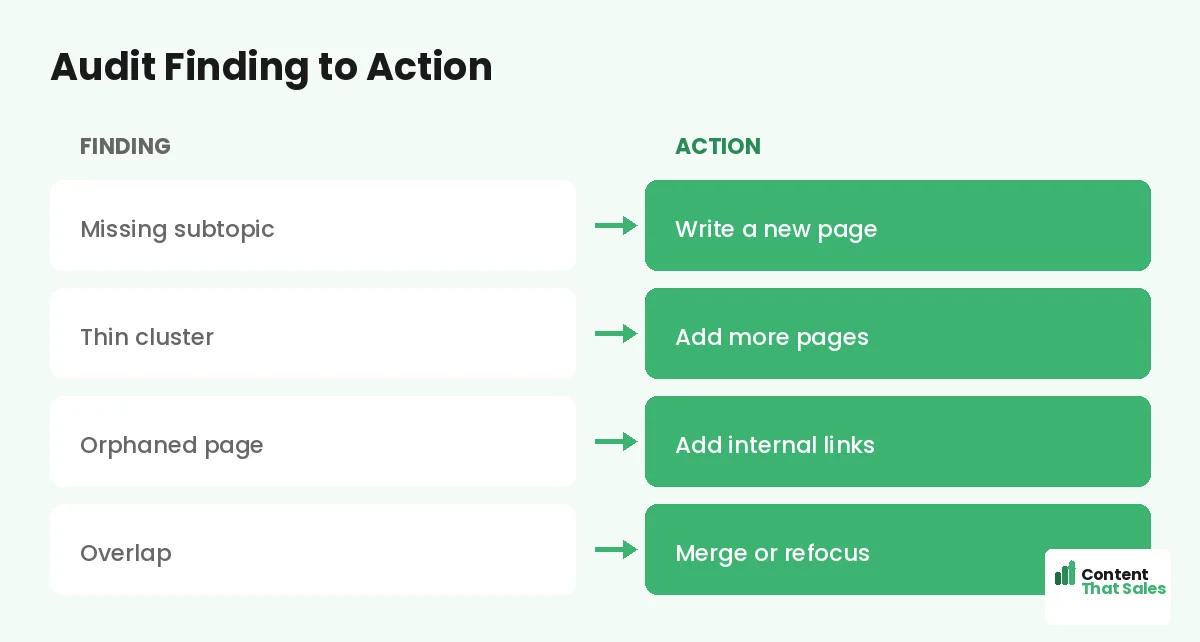
An audit is only useful if you act on it. Turn each finding into a clear action, write missing pages, add pages to thin clusters, link orphaned pages, resolve overlaps, and refresh weak content. This becomes your fix-it plan.
Prioritize the actions by impact. Some fixes, like adding internal links, are quick and powerful. Others, like writing new pages, take longer but matter most. A clear action list turns your audit into real improvement.
Audit on a Schedule
Audit your map regularly, every few months works well. Content grows, search trends shift, and new gaps appear. Regular audits catch problems early, before they cost you rankings, keeping your map strong and complete over time.
A scheduled audit makes maintenance a habit, not an afterthought. Simple, clear pages keep winning, and since easy reading lifts engagement, use each audit to keep your pages sharp and useful.
Put It All Together
To audit your topical map: check coverage, find thin clusters, catch orphaned pages, spot keyword overlap, review quality, and examine rankings and traffic. Then turn every finding into a clear action and work through the list.
An audit keeps your map strong as it grows, catching hidden problems before they cost you. Do it on a schedule, act on what you find, and your map stays complete, connected, and steadily building authority over time.
Document Your Audit Findings
As you audit, write down what you find in one place rather than trying to remember it. A simple document or spreadsheet listing each issue, the page it affects, and the planned fix turns a scattered review into an organized plan you can actually work through.
Documenting also lets you track progress over time. You can mark fixes as done, see how your map improves audit to audit, and avoid rechecking the same things. A written record makes your audits faster, smoother, and far more consistent each and every time you run one, and it gives anyone helping you a clear picture of what still needs attention.
How Content That Sales Helps
Auditing a large map takes time and a trained eye. That’s where we come in. At Content That Sales, we audit your existing map, find every gap and weak spot, and write or refresh the pages that strengthen your authority.
You get a thorough review plus the work to act on it. We find the problems, prioritize the fixes, and produce the content, often organizing it in a topical map template for clarity. The result is a stronger, complete map.
Ready to Audit Your Map?
Now you know how to audit your topical map: check coverage, clusters, links, overlap, quality, and performance, then act. A good audit turns hidden problems into clear wins. So why let gaps quietly hold your rankings back?
Let’s audit and strengthen your map together. Book your free consultation now. Call us at 8801631988589 or email service@contentthatsales.com. Let’s turn your existing content into a complete, authority-building map.
Frequently Asked Questions About Auditing a Topical Map
What is a topical map audit?
A review of your existing map that checks coverage, thin clusters, orphaned pages, keyword overlap, content quality, and performance, then turns findings into a fix-it plan.
Why should I audit my map?
As content grows, gaps, off-topic pages, and broken links creep in. An audit makes these hidden problems visible so you can fix them and keep building authority.
Where do I start?
Start with coverage, comparing your published pages against your full map to find what is missing. Missing pages are usually your highest-priority fixes.
What is an orphaned page?
A page with no internal links pointing to it. Orphans weaken your structure and are hard to find. The audit flags them so you can link them in.
What is keyword overlap?
When multiple pages target the same keyword, making them compete. The audit catches this so you can refocus or merge pages, giving each a distinct search.
How often should I audit?
Every few months works well. Regular audits catch new gaps and aging content early, before they cost you rankings, keeping your map strong over time.
What do I do with the findings?
Turn each into a clear action, write missing pages, fill thin clusters, link orphans, resolve overlaps, and refresh weak pages. Prioritize by impact.
Can Content That Sales help?
Yes. We audit your map, find the gaps, and write or refresh the pages to strengthen it. Reach out for a quick quote.