 Skip to content
A common question after building a map is how long to publish a full topical map. The honest answer is that it depends on the map’s size, your publishing pace, the depth of each page, and your resources. A 50-page map at one post a week takes about a year; at a faster pace or with a team, it can be done in months. This guide breaks down the timeline and how to plan a realistic schedule.
There is no single number, because maps and teams vary so much. But you can estimate your own timeline easily once you know your map size and a sustainable pace. The key is setting a realistic schedule you can actually keep.
Below, we walk through what affects the timeline, rough estimates at different paces, and how to plan a schedule that gets your map fully published.

It Depends on a Few Factors
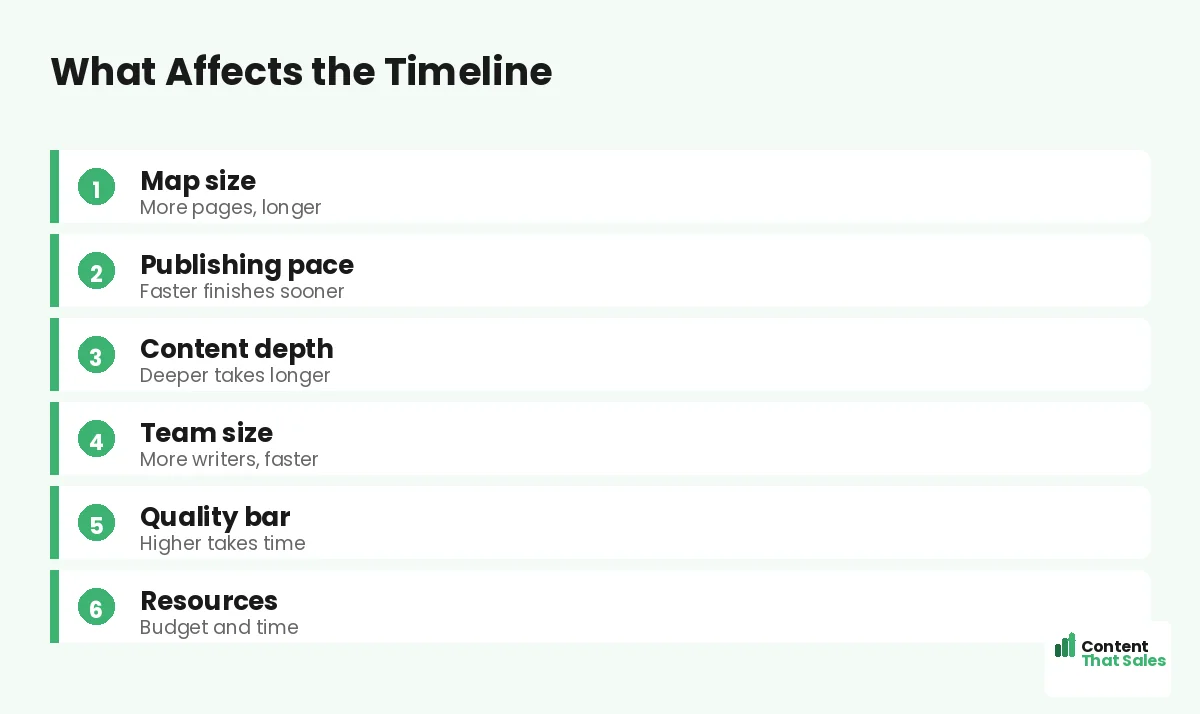
The timeline to publish a full map depends mainly on four things: how many pages it has, how fast you publish, how deep each page is, and what resources you have. Change any of these and your timeline changes. There is no one-size-fits-all answer.
Understanding these factors lets you estimate your own timeline. A small map published fast finishes in weeks; a large map at a slow pace takes a year or more. Knowing how to build a topical map first tells you the page count to plan around.
Map Size Sets the Baseline
The number of pages is the starting point. A 20-page niche map is far quicker to publish than a 200-page comprehensive one. Count your planned pages first, this number, combined with your pace, gives you a realistic timeline estimate.
Bigger maps mean more time, but also more authority once complete. Do not be daunted by a large map, just plan a pace that makes it achievable. The page count is simply the baseline you build your schedule around.
Publishing Pace Drives the Timeline
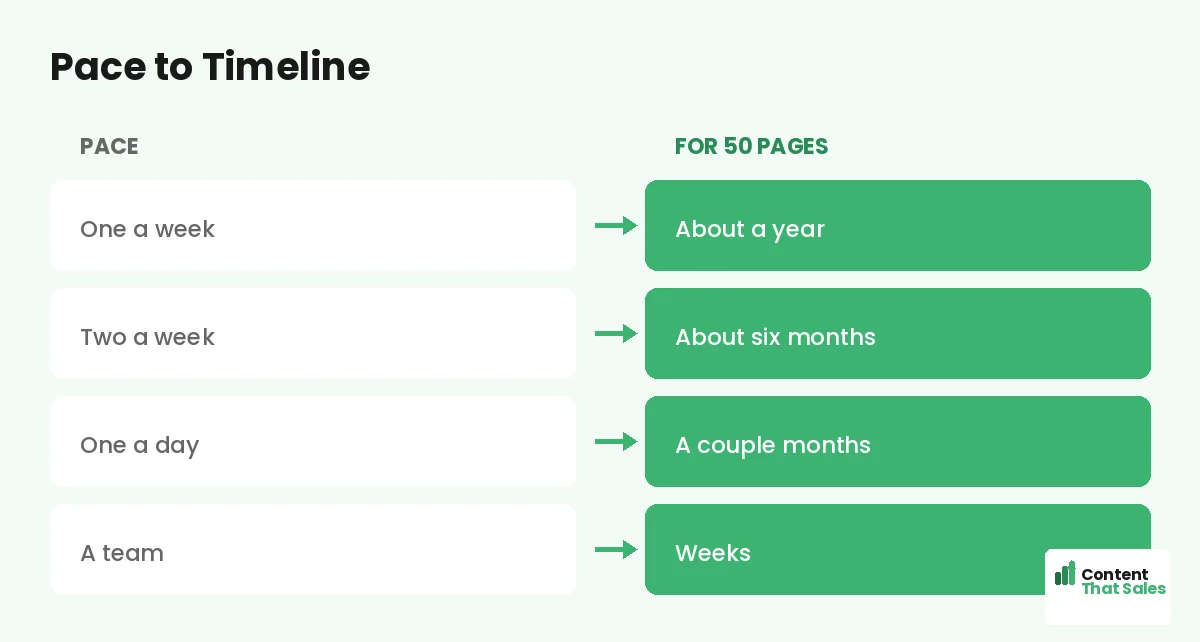
Your pace is the biggest lever. At one page a week, a 50-page map takes about a year. At two a week, about six months. With a team publishing daily, a couple of months. Your pace, more than anything, sets when you finish.
Choose a pace you can sustain. A faster pace finishes sooner but risks burnout or quality drops if unrealistic. Your publishing order tells you what to write; your pace tells you how quickly the whole map gets done.
Content Depth Affects Speed
How deep each page is affects how fast you can produce them. A thorough, well-researched page takes longer to write than a thin one. Since depth is what builds authority, do not sacrifice it for speed, factor it into your timeline instead.
Deeper pages mean a slower pace but stronger results. Balance is key, aim for pages thorough enough to rank, then set a pace that allows that quality. Since readers scan more than they read, depth plus clarity matters more than raw speed.
Your Resources Matter
Your resources, time, budget, and team size, shape your pace. One person writing part-time publishes slower than a team or an outsourced service. More resources mean a faster pace and a shorter timeline to a fully published map.
Be realistic about what you can commit. If you are solo and busy, plan a modest pace; if you have a team or budget, you can move faster. Matching your pace to your real resources keeps your schedule achievable rather than aspirational.
Did you know?
You do not have to finish a map to see results. Pages and clusters start ranking as you publish them, so authority builds throughout the timeline, not just at the end.
Realistic Timeline Estimates
As rough guides for a 50-page map: one page a week is about a year; two a week is about six months; one a day is a couple of months; a team can do it in weeks. Scale these to your own map size and pace.
These are estimates, not promises, real timelines vary with quality and consistency. But they give you a useful starting point. Take your page count and your sustainable pace, and you can estimate your own realistic finish date.
Plan a Schedule You Can Keep
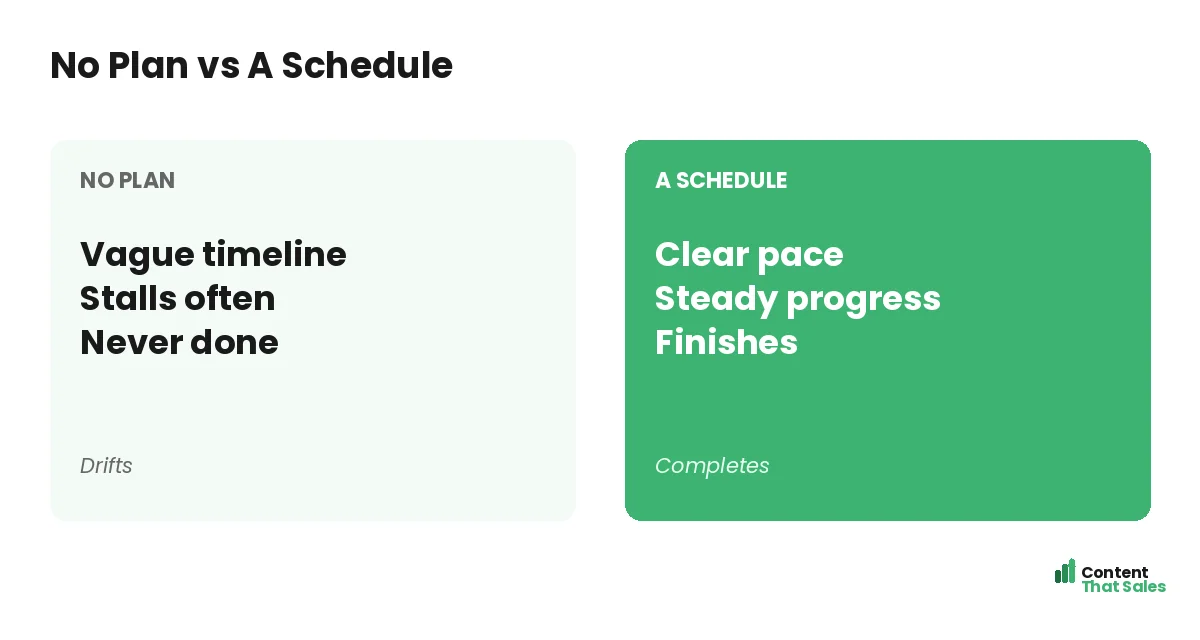
Turn your estimate into a schedule. Decide your pace, mark milestones, and commit to a rhythm you can sustain. A realistic schedule keeps you moving steadily, while a vague plan or an unrealistic sprint leads to stalling.
A schedule turns a daunting map into manageable steps. This is part of how you implement a topical map successfully. A plan you can actually keep is far better than an ambitious one you abandon after a few weeks.
Remember Results Come Along the Way
You do not have to wait until the map is complete to benefit. Pages start ranking as you publish, and clusters gain authority as they fill in. Results build throughout the timeline, which keeps you motivated to finish.
This is encouraging, the work pays off gradually, not just at the end. Build clear connections between pillar and cluster pages as you go, and your authority compounds throughout. Simple, clear pages keep winning, and since easy reading lifts engagement, quality pages perform from day one.
Put It All Together
How long to publish a full topical map depends on map size, publishing pace, content depth, and resources. A 50-page map ranges from weeks with a team to about a year at one post a week. Estimate from your page count and sustainable pace.
Plan a realistic schedule you can keep, and remember results build along the way. You do not need to finish to benefit, pages rank as you publish. Steady, sustainable progress is what gets your full map published and ranking.
Batching Can Speed Things Up
One way to publish faster without burning out is to batch your work. Instead of researching, writing, linking, and formatting one page at a time, group similar tasks together, research several pages at once, then draft several, then link them. Batching reduces the mental switching cost and often lets you produce more pages in the same hours.
Batching works especially well within a single cluster, where the pages share context and research. Producing a whole cluster in one focused push also means you can link those pages together immediately, strengthening your structure faster. If you have a team or outsource, batching makes coordination easier too, since everyone works on related pages at the same stage. Built into your schedule, batching can meaningfully shorten the timeline to a fully published map.
How Content That Sales Helps
Publishing a full map quickly takes capacity most teams do not have. That’s where we come in. At Content That Sales, we produce your map’s pages at a steady, reliable pace, so your full map gets published far faster than going it alone.
You get speed without sacrificing quality. We write, link, and publish, often organized in a topical map template for clarity. The result is a full map completed on a realistic schedule, ranking and building authority along the way.
Ready to Plan Your Timeline?
Now you know how long it takes to publish a full topical map and how to plan a realistic schedule. The pace is yours to set, and results build along the way. So why not map out your timeline and start publishing?
Let’s plan and publish your map together. Book your free consultation now. Call us at 8801631988589 or email service@contentthatsales.com. Let’s turn your map into a published, ranking resource on a schedule that works.
Frequently Asked Questions About the Timeline
How long does it take to publish a full topical map?
It depends on size, pace, depth, and resources. A 50-page map ranges from weeks with a team to about a year at one post a week.
What is the biggest factor?
Your publishing pace. At one page a week a 50-page map takes about a year; at two a week, six months; daily, a couple of months.
How do I estimate my timeline?
Count your planned pages and divide by your sustainable weekly pace. That gives a realistic finish estimate you can build a schedule around.
Should I publish faster to finish sooner?
Only if you can sustain it without dropping quality. Depth builds authority, so a realistic pace that keeps quality high beats an unsustainable sprint.
Do I have to finish before seeing results?
No. Pages and clusters start ranking as you publish them, so authority builds throughout the timeline, not just when the map is complete.
How does depth affect the timeline?
Deeper pages take longer to write, slowing your pace. Since depth builds authority, factor it into your timeline rather than sacrificing it for speed.
What if I have limited time?
Set a modest, sustainable pace, or outsource to move faster. A slower pace you can keep still finishes the map; an abandoned sprint does not.
Can Content That Sales help?
Yes. We produce your map’s pages at a steady pace so it gets published faster. Reach out for a quick quote.