 Skip to content
Combining SERP data with AI is how you build a topical map that is both fast and grounded in reality. AI alone can invent keywords and guess at demand, while SERP data shows you what people actually search and what already ranks. Feed real search data into AI, and you get a map built on evidence, not guesses. This guide shows you how to combine the two for a map that ranks.
A topical map plans complete coverage of your subject. AI builds it fast, but it needs grounding in real data to be accurate. SERP data provides that grounding, turning AI’s speed into reliable, evidence-based output.
Below, we walk through how to gather SERP data, feed it into AI, and build a map that reflects what searchers really want.

Why AI Alone Is Not Enough
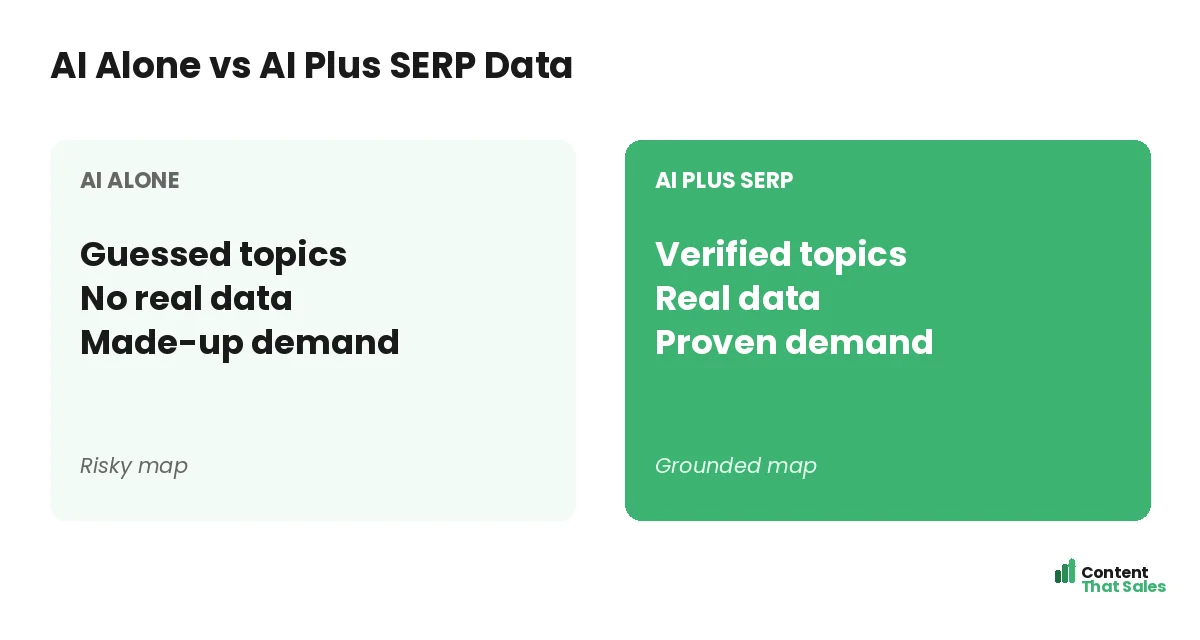
AI is fast at generating ideas, but it guesses at search demand and can invent keywords that nobody searches. Building a map on AI guesses alone risks wasting effort on pages with no audience. Real data fixes this.
Grounding AI in SERP data keeps your topical map tied to reality. The AI provides speed and breadth, and the data provides truth. Together they produce a map that targets searches people actually make.
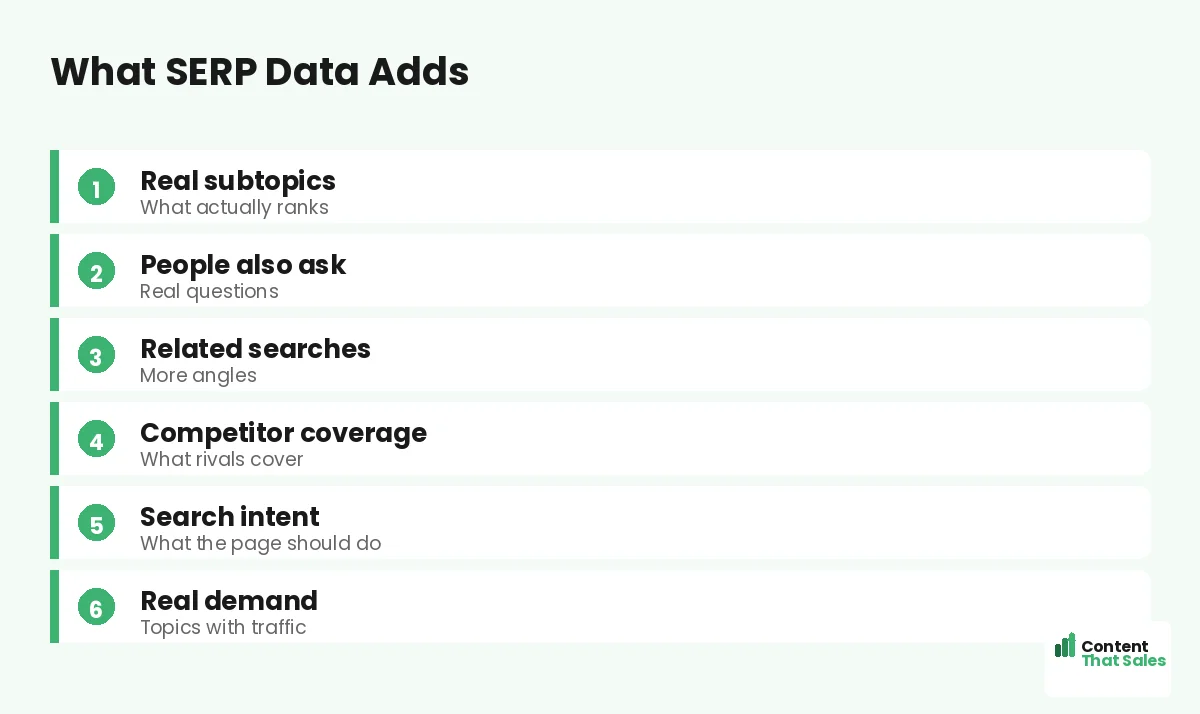
What SERP Data Tells You
SERP data shows the real search landscape, what people query, how often, what already ranks, and what related questions appear. This is evidence of genuine demand and intent, the foundation a strong topical map should be built on.
Looking at the actual results pages reveals what searchers want and what content wins. This grounds your map in proof rather than assumptions, so every page you plan targets a real search with a real audience behind it.
Gather Your SERP Data First
Before prompting AI, collect SERP data for your topic, keyword lists, search volumes, related searches, and the people-also-ask questions. Tools and search results give you this raw material, which becomes the evidence base for your whole map.
This data collection is where your map gets its accuracy. Pull the keywords and questions around your subject, the same research that helps you find cluster topics grounded in genuine demand rather than guesswork.
Feed the Data Into AI
Now give the SERP data to AI as context. Paste your keyword lists, related searches, and questions, then ask the AI to organize them into pillars and clusters. The AI structures real data instead of inventing from nothing.
This is the key move, AI organizing evidence rather than guessing. The result is a map where every pillar and cluster traces back to real searches. The AI does the fast sorting; the data ensures it is grounded in truth.
Let AI Group by Intent
Ask the AI to group your keywords by search intent and topic. It can quickly cluster related terms, spot which belong together, and identify the intent behind each group, turning a messy keyword list into an organized structure.
This grouping is tedious by hand but fast for AI. Since readers scan more than they read, organizing by intent ensures each planned page targets a clear need, making your map both complete and focused.
Map Keywords to Pages
With keywords grouped, have the AI assign one primary keyword per page and suggest the page title and intent. This turns your grouped data into a concrete page list, each page targeting one real search backed by SERP evidence.
This step converts data into a plan. Every page now has a keyword with proven demand and a clear purpose. Because it is built from SERP data, you avoid the common AI trap of planning pages no one is searching for.
Did you know?
The people-also-ask box is a goldmine. Feeding those exact questions into AI gives you cluster pages that match what searchers literally type, word for word.
Check the Competition
SERP data also shows what already ranks. Ask the AI to review the top results for your key terms and suggest angles or gaps you can fill. This helps you plan pages that can actually compete and win, not just exist.
Knowing what ranks tells you the bar to clear. Use the AI to spot where existing content is thin or missing an angle, then plan pages that do better. This turns competitive data into a real ranking opportunity.
Build the Structure
Have the AI assemble everything into a map, pillars with data-backed clusters beneath each, in a table you can use. Because it is built from SERP data, this structure reflects real demand at every level, not assumptions.
Drop the table into a spreadsheet to organize your pillar-and-cluster structure. Every entry now has evidence behind it. The AI assembled it fast, and the SERP data made it trustworthy and aimed at genuine searches.
Review and Verify
Even with data, review the output. Check that groupings make sense, keywords are accurate, and no important search is missing. The combination of data and AI is powerful, but human judgment still finalizes a strong, accurate map.
Verify the AI did not misread the data or miss a cluster. Simple, clear pages win, and since easy reading lifts engagement, plan each page to serve its search clearly and well.
Put It All Together
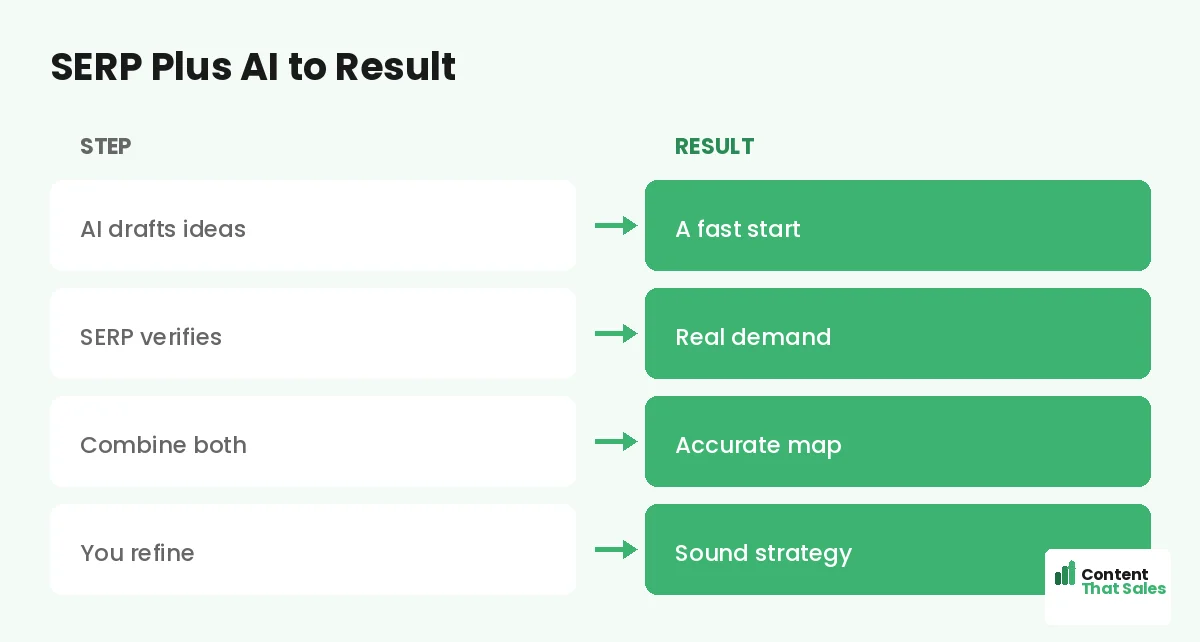
To combine SERP data with AI: gather keyword and question data first, feed it to the AI as context, let it group by intent, map keywords to pages, check the competition, and assemble the structure. Then review and verify.
SERP data grounds the map in real demand; AI organizes it fast. Together they produce a map built on evidence, not guesses, far quicker than manual research alone. The result targets searches people actually make.
Plan Links From the Data Too
SERP data and AI can guide your internal linking as well. Related searches and shared keywords show which topics naturally connect, so you can ask the AI to suggest which pages should link to each other based on that overlap. The result is a linking plan grounded in how searchers move between related questions.
Apply the suggestions to build strong connections between pillar and cluster pages. When your links follow real topical relationships, search engines understand your structure better and readers find the next answer faster. Data-driven linking turns a list of pages into a connected, authoritative web that compounds over time.
How Content That Sales Helps
Gathering data and combining it with AI takes skill and time. That’s where we come in. At Content That Sales, we pull the SERP data, run it through AI, build your data-backed map, and write the pages that fill it.
You get a map grounded in real demand without the research grind. We handle the data, the AI, and the content, often organizing it in a topical map template so it stays clear. The result is a map that ranks.
Ready to Build a Data-Backed Map?
Now you know how to combine SERP data with AI: ground the AI in real search data, then let it organize and structure your map. Evidence plus speed equals a map that ranks. So why build on guesses when you have data?
Let’s build your data-backed map together. Book your free consultation now. Call us at 8801631988589 or email service@contentthatsales.com. Let’s turn real search data into a content plan that ranks and sells.
Frequently Asked Questions About SERP Data and AI
Why combine SERP data with AI?
AI is fast but guesses at demand; SERP data shows real searches. Combining them gives you a map that is both quick to build and grounded in evidence.
What SERP data do I need?
Keyword lists, search volumes, related searches, and people-also-ask questions. This data reveals real demand and intent to build your map on.
How do I feed data into AI?
Paste your keyword lists, related searches, and questions as context, then ask the AI to organize them into pillars and clusters by topic and intent.
Why not just use AI alone?
AI can invent keywords nobody searches, wasting effort on pages with no audience. SERP data grounds it so every page targets a real, proven search.
How does this help with competition?
SERP data shows what already ranks. AI can review the top results and suggest gaps or angles, so you plan pages that can actually compete and win.
Why is people-also-ask useful?
Those are real questions searchers type. Feeding them into AI gives you cluster pages that match what people literally ask, word for word.
Do I still need to review the output?
Yes. Check groupings, verify keywords, and confirm no important search is missing. Data plus AI is powerful, but human judgment finalizes the map.
Can Content That Sales help?
Yes. We pull the data, run it through AI, build the map, and write the pages. Reach out for a quick quote.