 Skip to content
This topical map for local businesses step-by-step guide gives you a clear, repeatable process to cover your services, your service areas, and the questions local customers ask, so you can own your local market in search. Local SEO is winnable because you compete only with nearby businesses, and a topical map is how you turn that advantage into rankings. Follow the steps below to build yours.
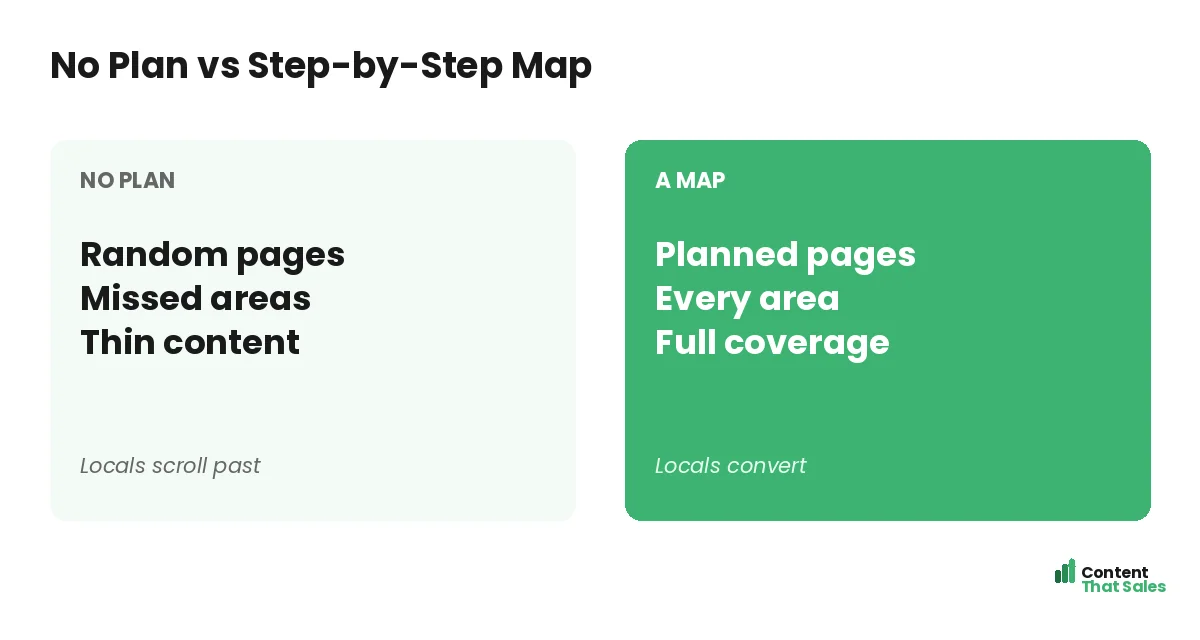
Most local businesses publish a thin site and stop. A topical map fills the gaps with a page per service, pages per area, and content answering real local questions. The result is complete local coverage that makes you the obvious choice.
Below, we walk through the steps to build a local topical map, from setting your core service to linking it all together and turning it into booked jobs.

Why Local Businesses Win With a Map
Local SEO is one of the most winnable arenas, because you only compete with other businesses in your area. A topical map lets you cover your local subject so completely that you stand out as the clear local authority and capture nearby searches.
This builds on the same principle as any topical map, tuned for location. Most local competitors do the minimum online, so a complete local map lets you leapfrog them and own your market.
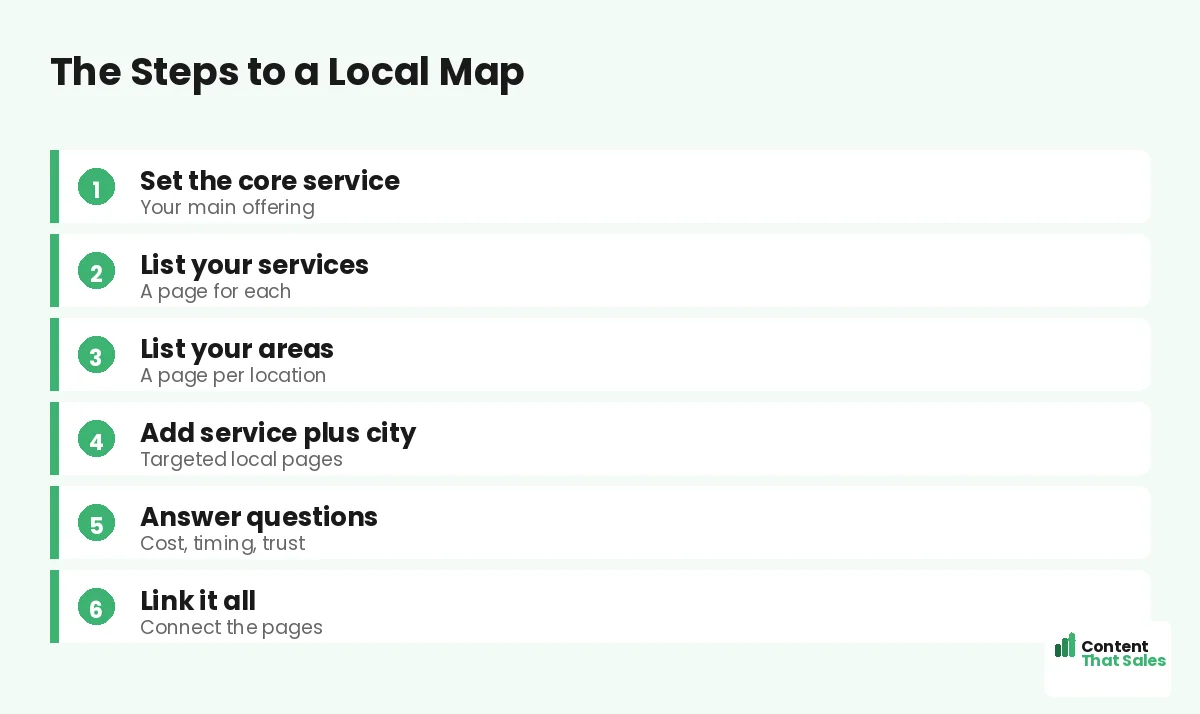
Step 1: Set Your Core Service
Start by defining your core service, the main thing your business does. This anchors the whole map. If you are an electrician, it is electrical services; if a cleaner, cleaning. Everything, your services and areas, branches from this center.
Keep the core true to your business. A clear core service makes every later step easier, since your services and locations all relate to it. This is the foundation the rest of your local map is built on.
Step 2: List Your Services
List every service you offer and plan a dedicated page for each. Separate service pages let you rank for each specific search and fully answer the customer looking for it. One lumped-together services page cannot do that.
For each service, you will create a focused page covering that offering in depth. These service pages are the backbone of your local map, the same approach as building a topical map for a service business, with local detail added.
Step 3: List Your Service Areas
List every area you serve and plan a page for each location. Local customers search by area, so a page for each town or region you cover helps you rank where your customers are. Define your service area clearly across these pages.
Location pages name the area, describe your service there, and include local detail. They capture the searches specific to each place you serve. Mapping your areas ensures you show up across your whole coverage zone, not just one spot.
Step 4: Add Service-Plus-City Pages
The most powerful local pages combine service and location, like electrician in your-town. These match exactly what local searchers type and capture high-intent traffic. Create service-plus-city pages for your key services and areas.
This is the heart of local coverage, the same idea behind strong local landing pages, applied across your map. Service-plus-city pages target precise local searches your competitors often miss entirely.
Step 5: Answer Local Questions
Map the questions local customers ask: how much does it cost, how soon can you come, what areas do you cover, are you licensed. Each question becomes a page that builds trust and captures informational local searches.
These question pages reach customers earlier and show you are helpful and transparent. Since readers scan more than they read, answer each clearly so locals get what they need fast and trust you with the job.
Did you know?
Service-plus-city pages often capture the highest-intent local searches, because someone typing a service and a town is usually ready to call or book.
Step 6: Structure the Map
Organize your map into clusters: a core service pillar, individual service pages, location pages, service-plus-city pages, and question content. Think of it as a grid of services and locations, filled in completely for full local coverage.
This structure covers both what you do and where you do it. Filling the grid means a local searcher finds you whatever they type, your service, their city, or both. That completeness is what builds local topical authority.
Step 7: Link It All Together
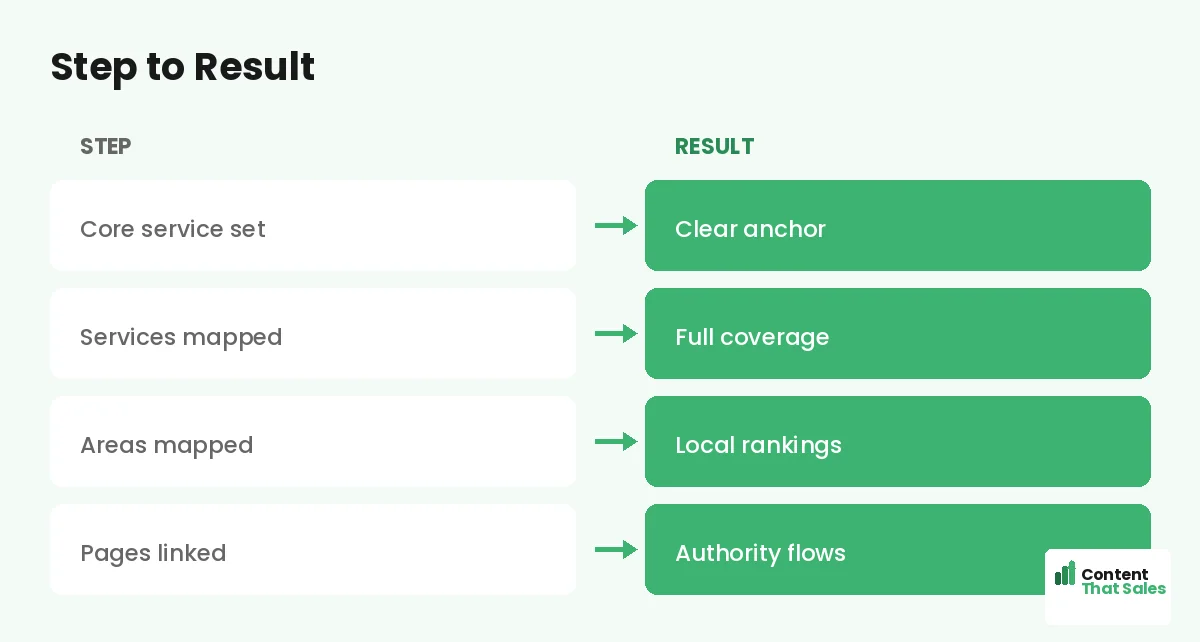
Connect your pages with internal links. The service pillar links to each service; services link to their location and service-plus-city pages; question pages link to the relevant services. This linking spreads authority and guides customers.
Strong internal linking ties your local map into one connected system and helps Google understand your local relevance. It also moves customers from a question to a service to a booking. A well-linked map works far better than scattered pages.
Step 8: Build It Cluster by Cluster
With the map planned, build it in order: start with your top services and main areas, then expand. Finishing one service cluster before the next sends a strong signal and keeps your effort focused. Steady progress beats scattered publishing.
Prioritize the services and areas that matter most to your business. Completing high-value clusters first means your early work drives real results. Build the map cluster by cluster, and your local coverage grows steadily into authority.
Turn the Map Into Bookings
Coverage gets you found; clear calls to action get you booked. Every service and location page should guide the local visitor to contact you, with a tap-to-call button, your phone number, and an easy quote request. Rankings mean little without bookings.
Make every page convert, not just inform. Simple, clear content keeps winning, since easy reading lifts engagement. A local map that ranks and converts turns nearby searches into the booked jobs that grow your business.
Put It All Together
To build a topical map for a local business, set your core service, list services and areas, add service-plus-city pages, answer local questions, structure the grid, link it all, and build cluster by cluster, then drive every page to contact.
Local SEO is winnable, and this step-by-step map is how you win it. Cover your services and areas completely, answer real questions, link it together, and convert. Do that, and you own your corner of the local market while competitors run thin pages.
How Content That Sales Helps
We build local maps that book jobs. That’s where we come in. At Content That Sales, we plan your local topical map, cover your services and areas, and write the pages that rank locally and convert.
You share your services and locations. We map the full grid, write the service, location, and question pages, and link them to convert. The result is complete local coverage that makes you the top choice in your area.
Ready to Own Your Local Market?
Now you have a step-by-step topical map for local businesses: core service, services and areas, service-plus-city pages, local questions, structured and linked. Local SEO is winnable. So why settle for a thin site?
Let’s map your local market and win it. Book your free consultation now. Call us at 8801631988589 or email service@contentthatsales.com. Let’s turn local searches into booked jobs.
Frequently Asked Questions About Local Topical Maps
Why do local businesses benefit from a topical map?
Local SEO is winnable because you only compete with nearby businesses. A topical map covers your services and areas so completely you become the clear local authority.
What is the first step?
Set your core service, the main thing your business does. It anchors the whole map, with your services and areas branching from it.
Should I have a page per service?
Yes. Separate service pages let you rank for each specific search and fully answer the customer. One lumped services page cannot do that.
What are service-plus-city pages?
Pages that combine a service and a location, like service in a town. They match what local searchers type and capture the highest-intent local traffic.
What local questions should I cover?
Cost, availability, service area, and licensing, the things locals ask before hiring. Each becomes a page that builds trust and captures informational searches.
How should I structure the map?
As a grid of services and locations, with a core service pillar, service pages, location pages, service-plus-city pages, and question content, all linked.
How do I turn rankings into bookings?
Make every page convert, with a tap-to-call button, phone number, and easy quote request. Coverage gets you found; clear CTAs get you booked.
Can Content That Sales help?
Yes. We plan your local map and write the service, location, and question pages that rank locally and book jobs. Reach out for a quick quote.