 Skip to content
Learning how to build a topical map for a service business turns a thin website into a complete, authoritative resource that ranks for every service you offer and every question your clients ask. Most service businesses publish one services page and stop, leaving huge gaps. A topical map fills them, with a page per service, answers to client questions, and content on cost and process. This guide walks you through building one.
Service businesses compete on trust and relevance. A topical map builds both by covering your services completely and answering the real questions buyers have before they hire. Done well, it makes you the obvious, authoritative choice in your field.
Below, we walk through choosing your core service, mapping individual services, answering client questions, and connecting it all into a map that ranks and converts.

Why Service Businesses Need a Map
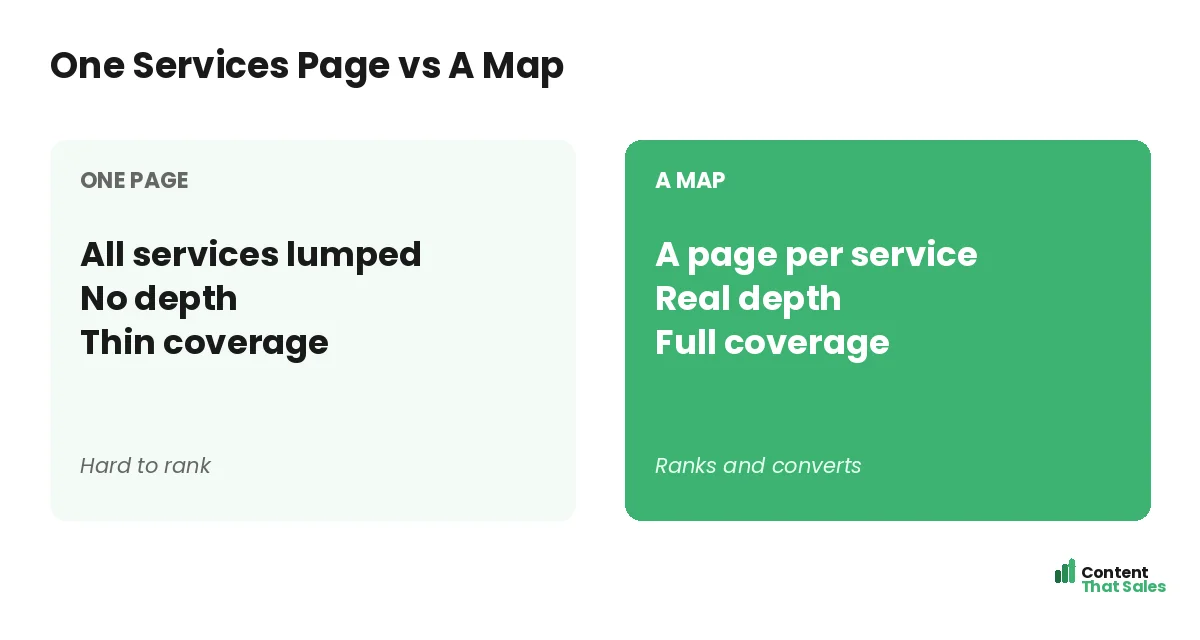
A single services page cannot rank for everything you do or answer every client question. A topical map can. By covering each service in depth and addressing the questions buyers ask, it builds the relevance and trust that win clients.
This is the same discipline behind any topical map, applied to services. Most competitors do the minimum online, so a complete service map lets you stand out as the authority in your field.
Start With Your Core Service
Your core topic is your main service category, the umbrella over everything you offer. This anchors your map. If you are a marketing agency, your core might be marketing services; if a plumber, plumbing. Everything branches from this central service.
Keep the core true to what you actually do. For help choosing it, see our guide on defining your core topic for a topical map. A clear core service makes the rest of the map fall into place, and the major service areas beneath it become the pillar topics for your clusters.
Map a Page Per Service
Create a dedicated page for each distinct service, not one lumped-together list. Each service page covers that offering in depth, letting you rank for the specific search and fully answer the buyer looking for it. This is the backbone of a service map.
A single page covering everything dilutes your relevance for each service. Separate pages signal depth and capture specific demand. List every service you offer, and give each its own focused, thorough page within your map.
Answer Client Questions
Beyond services, map the questions clients ask before hiring: how much does it cost, how long does it take, what is included, are you qualified. Each question becomes a page that builds trust and captures informational searches.
These question pages reach buyers earlier in their decision and position you as helpful and transparent. Since readers scan more than they read, answer each question clearly and directly so clients get what they need fast.
Cover Cost and Pricing
Service buyers want to know what things cost, yet many businesses hide pricing. Mapping cost and pricing content, even ranges or how pricing works, builds trust and captures the many searches around cost. Transparency wins clients.
A clear cost guide reassures cautious buyers and pre-qualifies leads. It also captures high-intent searches competitors ignore. Include pricing content in your map, and you address one of the biggest questions every service buyer has.
Explain Your Process
Clients want to know how working with you actually goes. Map content that explains your process step by step, what happens from first contact to finished work. This reduces uncertainty and makes hiring you feel safe and clear.
Process content also differentiates you, showing professionalism and care. A page that walks through how the work happens answers a real question and builds confidence. Include it in your map alongside services and pricing for complete coverage.
Did you know?
Service buyers often search for cost and process before they ever contact a business, so covering those topics captures high-intent visitors competitors miss.
Add Trust and Proof Content
Trust is everything in services. Map content that builds it: credentials, results, case studies, and reviews. These pages reassure buyers that you can deliver, supporting the service and question pages with the proof that closes the deal.
Proof content also captures searches like reviews or results for your type of service. Weaving trust content through your map, not just on one page, reinforces your credibility everywhere a buyer might land. Trust, shown widely, wins the hire.
Structure and Link the Map
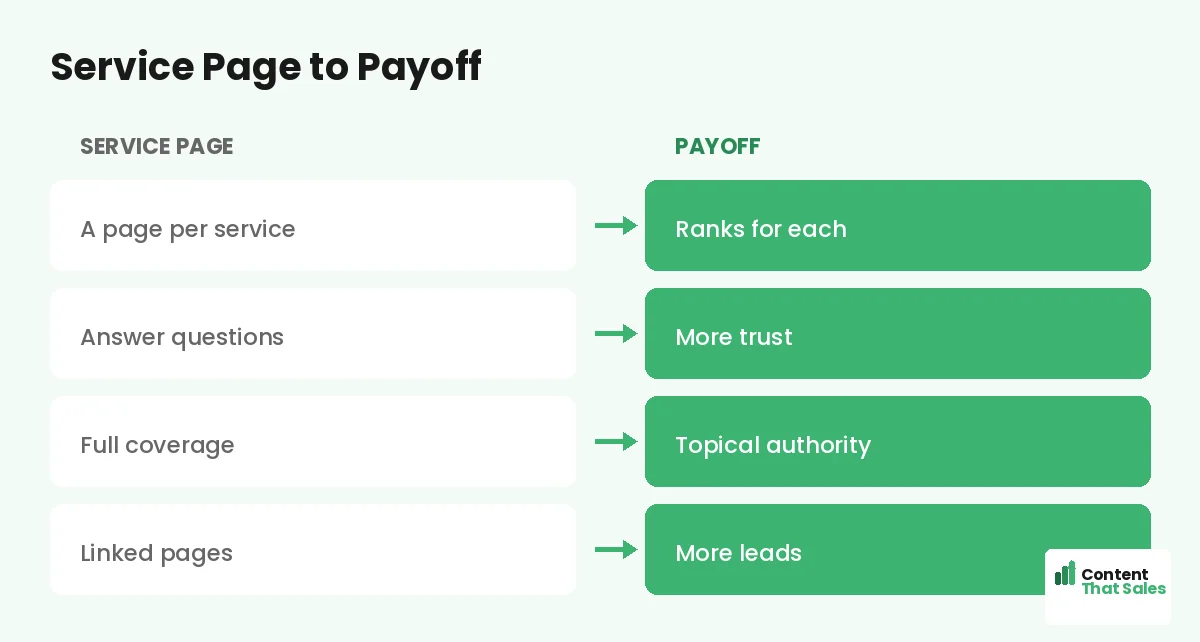
Organize your map into clusters: a core service pillar, individual service pages, and supporting question, cost, and process pages. Link them so the pillar connects to services, and services connect to the relevant questions and proof.
Strong internal linking ties the map together and guides buyers from a question to a service to contact. A well-linked service map works as one connected system. For local service businesses, this pairs with a focused local topical map.
Turn the Map Into Leads
Coverage builds authority, but conversions need clear calls to action. Every service and question page should guide the visitor to contact you, with a clear next step, your phone number, and an easy way to request a quote.
Make every page convert, not just inform. Simple, clear content keeps winning, since easy reading lifts engagement. A service map that ranks and converts turns the traffic it earns into real inquiries and clients.
Put It All Together
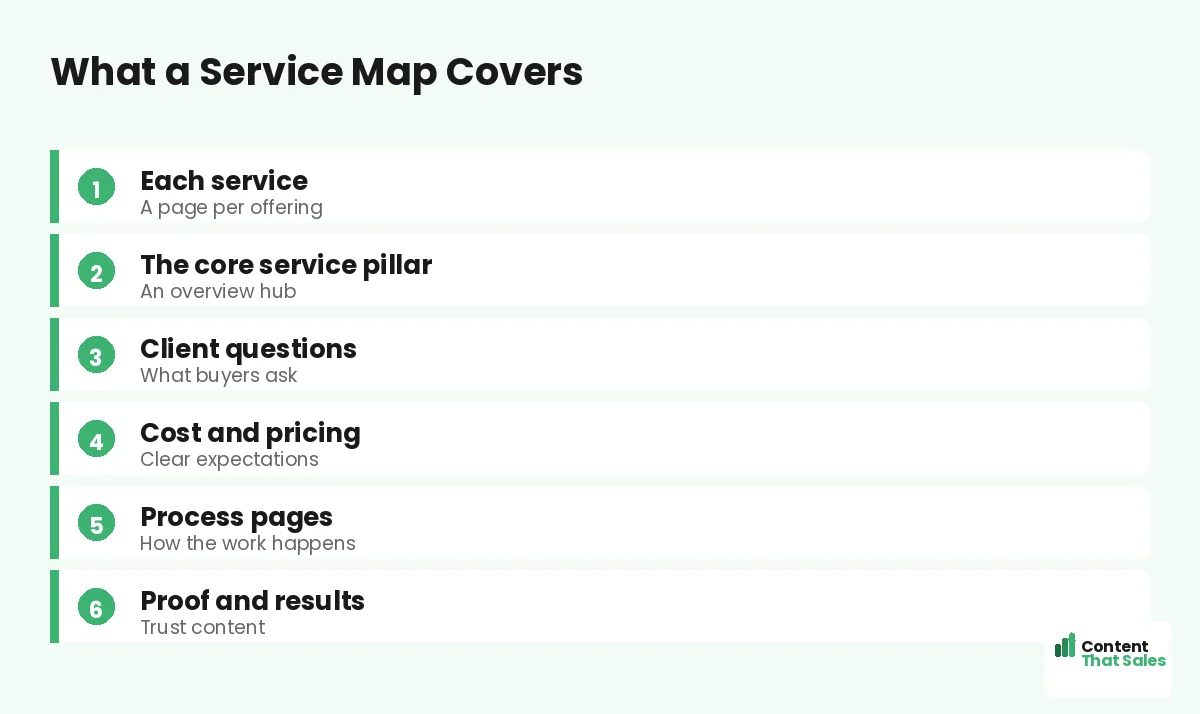
To build a topical map for a service business, set your core service, map a page per service, answer client questions, cover cost and process, add trust content, and link it all toward contact. This turns a thin site into an authoritative one.
Most service businesses leave this opportunity on the table. Cover your services completely, answer the real questions, and link the map well, and you become the trusted, authoritative choice that ranks and wins the clients in your field.
Find the Right Service Subtopics
Under each service pillar, you need the right cluster topics, the specific questions and angles buyers search for around that service. These come from real research, not guesswork: keyword tools, the questions clients ask, and what competitors cover. Each genuine subtopic becomes a supporting page that deepens the service cluster.
This is the same process as how you find cluster topics that support pillars on any map. List the real subtopics under each service, validate that people search them, and map each to its service pillar. Done well, every service ends up surrounded by the supporting pages that fully cover it, which is exactly what builds authority and captures the long tail of service-related searches.
How Content That Sales Helps
We map and write service content that wins clients. That’s where we come in. At Content That Sales, we plan your service map, cover every service and question, and write the pages that rank and convert.
You share your services and goals. We map the structure, write the service, question, cost, and trust pages, and link them to convert. The result is complete coverage that makes you the authoritative choice in your field.
Ready to Map Your Services?
Now you know how to build a topical map for a service business: cover every service, answer client questions, address cost and process, and link it all to convert. A thin site loses; a complete map wins. So why settle for one services page?
Let’s map your services and win clients. Book your free consultation now. Call us at 8801631988589 or email service@contentthatsales.com. Let’s turn searches into inquiries.
Frequently Asked Questions About Service Business Topical Maps
Why does a service business need a topical map?
A single services page cannot rank for everything you do or answer every client question. A topical map covers each service in depth and builds the trust that wins clients.
What should the core topic be?
Your main service category, the umbrella over everything you offer. Everything else, individual services and supporting content, branches from this central service.
Should I have a page per service?
Yes. A dedicated page per service lets you rank for each specific search and fully answer the buyer. One lumped-together list dilutes your relevance.
What questions should I answer?
The ones clients ask before hiring: cost, timing, what is included, and qualifications. Each becomes a page that builds trust and captures informational searches.
Should I cover pricing?
Yes. Many buyers search for cost before contacting a business. Covering pricing, even ranges or how it works, builds trust and captures high-intent searches.
How do I build trust through the map?
Map credentials, results, case studies, and reviews, woven through the map rather than on one page, so your credibility shows wherever a buyer lands.
How do I turn the map into leads?
Make every page convert, with a clear call to action, phone number, and easy quote request. Coverage builds authority; clear CTAs turn it into inquiries.
Can Content That Sales help?
Yes. We plan your service map and write the pages that rank and convert, covering every service and question. Reach out for a quick quote.