 Skip to content
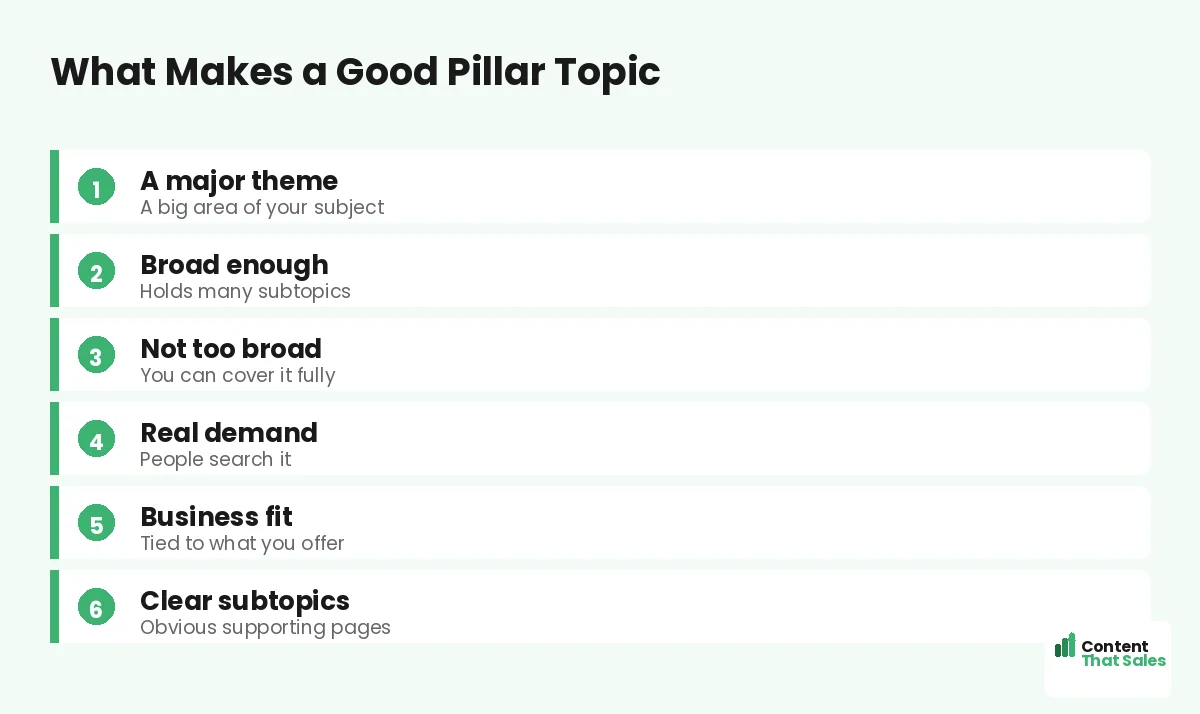
Knowing how to identify pillar topics for your topical map is what gives your content structure, because pillars are the broad themes that anchor each cluster of pages. Pick the right pillars and your map organizes itself; pick poorly and your structure wobbles. A good pillar topic is a major theme, broad enough to hold many subtopics but focused enough to cover fully, with real demand and business fit. This guide shows you exactly how to find them.
Pillars are the load-bearing walls of your topical map. Each one anchors a cluster of supporting pages and targets a broad keyword. Identifying them well is the bridge between your core topic and your detailed content, so it deserves careful thought.
Below, we cover what makes a good pillar topic, how to find your pillars within your subject, and how to test them before you build.

What a Pillar Topic Is
A pillar topic is a major theme within your subject, broad enough to anchor a whole cluster of supporting pages. It becomes a pillar page that gives the overview and links to deeper cluster pages. Pillars sit between your core topic and your detailed content.
They are the main divisions of your subject. For how pillars and clusters work together, see our breakdown of pillar pages vs cluster pages. Identifying strong pillar topics is the first step in structuring your map after defining the core.
Start From Your Core Topic
Pillars come from your core topic. Once you know the central subject your site covers, the pillars are its major sub-areas, the big themes that divide it. So identifying pillars begins with a clear core to break down into its main parts.
If your core is not yet defined, start there. See our guide on defining your core topic for a topical map. With a clear core, the pillar topics are the natural major divisions beneath it, the next level of your hierarchy.
Look for Major Themes
To find pillars, brainstorm the major themes within your core topic, the big areas a comprehensive site on the subject would cover. These broad themes, not narrow questions, are your pillar candidates. Each should feel like a substantial area in its own right.
For a core topic like email marketing, major themes might be list building, email design, and automation. Each is broad enough to anchor a cluster. Listing these big themes gives you your candidate pillars to evaluate and refine.
Check the Breadth
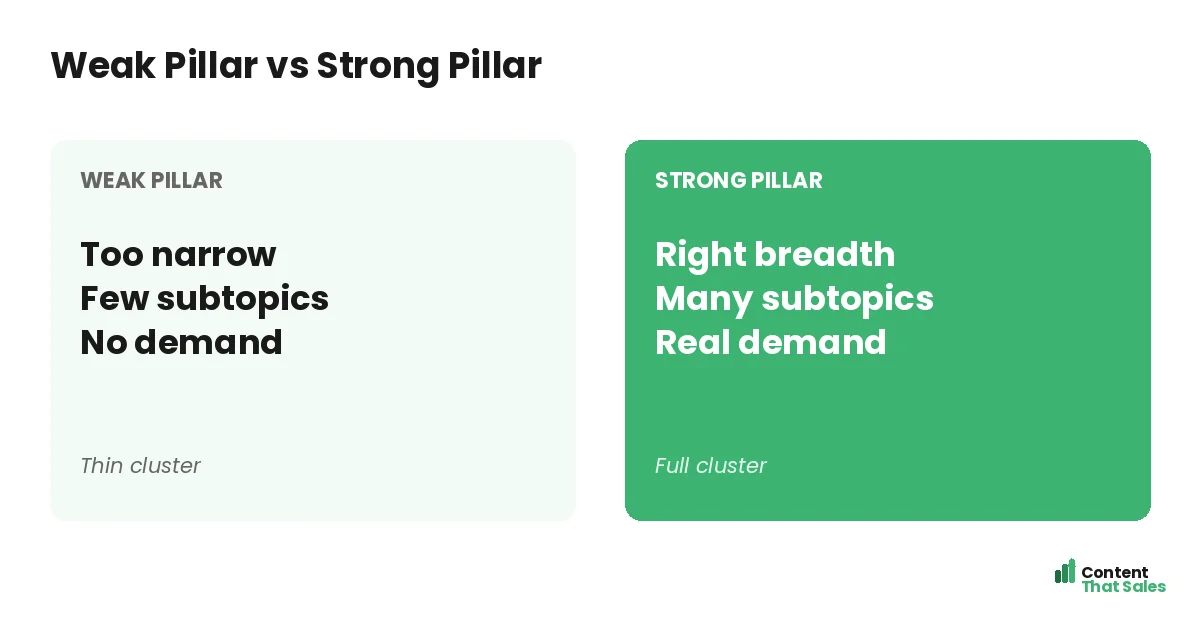
A good pillar has the right breadth: broad enough to support many subtopics, but not so broad it overlaps your whole core. If a candidate is too narrow, it is really a cluster page; too broad, and it competes with the core itself.
Test each candidate by asking whether it can hold several supporting pages without being as big as the entire subject. The pillars should divide your core into balanced, substantial sections, each a manageable area you can cover completely.
Ensure Enough Subtopics
A pillar topic needs enough subtopics to justify a cluster. If a candidate only has one or two supporting pages, it is probably a cluster page itself, not a pillar. A real pillar generates a healthy list of subtopics beneath it.
Quickly sketch the subtopics each candidate could support. If several distinct, searchable subtopics flow easily, it is a strong pillar. If you struggle to find more than a couple, fold it into another pillar instead. Pillars need depth beneath them.
Confirm Real Demand
Each pillar should have real search demand, both for the broad pillar term and for its subtopics. A theme no one searches is not worth a pillar. Use keyword research to confirm the demand across the pillar and its cluster before committing.
Demand validates the effort. Since readers scan more than they read, each pillar and its pages should answer searches people actually make. A pillar with strong demand across its cluster is one worth building fully.
Did you know?
If a candidate pillar only supports one or two pages, it is usually a cluster page itself, since a true pillar generates a whole cluster of subtopics beneath it.
Match Pillars to Your Business
Strong pillars connect to what you offer. The traffic a pillar attracts should include people who could become customers. A pillar with lots of search demand but no link to your business builds an audience you cannot serve.
Prioritize pillars that align with your products or services. These bring in the right visitors and lead them toward your offer. Business fit ensures the authority you build with each pillar also drives real results, not just traffic for its own sake.
Aim for the Right Number
Most subjects have a handful of major pillars, often a few to several, not dozens. If you find yourself with too many pillars, some are probably clusters in disguise. If you have only one, your core may be too narrow or your themes too broad.
A balanced map usually has several strong pillars, each anchoring a substantial cluster. This is the structure that covers a subject completely without sprawling, the backbone of a strong topical map strategy. Aim for the number of pillars that genuinely divides your subject into its major parts.
Test Your Pillar Candidates
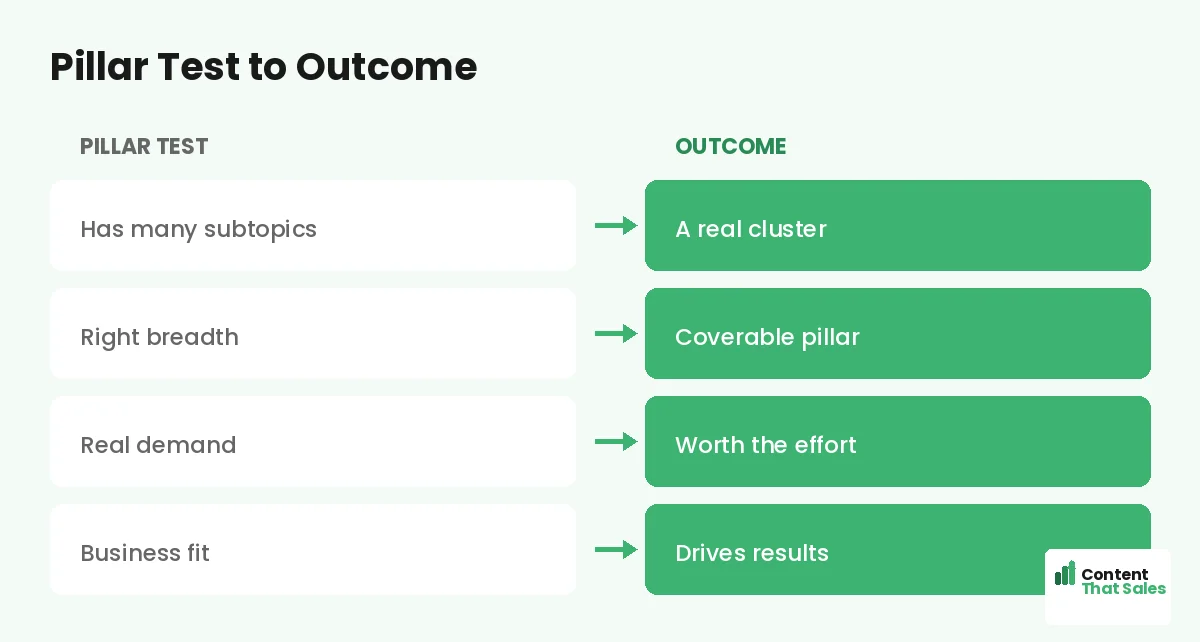
Before committing, test each pillar candidate. Ask: Is it a major theme? Does it have the right breadth? Can it support several subtopics? Is there real demand? Does it fit my business? A candidate that passes all five is a strong pillar.
This quick test filters out weak candidates, the ones too narrow, too broad, or lacking demand. Run every candidate through it, and you end up with a clean set of pillars that genuinely structure your subject. Testing now saves rework later.
From Pillars to the Full Map
Once you have your pillars, each becomes the anchor of a cluster, with supporting pages branching beneath. Related pillars link to each other to form the full map. Your pillars are the skeleton that the rest of your content hangs on.
This is how identifying pillars fits into building the whole map. For the complete process, see our guide on how to build a topical map. Strong pillars make every later step, clusters, links, content, fall into place.
Refine Pillars Over Time
Your pillars are not fixed forever. As you publish and learn what resonates, you may merge, split, or add pillars. A theme that grows large may split into two pillars; a thin one may merge into another. Let your pillar structure evolve sensibly.
Simple, clear content keeps winning, since easy reading lifts engagement. Revisit your pillars as your map matures, keeping each one a substantial, in-demand, business-fit theme. Well-chosen pillars keep your whole map strong as it grows.
Put It All Together
To identify pillar topics for your topical map, start from your core topic, look for the major themes within it, and test each for the right breadth, enough subtopics, real demand, and business fit. The candidates that pass become your pillars.
Pillars are the load-bearing themes that anchor your clusters and structure your whole map. Choose a balanced set of strong ones, each substantial and in-demand, and the rest of your map builds naturally. Get the pillars right, and the structure follows.
How Content That Sales Helps
We identify the right pillars and build them out. That’s where we come in. At Content That Sales, we analyze your subject, find the pillar themes with real demand and business fit, and write the pillars and clusters that build authority.
You share your core topic and goals. We identify the pillars, map the clusters beneath them, and produce the connected content. The result is a well-structured topical map anchored on strong pillars, built to cover your subject and rank.
Ready to Find Your Pillars?
Now you know how to identify pillar topics for your topical map: start from your core, find the major themes, and test each for breadth, subtopics, demand, and business fit. Strong pillars structure everything. So why build on shaky themes?
Let’s find your pillars and build your map. Book your free consultation now. Call us at 8801631988589 or email service@contentthatsales.com. Let’s turn your subject into a structure that ranks.
Frequently Asked Questions About Identifying Pillar Topics
What is a pillar topic?
A major theme within your subject, broad enough to anchor a whole cluster of supporting pages. It becomes a pillar page that gives the overview and links to deeper clusters.
How do I find pillar topics?
Start from your core topic and brainstorm its major themes, the big areas a comprehensive site would cover. Those broad themes are your pillar candidates.
How broad should a pillar be?
Broad enough to support many subtopics, but not so broad it overlaps your whole core. Too narrow and it is a cluster page; too broad and it competes with the core.
How do I know a theme is a pillar, not a cluster?
A pillar generates a whole cluster of subtopics beneath it. If a candidate only supports one or two pages, it is usually a cluster page itself.
Should pillars have search demand?
Yes. Each pillar should have real demand for the broad term and its subtopics. Confirm with keyword research before committing to building the cluster.
How many pillars should I have?
Usually a few to several major pillars, not dozens. Too many means some are clusters in disguise; too few may mean your core is too narrow.
Do pillars need to fit my business?
Yes. Prioritize pillars tied to what you offer, so the traffic includes potential customers and the authority you build also drives real results.
Can Content That Sales help?
Yes. We identify the right pillar themes with real demand and business fit, then build the pillars and clusters that rank. Reach out for a quick quote.