 Skip to content
Understanding pillar pages vs cluster pages is essential for building a topical map that ranks, because the two play different roles: a pillar page covers a topic broadly and anchors the group, while cluster pages dive deep into specific subtopics and support it. Knowing how they differ, how they link, and when to use each is the key to a structure that builds authority. This complete breakdown explains both page types and how they work together.
People often blur the two, but the distinction matters. A pillar is your broad hub; clusters are your deep spokes. Each targets different keywords and serves a different purpose, and together they form the connected group that signals expertise to Google.
Below, we break down what a pillar page is, what a cluster page is, how they differ, how they link, and when to use each.

What a Pillar Page Is
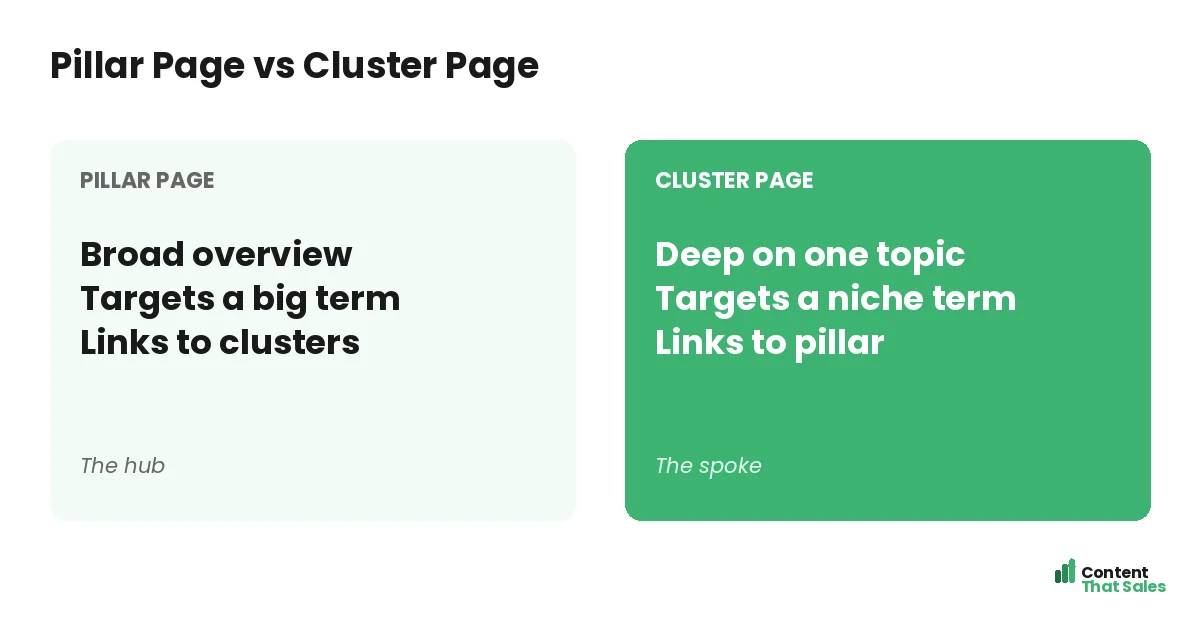
A pillar page is a broad, comprehensive page covering a main topic at a high level. It introduces the whole subject, touches on its key areas, and links out to detailed cluster pages. It targets a broad, often competitive keyword and anchors the group.
Think of the pillar as the hub of a wheel. It gives readers the overview and routes them to specifics. Pillars are central to the pillar-and-cluster framework, serving as the main page each group is built around.
What a Cluster Page Is
A cluster page is a focused, in-depth page covering one specific subtopic. Where the pillar is broad, a cluster page is narrow and thorough, fully answering a particular question or angle. It targets a more specific, often less competitive keyword.
Cluster pages are the spokes that support the pillar hub. Each goes deep on one subtopic and links back to the pillar. Together, the cluster pages cover the whole topic in detail, while the pillar keeps them organized under one umbrella.
The Core Difference
The core difference is breadth versus depth. A pillar covers a topic broadly and shallowly; a cluster covers a subtopic narrowly and deeply. The pillar targets a big keyword; clusters target specific ones. One is the overview, the others are the details.
They also differ in role. The pillar is the central hub that organizes and anchors; clusters are the supporting pages that provide depth and capture specific searches. Both are essential, and they are designed to work together, not compete.
How They Differ in Content
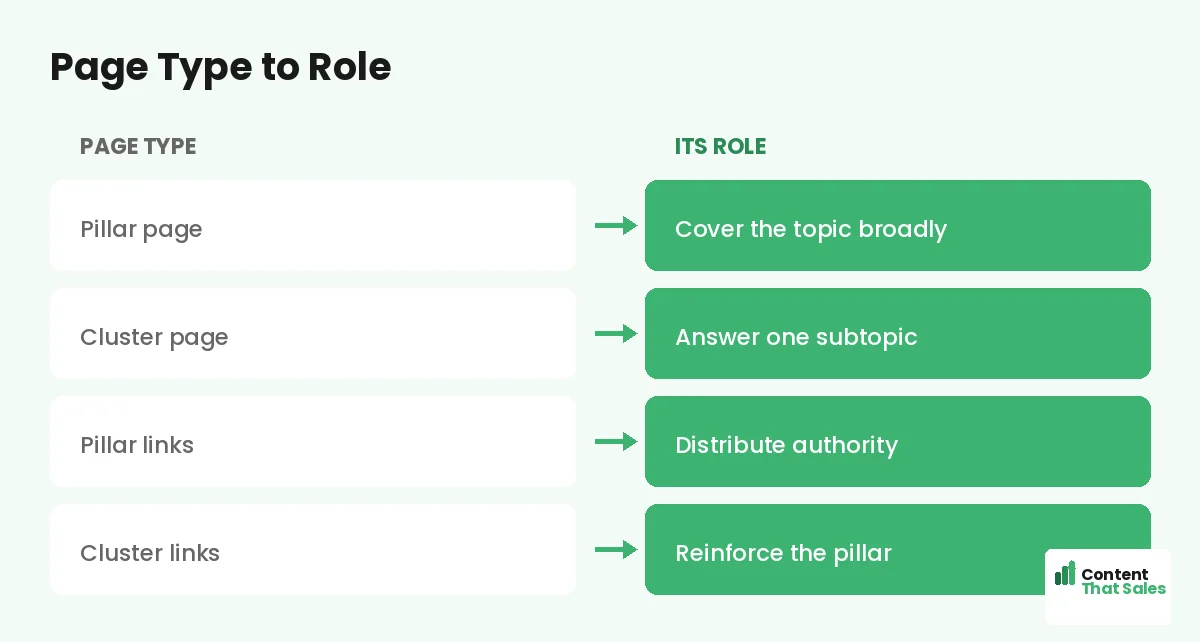
A pillar page is longer in scope but lighter on any single point, since it covers many areas at an overview level. A cluster page is tightly focused, going as deep as needed on its one subtopic. The pillar surveys; the cluster excavates.
This shapes how you write each. A pillar gives a satisfying overview and points to clusters for more. A cluster fully satisfies one specific search. Since readers scan more than they read, both should be clear, but they serve different reader needs.
How They Differ in Keywords
Pillars and clusters target different keywords. The pillar goes after a broad, high-level term that describes the whole topic, usually more competitive. Cluster pages target specific, long-tail keywords for individual subtopics, usually easier to rank for.
This division prevents your pages from competing with each other and lets each rank for its own search. Assigning the right keyword to each page type is part of avoiding cannibalization and ensuring full coverage across the topic.
How They Link Together
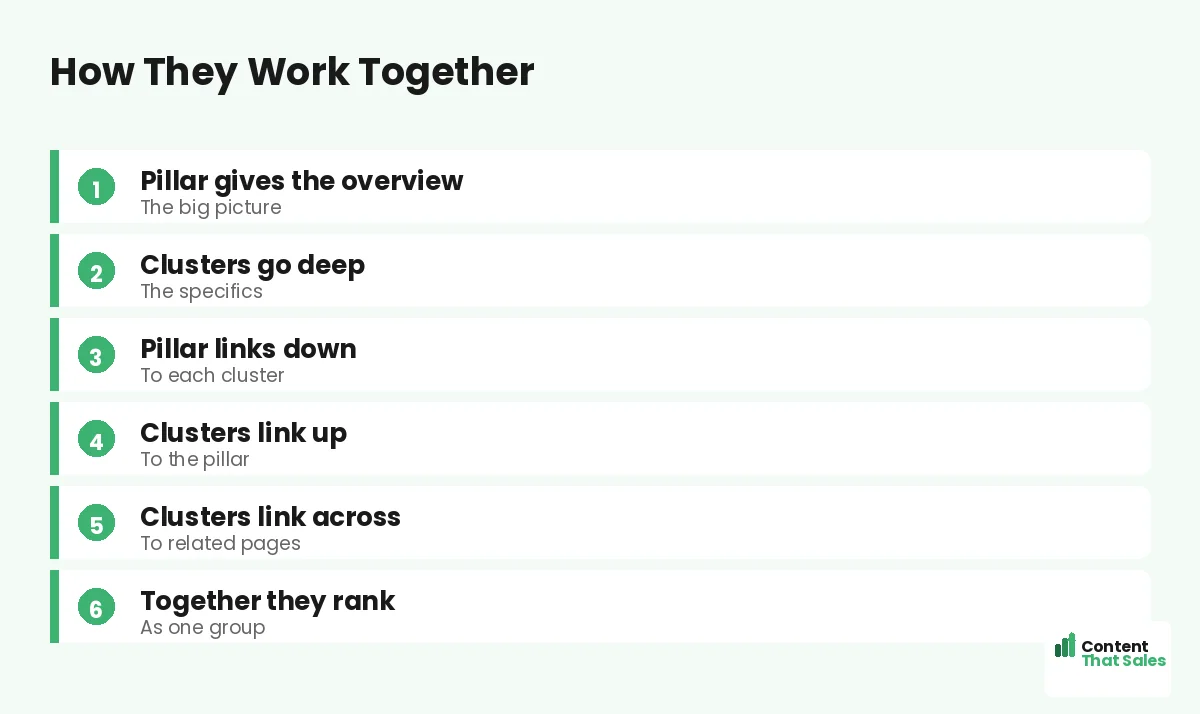
Linking is what unites pillars and clusters. The pillar links down to every cluster page. Each cluster links back up to the pillar. And cluster pages link across to related clusters. This web of links binds the group into one connected unit.
These links pass authority around the group and show Google the pages belong together. The pillar collects links from all its clusters, concentrating authority; the clusters benefit from the pillar’s prominence. The linking is what makes the structure rank.
Did you know?
Cluster pages often rank first because their specific, long-tail keywords are easier to win, then they pass authority up to the pillar through internal links.
How They Work Together
Pillars and clusters are a team. The pillar provides the broad overview and anchors the group; the clusters provide depth and capture specific searches. The links connect them so authority flows both ways, lifting the whole group’s rankings.
This teamwork is the heart of topical authority. The pillar alone would be too shallow; the clusters alone would lack a hub. Together they cover a topic completely and connectedly, which is exactly what earns strong rankings across the subject.
When to Use a Pillar Page
Use a pillar page for each broad topic you want to own. It is the overview that anchors a cluster and targets the main keyword. Whenever you start covering a new major topic, the pillar is usually the first page you create.
You need one pillar per topic cluster, not many. The pillar defines the topic’s scope and links to all its supporting pages. If you are deciding which topics deserve pillars, see our guide on how to identify pillar topics.
When to Use a Cluster Page
Use cluster pages for every specific subtopic under a pillar. Each question, angle, or detail that deserves its own focused page becomes a cluster page. You will have many cluster pages per pillar, each capturing a specific search.
Cluster pages are where most of your content lives and where much of your specific traffic comes from. Create one for each distinct subtopic, link it to the pillar, and you steadily build out the full coverage that makes the group authoritative.
Common Mistakes to Avoid
A frequent mistake is making the pillar too thin or the clusters too broad. The pillar should be a genuinely useful overview, not a stub; clusters should each focus on one subtopic, not sprawl. Blurring the roles weakens the whole structure.
Another mistake is weak linking, clusters that do not link to the pillar, or a pillar that does not link to its clusters. Without the links, the group is just separate pages. Get the roles and links right, and the structure works as intended.
Pillars, Clusters, and the Map
Pillars and clusters are the building blocks of your whole topical map. Each topic becomes a pillar with its clusters, and related pillars link to each other to form the full topical map. Understanding the two page types is fundamental to building one.
Simple, clear content keeps winning, since easy reading lifts engagement. Use strong pillars and focused clusters, linked well, across your map, and you build the connected, authoritative structure that ranks across an entire subject.
Put It All Together
Pillar pages cover a topic broadly and anchor the group; cluster pages cover subtopics deeply and support it. They differ in breadth, keywords, and role, and they link together so authority flows. Pillars are the hubs; clusters are the spokes.
Use one pillar per topic and many focused clusters beneath it, all tightly linked. Get the roles and links right and the group ranks as a unit. Master the difference between pillars and clusters, and you have the foundation of a topical map that works.
How Content That Sales Helps
We build pillars and clusters that rank together. That’s where we come in. At Content That Sales, we plan your pillars, write the supporting clusters, and link them so each group covers its topic and concentrates authority.
You share your topics and goals. We design the structure, write the broad pillars and deep clusters, and connect them. The result is a set of groups built to rank as units, the foundation of a topical map that wins.
Ready to Build Pillars and Clusters?
Now you understand pillar pages vs cluster pages: pillars are broad hubs, clusters are deep spokes, and together they rank. The structure is the foundation of topical authority. So why leave your pages disconnected?
Let’s build your pillars and clusters. Book your free consultation now. Call us at 8801631988589 or email service@contentthatsales.com. Let’s turn your topics into groups that rank.
Frequently Asked Questions About Pillar vs Cluster Pages
What is a pillar page?
A broad, comprehensive page covering a main topic at a high level, linking out to detailed cluster pages. It targets a broad keyword and anchors the group.
What is a cluster page?
A focused, in-depth page covering one specific subtopic, targeting a more specific keyword and linking back to the pillar. It provides the depth the pillar lacks.
What is the core difference?
Breadth versus depth. A pillar covers a topic broadly; a cluster covers a subtopic deeply. The pillar targets a big keyword; clusters target specific ones.
How do they link?
The pillar links to every cluster, each cluster links back to the pillar, and clusters link to related clusters. This web binds the group into one unit.
Which ranks first?
Often the cluster pages, since their specific long-tail keywords are easier to win. They then pass authority up to the pillar through internal links.
How many pillars and clusters do I need?
One pillar per topic and many focused cluster pages beneath it, one for each distinct subtopic that deserves its own page.
What is the most common mistake?
A thin pillar or sprawling clusters, plus weak linking. Keep the pillar a useful overview, clusters focused on one subtopic each, and link them tightly.
Can Content That Sales help?
Yes. We plan your pillars, write the clusters, and link them so each group ranks as a unit. Reach out for a quick quote.