 Skip to content
The question of how many internal links per cluster page should be on each page has a practical answer: enough to connect it well, the pillar plus a few relevant siblings and deeper pages, but not so many that the links lose meaning. There is no exact magic number; relevance and usefulness decide. This guide shows you which links every cluster page needs and how to avoid both too few and too many.
Internal links connect your cluster into a group, but more is not automatically better. A cluster page stuffed with dozens of links dilutes each one and overwhelms readers. One with no links sits orphaned. The sweet spot is a handful of purposeful, relevant links.
Below, we cover the links every cluster page needs, how to judge the right number, and how to avoid the extremes of too few and too many.

There Is No Magic Number
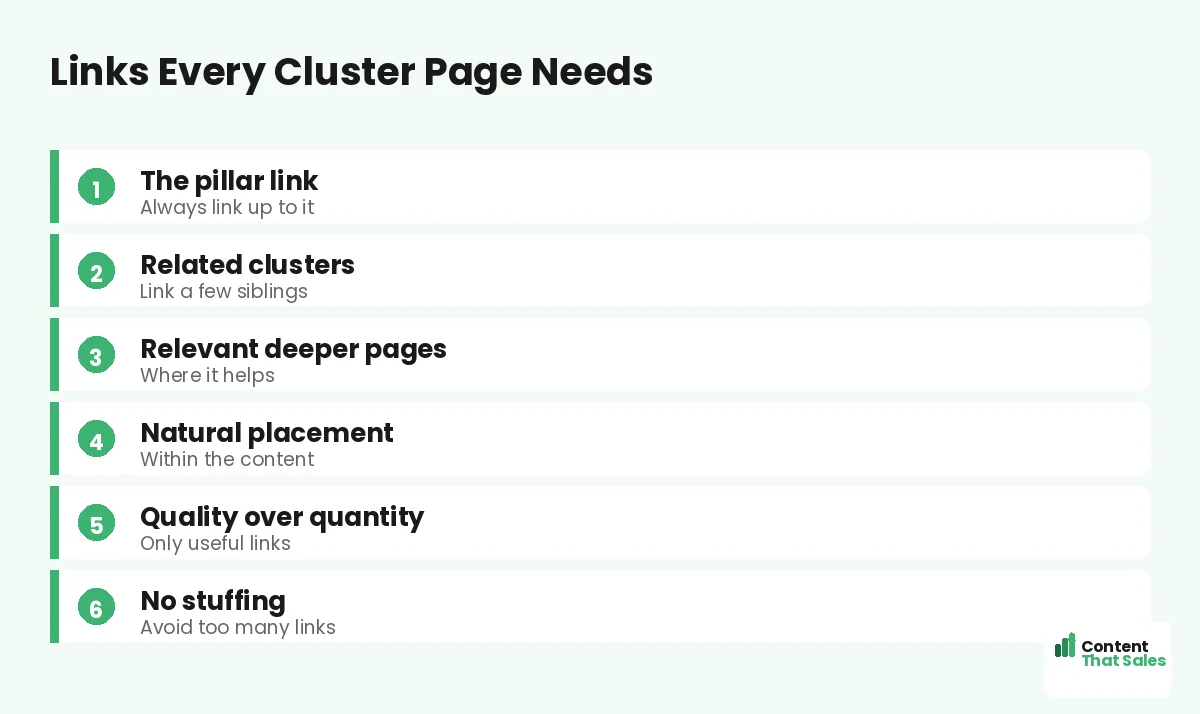
First, accept that there is no fixed number of internal links a cluster page must have. Relevance decides, not a quota. A cluster page should have the links that genuinely help readers and connect it to its group, however many that turns out to be.
That said, there are links every cluster page should include and patterns to follow. The goal is purposeful connection, part of strong internal linking for topical authority, not hitting a target count.
Always Link the Pillar
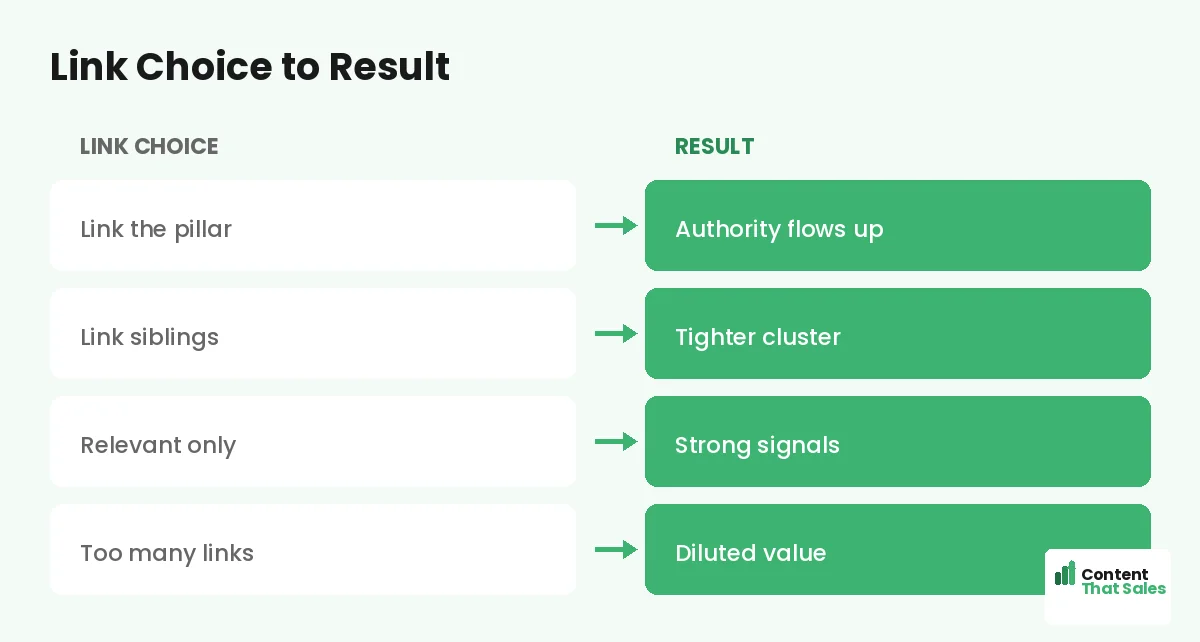
The one non-negotiable link is to the pillar. Every cluster page should link up to its pillar, passing authority to the hub and signaling it belongs to the group. This is the single most important internal link on any cluster page.
This upward link is core to how you link cluster pages to pillars and how you connect pillar and cluster pages overall. No matter how few other links a cluster page has, it must link to its pillar. Start every cluster page’s linking with this one.
Link a Few Relevant Siblings
Beyond the pillar, link to a few related sibling cluster pages where relevant. These cross-links help readers move between related subtopics and strengthen the cluster’s internal web. Two to a handful of sibling links is usually plenty.
Only link siblings that are genuinely related to the page’s topic. Forcing links to unrelated clusters adds no value. A few well-chosen sibling links, alongside the pillar link, connect the page firmly into its cluster.
Link Deeper Pages Where Helpful
If a cluster page references an even more specific topic that has its own page, link to it. These deeper links help readers go further when they want detail. Include them where they genuinely help, not just to add link count.
Such links also support a clear hierarchy, connecting broader cluster pages to more specific ones. Add them when the connection is real and useful. Together with pillar and sibling links, they round out a cluster page’s natural link set.
Quality Over Quantity
The guiding principle is quality over quantity. A few relevant, well-placed links beat many random ones. Each link should help the reader or reinforce a real topic relationship. Links added just to hit a number dilute value and clutter the page.
Since readers scan more than they read, too many links become noise they ignore. A focused set of purposeful links serves them far better. Judge links by usefulness, not count.
Avoid Too Few Links
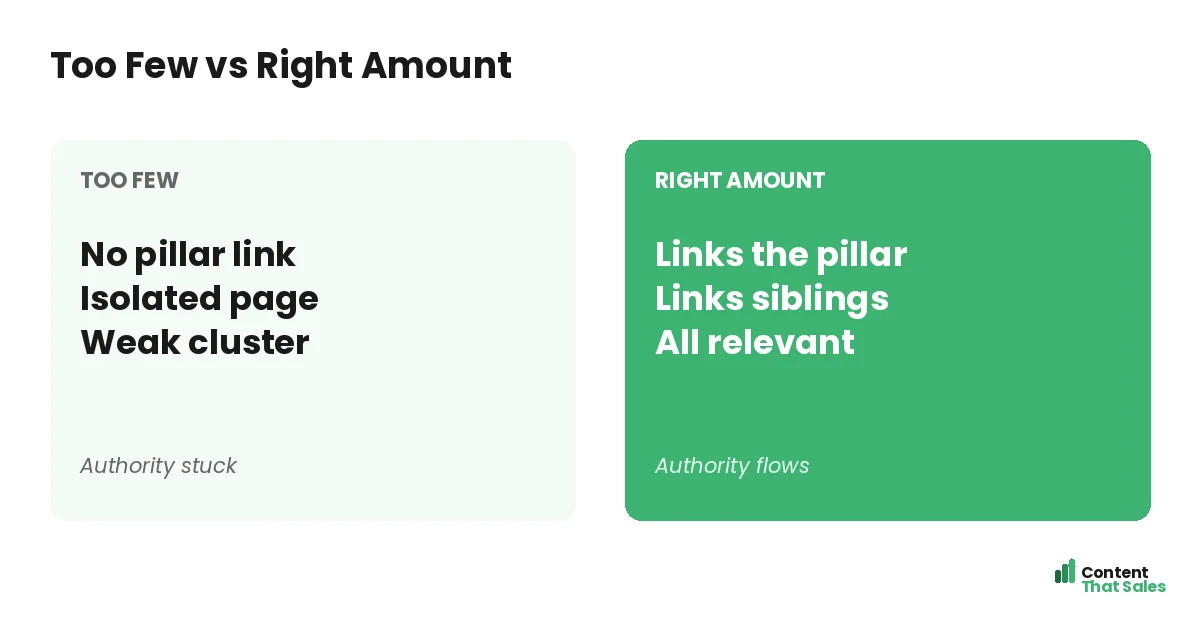
The first extreme to avoid is too few links. A cluster page with no link to its pillar is orphaned from its group, failing to pass authority. A page with no internal links at all is isolated and weak. Every cluster page needs at least its pillar link.
If your cluster pages are under-linked, the cluster does not cohere and authority does not flow. The fix is simple: ensure every page links to its pillar and to a few relevant siblings. Even a minimal, relevant link set beats none.
Did you know?
The most important internal link on a cluster page is the one to its pillar, so if a page has only a single internal link, that is the one it should be.
Avoid Too Many Links
The other extreme is over-linking. Stuffing a cluster page with dozens of internal links dilutes the value each passes and overwhelms readers. Too many links can also look manipulative. Keep the link set focused and relevant, not maximal.
If you find a page crammed with links, trim the irrelevant or redundant ones. Keep the pillar link, the most relevant siblings, and any genuinely helpful deeper links. A clean, focused link set is stronger than a stuffed one every time.
Place Links in the Content
Wherever your links land, place them within the body content, woven into relevant sentences, rather than only in a footer list. In-content links carry more weight and feel natural. This matters more than the exact number of links.
A few contextual links placed where they genuinely help beat a long list dumped at the bottom. Focus on putting each relevant link at the right moment in the text. Good placement makes a small number of links highly effective.
Let Relevance Set the Count
In the end, relevance sets the number. Link to the pillar, to the siblings and deeper pages that genuinely relate, and stop. If a page naturally has three strong links, that is fine; if it has six, also fine. Let the content, not a quota, decide.
This mirrors how you judge linking across your whole map. Simple, clear content keeps winning, since easy reading lifts engagement, and a sensible, relevant link set supports that. Relevance, not a target, is the right guide.
Put It All Together
How many internal links per cluster page? Enough to connect it well, always the pillar, plus a few relevant siblings and any helpful deeper pages, placed in the content, with quality over quantity. There is no magic number; relevance decides.
Avoid the extremes of too few, an orphaned page, and too many, a diluted, cluttered one. Link the pillar first, add relevant siblings, keep it purposeful, and place links naturally. A focused, relevant link set is what connects your cluster and builds topical authority.
Review Links as the Cluster Grows
The right number of links on a cluster page is not fixed once and forgotten. As you add new sibling pages, older cluster pages may deserve a link to the newcomer, and new pages should link back to the relevant siblings already published. Revisit your pages as the cluster grows so the linking stays current and complete.
This is exactly what an internal link audit catches: pages that were well-linked at launch but fell behind as the cluster expanded. A quick periodic review keeps every cluster page connected to the latest relevant pages, so no part of the group is left out of the loop.
How Content That Sales Helps
We get the linking right on every page. That’s where we come in. At Content That Sales, we write cluster pages with the right internal links, the pillar, relevant siblings, and helpful deeper pages, placed naturally in the content.
You share your cluster and structure. We connect each page with a focused, relevant link set, no orphans, no clutter. The result is a cluster where every page is well-connected and authority flows the way it should.
Ready to Get Your Linking Right?
Now you know how many internal links per cluster page to use: always the pillar, a few relevant siblings, quality over quantity, and relevance over a number. Too few orphans a page; too many dilute it. So why not link with purpose?
Let’s connect your cluster pages right. Book your free consultation now. Call us at 8801631988589 or email service@contentthatsales.com. Let’s link with purpose and build authority.
Frequently Asked Questions About Internal Links Per Cluster Page
How many internal links should a cluster page have?
Enough to connect it well, always the pillar, plus a few relevant siblings and helpful deeper pages. There is no magic number; relevance decides.
What is the most important link?
The link to the pillar. Every cluster page should link up to its pillar, passing authority and signaling it belongs to the group. If a page has one link, it is this.
Should I link to sibling pages?
Yes, a few genuinely related ones. Sibling links help readers move between subtopics and strengthen the cluster’s web. Only link siblings that truly relate.
Can a cluster page have too few links?
Yes. A page with no pillar link is orphaned from its group. Every cluster page needs at least its pillar link, plus a few relevant siblings.
Can a cluster page have too many links?
Yes. Stuffing a page with dozens of links dilutes each one and overwhelms readers. Keep the link set focused and relevant, not maximal.
Does placement matter more than count?
Yes. Links within the body content carry more weight and feel natural. A few well-placed contextual links beat a long list dumped at the bottom.
How do I decide the right number?
Let relevance set it. Link to the pillar, to siblings and deeper pages that genuinely relate, and stop. The content, not a quota, decides the count.
Can Content That Sales help?
Yes. We write cluster pages with the right internal links, placed naturally, no orphans, no clutter. Reach out for a quick quote.