 Skip to content
The question of pillar page length and depth has a clear answer: cover the topic completely and link out to your clusters, then stop, because depth and usefulness matter far more than hitting a word count. A pillar should be long enough to give a genuine overview of the whole subject, but it does not need to be exhaustive on every detail, that is what cluster pages are for. This guide explains how long a pillar should be and how deep it should go.
People often obsess over pillar word counts, chasing a magic number. That is the wrong focus. A pillar’s job is to cover the topic broadly, organize the subtopics, and route readers to deeper pages. Get that right and the length takes care of itself.
Below, we cover what a pillar should actually do, how to judge the right length and depth, and how to keep it useful rather than padded.

What a Pillar Page Should Do
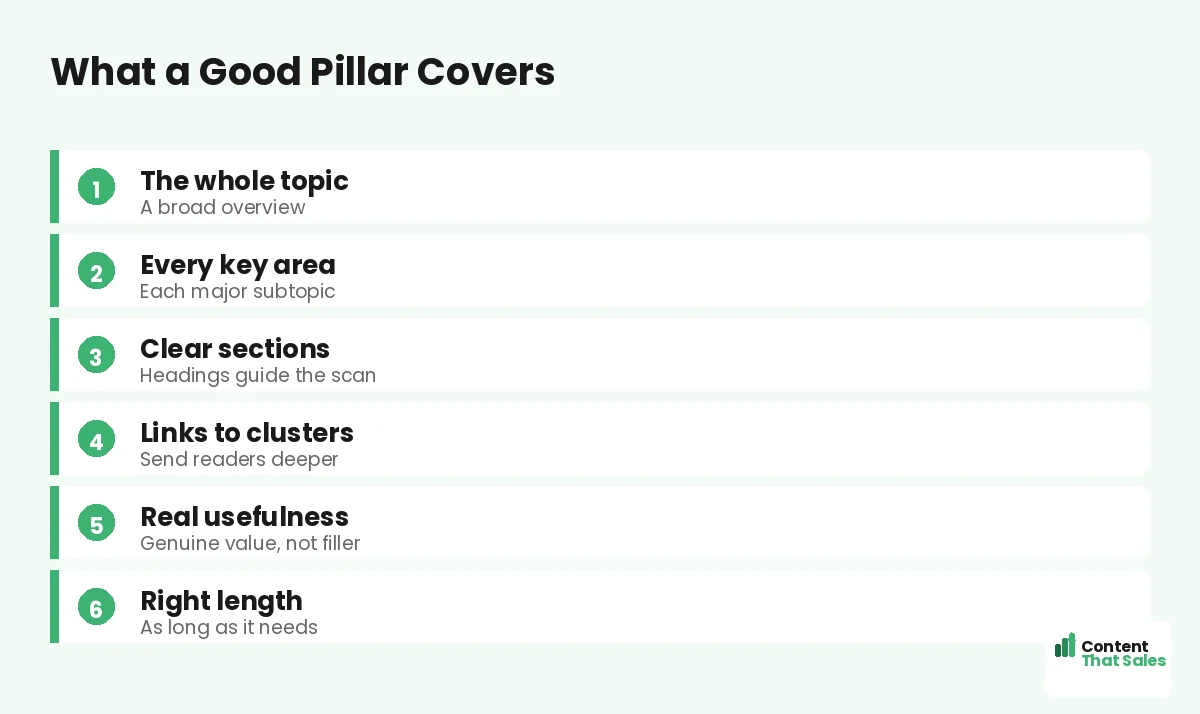
A pillar page gives a broad overview of your main topic. It introduces the subject, covers each major area at a high level, and links out to cluster pages for the details. Its length should follow from doing that job well, not from a target.
So the right question is not how many words, but does it cover the topic. For how pillars and clusters divide the work, see our breakdown of pillar pages vs cluster pages. The pillar surveys; the clusters go deep.
Cover the Whole Topic
The first rule of pillar length is complete coverage of the topic at an overview level. Touch on every major subtopic, enough to give the reader the full picture and to point them to the cluster page for more. Missing major areas leaves the pillar thin.
This usually means a pillar is fairly long, since it spans the whole subject. But the length comes from breadth of coverage, not padding. Cover every key area well, link to the clusters, and the pillar reaches the right length naturally.
Depth Over Word Count
Forget chasing a specific word count. A pillar that fully covers its topic in fewer words beats one padded to a target. Depth of coverage and genuine usefulness are what matter, not hitting an arbitrary number someone told you to reach.
Google rewards pages that satisfy the searcher, not pages of a certain length. Write until the topic is covered well, then stop. Whether that is two thousand words or four, the right length is however much it takes to cover the subject completely.
Do Not Pad to Hit a Number
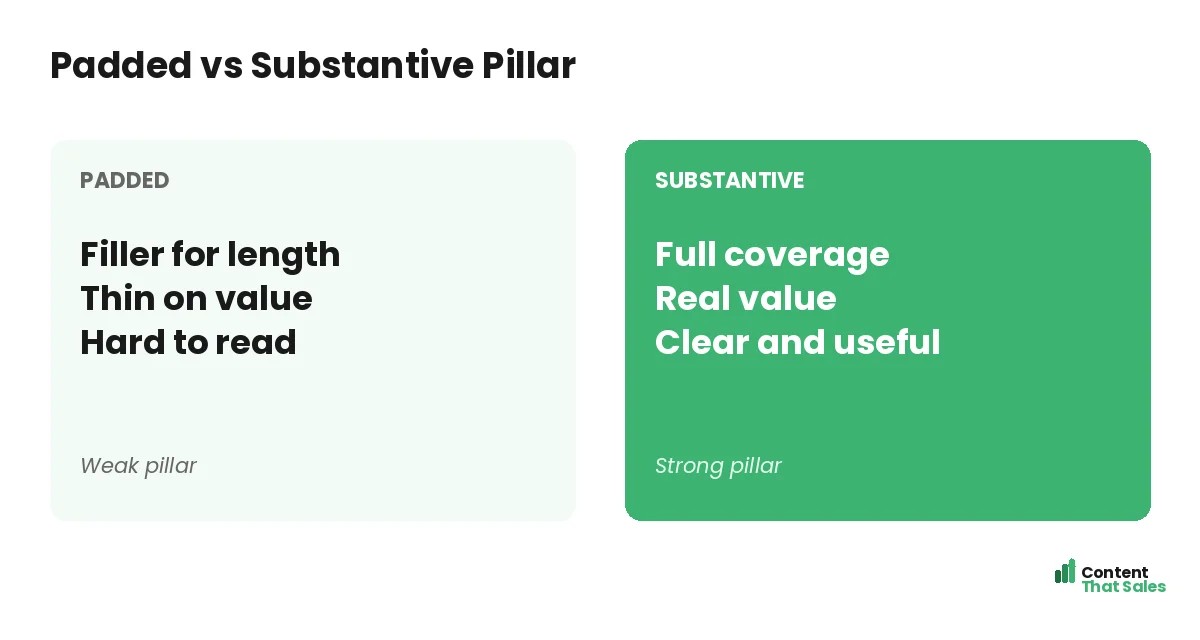
Padding is the enemy of a good pillar. Adding fluff, repetition, or filler to reach a word count makes the page worse, harder to read and weaker for SEO. Every section should earn its place by adding real value to the overview.
Since readers scan more than they read, padding actively hurts. A tight, useful pillar that covers the topic beats a bloated one every time. Cut anything that does not help the reader understand the subject.
Let Clusters Carry the Depth
A pillar does not need to exhaust every detail, because that is the cluster pages’ job. The pillar gives the overview and links to clusters for the deep dives. This division keeps the pillar focused and the right length, while depth lives in the clusters.
So resist the urge to cover every subtopic exhaustively on the pillar itself. Summarize each area, then link to the cluster page that covers it fully. This keeps your pillar readable and your structure clean, with depth where it belongs.
Link Out to Cluster Pages
Linking is part of pillar length and depth. A pillar should link to every cluster page beneath it, sending readers and authority to the deeper content. These links are what make the pillar the hub of its cluster, not just a long article.
The links also let the pillar stay an overview rather than a sprawling everything-page. For how to connect them well, see our guide on how to connect pillar and cluster pages with internal links. The links carry readers to the depth.
Did you know?
A pillar does not need to cover every detail, because its cluster pages do. The pillar’s job is the overview and the links, not exhausting every subtopic.
Keep It Readable
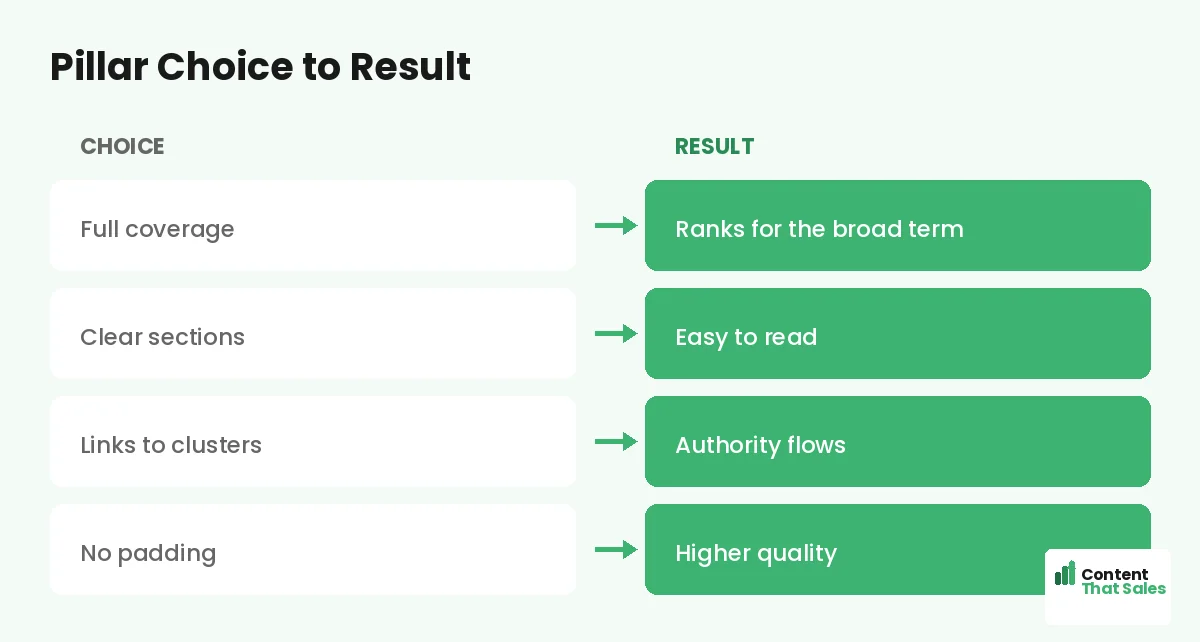
Length should never cost readability. A long pillar must be easy to navigate, with clear headings, short paragraphs, and a logical flow. Readers should be able to scan it, grasp the topic, and jump to the cluster page they need.
Use a clear structure that mirrors the subtopics, so the pillar reads like an organized guide, not a wall of text. A readable pillar of any length serves the reader better than a long, dense one. Clarity makes the length work.
Match Length to the Topic
The right pillar length varies by topic. A broad, complex subject needs a longer pillar to cover all its areas; a simpler one needs less. Let the topic’s scope, not a fixed rule, set the length. Cover what the subject genuinely requires.
This mirrors how you judge topical map depth overall: match the coverage to the real subject. A pillar should be as long as it takes to cover its topic well, and no longer. The subject sets the length.
Quality Signals Beat Length
What ranks a pillar is not length but quality: complete coverage, clear structure, genuine usefulness, and strong internal links. A focused, well-linked pillar that covers the topic outranks a longer, padded one. Aim for quality signals, not word counts.
Invest your effort in making the pillar the best overview of its topic, not the longest. Cover the subject, organize it clearly, link to the clusters, and make it genuinely helpful. Those qualities, not length, are what earn rankings and topical authority.
Update the Pillar as It Grows
A pillar is a living page. As you add cluster pages, link them from the pillar and update its overview to reflect the new coverage. Its length naturally grows as the cluster grows, but always in service of covering the topic, not padding.
Simple, clear content keeps winning, since easy reading lifts engagement. Keep the pillar current and well-linked, and its length stays right-sized to the topic. A maintained pillar stays the strong hub of its cluster.
Put It All Together
Pillar page length and depth come down to one principle: cover the topic completely at an overview level, link out to clusters for the detail, and stop. Depth and usefulness beat word count. Let the subject set the length, never a fixed target.
Cover every major area, do not pad, let clusters carry the depth, link them well, and keep it readable. A pillar sized to its topic, focused and well-linked, is what builds authority, not a page padded to hit some arbitrary number of words.
How Content That Sales Helps
We write pillars sized for authority, not word counts. That’s where we come in. At Content That Sales, we write comprehensive, well-structured pillar pages that cover your topic, link to your clusters, and stay genuinely useful.
You share your topic and clusters. We write the pillar that covers the subject completely, organizes it clearly, and links to the depth. The result is a pillar sized right for its topic, built to anchor its cluster and rank.
Ready to Build a Strong Pillar?
Now you know how to judge pillar page length and depth: cover the topic fully, link to clusters, and let depth beat word count. Padding hurts; coverage helps. So why chase a number when usefulness is what ranks?
Let’s write a pillar that anchors your cluster. Book your free consultation now. Call us at 8801631988589 or email service@contentthatsales.com. Let’s cover your topic the right way, no padding.
Frequently Asked Questions About Pillar Page Length
How long should a pillar page be?
As long as it takes to cover the whole topic at an overview level and link to the clusters. There is no magic word count; the subject sets the length.
Does word count matter for pillars?
Not directly. Depth of coverage and usefulness matter. A pillar that fully covers its topic in fewer words beats one padded to hit a target.
Should a pillar cover every detail?
No. The pillar gives the overview and links to cluster pages for the deep detail. Exhausting every subtopic on the pillar makes it bloated and unfocused.
Why is padding bad?
Fluff and filler make the page harder to read and weaker for SEO. Every section should add real value. A tight, useful pillar beats a bloated one.
How does linking affect pillar length?
Links let the pillar stay an overview by sending readers to clusters for depth. A pillar should link to every cluster page beneath it.
Does the right length vary by topic?
Yes. A broad, complex subject needs a longer pillar; a simpler one needs less. Let the topic’s scope, not a fixed rule, set the length.
What ranks a pillar if not length?
Quality: complete coverage, clear structure, genuine usefulness, and strong internal links. A focused, well-linked pillar outranks a longer, padded one.
Can Content That Sales help?
Yes. We write comprehensive, well-structured pillars that cover your topic, link to your clusters, and stay useful, sized for authority. Reach out for a quote.