 Skip to content
A clear topical map hierarchy, organizing your topics into parent and child levels from broad to narrow, is what keeps a growing content library logical, navigable, and easy to link. Without a hierarchy, pages pile up flat and equal, and neither readers nor Google can tell what supports what. This guide shows you how to structure the levels of your topical map so authority flows and your content stays organized as it scales.
Hierarchy is the spine of a topical map. It decides which pages are broad pillars and which are supporting details, how they nest, and how links flow between them. Get the levels right and your whole map becomes clear and self-reinforcing.
Below, we walk through the levels of a topical hierarchy, how to assign topics to each, how the levels guide your linking, and how to keep the structure logical as you grow.

What a Topical Hierarchy Is
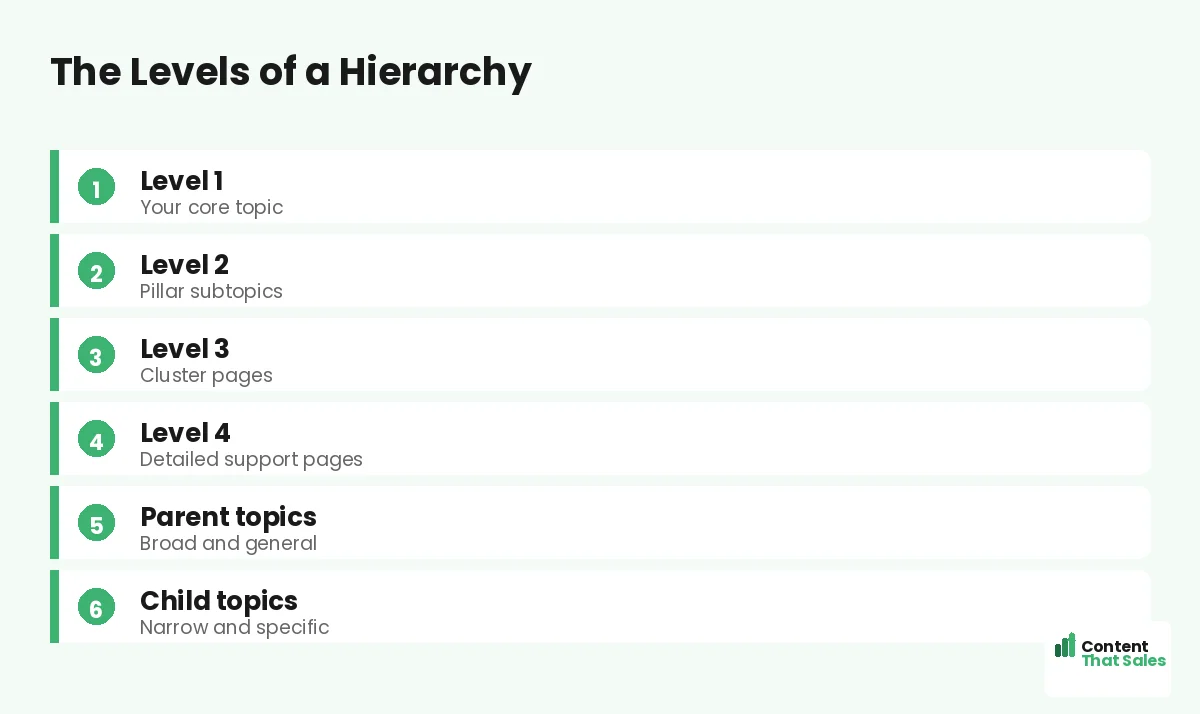
A topical hierarchy organizes your topics into levels of broadness. At the top is your core topic, beneath it broad pillar subtopics, then narrower clusters, then specific support pages. Each level is more specific than the one above, forming a clear chain from general to detailed.
This hierarchy gives your map structure. It builds on the foundation of a topical map, adding clear levels so every page knows its place. The hierarchy is what turns a list of topics into an organized, navigable structure.
Level 1: The Core Topic
The top level is your core topic, the single subject your whole map covers. It usually becomes your main pillar page, a broad overview that everything else branches from. This is the most general level, the umbrella under which all other levels sit.
Defining a clear core anchors the whole hierarchy. For help, see our guide on defining your core topic for a topical map. With a strong core at level one, the lower levels fall into place beneath it.
Level 2: Pillar Subtopics
Below the core sit the major subtopics, the broad areas of your subject. Each is broad enough to be its own pillar, with its own cluster of supporting pages beneath it. These second-level topics divide your subject into its main sections.
Level-two topics are parents to the clusters below them and children of the core above. They are broad but not as broad as the core, the middle layer that organizes your subject into manageable, meaningful groups.
Level 3: Cluster Pages
The third level holds the cluster pages, narrower topics that dive into specifics under each pillar subtopic. These pages cover focused subtopics in depth and link up to their parent pillar. Most of your detailed content lives at this level.
Level-three pages are specific enough to target precise searches while still grouping under a broader parent. They are the workhorses of the hierarchy, each fully answering one subtopic and reinforcing the pillar above it through links.
Level 4 and Beyond
For deep subjects, you may add further levels, even more specific support pages beneath the clusters. How many levels you need depends on the subject’s depth. Simple subjects may stop at three levels; complex ones may go four or more.
The key is that each new level is more specific than the last and nests clearly beneath its parent. Add levels only when real subtopics warrant them, matching the structure to genuine topical map depth rather than forcing extra layers.
Parent and Child Topics
The hierarchy works through parent-child relationships. A parent topic is broader and sits above; a child topic is narrower and sits below. Every page except the core has a parent, and every page except the deepest leaves has children.
These relationships define the structure. Since readers scan more than they read, a clear parent-child structure also helps visitors understand where they are and navigate from broad overviews to specific details with ease.
Did you know?
A clear hierarchy tells Google which pages are most important, since broad parent pages naturally receive more internal links than narrow child pages.
How the Hierarchy Guides Linking
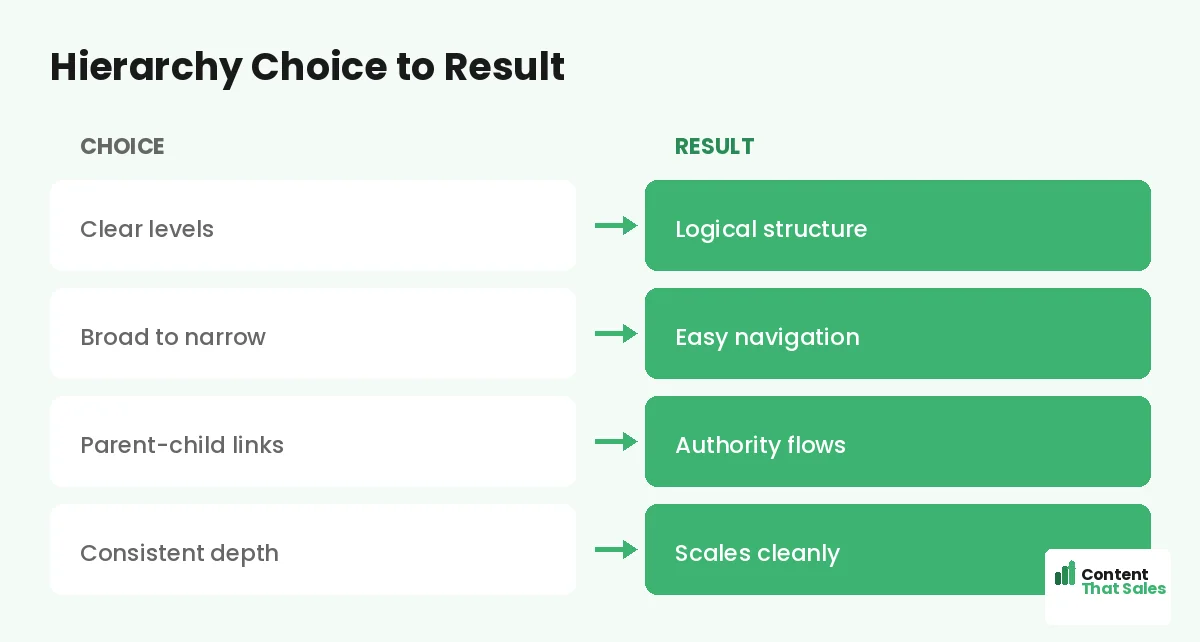
Your hierarchy directly shapes your internal linking. Parent pages link down to their children; children link up to their parents; and siblings at the same level link across where relevant. This linking mirrors the levels and flows authority logically.
Because broad parent pages collect more links, the hierarchy signals which pages matter most. This concentrates authority on your pillars while still supporting the detailed pages. A clear hierarchy makes your linking obvious instead of guesswork.
Keep the Levels Consistent
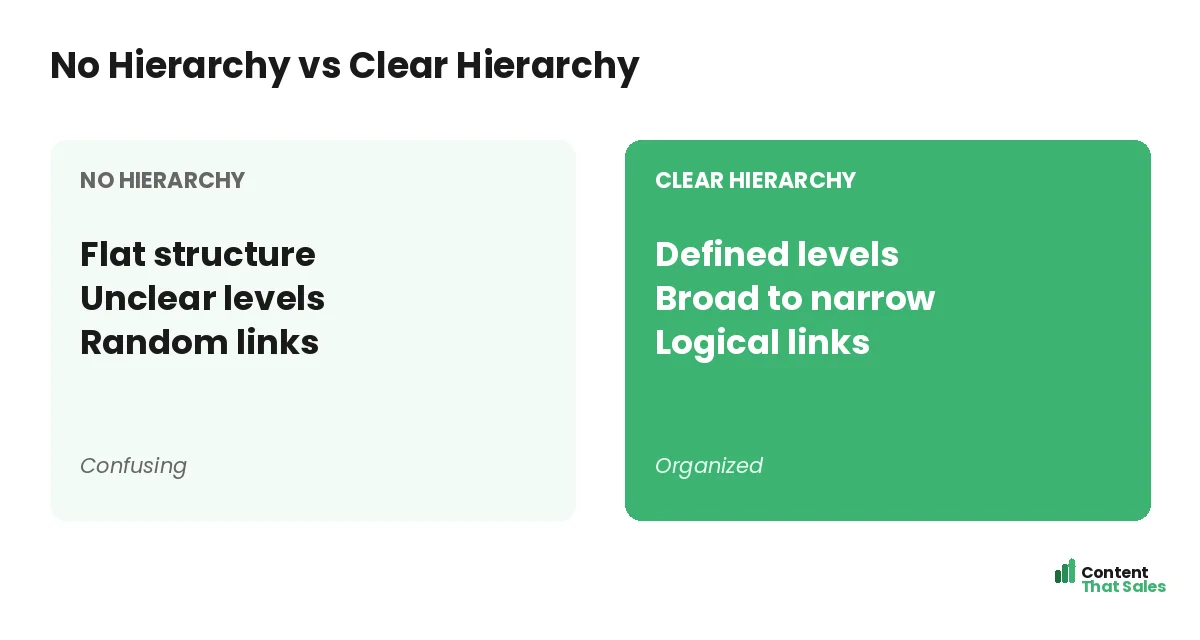
For the hierarchy to work, keep levels consistent. A page placed at level three should be comparable in breadth to other level-three pages. Mixing broad and narrow topics at the same level confuses the structure and muddies your linking.
Review your map to ensure each level holds topics of similar scope. Consistency keeps the hierarchy clear and predictable, so both readers and search engines can follow it. A tidy, consistent hierarchy scales far better than a haphazard one.
Hierarchy and Site Structure
A good topical hierarchy often maps onto your URL and navigation structure too. Broad pillars become main sections; clusters become pages within them. Aligning your content hierarchy with your site structure reinforces the levels for both users and Google.
This alignment is not strictly required, but it helps. When your menus, URLs, and internal links all reflect the same hierarchy, the structure becomes unmistakable. A consistent hierarchy across content and site design strengthens the whole.
Build the Hierarchy Top Down
Build your hierarchy from the top down. Start with the core, define the level-two pillars, then the clusters, then any deeper pages. Working downward keeps the structure logical and ensures every page has a clear parent before you create it.
This mirrors how you build a topical map overall. Simple, clear content keeps winning, since easy reading lifts engagement. A top-down hierarchy gives every level a clear place from the start.
Put It All Together
A topical map hierarchy organizes topics into levels, from the core at the top, through pillar subtopics and clusters, down to specific support pages, with parent-child relationships guiding the links. It keeps your map logical, navigable, and scalable.
Define clear levels, keep them consistent, link by the hierarchy, and build top down. The structure tells readers and Google what supports what and where authority should flow. Get the hierarchy right and your growing content library stays organized and strong.
How Content That Sales Helps
We structure your levels for clarity and rankings. That’s where we come in. At Content That Sales, we design your topical hierarchy, assign every topic its level, and link by the structure so authority flows and your map scales cleanly.
You share your subject and goals. We define the levels, set the parent-child relationships, and write the connected pages. The result is a clear hierarchy that keeps your content organized and tells Google exactly what supports what.
Ready to Structure Your Levels?
Now you know how to structure a topical map hierarchy: core at the top, pillars and clusters beneath, parent-child links guiding the flow. A clear hierarchy keeps your map logical and scalable. So why let your pages pile up flat?
Let’s structure your hierarchy and map. Book your free consultation now. Call us at 8801631988589 or email service@contentthatsales.com. Let’s turn your topics into a clear, ranking structure.
Frequently Asked Questions About Topical Map Hierarchy
What is a topical map hierarchy?
A way of organizing topics into levels of broadness, from a core topic at the top through pillar subtopics and clusters down to specific support pages, with parent-child relationships.
What sits at the top level?
Your core topic, the single subject your whole map covers. It usually becomes the main pillar page that everything else branches from.
What are parent and child topics?
A parent is broader and sits above; a child is narrower and sits below. Every page except the core has a parent, and broad pages have children beneath them.
How many levels should I have?
It depends on the subject’s depth. Simple subjects may stop at three levels; complex ones may go four or more. Add levels only when real subtopics warrant them.
How does the hierarchy guide linking?
Parents link down to children, children link up to parents, and siblings link across. This mirrors the levels and flows authority logically through the map.
Why keep levels consistent?
So each level holds topics of similar breadth. Mixing broad and narrow topics at one level confuses the structure and muddies your internal linking.
Should the hierarchy match my site structure?
It helps. Aligning your URLs and navigation with the content hierarchy reinforces the levels for both users and Google, strengthening the whole.
Can Content That Sales help?
Yes. We design your hierarchy, assign every topic its level, and link by the structure so your map scales cleanly. Reach out for a quick quote.