 Skip to content
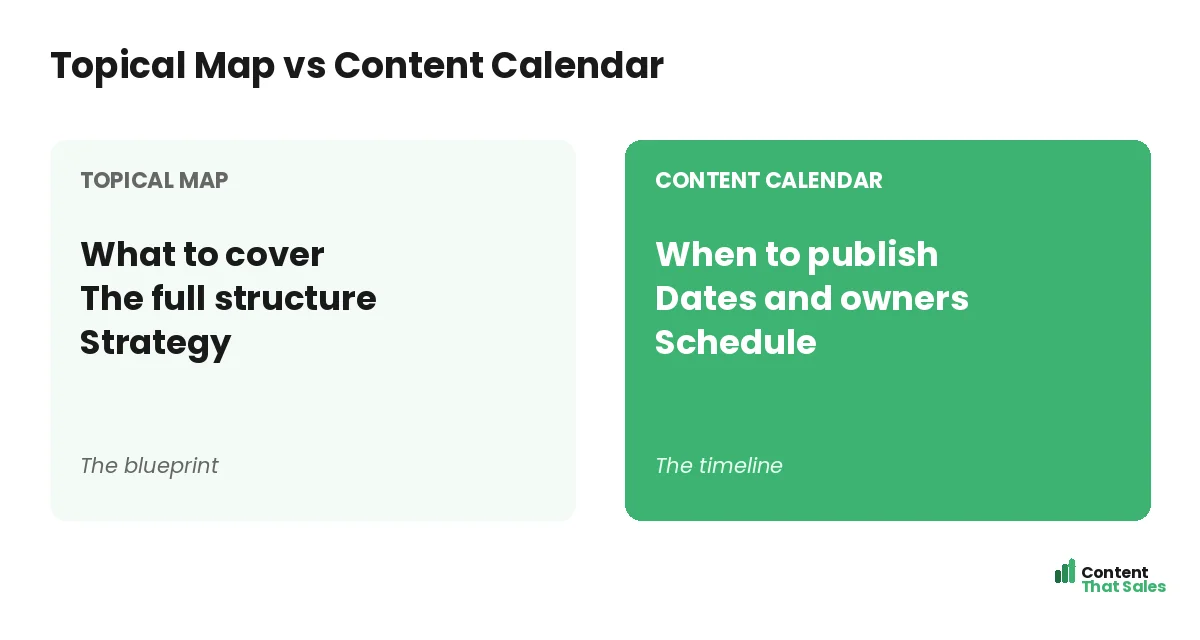
The topical map vs content calendar question trips up a lot of content teams, but the distinction is simple: a topical map decides what to cover, while a content calendar decides when to publish it. One is your strategy, the other your schedule. You need both, and confusing them leads to either aimless publishing or strategic plans that never ship. This guide explains what each does, how they differ, when to use each, and how they work together.
Many teams jump straight to a calendar, filling dates with post ideas, and wonder why their content does not build authority. The missing piece is the map, the strategy that decides what those posts should be. Used together, the two turn random publishing into purposeful growth.
Below, we define each tool, compare them side by side, and show how to use them together for content that ranks and ships on time.

What a Topical Map Does
A topical map is your content strategy. It lays out the full subject you want to cover, every subtopic, grouped into clusters with a clear structure. It answers the question “what should we write to own this topic?” It is about coverage and topical authority.
The map is the blueprint. If you want the full method, see our guide on how to build a topical map. Its job is to ensure you cover the subject completely and connect your pages, not to schedule anything.
What a Content Calendar Does
A content calendar is your publishing schedule. It assigns dates, owners, and deadlines to the content you plan to produce. It answers the question “when does each piece go live, and who is responsible?” It is about timing and workflow.
The calendar keeps your team on track and your publishing consistent. It does not decide what to write strategically; it organizes the production and timing of whatever content you have planned, ideally drawn from your topical map.
The Core Difference
The core difference is strategy versus schedule. The map is the what and why, the subjects you cover to build authority. The calendar is the when and who, the dates and people that get content shipped. They answer different questions entirely.
Confusing them causes problems. A calendar without a map means publishing without direction. A map without a calendar means a great strategy that never ships. You need the map to know what to write and the calendar to actually write it.
When to Use a Topical Map
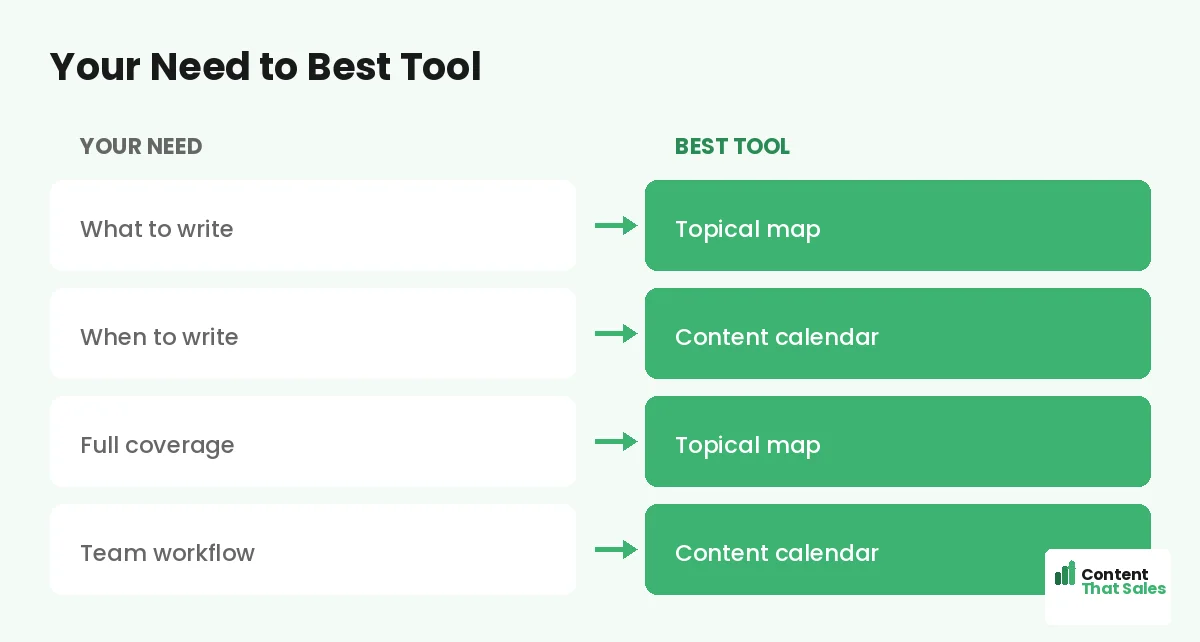
Reach for a topical map when you are planning what to cover. Use it to map a new subject, find content gaps, organize existing pages, or build authority on a topic. Any time the question is “what should we write,” the map is the tool.
The map is also where you plan internal links and structure, since it shows how pages relate. It is the strategic foundation you build before you ever touch a calendar. Get the map right and the calendar has something worth scheduling.
When to Use a Content Calendar
Reach for a content calendar when you are organizing production. Use it to set publishing dates, assign writers, track deadlines, and keep a steady cadence. Any time the question is “when and who,” the calendar is the tool.
The calendar turns your strategy into shipped content. It keeps the team accountable and the pipeline flowing. Without it, even a great map can stall, since nothing pins down who does what by when. The calendar makes the plan happen.
How They Work Together
The two are partners, not rivals. You build the topical map first to decide what to cover, then feed those pages into the content calendar to schedule when each is written and published. Strategy flows into execution.
This pairing is powerful. The map ensures everything you publish builds authority; the calendar ensures it actually gets published, consistently. Since readers scan more than they read, the map also keeps each scheduled piece focused on a real subtopic readers search for.
Did you know?
Teams that build a topical map before their calendar often publish less but rank more, because every scheduled post serves a deliberate coverage strategy.
The Map Comes First
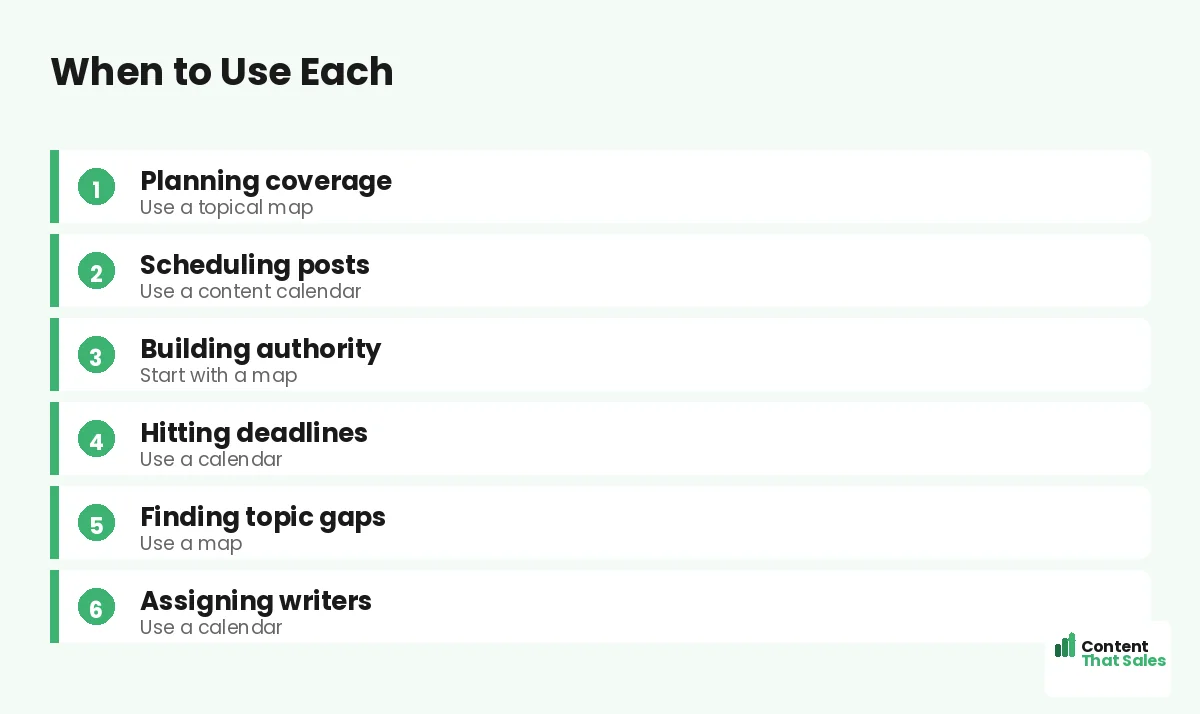
Order matters. Build the map before the calendar. If you schedule posts before planning your coverage, you fill dates with whatever ideas come to mind, and your content lacks strategic direction. The map gives the calendar its purpose.
Start with the subject you want to own, map it completely, even if you are new to topical maps, then schedule the pages cluster by cluster. This sequence ensures every date on your calendar advances your authority. Strategy first, schedule second, always in that order.
A Calendar Keeps You Consistent
While the map provides direction, the calendar provides discipline. Consistent publishing is essential for building authority, and the calendar is what makes it happen. It turns good intentions into a reliable cadence your audience and Google can count on.
Without a calendar, publishing slips, and momentum dies. The calendar holds you to a rhythm, ensuring your map gets executed over time. Consistency is a ranking factor in practice, and the calendar is how you achieve it.
Map vs Keyword Map Too
While we are clearing up confusion, note that a topical map also differs from a keyword map. The topical map plans subjects and structure; a keyword map assigns specific search terms to pages. See our guide on a topical map vs a keyword map for that distinction.
Together, these tools form a complete content system: the topical map for strategy, the keyword map for targeting, and the content calendar for scheduling. Each plays a distinct role, and using them in concert is how strong content programs run.
Avoid the Common Mistake
The most common mistake is treating a content calendar as your whole strategy. A calendar full of post ideas feels productive, but without a map behind it, the content scatters and authority never builds. Do not mistake activity for strategy.
Equally, do not build a map and never schedule it. A plan that never ships is worthless. The fix for both is to use the two together, map for what, calendar for when, so your content is both strategic and consistently published.
Put It All Together
A topical map decides what to cover; a content calendar decides when to publish. The map is strategy, the calendar is schedule. Build the map first to plan complete, authority-building coverage, then use the calendar to ship it consistently.
Used together, they turn random publishing into purposeful growth. Simple, clear content keeps winning, since easy reading lifts engagement. Map what to write, schedule when to write it, and your content both ranks and ships.
How Content That Sales Helps
We pair strategy with execution. That’s where we come in. At Content That Sales, we build your topical map to plan the coverage, then organize a calendar and write the pages so your content both ranks and ships.
You share your subject and goals. We map the strategy, schedule the work, and produce the connected pages that build authority. The result is a content program with direction and discipline, not just a calendar full of ideas.
Ready to Plan Content That Ranks?
Now you know the difference: a topical map decides what to cover, a content calendar decides when to publish, and you need both. Strategy without a schedule stalls; a schedule without strategy scatters. So why not use them together?
Let’s build your map and ship it on schedule. Book your free consultation now. Call us at 8801631988589 or email service@contentthatsales.com. Let’s turn your strategy into published, ranking content.
Frequently Asked Questions About Topical Map vs Content Calendar
What is the difference between a topical map and a content calendar?
A topical map decides what to cover for authority; a content calendar decides when to publish and who is responsible. One is strategy, the other schedule.
Which should I build first?
The topical map. Plan your coverage first, then feed those pages into a calendar to schedule them. Strategy comes before scheduling, always.
Can I just use a content calendar?
Not effectively. A calendar without a map means publishing without direction, so your content scatters and never builds authority. You need both.
What does a content calendar do?
It assigns dates, owners, and deadlines to your planned content, keeping your team accountable and your publishing consistent over time.
What does a topical map do?
It plans the full subject you want to cover, every subtopic grouped into clusters, so your site builds complete coverage and topical authority.
How do they work together?
Build the map to decide what to write, then schedule those pages on the calendar. The map gives direction; the calendar gives discipline.
Is a topical map the same as a keyword map?
No. The topical map plans subjects and structure; a keyword map assigns specific search terms to pages. They are different but complementary tools.
Can Content That Sales help?
Yes. We build your map, organize the schedule, and write the pages so your content ranks and ships. Reach out for a quick quote.