 Skip to content
Message match between ads and landing pages is the simple discipline of making your page deliver exactly what your ad promised, and it is one of the fastest ways to lift conversions and lower ad costs. When a visitor clicks an ad and the page echoes it, they feel they are in the right place and read on. When the page says something different, they doubt, hesitate, and bounce. This guide shows you what to match, why it works, and how to do it right.
Most advertisers obsess over the ad and forget the page, breaking the connection the moment the visitor arrives. That broken promise quietly wastes ad spend on clicks that never convert. Message match fixes the leak by keeping ad and page in lockstep.
Below, we cover what message match is, the elements to align, the payoff, the common mistakes, and how to apply it across your campaigns.

What Message Match Really Means
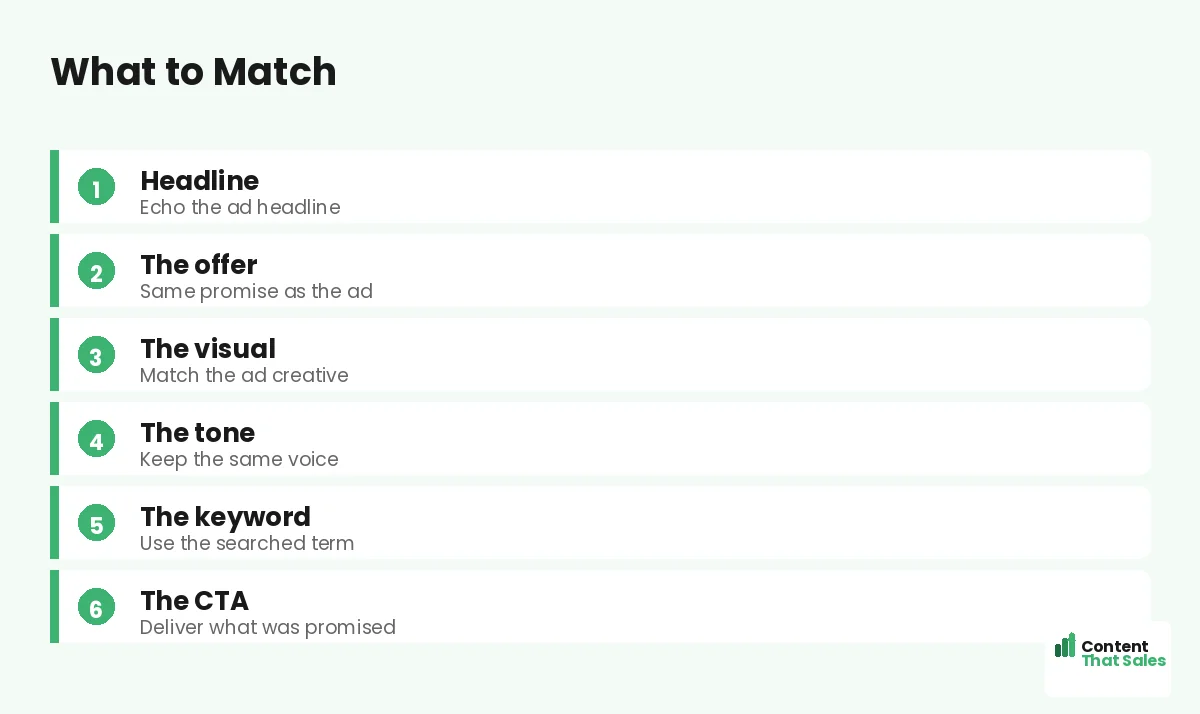
Message match means the landing page continues the conversation the ad started. The headline, offer, visuals, and tone on the page mirror the ad the visitor clicked. There is no jolt, no confusion, just a smooth handoff from ad to page.
It is built on a simple truth: a click is a promise. The ad promises something, and the page must keep it. When your page and a strong landing page structure deliver on that promise, trust holds and conversions follow.
Why Message Match Lifts Results
When the page matches the ad, the visitor instantly feels reassured. They clicked for a reason, and the page confirms they made the right choice. That confidence keeps them reading and moves them toward the action you want.
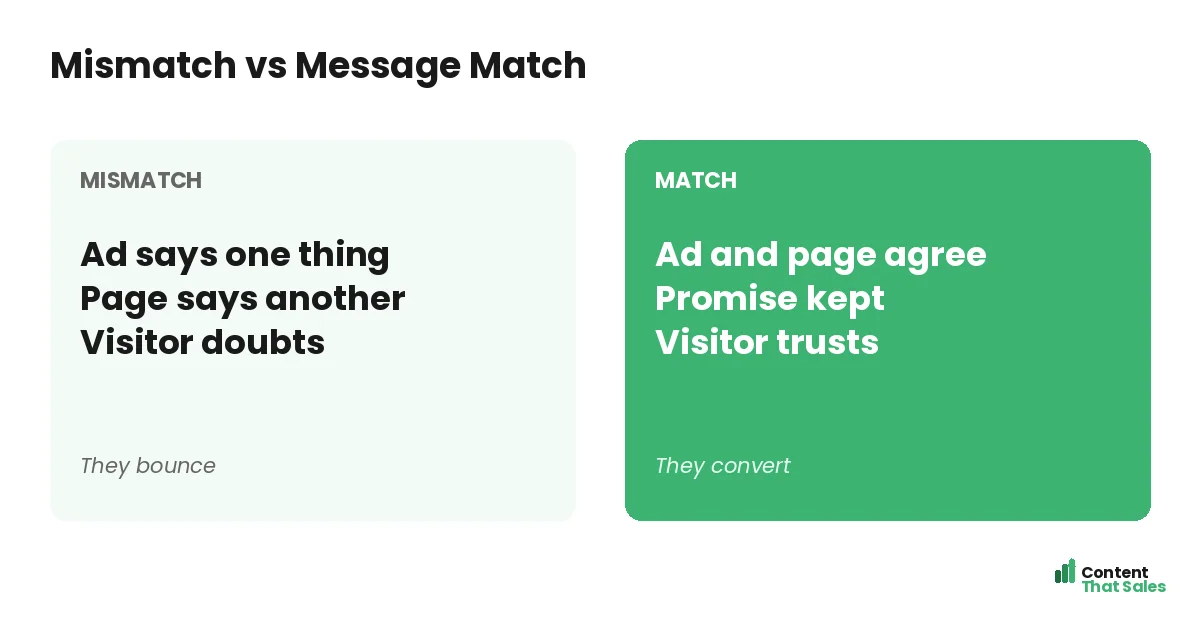
Break the match, and you break the spell. A visitor who sees a different headline or offer than the ad promised feels misled and leaves. Message match lowers bounce rates, lifts conversions, and improves your landing page quality score all at once.
Match the Headline First
The headline is where message match matters most. The page headline should echo the ad headline closely, ideally repeating the key phrase. If the ad says “Save 20% on car insurance,” the page headline should say almost exactly that.
This is the first thing the visitor sees, so it confirms the match in a split second. A headline that mirrors the ad reassures the visitor immediately. A headline that wanders off topic plants doubt before they read another word.
Match the Offer and Promise
The offer on the page must be the same as the offer in the ad. If the ad promised a free trial, the page must lead with that free trial, not a different deal. A switched offer is the fastest way to lose a visitor’s trust.
Keep the promise identical, down to the details. If the ad said “no credit card,” the page should repeat it. Visitors notice when the terms change between ad and page, and that mismatch reads as a bait and switch.
Match the Visuals and Tone
Beyond words, match the look and feel. If the ad showed a specific product image or color scheme, carry it onto the page. The visual continuity tells the visitor, before they even read, that this is the right place.
Tone matters too. A playful ad should lead to a playful page, a serious ad to a serious page. Since readers scan more than they read, matching visuals and tone confirms the match at a glance and keeps them moving.
Use the Searched Keyword
For search ads, the keyword the visitor typed is part of the match. Reflecting that term on the page reassures the visitor and lifts relevance for Google. The searcher sees their exact need mirrored back at them.
You do not need to stuff the keyword everywhere, just use it naturally in the headline and key spots. This deepens the message match and strengthens your quality score, which is a proven way to improve your Google Ads landing pages and lower cost per click.
Did you know?
Strong message match can sharply cut bounce rates, because visitors who instantly see the page deliver on the ad have no reason to hit back and leave.
The Payoff of Strong Message Match
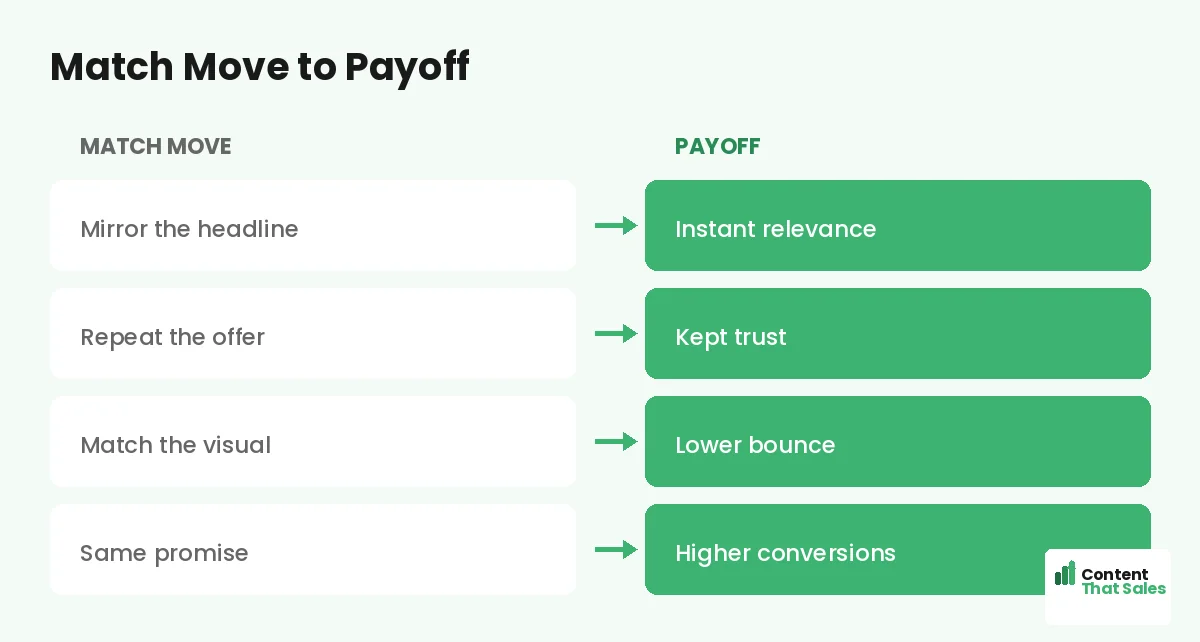
Strong message match pays off in three ways. It lowers bounce rates, because visitors feel they are in the right place. It lifts conversions, because trust carries them to the CTA. And it improves quality score, because Google sees a relevant, consistent journey.
That combination means more leads from the same traffic and cheaper clicks at the same time. Few tweaks in paid advertising deliver such a clear return for so little effort. Message match is a quiet multiplier on every campaign.
Common Message Match Mistakes
The most common mistake is sending ad traffic to a generic homepage that matches nothing. Others include changing the offer, using a different headline, or switching visuals between ad and page. Each break costs you trust and conversions.
Another subtle error is matching the headline but not the offer, or the words but not the tone. Match all of it. A ready landing page copy template helps you build matched pages quickly so nothing slips between ad and page.
One Ad, One Matched Page
For the tightest match, pair each ad or ad group with its own page. When you run several offers or audiences, build a page variant for each so every visitor lands on a page that mirrors the exact ad they clicked.
This is more work than one generic page, but the relevance pays off in conversions and lower costs. The closer the one-to-one match between ad and page, the stronger the message match and the better your results.
Message Match Across Channels
Message match applies everywhere you run ads, search, social, display, and email. The principle is the same: the page keeps the promise the ad made. On social, match the creative and hook. In email, match the subject line and offer.
Wherever the click comes from, the visitor arrives with an expectation set by the ad. Meet that expectation on the page, and you convert more of every traffic source. Message match is a universal rule, not a search-only trick.
Test Your Message Match
Check your match by clicking your own ads. Does the page headline echo the ad? Is the offer identical? Do the visuals and tone carry over? If anything feels off, your visitors feel it too, and your conversions suffer for it.
Then test improvements. Simple, clear copy keeps winning, since easy reading lifts conversions. Tighten the match, watch bounce rates fall and conversions rise, and keep refining until ad and page feel like one seamless step.
Put It All Together
Strong message match means the page keeps every promise the ad made: the headline, the offer, the visuals, the tone, and the keyword. Get them aligned and you lower bounce, lift conversions, and cut costs across your campaigns.
It is one of the simplest, highest-return habits in paid advertising. Treat the ad and page as one journey, not two pieces, and your traffic converts far better. Message match turns clicks you paid for into leads you keep.
How Content That Sales Helps
We make ad and page feel like one. That’s where we come in. At Content That Sales, we write landing pages that mirror your ads, keep every promise, and convert more of the clicks you pay for.
You share your ads and offers. We write matched pages that lower bounce, lift conversions, and improve your quality score. The result is a smoother journey from ad to action and a lower cost per lead.
Ready to Match Your Ads to Your Pages?
Now you know how message match between ads and landing pages lowers bounce, lifts conversions, and cuts costs by keeping every promise the ad made. A click is a promise. So why break it the moment the visitor arrives?
Let’s build pages that keep your ad’s promise. Book your free consultation now. Call us at 8801631988589 or email service@contentthatsales.com. Let’s turn your next click into your next customer.
Frequently Asked Questions About Message Match
What is message match?
It is making the landing page continue the ad. The headline, offer, visuals, and tone on the page mirror the ad the visitor clicked, with no jolt or confusion.
Why does message match matter?
A click is a promise. When the page keeps it, the visitor trusts and converts. When it breaks, they feel misled and bounce, wasting the click.
What should I match first?
The headline. The page headline should echo the ad headline closely, ideally repeating the key phrase, since it is the first thing the visitor sees.
Do I need to match the offer too?
Yes, exactly. If the ad promised a free trial, the page must lead with that same trial. A switched offer reads as a bait and switch and loses trust.
Does message match help quality score?
Yes. A consistent, relevant journey from ad to page improves your quality score, which lowers your cost per click alongside the conversion lift.
What is the most common mistake?
Sending ad traffic to a generic homepage that matches nothing. Others include changing the offer, headline, or visuals between ad and page.
Does message match apply beyond search?
Yes. It works on social, display, and email too. Wherever the click comes from, the page should keep the promise the ad or subject line made.
Can Content That Sales help?
Yes. We write matched pages that mirror your ads, lower bounce, and convert more clicks. Reach out for a quick quote.