 Skip to content
Landing pages for Google Ads are where your ad budget is won or lost, because the page, not the ad, decides whether a click becomes a lead. A great ad that sends traffic to a weak or generic page just burns money. The page must match the ad, load fast, and drive one clear action. This guide shows you how to build Google Ads landing pages that lift your quality score, lower your cost per click, and convert more of the traffic you pay for.
Google rewards relevance. When your page matches the search and the ad, your quality score rises, your costs fall, and your ads show more often. When it does not, you pay more for less. So the page is not an afterthought, it is the core of a profitable campaign.
Below, we walk through message match, quality score, speed, and the page elements that turn paid clicks into leads.

Why the Page Matters More Than the Ad
You can write a perfect ad, but if the page does not deliver, the click is wasted. The ad gets attention; the page gets the conversion. Every dollar you spend on clicks rides on whether the page convinces the visitor to act.
That is why a dedicated page beats sending ad traffic to your homepage. A focused page built on a strong landing page structure matches the visitor’s intent and guides them to one action, instead of letting them wander a busy site and leave.
Message Match: The Big One
Message match is the most important rule. The page headline should echo the ad the visitor clicked. If your ad promises “fast roof repair,” the page should say “fast roof repair,” not “welcome to our company.” That continuity reassures the visitor they are in the right place.
When the page matches the ad, bounce rates drop and conversions rise. When it does not, visitors feel a jolt of doubt and leave. Match the headline, the offer, and the tone to the ad, and you keep the trust the ad earned.
Use the Keyword on the Page
Put the keyword the visitor searched for right on the page, especially in the headline. This boosts relevance for both the visitor and Google. The reader sees their exact need reflected back, and Google sees a page that matches the query.
Do not stuff the keyword everywhere, just use it naturally in the headline and a few key spots. Relevance is a core part of quality score, and a keyword-aligned page is one of the simplest ways to earn it. Match the page to the search.
Quality Score and Why It Pays
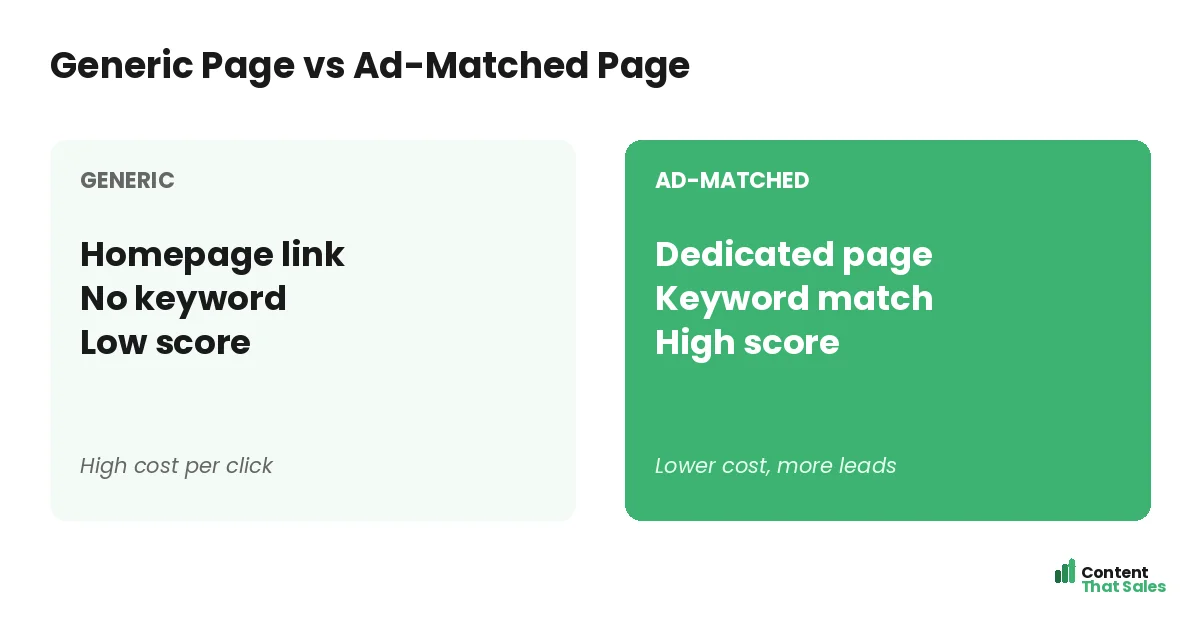
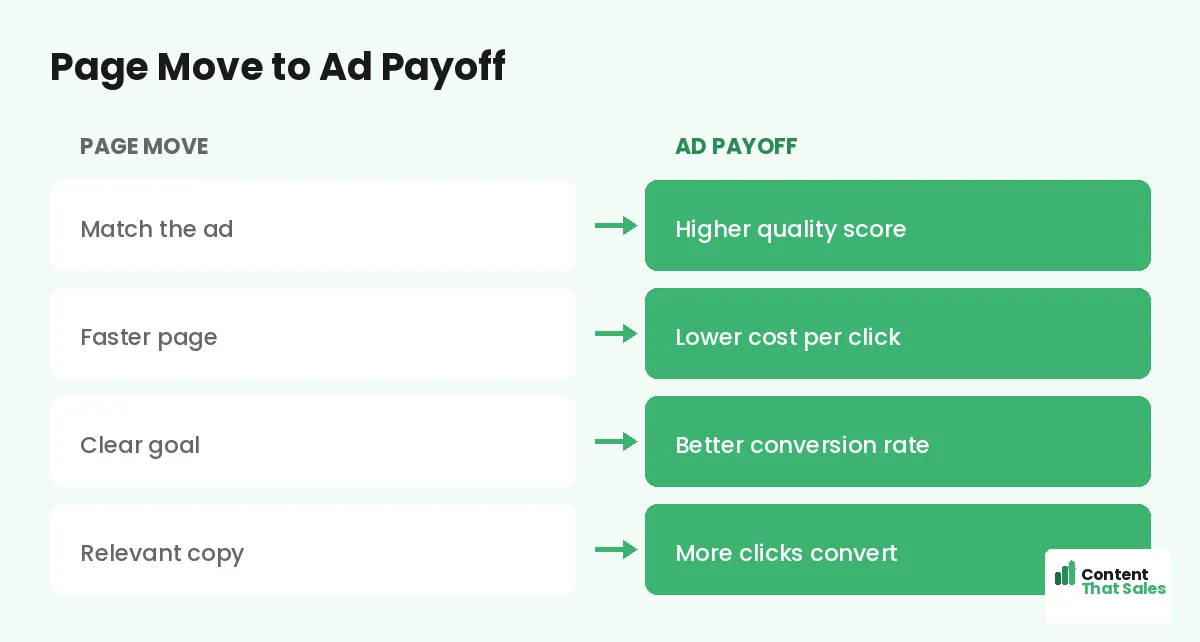
Quality score is Google’s rating of how relevant and useful your ad and page are. A higher score means lower costs and better ad positions. Your landing page experience is a major input, so a strong page directly lowers what you pay per click.
This is the quiet power of a good page: it does not just convert better, it makes your whole campaign cheaper. Two advertisers can bid the same amount, and the one with the better page pays less and ranks higher. The page is your edge.
Match the Page to Search Intent
Beyond the keyword, match the page to what the searcher actually wants. Someone searching “emergency plumber” wants speed and a phone number, not a long brand story. Give them the action they came for, fast, and you convert far more of them.
Think about the intent behind each keyword group and build a page that answers it directly. The closer the page matches the visitor’s goal, the higher it converts. Since readers scan more than they read, lead with exactly what they searched for.
Speed: Fast Pages Win
Page speed matters for both conversions and quality score. Paid visitors are impatient, and many are on mobile. A slow page loses them before it loads, and Google factors speed into your score, so a sluggish page costs you twice.
Keep images light, trim heavy scripts, and aim for a fast load on mobile. Every second counts. A quick page protects the clicks you paid for and signals quality to Google, helping your ads cost less and show more.
Did you know?
A higher quality score can noticeably lower your cost per click, because Google rewards relevant ads and pages with cheaper clicks and better positions.
Build for Mobile First
Most Google Ads clicks come from phones, so design the page for mobile first. Stack the content in one column, make the headline and CTA visible without scrolling, and keep buttons easy to tap. A page that works on mobile works everywhere.
Test the page on a real phone before you spend. If the headline is cut off or the button is hard to reach, you are paying for clicks you will not convert. Mobile-first is not optional for paid traffic, it is the baseline.
One Clear Goal and CTA
A Google Ads page should have one job. Remove the menu, extra links, and anything that pulls focus from the action you want. Whether it is a call, a form, or a purchase, make that one next step obvious and repeated.
Use a clear, benefit-led button and follow solid landing page CTA best practices. One goal keeps the visitor focused and lifts your conversion rate, which in turn improves the return on every click you buy.
Add Proof Near the Action
Paid visitors are skeptical, so prove your claims. Place reviews, ratings, a customer count, or trust badges near the CTA, where doubt peaks. Strong proof reassures the visitor that the action is safe and worth taking.
Specific proof beats vague claims. “Trusted by 2,000 local homeowners” works harder than “we are the best.” The right proof beside the button turns a hesitant paid click into a converted lead, lifting the return on your ad spend, which is what makes landing page copywriting worth it.
Match One Page Per Ad Group
For the best results, build a dedicated page for each ad group or major keyword theme. The tighter the match between the ad and the page, the higher the relevance and the conversion rate. One generic page for all ads dilutes the match.
This takes more work, but it pays. Each focused page speaks directly to its audience, lifting quality score and conversions together. A ready landing page copy template makes spinning up these pages fast and consistent.
Test and Improve Your Pages
Paid traffic gives you fast data, so use it. Test different headlines, CTAs, and offers to see what converts best. Even small wins compound when every visitor costs money. A page that improves over time lowers your cost per lead steadily.
Simple, clear copy keeps winning, since easy reading lifts conversions. Watch your numbers, keep the winners, and your Google Ads pages get cheaper and more effective with each round of testing.
Put It All Together
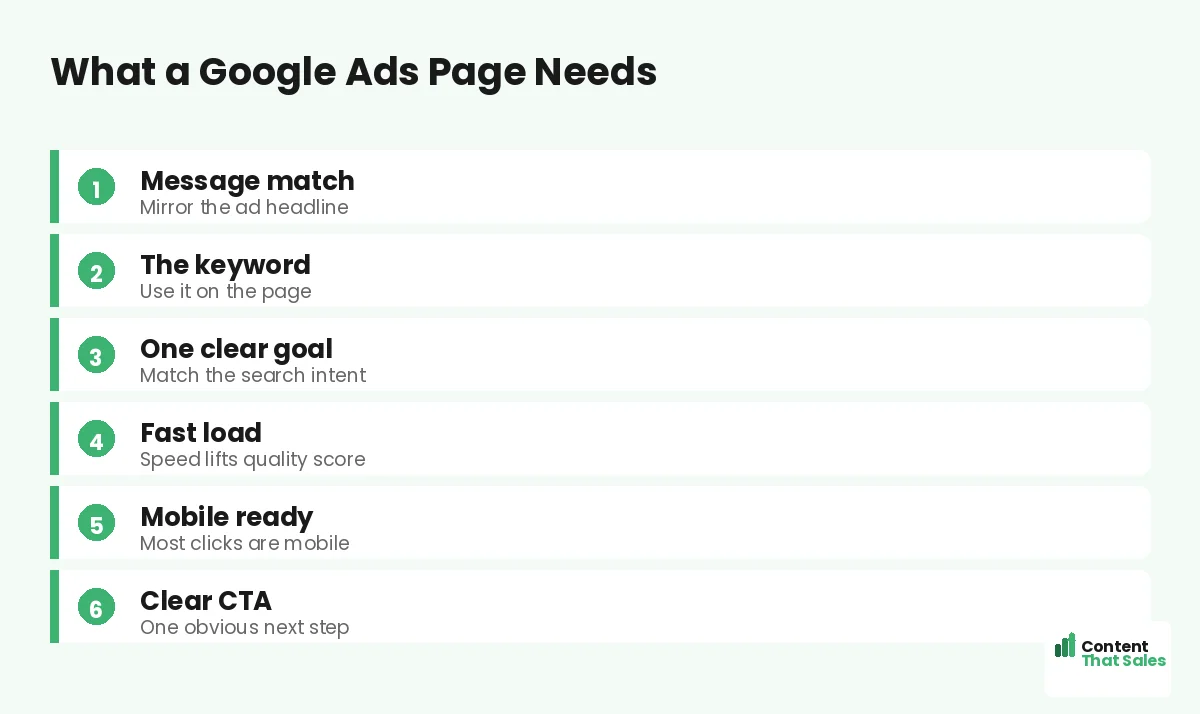
A high-performing Google Ads page matches the ad, uses the keyword, loads fast, works on mobile, drives one clear action, and proves its claims. Get those right and you lift quality score, lower cost per click, and convert more of your paid traffic.
The page is the lever that makes your whole campaign profitable. Spend as much care on it as on your ads and bids, and your budget will go further. A focused, relevant page is the difference between paid traffic that pays and paid traffic that drains.
How Content That Sales Helps
We build pages that make your ad spend pay. That’s where we come in. At Content That Sales, we write Google Ads landing pages that match your ads, lift your quality score, and convert more of the clicks you pay for.
You share your campaign and your offer. We write a focused, relevant page built to convert paid traffic. The result is a lower cost per lead and an ad budget that finally works as hard as it should.
Ready to Make Your Ad Spend Pay?
Now you know how landing pages for Google Ads lift quality score, lower cost per click, and convert more paid traffic. The page, not the ad, decides if your budget pays off. So why send expensive clicks to a page that lets them slip away?
Let’s build a page that turns clicks into customers. Book your free consultation now. Call us at 8801631988589 or email service@contentthatsales.com. Let’s turn your next paid click into your next lead.
Frequently Asked Questions About Google Ads Landing Pages
Why do landing pages matter for Google Ads?
The page, not the ad, decides whether a click converts. A weak or generic page wastes your ad budget, no matter how good the ad itself is.
What is message match?
It is making the page headline echo the ad the visitor clicked. When the page matches the ad, bounce rates drop and conversions rise.
How do landing pages affect quality score?
Landing page experience is a major input to quality score. A relevant, fast, useful page raises your score, which lowers cost per click and improves ad position.
Should I use the keyword on the page?
Yes, naturally in the headline and a few key spots. It boosts relevance for both the visitor and Google. Avoid stuffing it everywhere.
Can I send ad traffic to my homepage?
You should not. A busy homepage scatters paid visitors. A dedicated, focused page matches intent and converts far more of the clicks you pay for.
Why does page speed matter?
Paid visitors are impatient and often on mobile, and Google factors speed into quality score. A slow page loses conversions and costs you more per click.
Should I build one page per ad group?
Yes, when you can. A tighter match between ad and page lifts relevance and conversions. A template makes spinning up these pages fast.
Can Content That Sales write my ad pages?
Yes. We build Google Ads pages that match your ads and convert paid traffic, lowering your cost per lead. Reach out for a quick quote.