 Skip to content
A landing page copy brief template gives you a simple set of questions to answer before anyone writes a word, so the writer knows the goal, the audience, the offer, and the proof from day one. A clear brief is the difference between copy that lands on target and copy that needs five rounds of revisions. This guide gives you the full brief, question by question, with examples, so you can brief a writer or yourself and get better copy faster.
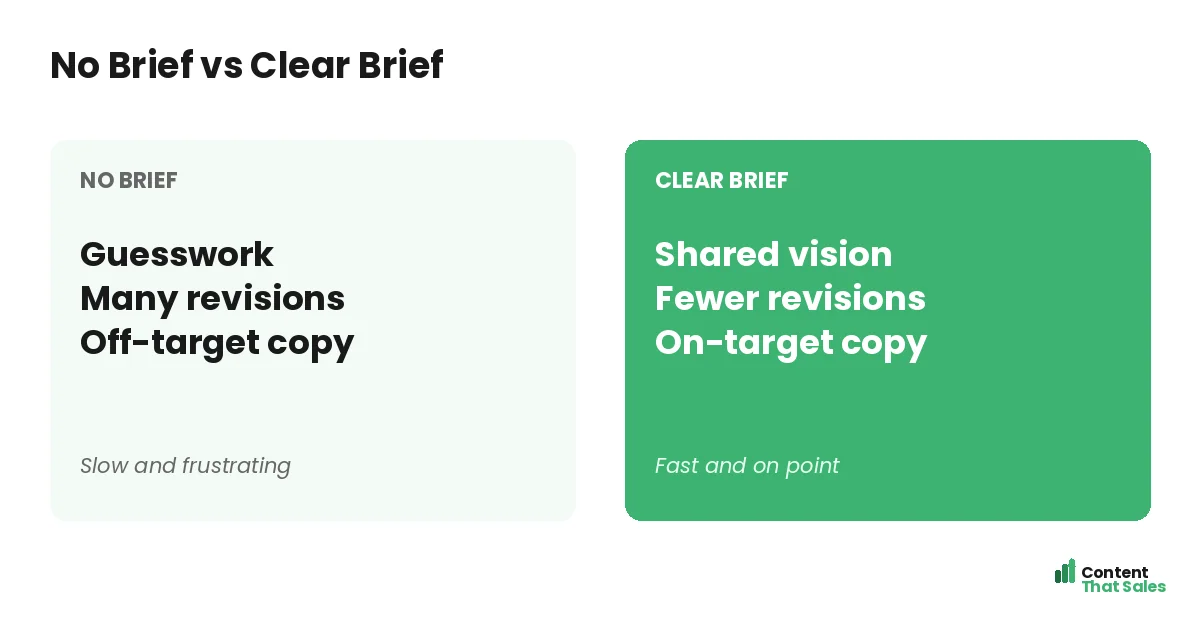
Why a brief? Because vague input leads to vague copy. When the writer has to guess your goal or your audience, the first draft misses, and you both waste time. A clear brief shares the vision up front, so the very first draft is close. Let’s walk through it.
Below, we give you each section of the brief, the question to answer, and an example, plus tips to make briefing quick and painless.

Why a Copy Brief Matters
A brief aligns everyone before the work starts. It captures the goal, the reader, and the message in one place, so the writer is not guessing. Time spent on a brief is saved many times over in fewer revisions and a sharper first draft.
The brief also feeds straight into a proven structure like the best landing page structure. Answer the questions, and the writer maps your inputs to each section of the page. A good brief is the foundation of good copy.
Section 1: The Goal
Start with the one action this page must drive. Not three actions, one. Every word on the page will push toward this single goal, so naming it clearly is the most important step in the brief.
Question: what is the one action you want a visitor to take? Example: “Book a free strategy call.” Be specific. A clear goal keeps the page focused and tells the writer exactly what to build toward.
Section 2: The Audience
Describe who the page speaks to. The more specific, the better the copy. Include their role, their situation, and what they care about. Writing for “everyone” produces copy that moves no one.
Question: who is the ideal reader, and what is their situation? Example: “Small clinic owners who run ads but get few bookings.” Specific audiences get copy that speaks their language, which always converts better than generic lines.
Section 3: The Offer
Spell out exactly what the reader gets. The product or service, what is included, the price or that it is free, and the format. The writer needs the full offer to make it sound irresistible without overpromising.
Question: what is the offer, in plain terms? Example: “A free 30-minute audit call plus a written action plan.” Clarity here prevents vague copy. When the offer is crisp in the brief, it is crisp on the page.
Section 4: The Proof
List your strongest proof. Testimonials, reviews, numbers, case studies, client logos, and any results you can show. Proof turns claims into belief, and the writer can only use proof that you provide.
Question: what proof can you share? Example: “200 clients served, a 4.9 star rating, and a quote from Mark in Denver.” Gather real, specific proof for the brief. People scan more than they read, so concrete numbers stand out.
Section 5: The Objections
Name what holds buyers back. Price, time, trust, past bad experiences, or fear it will not work for them. Every objection you list becomes a line of copy or an FAQ that clears the doubt before it stops the sale.
Question: what makes prospects hesitate? Example: “They worry it is too expensive and that they have no time.” List the top three. The writer turns each objection into reassurance, so the page answers doubts before the reader leaves.
Did you know?
A clear brief usually cuts revision rounds in half, because the writer hits the goal and the audience on the first draft instead of guessing.
Section 6: The Voice and Tone
Tell the writer how the copy should sound. Friendly, expert, bold, calm. Add words to use and words to avoid, plus a sample of writing you like. Voice keeps the page on-brand and consistent.
Question: how should the copy sound, and are there words to use or avoid? Example: “Warm and plain, no jargon, never say cheap.” A clear voice note means the first draft already sounds like you, not a stranger.
Bonus: Links and Logistics
Round out the brief with the practical details. The URL or slug, the main keyword for SEO, any pages to link to, the deadline, and where the copy will live. These small details prevent back-and-forth later.
Question: what are the logistics, like keyword, links, and deadline? Example: “Keyword landing page copy, link to the pricing page, due Friday.” Logistics in the brief keep the project moving and the writer unblocked.
How the Brief Becomes Copy
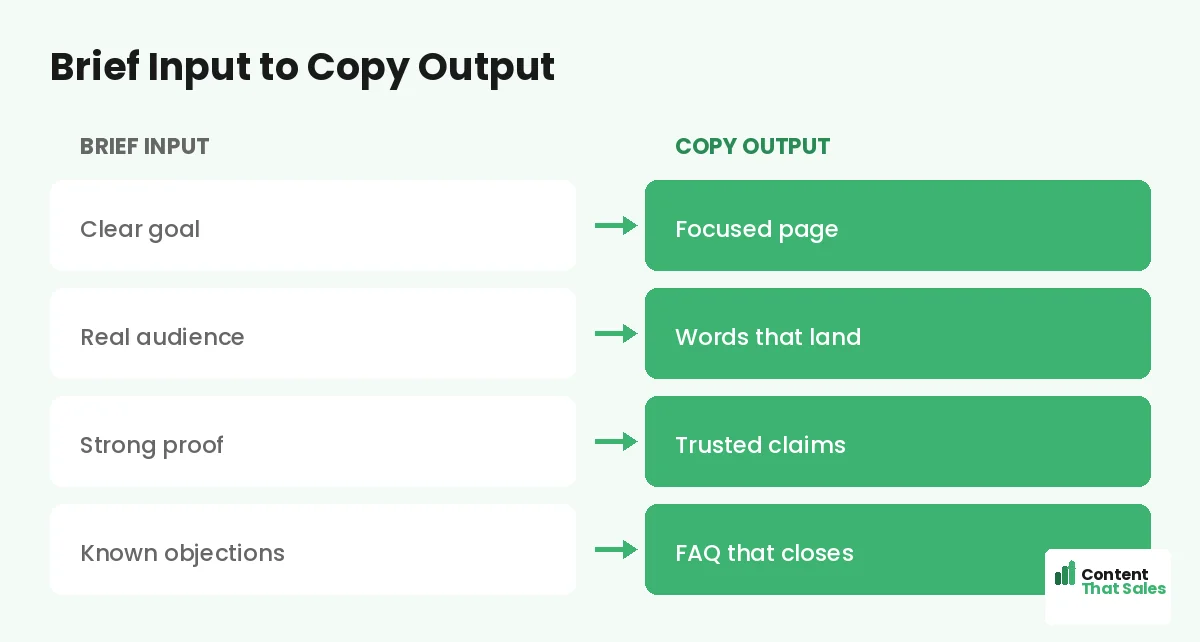
Once the brief is filled, the writer maps each answer to the page. The goal sets the CTA, the audience shapes the words, the offer fills the hero, the proof builds trust, and the objections become the FAQ. The brief is the blueprint.
Pair the brief with a ready structure like the landing page copy template and the writing goes fast. Good inputs make good outputs. A clear brief almost writes the page for you.
Keep the Brief Short and Honest
A good brief is clear, not long. A page or two is plenty. Answer each question honestly, even if the answer is “we are not sure yet.” A short, honest brief beats a long one full of filler the writer has to wade through.
If you do not know an answer, say so, and the writer can help you find it. Pretending to have proof or a clear audience when you do not just leads to copy that rings false. Honesty in the brief makes the page believable.
Use the Brief Every Time
Make the brief a habit. Fill it out before every new page, whether you write the copy yourself or hire it out. It forces you to think through the goal and the reader, which improves the page even before a word is written. It pairs perfectly with a landing page wireframe template so layout and message stay in sync.
Over time, briefing gets faster, and your pages get more consistent. Clear, simple copy keeps winning, since easy reading lifts conversions. A reliable brief is how you get that copy every time, without the guesswork.
The Full Brief at a Glance
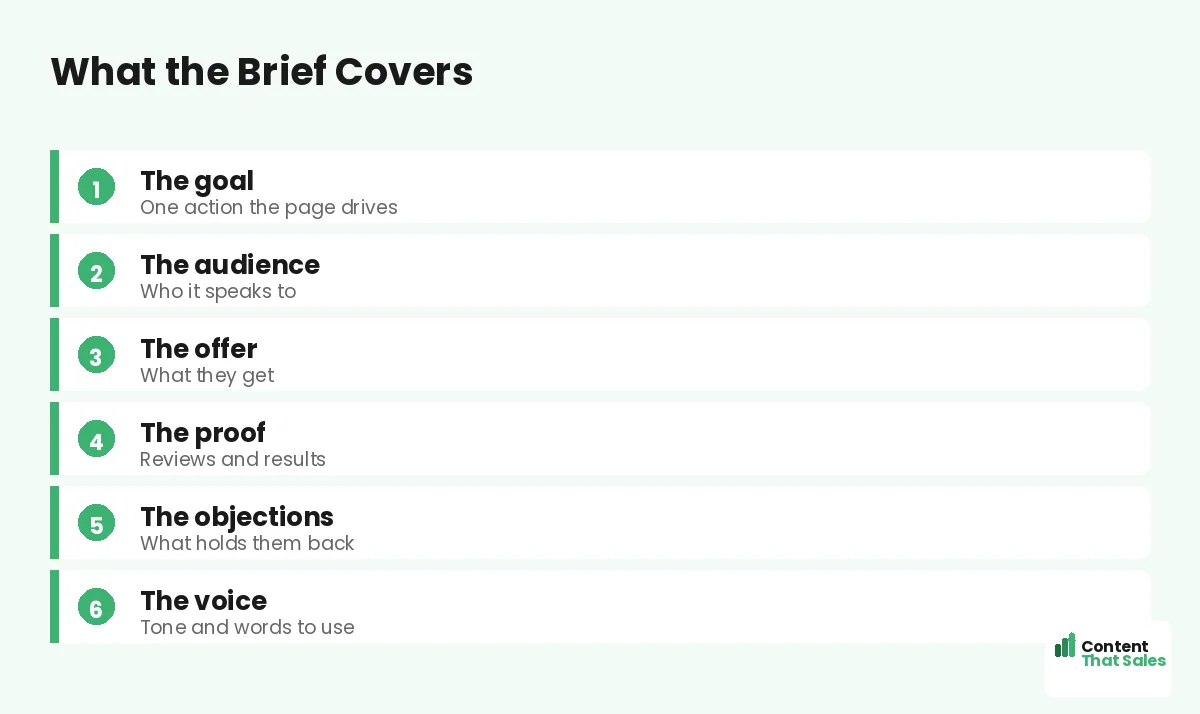
Here is the whole brief in order: the goal, the audience, the offer, the proof, the objections, the voice and tone, and the links and logistics. Answer each one and you have everything a writer needs to nail the page on the first try.
Keep this brief as a reusable form. Copy it for every project and fill in the blanks. To turn the brief into words, see how to write landing page copy that converts. Brief first, write second, and the page comes together fast.
How Content That Sales Uses Briefs
We start every project with a short brief. That’s where we come in. At Content That Sales, we ask the right questions up front, so the first draft lands close and the revisions are light. A clear brief is how we move fast without missing the mark.
You answer a few questions about your goal, audience, and offer. We turn those answers into copy built to convert. The result is a page that sounds like you and speaks to your reader, delivered without endless back-and-forth.
Ready to Turn Visitors Into Customers?
Now you have a landing page copy brief template. The goal, the audience, the offer, the proof, the objections, the voice, and the logistics. Fill it in and you give any writer what they need to nail the page. So why start a project with a vague request?
Let’s turn a clear brief into copy that converts. Book your free consultation now. Call us at 8801631988589 or email service@contentthatsales.com. Let’s turn your next visitor into your next customer.
Frequently Asked Questions About the Copy Brief
What is a landing page copy brief?
A short document that answers the key questions about a page before writing, the goal, audience, offer, proof, objections, and voice, so the writer knows exactly what to build.
Why do I need a brief?
Vague input produces vague copy and many revisions. A clear brief shares the vision up front, so the first draft lands close and the project moves faster.
What sections does the brief include?
The goal, the audience, the offer, the proof, the objections, the voice and tone, and a bonus section for links and logistics like keyword and deadline.
How long should the brief be?
One or two pages is plenty. Keep it clear, not long. Answer each question honestly, and say so if you do not know an answer yet.
What if I do not have proof yet?
Say so in the brief. The writer can help you find or frame proof, or lean on other trust signals. Honesty beats inventing results that ring false.
Can I use the brief for DIY copy?
Yes. Filling out the brief forces you to think through the goal and reader, which improves your own writing even before the first word.
How does the brief speed up the work?
It removes guesswork. The writer maps each answer to a page section, so the first draft is on target and revisions are light instead of heavy.
Can you write from my brief?
Yes. Content That Sales turns a short brief into copy built to convert. Send us your answers and we will handle the rest.