 Skip to content
These 10 topical map mistakes that hurt your SEO are the errors that quietly keep maps from building authority, and avoiding them is often as valuable as building the map itself. From a core that is too broad to thin pages and weak linking, each mistake undermines your rankings. This guide walks through all ten and the fix for each, so your map actually works.
A topical map is powerful, but only when built right. Most that underperform fall into the same traps. Knowing these ten mistakes lets you spot and fix them before they cost you traffic and authority.
Below, we walk through the ten most damaging topical map mistakes and exactly how to fix each one.

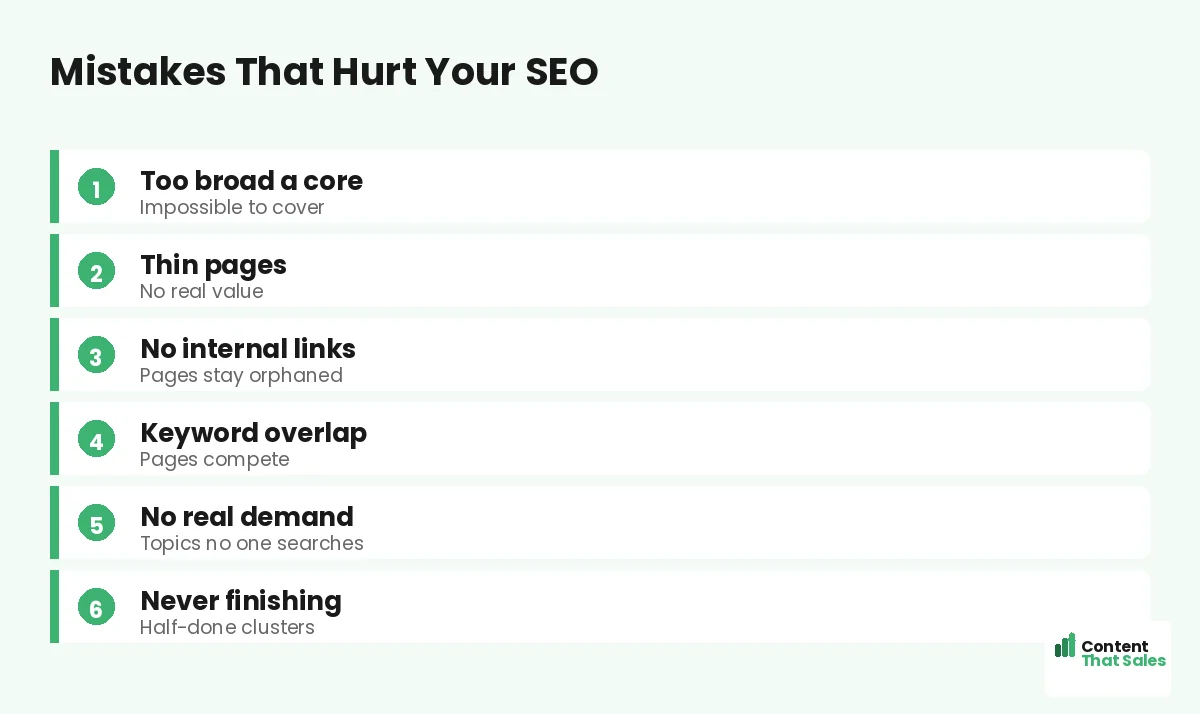
Why These Mistakes Matter
Each mistake weakens the system that makes a topical map work. A flawed map covers gaps, dilutes authority, or confuses search engines, undermining the rankings you built it for. Avoiding these errors is foundational to success.
The good news is they are all fixable once you know them. A map built on the topical map fundamentals, while avoiding these traps, builds real authority. Let’s go through the ten.
Mistake 1: Too Broad a Core Topic
The first mistake is choosing a core topic so broad it cannot be covered. A whole industry as your core means impossible competition and thin coverage. The fix is to narrow your core to a focused subject you can genuinely own.
Get the breadth right, as covered in choosing your core topic. A focused core is coverable and winnable; a sprawling one stalls. Narrow until you can realistically dominate the subject.
Mistake 2: Thin, Low-Value Pages
Filling your map with thin pages that add no real value is a serious mistake. Thin content signals low quality and dilutes your authority. The fix is to make every page genuinely useful, covering its subtopic thoroughly.
Quality beats quantity. A map of fewer, stronger pages outperforms one padded with filler. Ensure each page earns its place with real depth and usefulness, not just words to hit a count.
Mistake 3: No Internal Links
Failing to link your pages together leaves them orphaned and your authority scattered. Without internal links, your map is just disconnected posts. The fix is to connect every page, linking clusters to pillars and related pages to each other.
Strong internal linking is what turns pages into a cluster that ranks. Connect everything, leave no orphans, and let authority flow through your map.
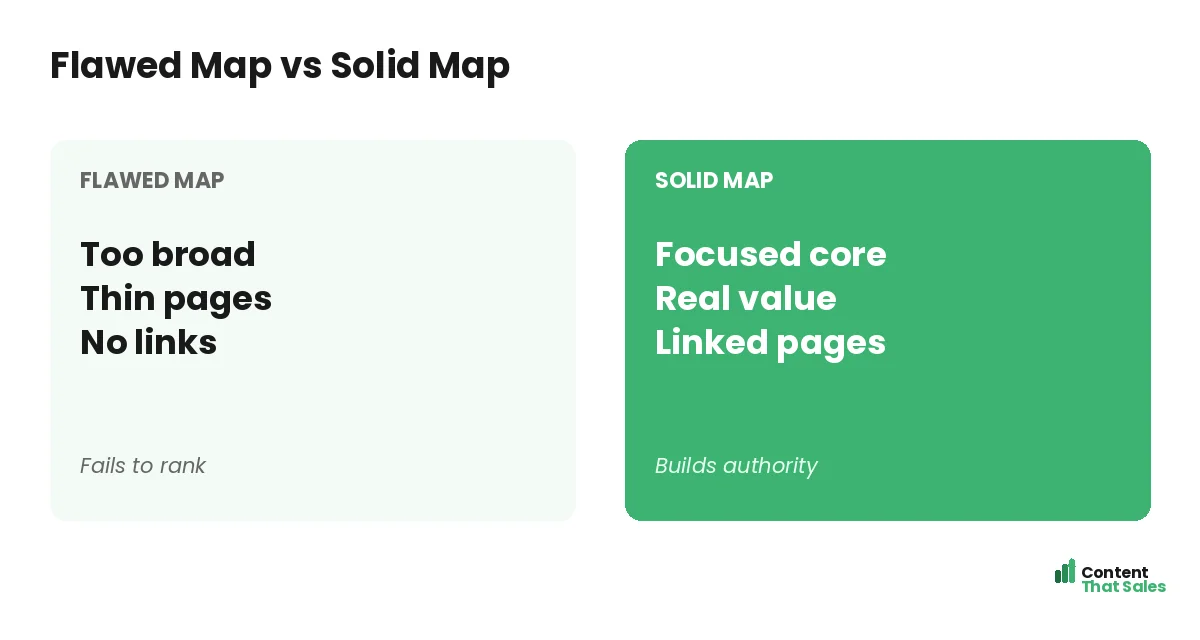
Mistake 4: Keyword Cannibalization
Creating multiple pages targeting the same keyword makes them compete with each other, splitting your ranking potential. The fix is to assign one primary keyword per page, so each has a distinct purpose and no two overlap.
Map your keywords carefully to avoid this. Each page should own a unique subtopic and term. Clear keyword assignment keeps your pages from cannibalizing one another and lets each rank for its own search.
Mistake 5: Targeting Topics With No Demand
Building pages for subtopics no one searches wastes effort and creates thin, trafficless pages. The fix is to validate demand before committing. Use keyword research to confirm people actually search each topic you plan to cover.
Let real demand guide your map, the same discipline as judging topical map depth. Cover what people search; skip what they do not. Demand keeps your map focused on pages that can rank.
Mistake 6: Never Finishing Clusters
Jumping between clusters and leaving them all half-done is a common mistake. Half-finished clusters do not signal complete coverage. The fix is to finish one cluster before starting the next, sending a strong signal of authority.
This finishing-focused approach is the heart of a sound topical map strategy. Complete each cluster fully, and your authority compounds. Scattered, unfinished clusters never build the depth Google rewards.
Did you know?
Finishing one cluster completely usually builds more authority than starting five, because Google rewards thorough coverage over scattered, half-done topics.
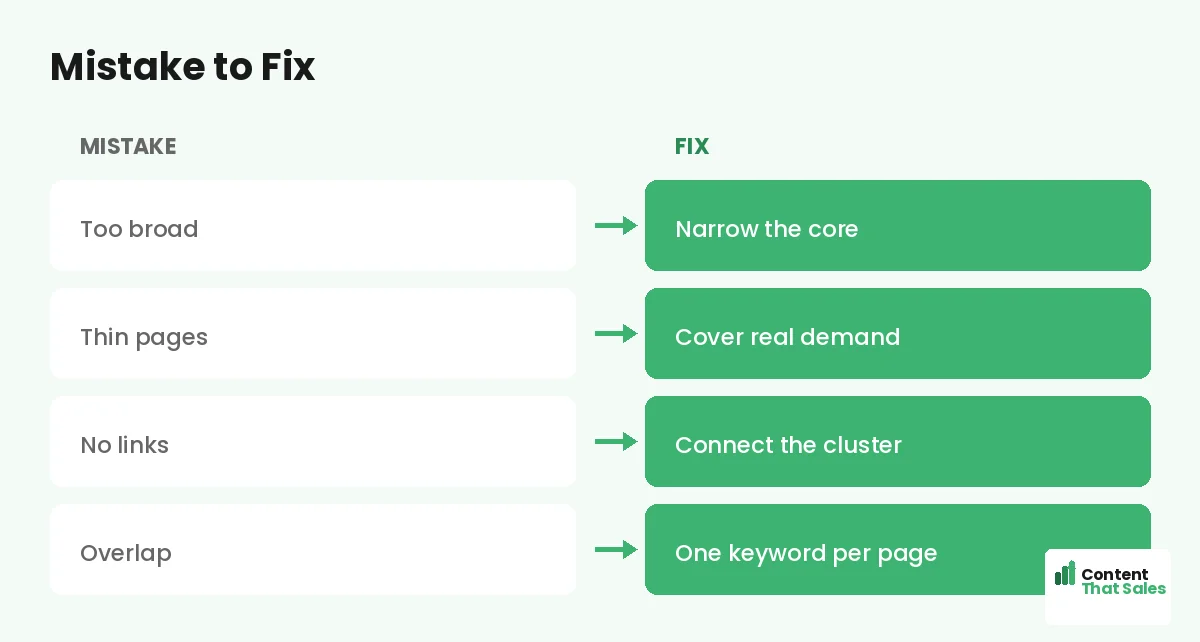
Mistake 7: Ignoring Search Intent
Creating pages that do not match what searchers actually want is a costly mistake. A page that misreads intent will not rank or satisfy readers. The fix is to match each page to the real intent behind its keyword.
Study what already ranks for a term to understand the intent, then deliver it. Since readers scan more than they read, a page that nails intent and answers fast is what ranks and converts.
Mistake 8: Weak or Missing Pillars
A map with thin pillars, or no clear pillars at all, lacks the hubs that anchor clusters. The fix is to build comprehensive pillar pages that cover each broad topic and link to their clusters, giving your map a clear structure.
Strong pillars are the backbone of the pillar-and-cluster framework. Without them, your clusters have no center. Invest in pillars that genuinely anchor and organize each part of your map.
Mistake 9: Adding Random Off-Topic Posts
Publishing random posts unrelated to your core dilutes your topical focus and confuses search engines about what you are about. The fix is to stay on-topic, publishing only content that fits your map and reinforces your subject.
Off-topic content scatters the authority you are trying to concentrate. Resist the urge to chase unrelated traffic. A focused map, free of random posts, sends a clear, strong signal about your expertise.
Mistake 10: Never Updating the Map
Treating your map as finished and never updating it lets coverage go stale as the subject and search trends evolve. The fix is to revisit your map regularly, adding new subtopics, filling gaps, and refreshing older content.
A living map stays complete over time. Simple, clear content keeps winning, since easy reading lifts engagement, and updates keep that content current. Keep your map alive, and it keeps building authority.
How to Avoid All Ten
Avoiding these mistakes comes down to fundamentals: a focused core, real demand, quality pages, clear pillars, strong linking, finished clusters, matched intent, on-topic focus, and regular updates. Build on those, and you sidestep every trap.
Use this list as a checklist when planning and reviewing your map. Each mistake has a clear fix, and together they form the recipe for a map that works. Get the fundamentals right, and your map builds the authority you want.
Audit Your Map for These Mistakes
Periodically audit your existing map against these ten mistakes. Look for orphans, thin pages, overlap, gaps, and stale content. Fixing what you find strengthens your map without building anything new, often a fast path to better rankings.
Most underperforming maps suffer from several of these at once. A regular review catches them early. Treat this list as a recurring audit, and you keep your map free of the errors that quietly hurt SEO.
Put It All Together
The ten topical map mistakes, too broad a core, thin pages, no links, cannibalization, no demand, unfinished clusters, ignored intent, weak pillars, off-topic posts, and never updating, all hurt your SEO. Each has a clear, simple fix.
Avoid them by getting the fundamentals right and auditing regularly. A map free of these mistakes covers its subject, connects its pages, and builds real authority. Sidestep the traps, and your topical map delivers the rankings you built it for.
How Content That Sales Helps
We build maps that avoid these mistakes. That’s where we come in. At Content That Sales, we plan a focused, well-linked map with quality pages and finished clusters, sidestepping every trap that hurts SEO.
You share your subject and goals. We build the map right, audit it against these mistakes, and keep it updated. The result is a topical map that covers its subject, connects its pages, and builds the authority you want.
Ready to Fix Your Map?
Now you know the 10 topical map mistakes that hurt your SEO and how to fix each: focused core, real demand, quality pages, strong links, finished clusters, and more. Most maps suffer several at once. So why let these errors hold you back?
Let’s build or fix your map the right way. Book your free consultation now. Call us at 8801631988589 or email service@contentthatsales.com. Let’s turn a flawed map into one that ranks.
Frequently Asked Questions About Topical Map Mistakes
What is the most common topical map mistake?
Choosing a core topic that is too broad to cover. The fix is to narrow your core to a focused subject you can genuinely own and dominate.
Why are thin pages a problem?
They signal low quality and dilute your authority. Every page should be genuinely useful and cover its subtopic thoroughly. Quality beats quantity.
What is keyword cannibalization?
When multiple pages target the same keyword and compete with each other. The fix is one primary keyword per page so each has a distinct purpose.
Why finish clusters?
Half-done clusters do not signal complete coverage. Finishing one before starting the next sends a strong authority signal, and your results compound.
Do random off-topic posts hurt?
Yes. They dilute your topical focus and confuse search engines about your subject. Stay on-topic, publishing only content that fits your map.
Should I update my map?
Yes. Coverage goes stale as the subject evolves. Revisit regularly to add subtopics, fill gaps, and refresh content so the map stays complete.
How do I avoid all these mistakes?
Get the fundamentals right, focused core, real demand, quality pages, strong pillars and links, finished clusters, and regular updates, and audit your map against this list.
Can Content That Sales help?
Yes. We build well-linked, quality maps that avoid every trap, and audit existing ones to fix them. Reach out for a quick quote.