 Skip to content
This topical map example for a local plumber website shows a complete, real-world structure, the core service, the service pillars, the local pages, and the linking, so you can see exactly how a local trade business builds a map that ranks. Plumbing is local, urgent, and heavily searched, which makes it a perfect example to learn from. Use this blueprint to model your own plumbing or local trade map.
A plumber competes locally and on trust, often for urgent jobs. A topical map covers every service, every area, and every common plumbing question, making the plumber the obvious local choice. This example lays out exactly how.
Below, we walk through the plumber map’s core service, its service pillars, the clusters and local pages beneath them, and how it all links.

The Core Service
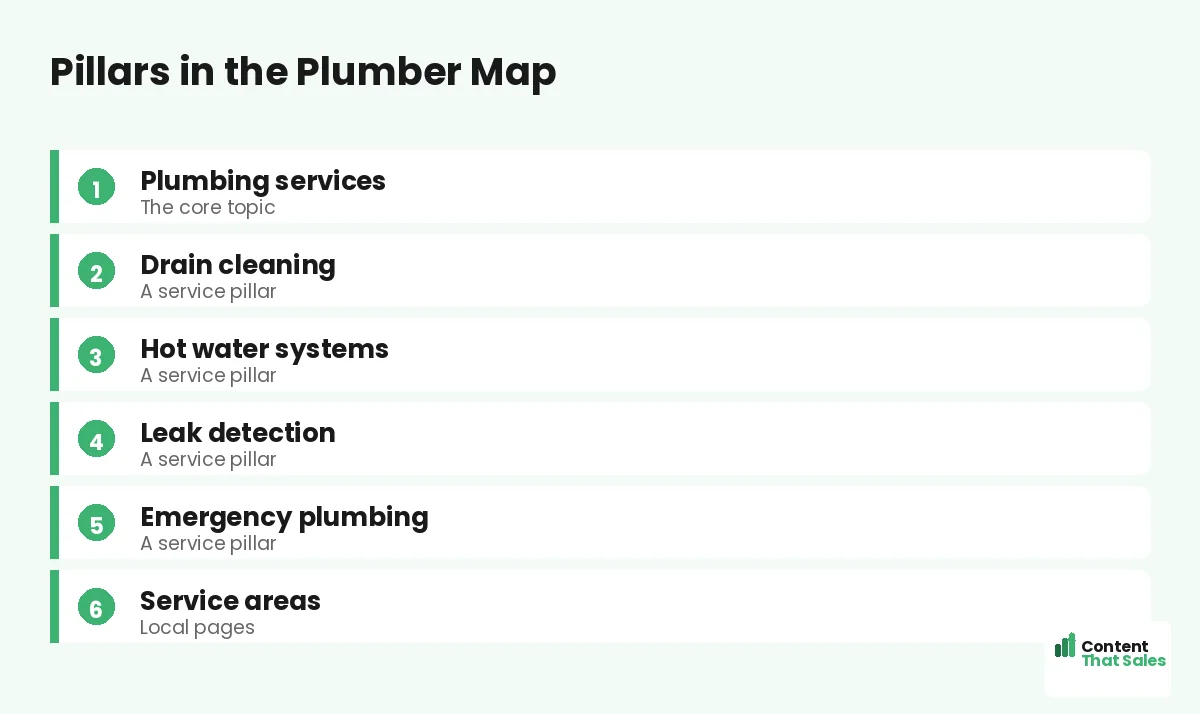
The core topic is plumbing services, the central subject the whole site is built around. Every service, location page, and question branches from this core. It is the umbrella that ties the plumber’s entire map together.
Choosing this core follows the same logic as any core topic: tied to the business, broad enough for depth, focused on what the plumber does. Plumbing services anchors the whole example map.
Pillar 1: Drain Cleaning
The first service pillar is drain cleaning. Its pillar page overviews the service, with clusters covering blocked drains, drain repair, cost, and signs of a problem. Each cluster is a focused page capturing a specific drain-related search.
This pillar captures everyone searching about drains and routes them to the details. It shows depth on one service, the goal of each service pillar. Drain cleaning is one strong branch of the plumber’s core.
Pillar 2: Hot Water Systems
The second pillar is hot water systems. Its pillar overviews hot water services, with clusters on repair, replacement, types of systems, and cost. These cover the specific subtopics customers search around hot water.
Hot water is a common, high-intent search area, so this pillar captures valuable traffic. The clusters address the real questions customers have, completing the coverage of this service branch with focused, useful pages.
Pillar 3: Leak Detection
The third pillar is leak detection. Its pillar covers finding and fixing leaks, with clusters on hidden leaks, water leak signs, and cost. These capture customers worried about leaks and searching for help.
Leak issues drive urgent searches, making this a valuable pillar. The clusters answer specific leak questions and guide worried customers toward booking. Each is a focused page deepening this branch of the map.
Pillar 4: Emergency Plumbing
The fourth pillar is emergency plumbing, capturing the urgent jobs that are gold for plumbers. Its pillar overviews emergency services, with clusters on burst pipes, after-hours plumbing, and what to do in an emergency.
Emergency searches are high-intent, customers need help now. Since readers scan more than they read, these pages make the phone number and call to action prominent so urgent customers act fast. This is a high-value branch.
Local Pages and Service-Plus-City
Plumbing is local, so the map includes pages for each service area and service-plus-city pages, like drain cleaning in a named suburb. These capture exactly what local customers type and help the plumber rank across their whole area.
Service-plus-city pages are the highest-intent local searches, following the same approach as strong local landing pages. They combine the plumber’s services with their locations to capture ready-to-book local demand.
Did you know?
Emergency and service-plus-city pages capture the highest-intent plumbing searches, because a customer with a burst pipe in their suburb is ready to call right now.
The Cluster Pages
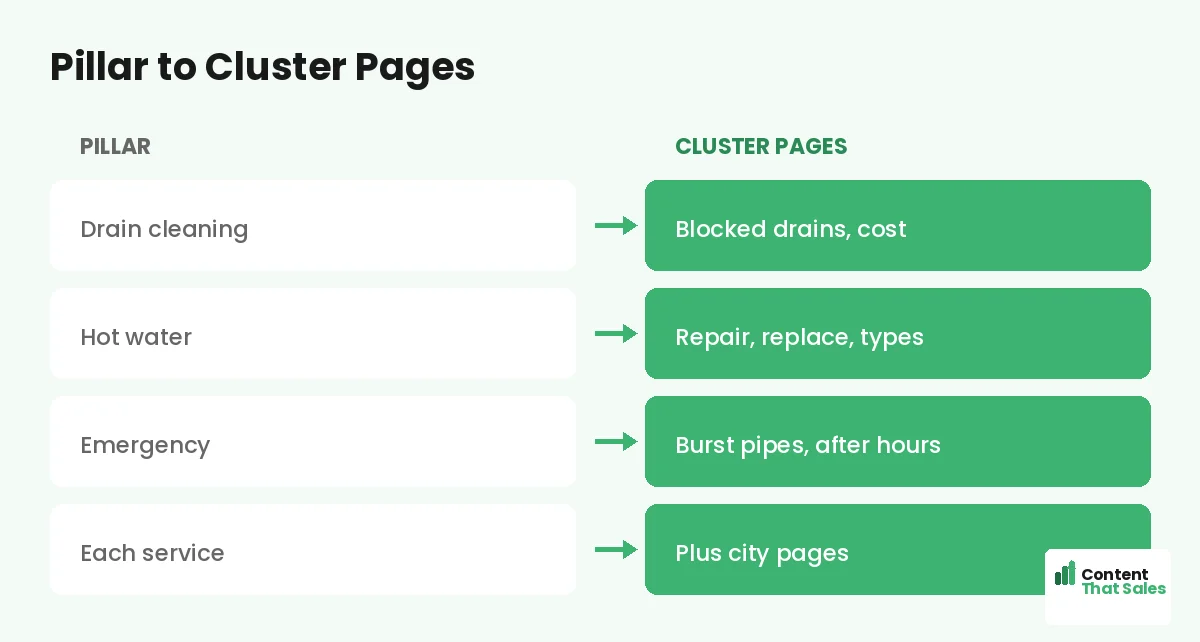
Under each service pillar sit the cluster pages, the deep, specific pages that capture detailed searches. For drain cleaning, that is blocked drains and cost; for hot water, repair and replacement. Each is one focused, useful page.
These clusters come from real research into what customers search, the way you find cluster topics that support pillars. The cluster pages are where most of the traffic lives, fully covering each service.
How It All Links
The map links together: each service pillar links to its clusters and its local pages, clusters link back to their pillar, and local pages link to the relevant service. Everything connects to the plumber’s contact or quote page.
This linking turns the pages into a connected whole, following how you connect pillar and cluster pages. The links spread authority and guide customers from a question to a service to a call. Linking is what makes the map rank.
Why This Structure Works
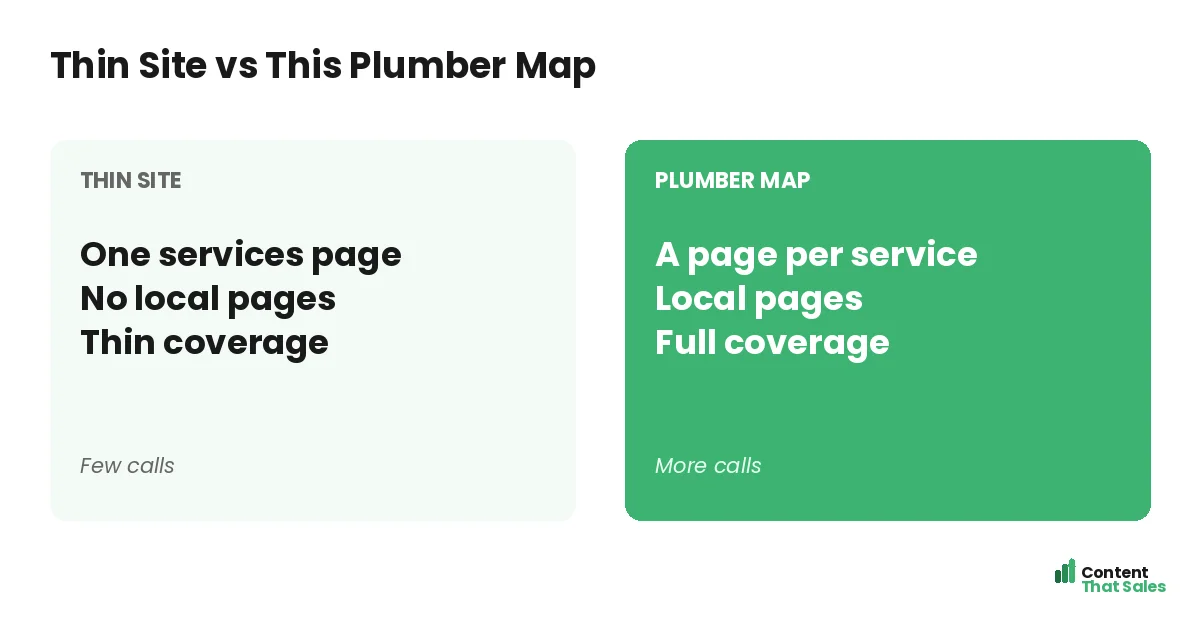
This plumber map works because it covers every service in depth, every area locally, and every common question, all connected by links and pointed to a call. It builds local authority while capturing the urgent, high-intent searches that book jobs.
It blends service pillars, local pages, and question content to cover the full local journey. That balance makes the map both authoritative and conversion-focused, exactly what a local plumber needs to win work. Over time, as the plumber finishes each service cluster and adds more suburbs, the map deepens into complete local coverage that competitors with a single thin services page simply cannot match, capturing demand by service, by suburb, and by urgent need all at once.
How to Adapt It to Your Trade
To adapt this for any local trade, swap in your own services as pillars, add your service areas and service-plus-city pages, and cover the common questions in your trade. The structure, service pillars plus local pages plus questions, stays the same.
Whether you are an electrician, builder, or cleaner, this pattern works. Simple, clear content keeps winning, since easy reading lifts engagement. Use this plumber example as a template and fill it with your trade’s specifics.
Put It All Together
This topical map example for a local plumber website shows a complete structure: plumbing services as the core, pillars for drain cleaning, hot water, leak detection, and emergency plumbing, plus local and service-plus-city pages, all linked.
It blends service depth, local coverage, and question content to rank and book jobs. Adapt the structure to your own trade, fill it with your services and areas, and link it well. This blueprint shows exactly how a local trade map comes together, from the core service down to each suburb page, ready for you to copy.
How Content That Sales Helps
We build local trade maps like this example. That’s where we come in. At Content That Sales, we design your map, cover your services and areas, and write the connected pages that rank locally and book jobs.
You share your trade and areas. We plan the service pillars, local pages, and questions, write the content, and link it to a call. The result is complete local coverage modeled on this proven structure, tailored to your business.
Ready to Build Your Trade Map?
Now you have seen a complete topical map example for a local plumber website: core service, service pillars, local pages, and links. Adapt it to your trade and fill it with your specifics. So why not build your map on this proven blueprint?
Let’s build your local trade map. Book your free consultation now. Call us at 8801631988589 or email service@contentthatsales.com. Let’s turn this blueprint into booked jobs.
Frequently Asked Questions About This Plumber Map
What is the core topic of this plumber map?
Plumbing services, the central subject the whole site is built around. Every service, location page, and question branches from this core.
What are the service pillars?
Drain cleaning, hot water systems, leak detection, and emergency plumbing, each a service the plumber offers, covered broadly with deep clusters beneath.
Why include emergency plumbing?
Emergency searches are high-intent, customers need help now. This pillar captures urgent jobs with prominent calls to action so customers call fast.
What are service-plus-city pages?
Pages combining a service and a location, like drain cleaning in a suburb. They capture the highest-intent local searches from ready-to-book customers.
Where do the cluster pages come from?
From real research into what customers search around each service, like blocked drains or hot water repair. They provide the depth and most of the traffic.
How does the map link together?
Service pillars link to clusters and local pages, clusters link back, local pages link to services, and everything connects to a contact or quote page.
Can I adapt this for another trade?
Yes. Swap in your services as pillars, add your areas and service-plus-city pages, and cover your trade’s questions. The structure stays the same.
Can Content That Sales help?
Yes. We build local trade maps like this example, tailored to your business and built to rank and book jobs. Reach out for a quick quote.