 Skip to content
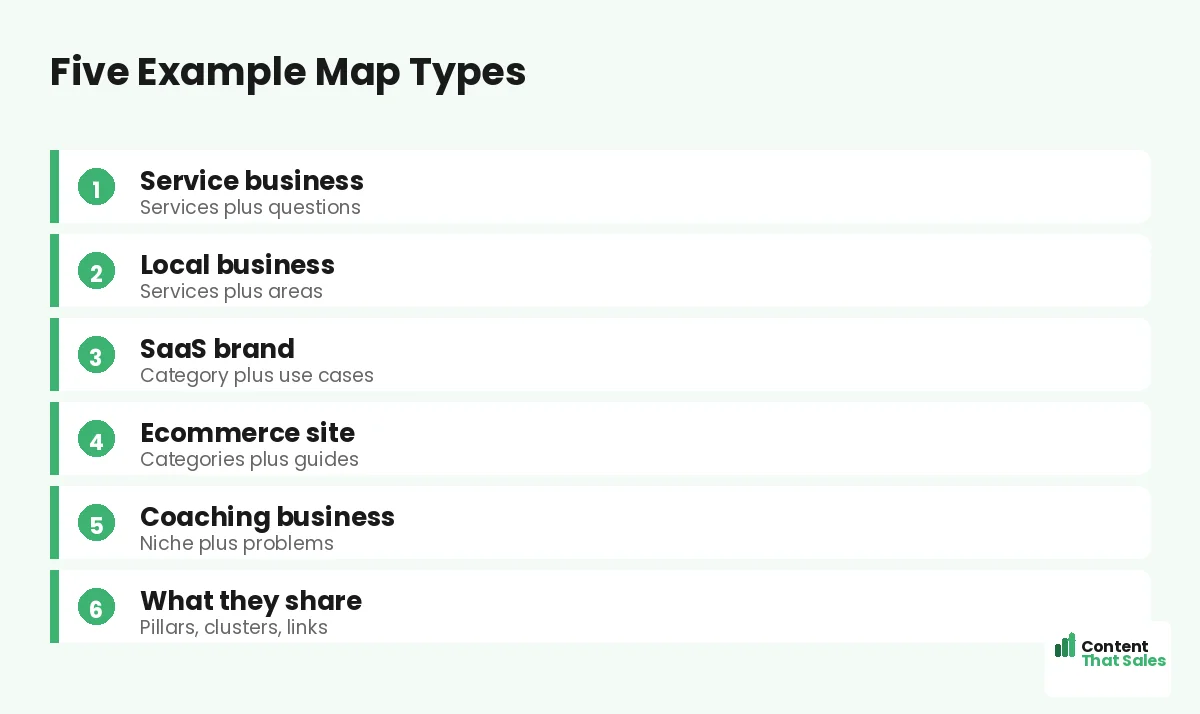
Studying real topical map examples is one of the fastest ways to understand how the strategy works in practice, so here are 5 topical map examples worth studying, one each for a service business, a SaaS brand, an ecommerce store, a local business, and a coaching practice. Rather than abstract theory, these examples show how a core topic, pillars, and clusters come together in different industries, and what they all share. This guide breaks each one down.
Every strong topical map follows the same underlying pattern, a core topic, broad pillars, and deep cluster pages, but how it looks varies by business. Seeing that pattern across five examples makes it concrete and easy to apply to your own site.
Below, we walk through five example map types, the lessons each teaches, and the common DNA they all share.

What These Examples Show
Each example shows a real-world topical map structure for a type of business. They demonstrate how to choose a core topic, define pillars, and fill clusters, adapted to each industry’s needs. Together they reveal the flexible pattern behind every good map.
If you want the fundamentals first, see our guide on what a topical map is. These examples then show the concept in action, so you can model your own map on a structure that fits your business.
Example 1: A Service Business Map
A service business map centers on the core service, with a pillar for each service offered and clusters covering questions, cost, and process. For example, a cleaning company would have pillars for each cleaning service, surrounded by client questions.
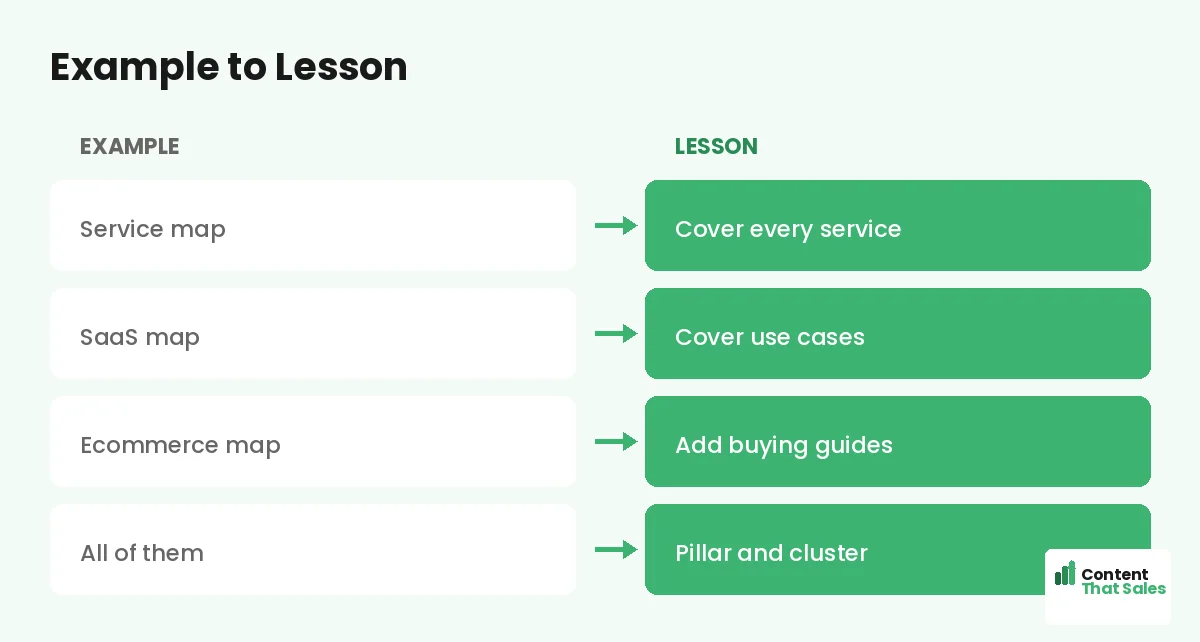
The lesson: cover every service in depth and answer the questions buyers ask. See our full guide on a topical map for a service business for the detailed build. Service maps win by complete service coverage plus trust content.
Example 2: A SaaS Map
A SaaS map centers on the product category, with pillars for use cases, comparisons, and integrations, and clusters covering each specific use case and competitor comparison. It captures buyers across the whole research journey to signup.
The lesson: cover use cases and comparisons, not just features. See our guide on a topical map for SaaS companies for the full structure. SaaS maps win by covering buyer needs across the funnel.
Example 3: An Ecommerce Map
An ecommerce map centers on product categories, with each category as a pillar surrounded by buying guides, comparisons, and how-to content, all linked to product pages. It captures shoppers researching before they buy and sends them to products.
The lesson: surround categories with guides and comparisons. See our guide on a topical map for ecommerce brands for the detail. Ecommerce maps win by capturing the research that happens before the product search.
Example 4: A Local Business Map
A local business map centers on the core service, with pillars for each service and pages for each area served, including service-plus-city pages. It captures local searches by service, by location, and by both, owning the local market.
The lesson: cover services and areas as a grid. See our guide on a local topical map for the full approach. Local maps win by complete coverage of every service in every area you serve.
Example 5: A Coaching Map
A coaching map centers on the niche, with pillars for client problems and your method, and clusters covering specific struggles, advice, and results. It attracts ideal clients by speaking to their problems and proving your approach works.
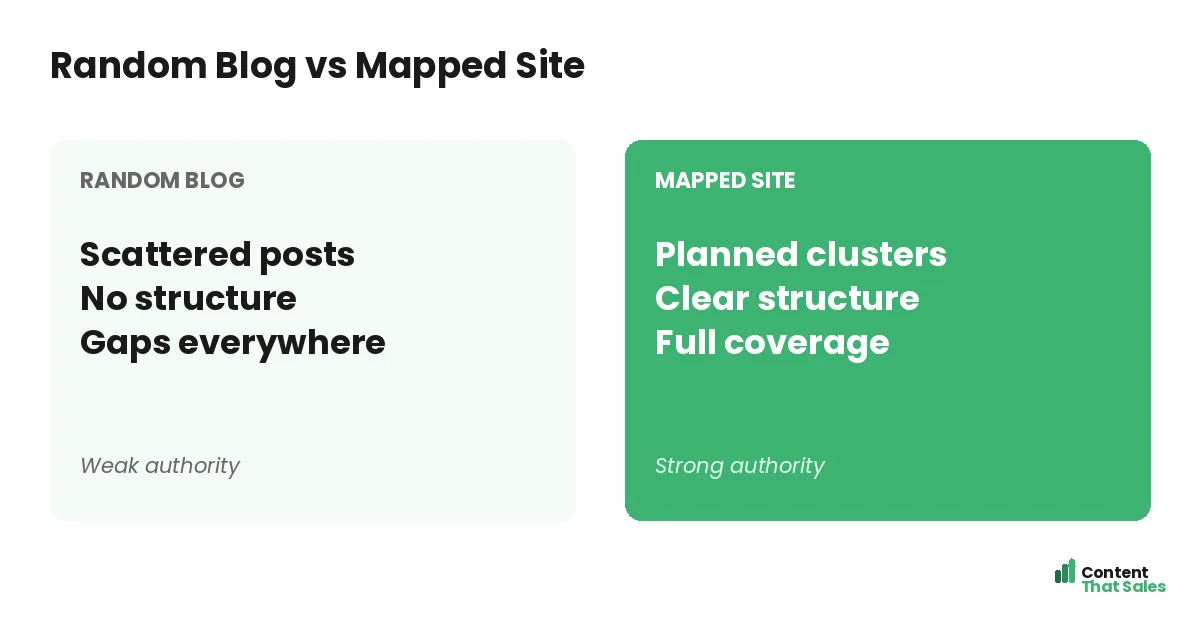
The lesson: cover client problems and your method, not random topics. A focused coaching map builds the authority and trust that turn readers into clients. It wins by depth in one niche rather than scattered, unfocused posts.
Did you know?
Across every industry, the best topical maps share the same DNA, a core topic, broad pillars, and deep cluster pages connected by internal links.
What They All Share
Despite serving different industries, all five examples share the same DNA: a clear core topic, broad pillar pages, deep cluster pages, and internal links connecting them. The structure is universal; only the specific topics change by business.
This is the key takeaway. Whatever your industry, the pattern is the same, choose a core, define pillars, fill clusters, and link them. Since readers scan more than they read, each example also keeps its pages focused and scannable.
The Common Pattern
Every example follows pillar and cluster. A broad pillar covers a topic, deep clusters cover its subtopics, and links tie them together. This is the pillar-and-cluster framework applied across industries, the engine behind all five maps.
Recognizing this pattern means you can build a map for any business by applying the same steps. The examples differ in their topics but not in their structure. Master the pattern, and you can map any subject in any field.
How to Apply These Examples
To apply what these examples teach, identify your business type, then model your map on the matching example: choose your core, define your pillars, fill your clusters, and link them. Adapt the structure to your specific topics and audience.
Do not copy the topics, copy the structure. Your map will have your services, your category, or your niche, but the same pillar-and-cluster shape. The examples give you a proven template to adapt, not a fixed plan to replicate.
Study Maps in Your Own Niche
Beyond these examples, study the sites that rank in your niche. Look at how they structure their content, what pillars they have, and how they cluster topics. Real ranking sites are living examples you can learn from and aim to beat.
Note their coverage and their gaps. Where they are thin, you can be thorough. Studying real examples in your field, alongside these five, gives you both a structure to follow and opportunities to outdo the competition.
Put It All Together
These five topical map examples, service, SaaS, ecommerce, local, and coaching, show the strategy across industries. Each adapts the same pattern: a core topic, broad pillars, deep clusters, and internal links. The structure is universal; the topics vary.
Study the example that matches your business, copy the structure not the topics, and study ranking sites in your niche too. Simple, clear content keeps winning, since easy reading lifts engagement. Apply the pattern, and you can map any subject.
How Content That Sales Helps
We build maps modeled on what works. That’s where we come in. At Content That Sales, we study the best structures in your industry, design your topical map, and write the connected pages that build authority and rank.
You share your business and goals. We apply the proven pattern to your niche, plan your pillars and clusters, and produce the content. The result is a topical map modeled on real examples and tailored to your business.
Ready to Build Your Map?
Now you have five topical map examples worth studying and the pattern they share: core, pillars, clusters, links. The structure is universal. So why not model your map on what already works in your industry?
Let’s build your map on a proven pattern. Book your free consultation now. Call us at 8801631988589 or email service@contentthatsales.com. Let’s turn a proven structure into your authority.
Frequently Asked Questions About Topical Map Examples
Why study topical map examples?
Examples make the strategy concrete. Seeing how core topics, pillars, and clusters come together across industries helps you apply the pattern to your own site.
What do all the examples share?
The same DNA: a clear core topic, broad pillar pages, deep cluster pages, and internal links connecting them. Only the specific topics change by business.
What does a service business map look like?
A core service with a pillar per service and clusters covering questions, cost, and process. It wins by complete service coverage plus trust content.
What does a SaaS map look like?
A product category core with pillars for use cases, comparisons, and integrations. It wins by covering buyer needs across the funnel, not just features.
What does an ecommerce map look like?
Product categories as pillars surrounded by buying guides and comparisons, linked to products. It wins by capturing research before the product search.
How do I apply these examples?
Identify your business type, model your map on the matching example, and copy the structure, not the topics. Adapt it to your specific subjects and audience.
Should I study ranking sites too?
Yes. Real sites that rank in your niche are living examples. Note their coverage and gaps, then be thorough where they are thin to outdo them.
Can Content That Sales help?
Yes. We study what works in your industry and build your map and content on a proven pattern. Reach out for a quick quote.