 Skip to content
The honest answer to how many cluster posts each pillar should have is: as many as the topic genuinely needs, no more and no less. There is no magic number. A pillar needs enough cluster posts to cover every real subtopic people search, but forcing extra pages just to hit a count creates thin content that hurts more than it helps. This guide shows you how to decide the right number for each pillar.
Many people want a fixed rule, like five or ten posts per pillar. But subjects vary. One pillar might warrant six cluster posts, another twenty. The right count comes from the topic and its real demand, not an arbitrary quota.
Below, we walk through what actually decides the count, how to avoid thin and forced posts, and how to know when a cluster is complete.

There Is No Magic Number
The first thing to accept is that there is no universal number of cluster posts per pillar. Anyone who gives you a fixed figure is guessing. The right count depends entirely on how many real subtopics your pillar contains and what people search.
This is the same principle as judging topical map depth. Cover what the topic genuinely warrants. A small pillar may need a handful of posts; a large one may need many. Let the subject decide, not a rule of thumb.
Cover the Real Subtopics
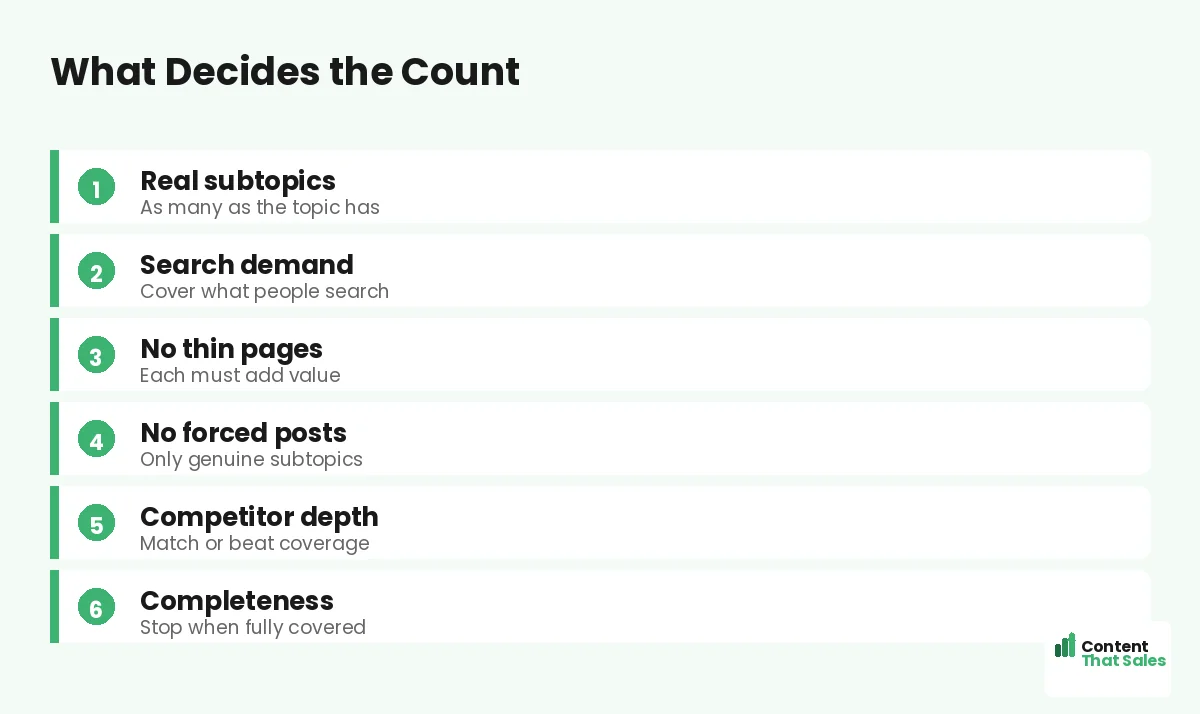
The core rule is to cover every real subtopic beneath the pillar. Each meaningful question or angle that people search deserves its own cluster post. The number of cluster posts is simply the number of genuine subtopics worth a page.
So start by listing the real subtopics, drawn from keyword research and questions people ask. That list, validated for demand, becomes your cluster post count, drawn from the way you find cluster topics that support the pillar. The number falls out of the coverage, rather than being decided in advance.
Let Search Demand Guide You
Search demand is your best guide. If people search a subtopic, it warrants a cluster post. If no one searches it, a post there adds thin content with no traffic. Let demand, not a target number, decide which subtopics become pages.
Use keyword research to find the real subtopics and their demand. The ones with genuine interest become cluster posts; the ones with none are skipped. This keeps your count grounded in reality and your cluster focused on pages that can rank.
Quality Over Quantity
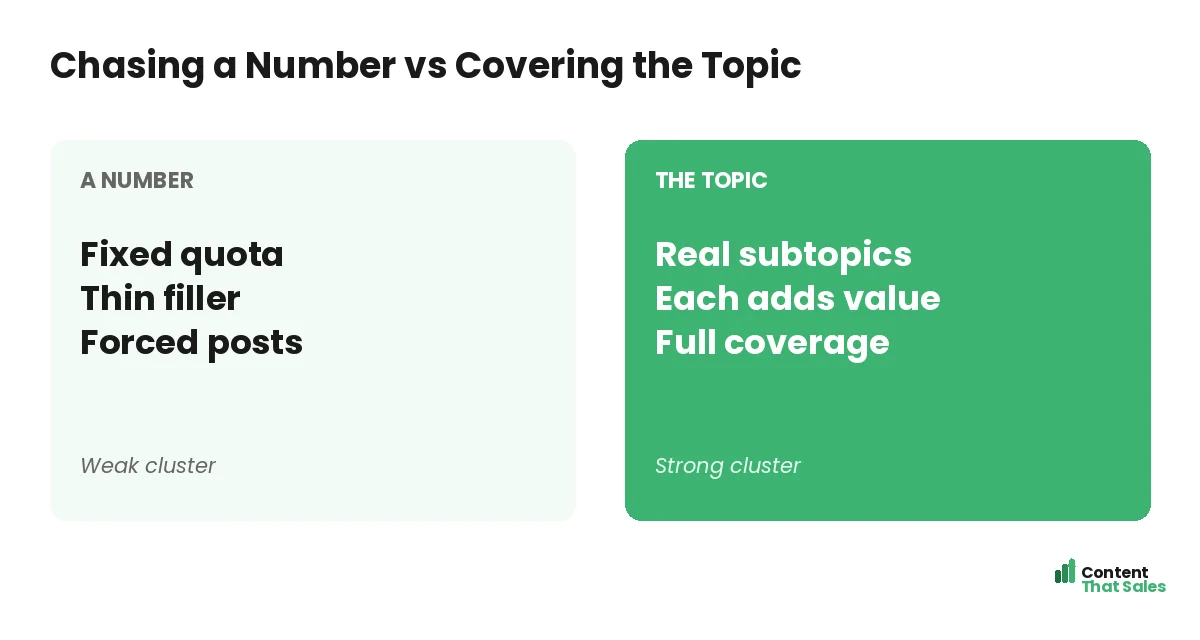
More posts is not automatically better. A pillar with ten strong, useful cluster posts beats one with thirty thin ones. Each cluster post must add real value and answer a real search. Quality, not quantity, is what builds topical authority.
Resist the urge to pad your cluster to look comprehensive. Since readers scan more than they read, thin filler pages frustrate them and weaken your map. Fewer, stronger posts that fully cover the real subtopics win every time.
Avoid Thin Pages
Going too far produces thin pages, posts so narrow there is little to say and little demand. Thin pages signal low quality and dilute your authority. If a subtopic cannot support a genuinely useful page, do not create one.
Before adding a cluster post, ask whether it can stand on its own with real value and an audience. If not, fold it into a broader post. Avoiding thin pages keeps your cluster strong, however many posts that turns out to be.
Do Not Force Posts
Equally, do not force posts to hit a number. Inventing subtopics no one searches, just to reach a quota, weakens your cluster. The count should reflect the real subtopics that exist, not an artificial target you feel you must meet.
A pillar is complete when you have covered its real subtopics well, whether that is six posts or twenty-six. Completeness, not a number, is the goal. Forcing posts beyond real demand adds dead weight rather than authority.
Did you know?
A pillar with ten strong cluster posts usually outperforms one with thirty thin ones, because Google rewards genuine coverage, not page count.
Check Competitor Depth
Competitors give a useful benchmark. Look at how deeply the top-ranking sites cover your pillar topic. To compete, you generally need to match or exceed their coverage of the real subtopics, not with filler, but with genuine, useful pages.
If competitors cover fifteen solid subtopics and you cover five, you have gaps to fill. If they pad with thin pages, you can win by covering the real subtopics better. Use competitor depth as a guide to completeness, not a number to copy blindly.
Know When the Cluster Is Complete
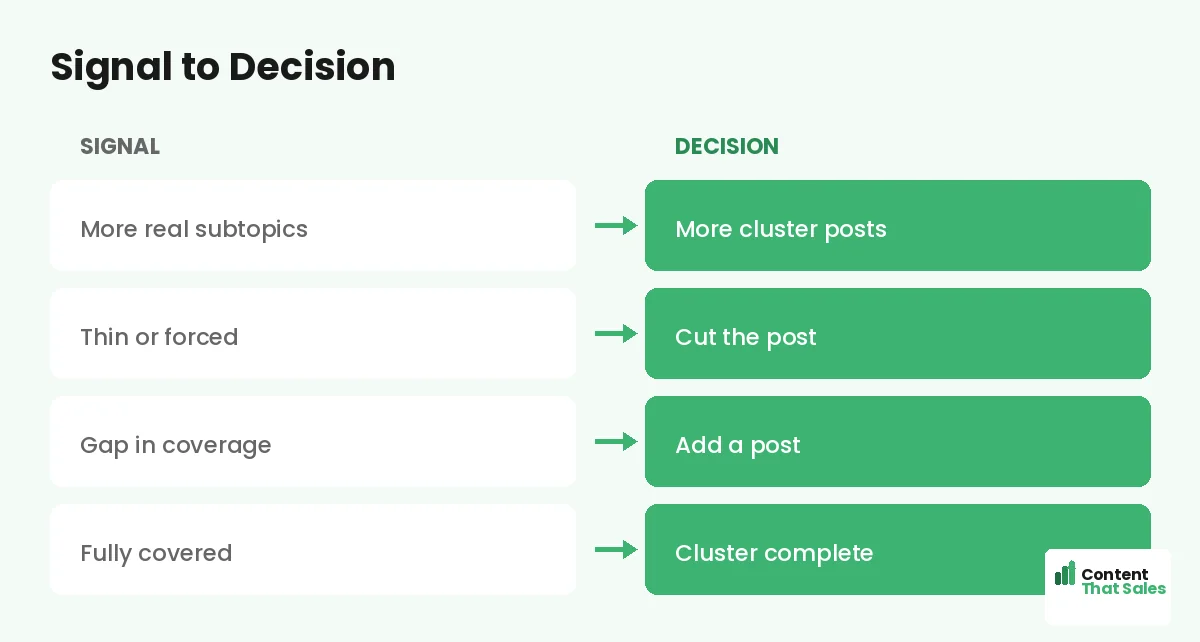
A cluster is complete when you have covered every real, in-demand subtopic with a useful page, and adding more would mean thin or unsearched content. That is your natural stopping point, regardless of the final count.
Watch for the signs: subtopics with no search data, ideas that overlap existing posts, angles you are inventing. When you hit those, the cluster is done. Completeness of real coverage, not a target, tells you when to stop.
Different Pillars, Different Counts
Expect your pillars to have different numbers of cluster posts, and that is fine. A broad, deep pillar may need many posts; a narrower one, fewer. A balanced map has pillars sized to their real subtopics, which starts with how you identify pillar topics, not all forced to the same count.
If every pillar somehow needs exactly the same number, that is a sign you are working to a quota rather than the topic. Let each pillar be as deep as its subject warrants. Varied counts across pillars reflect honest, demand-driven coverage.
Grow the Cluster Over Time
Your cluster count is not fixed forever. As new questions emerge and search trends shift, you can add cluster posts where new demand appears. A cluster complete today may grow tomorrow as the subject evolves.
Simple, clear content keeps winning, since easy reading lifts engagement. Revisit each pillar periodically, add posts for genuine new subtopics, and your clusters stay complete. The right count is a moving target tied to real demand.
Put It All Together
How many cluster posts should each pillar have? Exactly enough to cover every real, in-demand subtopic with a useful page, no more and no less. Forget magic numbers. Let the topic and its demand decide, and prioritize quality over quantity.
Cover the real subtopics, avoid thin and forced pages, check competitor depth, and stop when the cluster is genuinely complete. Expect different counts for different pillars, and grow them over time. Honest, demand-driven coverage is what builds authority.
How Content That Sales Helps
We size every cluster to its real demand. That’s where we come in. At Content That Sales, we research the genuine subtopics under each pillar, skip the filler, and write the cluster posts that fully cover the topic.
You share your pillars and goals. We find the real subtopics, validate demand, and produce the right number of strong cluster posts, no padding, no gaps. The result is clusters sized for authority, not for an arbitrary quota.
Ready to Build Complete Clusters?
Now you know how many cluster posts each pillar should have: enough to cover every real subtopic, no more. Forget magic numbers and let demand decide. So why pad a cluster with filler or leave it full of gaps?
Let’s size and build your clusters right. Book your free consultation now. Call us at 8801631988589 or email service@contentthatsales.com. Let’s cover your topics completely, without the filler.
Frequently Asked Questions About Cluster Posts Per Pillar
How many cluster posts should a pillar have?
As many as cover every real, in-demand subtopic with a useful page, no more and no less. There is no magic number; the topic and its demand decide.
Is there a fixed rule like five or ten?
No. Subjects vary. One pillar may warrant six cluster posts, another twenty. A fixed figure is guesswork. Cover the real subtopics that exist.
What decides the count?
The number of genuine subtopics people search beneath the pillar. List the real subtopics, validate demand, and that becomes your cluster post count.
Is more posts always better?
No. Ten strong, useful posts beat thirty thin ones. Each post must add real value and answer a real search. Quality builds authority, not quantity.
What is a thin page?
A post so narrow there is little to say and little demand. Thin pages signal low quality and dilute authority, so do not create them just to add count.
Should pillars have the same count?
No. Expect different counts. A broad pillar needs more posts; a narrow one, fewer. Identical counts usually mean you are working to a quota, not the topic.
How do I know a cluster is complete?
When every real, in-demand subtopic is covered and adding more would mean thin or unsearched content. That natural stopping point is the right count.
Can Content That Sales help?
Yes. We research the real subtopics under each pillar and write the right number of strong cluster posts, no filler, no gaps. Reach out for a quote.