 Skip to content
A landing page wireframe template with copy prompts lets you plan the whole page, block by block, before you write a polished word or touch a design tool. The wireframe maps what goes where, and the copy prompt for each block tells you what to say. Together they turn a blank canvas into a clear plan. This guide gives you a complete wireframe with a prompt for every block, so you can build a converting page fast and never miss a key section.
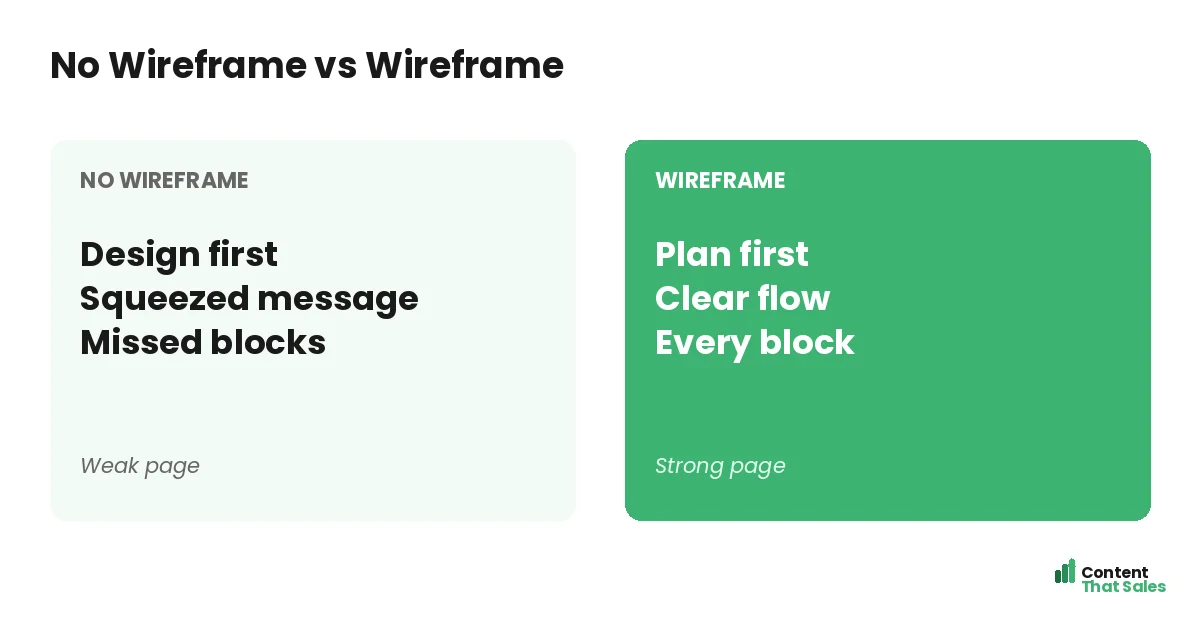
Why wireframe first? Because design without a plan squeezes the message to fit a layout, and writing without a plan wanders. A wireframe locks in the structure and the message order up front. Then design and copy both serve the plan. Let’s walk through the blocks.
Below, we give you each wireframe block, its job, and the copy prompt to fill it, plus tips to turn the wireframe into a finished page.

Why Wireframe Before You Design
A wireframe is a simple skeleton of the page, boxes and labels, no polish. It forces you to decide the order and purpose of every block before colors and images distract you. Plan the message, then let the design serve it, not the other way around.
This mirrors the proven flow in the best landing page structure. A wireframe is that structure made visual. With it, you never forget proof or a clear CTA, and your designer and writer work from the same clear plan.
Block 1: The Hero
The hero is the top of the page, above the fold. It holds the headline, a supporting subhead, a primary CTA, and a relevant visual. This block decides whether the visitor stays, so it carries the most weight.
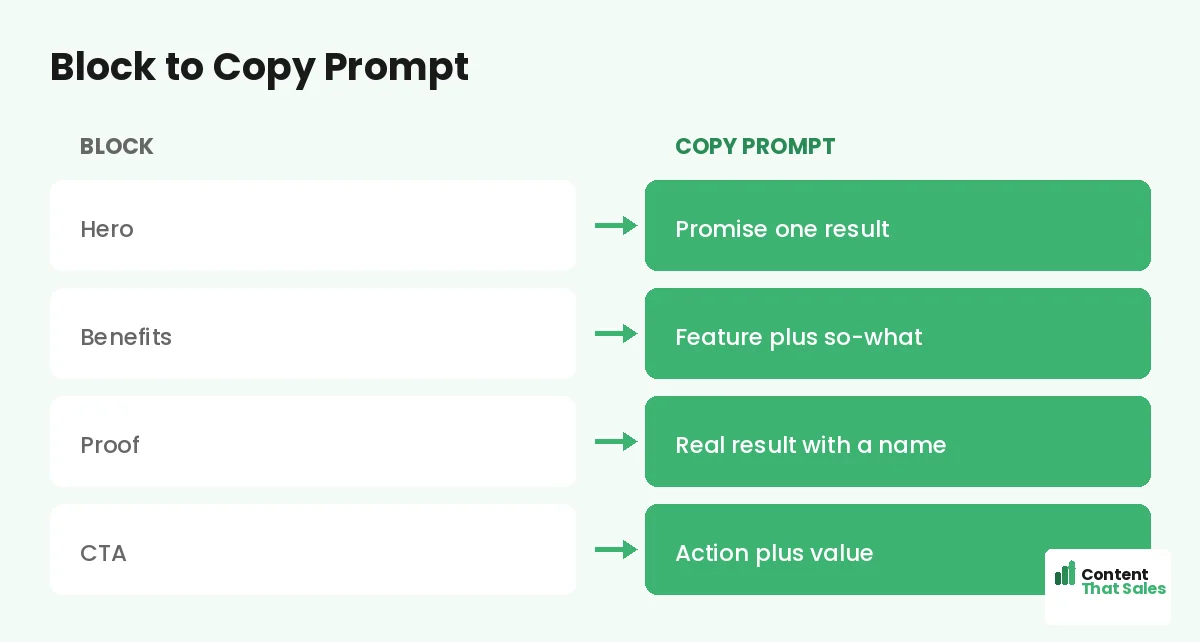
Copy prompt: write a headline that promises one clear result, a subhead that adds the how or proof, and a button that names the value. Example: “Get more booked jobs in 30 days,” with “Start with a free quote.” The hero earns the scroll.
Block 2: The Problem
Right below the hero, name the problem your reader faces. This block builds trust by showing you understand their situation before you pitch. It connects emotionally and sets up your solution.
Copy prompt: describe the pain in the reader’s words, then hint at relief. Example: “Tired of ads that bring clicks but no calls? You are not alone.” Keep it short and empathetic. The problem block makes the reader feel seen.
Block 3: The Benefits
The benefits block shows what the reader gains. Use three to five points, each framing a feature as a customer win. This is where desire is built, so lead with results, not specs.
Copy prompt: for each benefit, write “[feature] so you [benefit].” Example: “Done-for-you copy so you wake up to a finished page.” People scan more than they read, so keep each benefit short and scannable.
Block 4: The Proof
The proof block turns claims into belief. It holds testimonials, reviews, logos, numbers, and results. Place your strongest proof here and again near the final CTA, where doubt peaks. This block builds the trust that drives action.
Copy prompt: pair a number with a specific testimonial. Example: “Trusted by 200 owners. ‘We doubled our leads in 90 days.’ Mark, Denver.” Real, specific proof beats vague praise. This block answers the reader’s silent “prove it.”
Block 5: The Offer and CTA
This block makes the offer clear and asks for the action. Spell out what the reader gets, then give one clear, low-risk call to action. Repeat the same CTA from the hero so the page stays focused on one goal.
Copy prompt: “[What they get]. [Action] for [value], [reassurance].” Example: “Get a custom landing page. Book your free call, no obligation.” Follow solid landing page CTA best practices so the button converts.
Did you know?
Planning a page as a wireframe first usually produces a stronger result than designing as you go, because the message leads and the design follows.
Block 6: The Trust Close
The final block seals the deal. It holds a guarantee, a short FAQ, and any last trust signals. This is where hesitation lives, so meet it with reassurance and clear answers, then repeat the call to action one last time.
Copy prompt: answer the top two or three objections, add a guarantee, and restate the CTA. Example: “30-day guarantee. Cancel anytime. Book your free call.” The trust close turns a maybe into a yes right before the reader leaves.
How the Blocks Map to the Anatomy
These wireframe blocks are the same parts you find in the anatomy of a landing page, arranged as a layout. The wireframe just makes the order visual and adds a copy prompt to each. Structure and message stay in sync.
Once the wireframe is filled, you have both a layout and a first draft of copy. Hand it to a designer or build it yourself. Either way, every block has a job and a line of copy, so nothing important gets missed.
Turn the Wireframe Into Copy
Work down the wireframe, filling each prompt with your real details. Do not polish yet, just get the message down. Once every block has copy, read the whole page aloud to smooth the flow between blocks.
Then refine. Cut filler, sharpen the headline, and make each benefit specific. To level up the wording, see how to write landing page copy that converts. The wireframe gives you the bones; your copy gives them life.
Keep It Mobile-First
Wireframe for the phone first, since most visitors arrive on mobile. Stack the blocks in a single column and make sure the hero, with its headline and CTA, fits the small screen. A mobile-first wireframe prevents a cramped, clunky page later.
Check that the primary CTA is reachable early and repeated as the reader scrolls. Plan a sticky button if the page is long. A wireframe built for mobile from the start saves painful redesigns down the road.
Use the Wireframe Every Time
Keep this wireframe as your default. For every new page, start by filling the blocks before you design or write polished copy. It makes each page faster to build and more consistent in quality. One wireframe, used again and again.
Over time, the wireframe becomes second nature. You will spot a missing block instantly and plan a converting page in minutes. Simple, clear copy in each block wins, since easy reading lifts conversions.
The Full Wireframe at a Glance
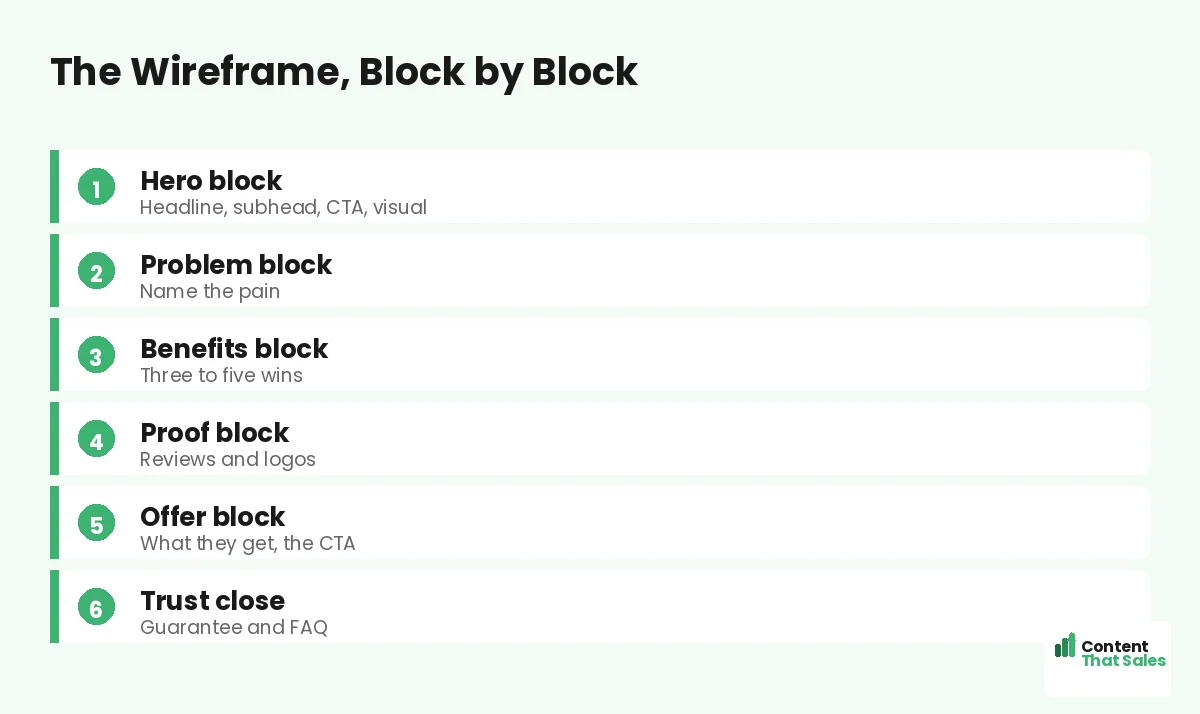
Here is the whole wireframe in order: hero with headline, subhead, CTA and visual; the problem; the benefits; the proof; the offer and CTA; and the trust close with a guarantee and FAQ. Each block has a copy prompt, so you always know what to write.
Fill it top to bottom and you have a planned, converting page. Pair it with the landing page copy template for ready-made prompts, and you can go from blank canvas to finished page in record time.
How Content That Sales Uses Wireframes
We plan every page as a wireframe before a word is polished. That’s where we come in. At Content That Sales, we map the blocks, fill each prompt with copy tailored to your offer, and hand you a page ready to design and convert.
You share your offer and your goal. We wireframe and write the page so the message leads and nothing is missed. The result is a focused page built on a clear plan, not a guess.
Ready to Turn Visitors Into Customers?
Now you have a landing page wireframe template with copy prompts. Plan the hero, the problem, the benefits, the proof, the offer, and the trust close, with a prompt for each. So why design blind when a wireframe gives you a clear plan?
Let’s wireframe and write a page that converts. Book your free consultation now. Call us at 8801631988589 or email service@contentthatsales.com. Let’s turn your next visitor into your next customer.
Frequently Asked Questions About Landing Page Wireframes
What is a landing page wireframe?
A wireframe is a simple skeleton of the page, boxes and labels with no polish. It maps what goes where, so you plan the structure and message before designing.
Why wireframe before designing?
Designing first squeezes the message to fit the layout. A wireframe locks in the structure and message order, so design and copy both serve a clear plan.
What blocks does the wireframe include?
Hero, problem, benefits, proof, offer and CTA, and a trust close. Each block has a job and a copy prompt, so nothing important gets missed.
What is a copy prompt?
A short instruction for what to write in each block, like “promise one result” for the hero. Prompts turn a blank wireframe into a first draft fast.
Should the wireframe be mobile-first?
Yes. Most visitors are on mobile. Stack blocks in one column and make sure the hero and CTA fit a small screen to avoid a cramped redesign later.
How does the wireframe relate to the page structure?
It is the same proven structure made visual. The wireframe arranges the anatomy of a landing page as a layout and adds a prompt to each block.
Can I reuse the wireframe?
Yes. Use it as your default for every page. It speeds up building and keeps quality consistent, so you never start from a blank canvas.
Can you wireframe and write my page?
Yes. Content That Sales plans and writes pages from a proven wireframe. Reach out for a quick quote.