 Skip to content
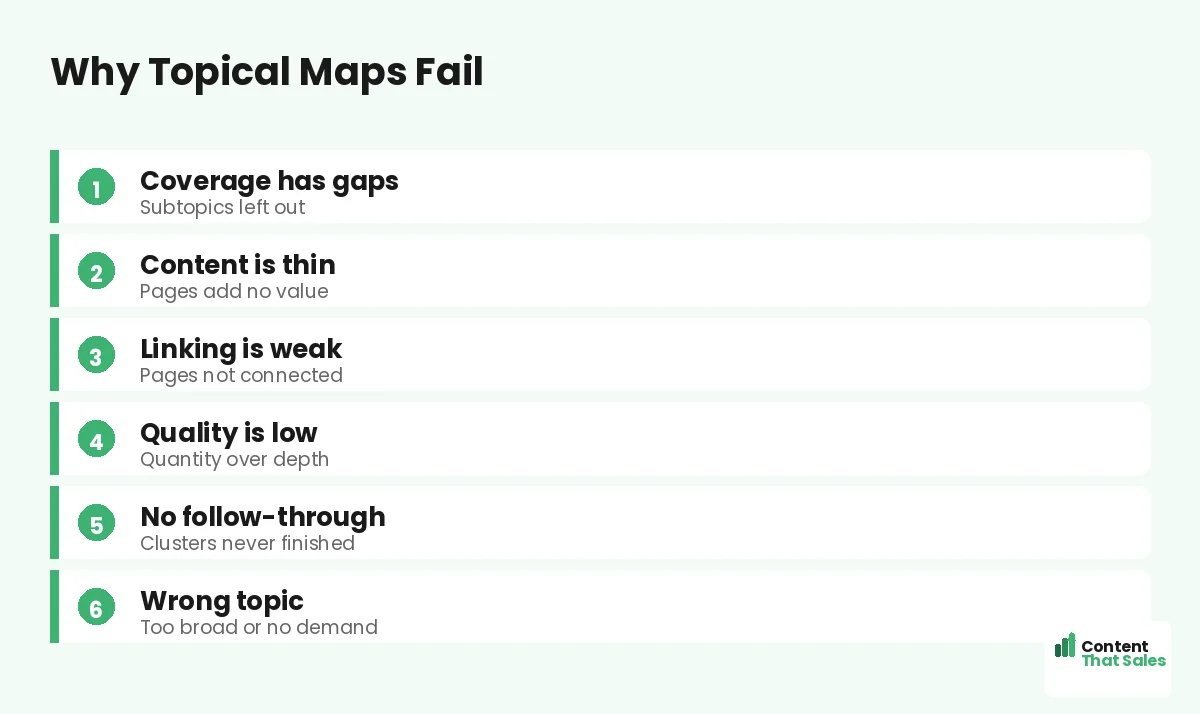
Understanding why most topical maps fail to build authority is the key to making yours succeed, because the failures almost always trace to a handful of avoidable causes: incomplete coverage, thin content, weak linking, and no follow-through. A topical map is only as good as its execution, and most maps stumble not on strategy but on the doing. This guide explains why maps fail and how to make yours work.
Plenty of sites build a topical map and still do not rank. The map looks right on paper, but the authority never comes. The reasons are consistent, and once you know them, they are all fixable. Let’s examine why maps fail.
Below, we walk through the real reasons topical maps fail to build authority and how to avoid each, so your map delivers the rankings it promises.

Maps Fail on Execution, Not Strategy
The first truth is that most maps fail in the doing, not the planning. The strategy, cover a subject completely and link it well, is sound. Maps fail when that strategy is executed poorly: gaps left, thin pages published, links skipped.
So the fixes are about execution. A map built on solid topical map fundamentals and executed well builds authority. Understanding the execution failures is how you avoid them.
Incomplete Coverage
The most common failure is incomplete coverage. A map that leaves subtopics uncovered does not signal complete expertise, so it does not earn full authority. Gaps in coverage are gaps in authority, and they hold the whole map back.
The fix is thoroughness. Cover every meaningful subtopic in your subject, leaving no obvious holes. Complete coverage is what tells Google you are the expert. A map with gaps is a map that fails to convince.
Thin, Shallow Content
Maps fail when their pages are thin. Covering many subtopics with shallow content does not build authority; Google rewards genuine depth and usefulness, not just the presence of a page. Thin content actively undermines the map.
The fix is quality on every page. Each should genuinely help the reader and cover its subtopic well. A map of deep, useful pages builds authority; a map of thin ones does not, no matter how complete the coverage looks.
Weak Internal Linking
Many maps fail because the pages are not connected. Without strong internal linking, authority does not flow and the pages do not work as a cluster. The structure exists on paper but not in the links that actually build it.
The fix is to connect everything. Strong internal linking ties the map into a cluster that ranks. Link pillars to clusters, clusters to pillars, and related pages to each other. Linking is what activates the map.
Quantity Over Quality
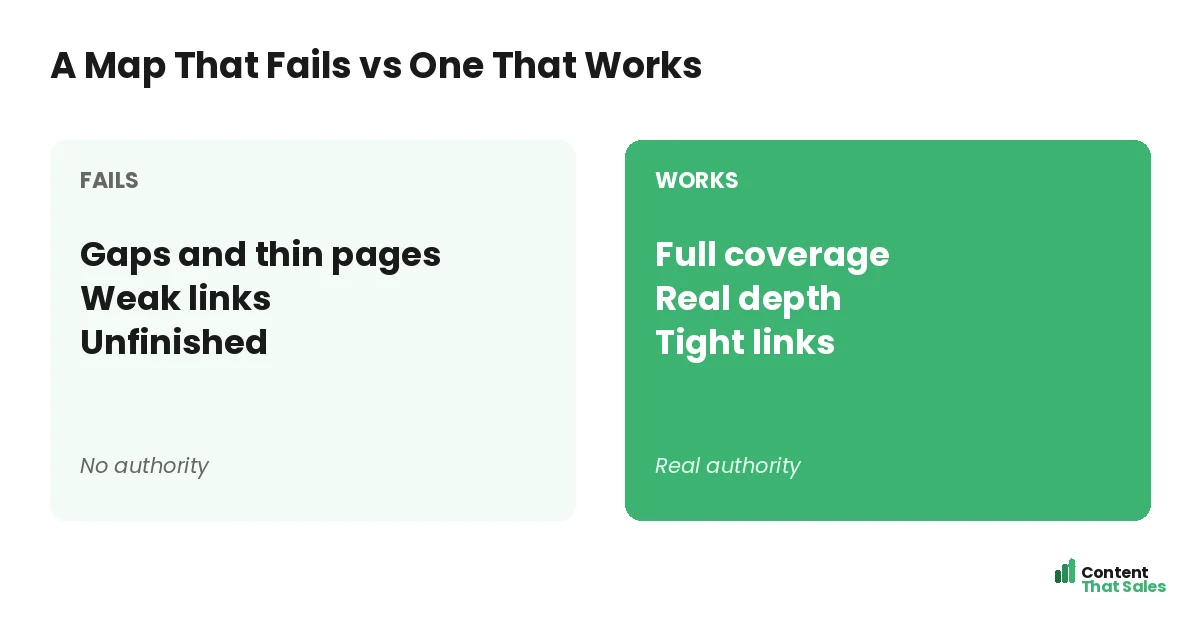
Some maps fail by chasing quantity, publishing as many pages as possible rather than as good as possible. Volume without quality produces a bloated map of weak pages that dilutes rather than builds authority. More is not better.
The fix is to prioritize quality and real demand. Fewer, stronger pages that cover real subtopics beat a pile of thin ones. A focused, high-quality map outperforms a large, shallow one every time.
No Follow-Through
A huge reason maps fail is simply not finishing them. A great map planned but only half-built never reaches the coverage that builds authority. Clusters started and abandoned leave the map incomplete and underpowered.
The fix is follow-through: finish your clusters, one at a time, until the map is complete. This finishing discipline is the heart of a sound topical map strategy. A finished map builds authority; an abandoned one does not.
The Wrong Core Topic
Maps fail when the core topic is wrong, too broad to cover, too narrow to matter, or with no real demand. A flawed core undermines everything built on it. No amount of good execution saves a map anchored on the wrong subject.
The fix is choosing the right core topic: focused, in-demand, and ownable. Get the core right, and the rest of the map has a solid foundation. Get it wrong, and the map struggles from the start.
Did you know?
Most topical maps fail on execution, not strategy, half-built clusters and thin pages, which means most failures are entirely fixable with follow-through.
Ignoring Search Intent
Maps fail when pages ignore what searchers actually want. A page that misreads intent will not rank or satisfy readers, even within a well-structured map. Coverage and links cannot save content that does not match intent.
The fix is to match each page to its real intent. Since readers scan more than they read, study what ranks and deliver what the searcher needs. Intent-matched pages are what make a map’s coverage actually rank.
Impatience
Many maps are judged a failure too soon. SEO takes time, and a map needs weeks or months to build authority and rank. Sites that abandon a map because it has not worked in a few weeks give up right before it would pay off.
The fix is patience. Keep building and publishing, and give the map time to mature. Authority compounds slowly, then noticeably. A map declared a failure prematurely was often just not given the time it needed to work.
How to Make Your Map Succeed
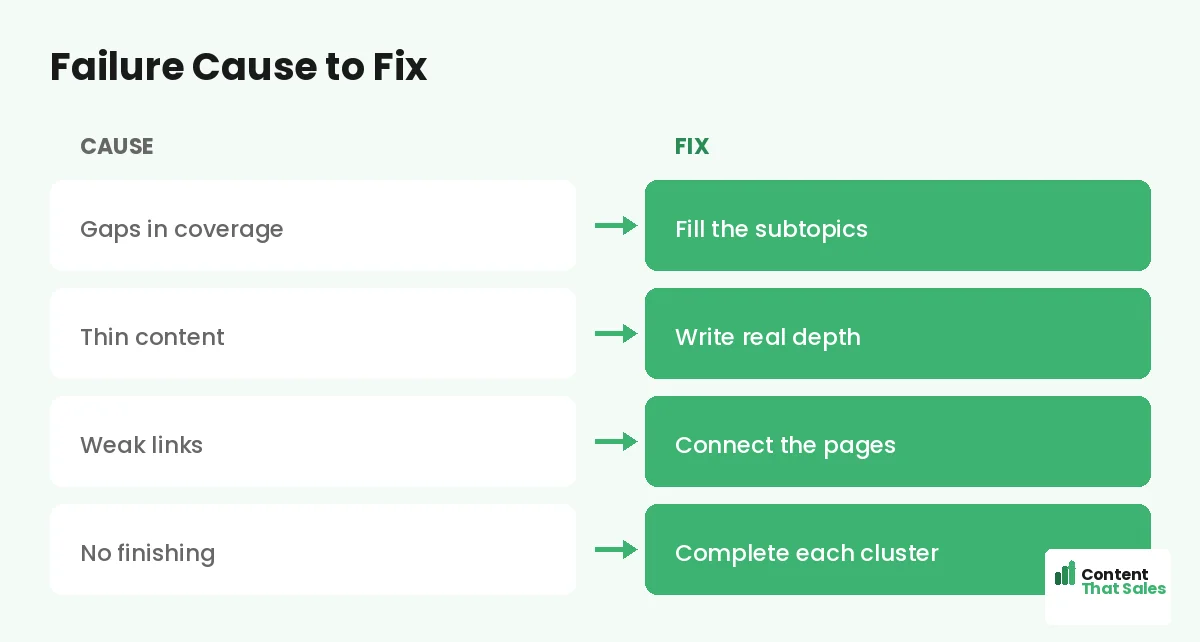
To make your map succeed, address each failure: cover the subject completely, write deep and useful pages, link everything tightly, prioritize quality, finish your clusters, choose the right core, match intent, and give it time.
None of these is complicated, but all require discipline. The sites whose maps succeed are not smarter; they execute the fundamentals fully. Do the same, and your map joins the ones that build authority rather than the many that fail.
Fix a Failing Map
If your map is already failing, diagnose it against these causes. Find the gaps, the thin pages, the missing links, the unfinished clusters, and fix them. Most failing maps recover once the execution problems are addressed.
Simple, clear content keeps winning, since easy reading lifts engagement. A failing map is rarely beyond saving, it usually just needs the execution finished. Fix the causes, and the authority follows.
Put It All Together
Most topical maps fail to build authority because of execution, incomplete coverage, thin content, weak linking, no follow-through, the wrong core, ignored intent, and impatience. The strategy is sound; the doing falls short.
Address each cause with thorough coverage, quality pages, strong links, a right-sized core, matched intent, finished clusters, and patience. Execute the fundamentals fully, and your map succeeds where most fail, building the authority it was meant to.
How Content That Sales Helps
We build maps that succeed where others fail. That’s where we come in. At Content That Sales, we execute the fundamentals fully, complete coverage, deep pages, strong links, finished clusters, so your map builds real authority.
You share your subject and goals. We build the map right and follow through, or diagnose and fix a failing one. The result is a map that avoids the common failures and delivers the rankings it was meant to.
Ready to Make Your Map Work?
Now you know why most topical maps fail, execution, not strategy, and how to make yours succeed: complete coverage, quality, strong links, finished clusters, and patience. Most failures are fixable. So why let yours be one of them?
Let’s build or fix your map the right way. Book your free consultation now. Call us at 8801631988589 or email service@contentthatsales.com. Let’s turn a map that fails into one that ranks.
Frequently Asked Questions About Why Topical Maps Fail
Why do most topical maps fail?
Usually on execution, not strategy: incomplete coverage, thin content, weak linking, and no follow-through. The plan is sound; the doing falls short.
Is incomplete coverage really a problem?
Yes. Gaps in coverage are gaps in authority. A map that leaves subtopics uncovered does not signal complete expertise, so it does not earn full authority.
Does thin content cause failure?
Yes. Google rewards depth and usefulness, not just the presence of a page. Thin content undermines the map, however complete the coverage looks.
How does weak linking cause failure?
Without strong internal links, authority does not flow and pages do not work as a cluster. The structure exists on paper but not where it counts.
What about not finishing the map?
A huge cause of failure. Half-built maps never reach the coverage that builds authority. Finish your clusters one at a time to make the map work.
Can a failing map be fixed?
Usually yes. Diagnose it against these causes, find the gaps, thin pages, and missing links, and fix them. Most failing maps recover once execution is addressed.
Is impatience a factor?
Yes. SEO takes time. Many maps are abandoned right before they would pay off. Keep building and give the map weeks or months to mature.
Can Content That Sales help?
Yes. We execute the fundamentals fully and follow through, or fix a failing map, so it builds real authority. Reach out for a quick quote.