 Skip to content
How long should a landing page be? Long enough to make the sale, and not one word longer. There is no magic number. The right length depends on your offer, your price, and how warm your traffic is. A free checklist needs a short page. A high-ticket coaching program needs a long one. This guide shows you how to find the right length for your page, every time.
The old debate of short versus long misses the point. Length is not the goal. Clarity is. A short page that skips key proof fails. A long page padded with fluff fails too. The winning page says exactly enough to move the reader to act, then stops. Let’s figure out what “enough” means for you.
Below, we cover what really drives length, when to go short, when to go long, and how to keep any page tight. By the end, you will stop guessing and start matching length to the job.

The Real Answer: It Depends
It sounds like a cop-out, but it is the truth. The right length depends on the situation. A simple, free, low-risk offer needs very little copy. A costly, complex, high-risk offer needs much more.
The reason is trust. The bigger the ask, the more doubt you must clear. More doubt means more copy, more proof, and more detail. Match the length to the size of the decision, and you will rarely go wrong. A reader signing up for a free tip is in a very different mindset than one about to spend thousands. Respect that gap and your page length will feel right.
What Actually Drives Page Length
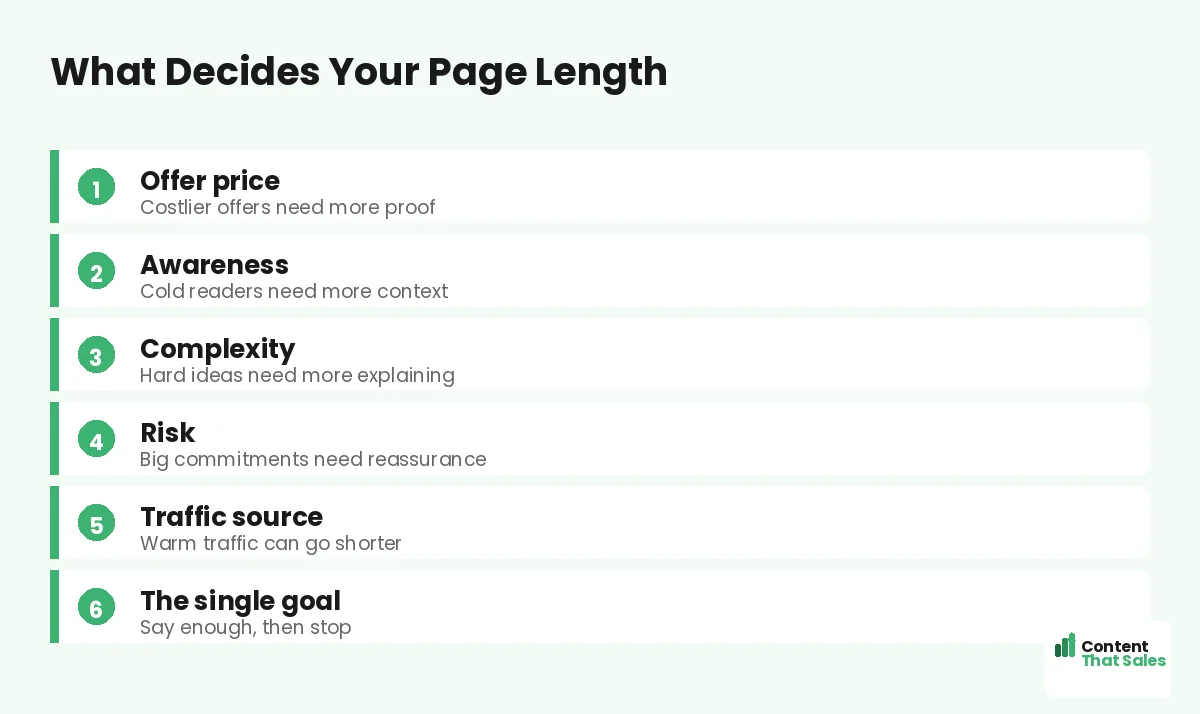
A few factors decide how long your page should run. The price of the offer. How aware the reader already is. How complex the idea is. How risky the commitment feels. And where the traffic comes from.
Stack these up for any page. A cheap, familiar, low-risk offer to warm traffic stays short. A pricey, new, high-risk offer to cold traffic runs long. Read the situation, then size the page to fit it. None of these factors works alone, so weigh them together. A cheap but complex offer might still need a longer page, while a pricey offer to loyal customers might not.
When to Use a Short Landing Page
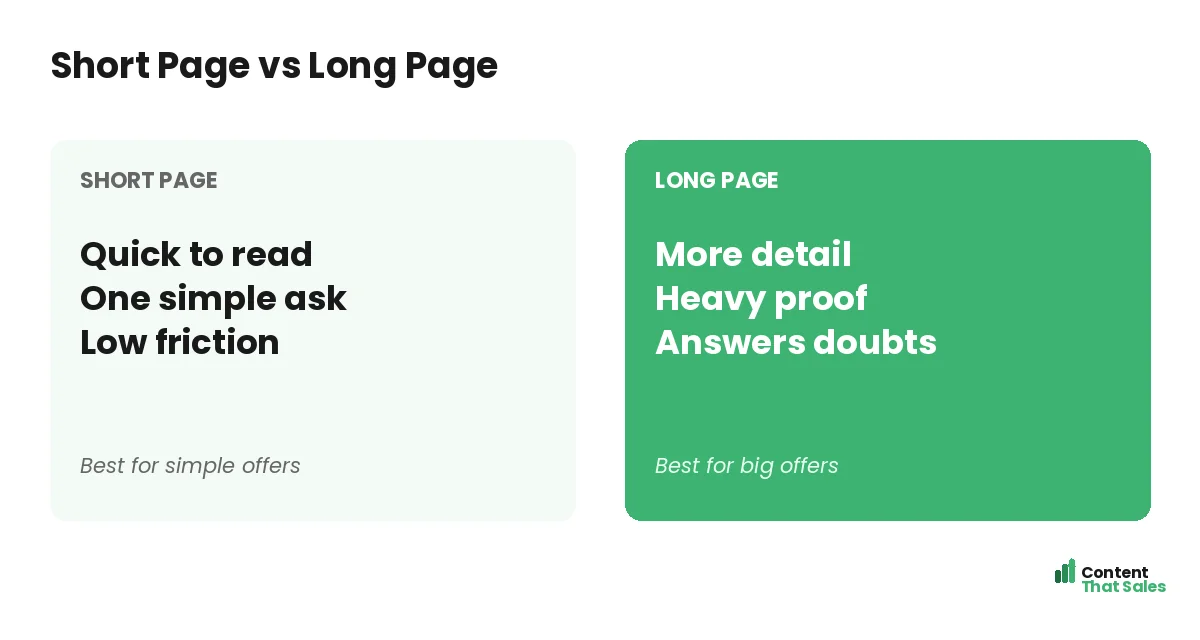
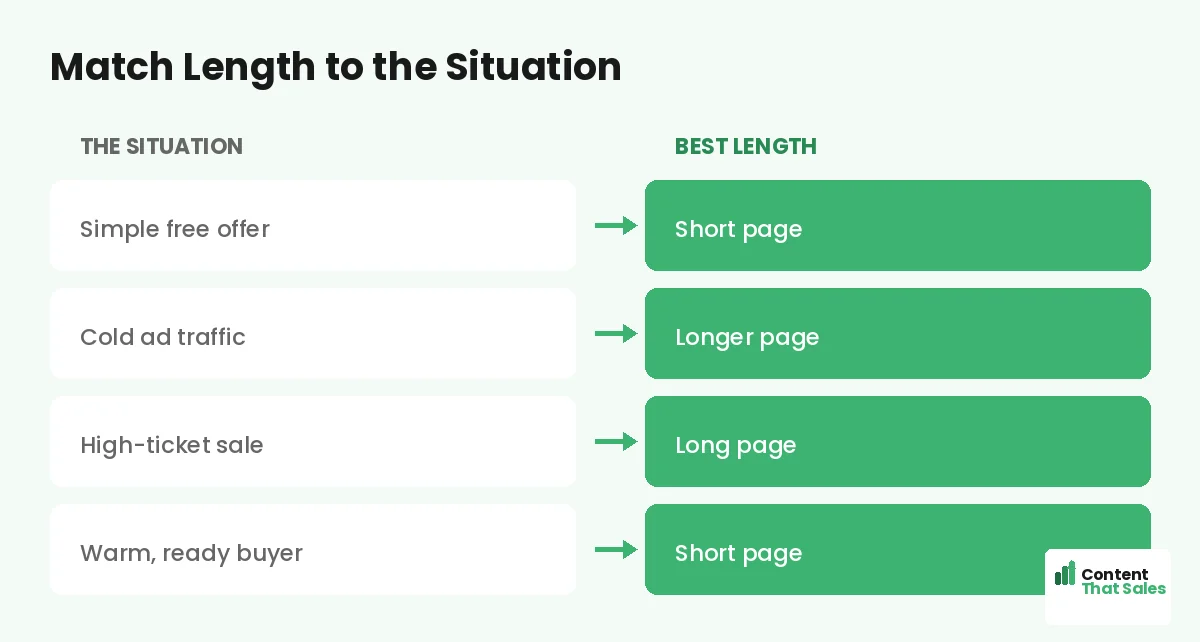
Go short when the ask is small and safe. A free guide, a newsletter signup, or a quick demo booking all work on a short page. The reader needs little convincing, so do not pad the page.
Short pages also suit warm traffic. People who already know and trust you do not need the full pitch. Give them the promise, a touch of proof, and a clear button. Less friction means faster action. A short page also loads faster and feels lighter on a phone, which matters since most visitors now arrive on mobile and judge the page in seconds.
When to Use a Long Landing Page
Go long when the stakes are high. Expensive products, coaching, courses, and complex services all need room. The buyer has real questions, and the page must answer every one before the ask.
Long pages earn their length with proof and detail. Each extra section crushes one more objection. This is the same logic behind a landing page vs sales page, where bigger offers call for fuller copy. Length is fine when every line earns its place.
Length and Reader Awareness
Awareness changes everything. A reader who knows the problem and your solution needs less convincing. A reader who knows neither needs the full story. Meet them where they are.
Cold traffic often needs a longer page to build context and trust. Warm traffic can convert on a short one. People scan more than they read, so even a long page must stay skimmable with clear headers.
Did you know?
For costly offers, long pages often outconvert short ones. More money at stake means buyers need more proof before they say yes.
Length Is Not an Excuse for Fluff
A long page is not a license to ramble. Every section must earn its spot. If a paragraph does not move the reader closer to yes, cut it. Long and tight beats long and bloated.
The same goes for short pages. Short does not mean thin. A short page still needs a clear promise, real proof, and a strong ask. The goal is the right amount, not the most or the least. Picture trimming a hedge. You cut until the shape is clean, then you put the shears down. Copy works the same way, so keep cutting until only the useful parts remain.
Say Enough, Then Stop
Here is a simple rule. Say everything the reader needs to decide, then stop. Not less, or they hesitate. Not more, or they tune out. The perfect length ends right when the reader is ready to act.
To find that point, list every question and objection your buyer has. Answer each one with a section. When the list is done, the page is done. To write each part well, see how to write landing page copy that converts.
How to Keep Any Page Tight
Whatever the length, keep it lean. Use short sentences and small paragraphs. Break ideas with clear headers. Cut filler words and jargon. A tight page respects the reader’s time and keeps them moving.
Structure helps a lot here. A clear order lets a long page feel easy to skim. For the full frame, see the best landing page structure. Good bones make any length feel effortless to read.
Test Your Way to the Right Length
You do not have to guess forever. Test it. Try a shorter version against a longer one and watch the conversion rate. The reader’s behavior will tell you what length they need.
Change one thing at a time so the results stay clean. Simple words help any length, since easy reading lifts conversions. Let data settle the short-versus-long debate for your page.
How Content That Sales Gets Length Right
Finding the right length takes judgment built on experience. That’s where we come in. At Content That Sales, we size every page to your offer, your buyer, and your traffic. No padding, no missing pieces.
You share the offer and the goal. We decide how much copy it needs and write every word to count. If you want done-for-you landing page copy, we make it effortless. The result is a page that is exactly as long as it should be.
Ready to Turn Visitors Into Customers?
So, how long should a landing page be? As long as it takes to make the sale, and no longer. Match length to the offer, the reader, and the risk. So why copy a random word count when your buyer should decide it?
Let’s build a page that is the perfect length to convert. Book your free consultation now. Call us at 8801631988589 or email service@contentthatsales.com. Let’s turn your next visitor into your next customer.
Frequently Asked Questions About Landing Page Length
How long should a landing page be?
As long as it needs to be to make the sale, and no longer. The right length depends on your offer price, the reader’s awareness, and how risky the commitment feels.
Are short or long landing pages better?
Neither wins by default. Short pages suit simple, low-risk offers and warm traffic. Long pages suit costly, complex offers and cold traffic that needs more proof.
What makes a long landing page convert?
Proof and detail that crush objections. A long page works when every section answers a real question and nothing is padding.
When should I use a short landing page?
For small, safe asks like a free guide or a newsletter signup, especially with warm traffic that already trusts you.
Does page length affect SEO?
Clarity and relevance matter more than raw length. A focused page that matches intent and keeps people engaged tends to perform best.
How do I know if my page is too long?
If a section does not move the reader closer to acting, it is too long. Cut anything that does not answer a question or build trust.
Should I match my competitor’s page length?
No. Their offer and traffic differ from yours. Size your page to your own buyer and test to confirm what works.
Can you decide the right length for my page?
Yes. Content That Sales sizes and writes pages to fit your offer and audience. Reach out for a quick quote.