 Skip to content
Studying pillar page examples that drive authority is one of the fastest ways to learn what a great pillar looks like, because the best ones share a clear pattern: a broad, useful overview, a clean structure, strong links to cluster pages, and genuine depth. Rather than naming specific live pages, this guide breaks down the types of pillar pages that consistently build authority and the traits that make them work, so you can model your own on what succeeds.
A pillar page is the hub of a content cluster, and the strong ones all do similar things well. By understanding those shared traits and seeing them through example types, you can build pillars that anchor your clusters and rank for competitive terms.
Below, we look at the traits great pillars share, common example types worth studying, and how to apply their lessons to your own pages.

What Great Pillar Pages Share
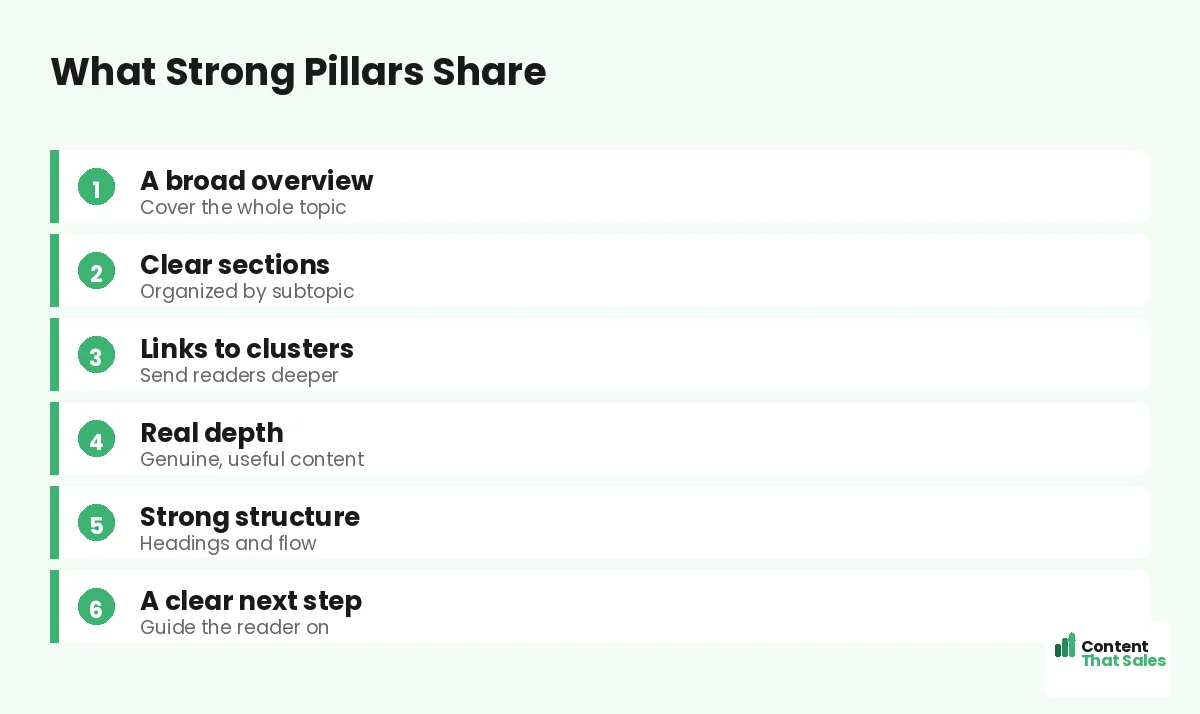
The best pillar pages share a clear set of traits: they cover the whole topic at an overview level, organize it into clean sections, link generously to cluster pages, and provide genuine, useful depth. These traits show up again and again in pillars that rank.
This pattern follows the pillar-and-cluster framework. A strong pillar is the comprehensive hub that anchors its clusters. Learning to spot these traits in examples helps you build pillars that do the same.
Example Type: The Complete Guide
One classic pillar example is the complete guide, a page titled something like “The Complete Guide to X.” It covers every major aspect of a topic at an overview level and links to detailed cluster pages for each subtopic. It is the go-to pillar format.
Complete guides work because they promise and deliver thoroughness. They give the reader the full picture and route them to depth via links. If you study any authoritative content cluster, the pillar is often a complete guide of this kind.
Example Type: The Definitive Resource
Another strong example is the definitive resource page, the page that aims to be the single best overview of a subject. It is comprehensive, well-organized, and frequently updated, positioning the site as the authority on that topic.
These resource pages earn links and rankings because they genuinely are the best overview available. They cover the subject so well that others reference them. Modeling your pillar on this ambition, to be the definitive overview, sets a high, useful bar.
Example Type: The Category Hub
For ecommerce and larger sites, a category hub is a common pillar example. It overviews a product or content category, explains the key considerations, and links to specific product pages, guides, and subcategories. It anchors a commercial cluster.
Category hubs blend overview content with links to deeper pages and products. They show that a pillar does not have to be a pure article; it can be a hub that organizes a whole section of a site. The principle, overview plus links, stays the same.
The Trait of Full Coverage
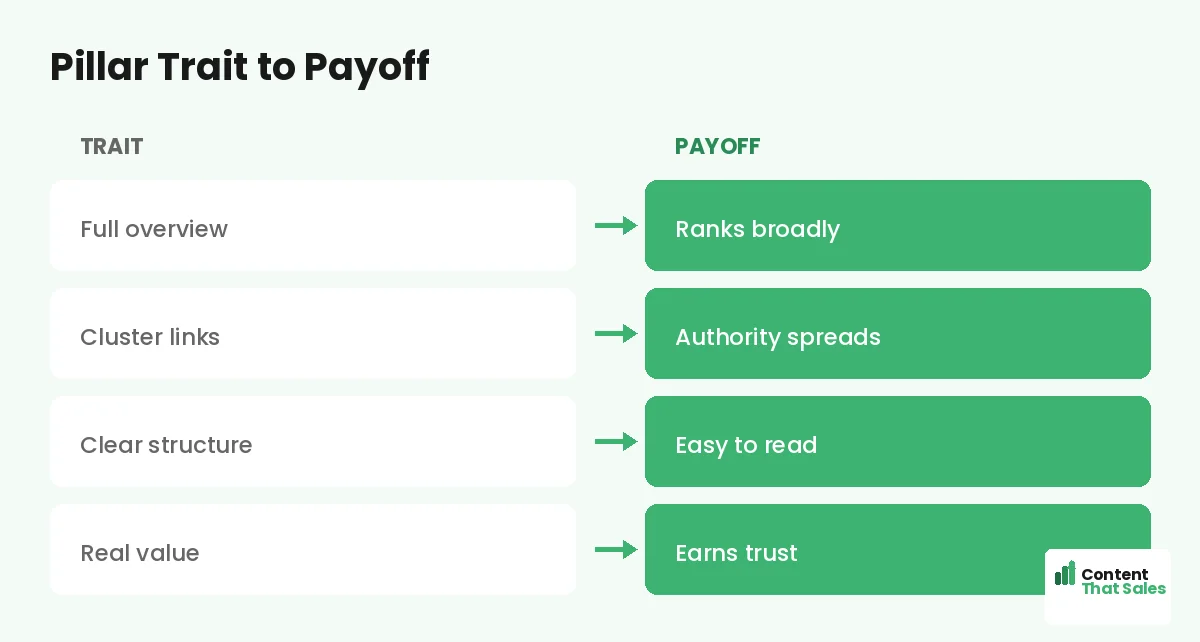
Across all these examples, full coverage is the common thread. A strong pillar touches every major area of its topic, leaving no obvious gaps. The reader feels the page covers the subject, even as it points to clusters for the details.
Full coverage is what signals authority. Since readers scan more than they read, a pillar should make its complete coverage easy to scan, with clear sections for each area. Completeness, shown clearly, is a defining trait of pillars that build topical authority.
The Trait of Strong Structure
Great pillar examples are always well-structured. Clear headings, logical flow, and scannable sections let readers navigate a long page easily and jump to what they need. Structure is what makes a comprehensive pillar usable rather than overwhelming.
Notice in strong examples how the structure mirrors the subtopics, often matching the cluster pages. This alignment makes the pillar a clear map of the topic. Good structure turns full coverage into something readers and Google can actually follow.
Did you know?
The strongest pillar pages often read like an organized table of contents for a topic, covering every area and linking to a deeper page for each one.
The Trait of Generous Linking
Every authority pillar links generously to its cluster pages. The links are not an afterthought; they are core to the pillar’s role as a hub. The pillar sends readers and authority to the clusters, and the clusters link back, forming the group.
When you study a strong pillar, notice how it links out at every relevant point to deeper pages. This is how to connect pillar and cluster pages. Generous, relevant linking is a hallmark of pillars that drive authority.
The Trait of Genuine Depth
Though a pillar is an overview, the best examples still offer real, useful depth in their summaries. They are not thin or padded; each section genuinely helps the reader understand that area before linking to more. Quality runs through the whole page.
This matters because Google rewards useful pages. A pillar that covers the topic with genuine, helpful content, not filler, earns trust. Depth at the overview level, combined with links to deeper clusters, is what separates authority pillars from shallow ones.
How to Apply the Lessons
To apply what these examples teach, build your pillar to cover the whole topic, structure it clearly by subtopic, link generously to your clusters, and keep every section genuinely useful. Model the traits, not the exact wording, of pages that succeed.
Start by outlining your topic’s major areas, then write an overview of each that links to its cluster. Keep the length right-sized to the topic, as we cover in our guide on pillar page length. Apply the traits and your pillar will drive authority too.
Avoid the Weak-Pillar Traps
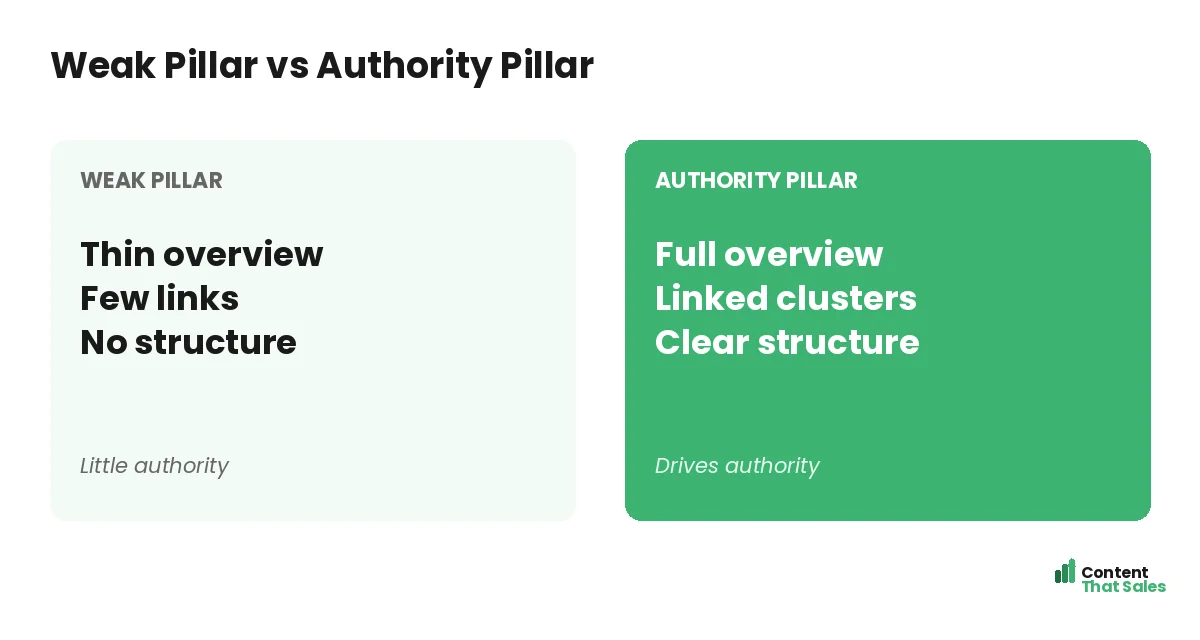
Studying strong examples also reveals what to avoid. Weak pillars are thin overviews, poorly structured, light on links, or padded with filler. They fail to anchor a cluster or rank well. The contrast with authority pillars makes the traps clear.
Simple, clear content keeps winning, since easy reading lifts engagement. Avoid the weak-pillar traps by ensuring full coverage, clean structure, generous links, and real depth. The examples show the standard to meet.
Put It All Together
Pillar page examples that drive authority, complete guides, definitive resources, and category hubs, all share the same traits: full coverage, strong structure, generous linking, and genuine depth. Those traits, not any single page, are the real lesson.
Model your pillars on these traits rather than copying. Cover the topic, structure it clearly, link to your clusters, and keep it useful. Do that and your pillar becomes the authoritative hub that anchors its cluster and ranks for its topic.
How Content That Sales Helps
We build pillars that look like the best examples. That’s where we come in. At Content That Sales, we write comprehensive, well-structured pillar pages with generous links and real depth, modeled on what drives authority.
You share your topic and clusters. We craft the pillar that covers the subject, organizes it clearly, and links to the depth. The result is an authority pillar that anchors your cluster and competes for its topic.
Ready to Build an Authority Pillar?
Now you know what pillar page examples that drive authority share: full coverage, clean structure, generous links, and real depth. Model the traits, not the wording. So why settle for a thin pillar when the standard is clear?
Let’s build your authority pillar. Book your free consultation now. Call us at 8801631988589 or email service@contentthatsales.com. Let’s turn your topic into a pillar that ranks.
Frequently Asked Questions About Pillar Page Examples
What do great pillar pages have in common?
Full coverage of the topic, clear structure, generous links to cluster pages, and genuine, useful depth. These traits show up in pillars that drive authority.
What is a complete guide pillar?
A page that covers every major aspect of a topic at an overview level and links to detailed cluster pages for each subtopic. It is the classic pillar format.
What is a definitive resource pillar?
A page that aims to be the single best overview of a subject, comprehensive, well-organized, and updated, positioning the site as the authority on it.
Can a category page be a pillar?
Yes. On ecommerce and larger sites, a category hub overviews a category and links to products, guides, and subcategories, acting as a commercial pillar.
Why is full coverage important?
It signals authority. A pillar that touches every major area, leaving no obvious gaps, tells readers and Google the page genuinely covers the subject.
How important is linking in a pillar?
Essential. Every authority pillar links generously to its cluster pages, sending readers and authority to the depth. Linking is core to the pillar’s role.
How do I apply these lessons?
Model the traits, not the wording. Cover the topic, structure it by subtopic, link to clusters, and keep every section useful. Avoid the weak-pillar traps.
Can Content That Sales help?
Yes. We write comprehensive, well-linked pillars modeled on what drives authority, built to anchor your cluster and rank. Reach out for a quick quote.