 Skip to content
A topical map strategy for SaaS brands helps you own your category in search by covering the problems you solve, the use cases you serve, and the comparisons buyers make before they choose. SaaS content too often talks about features and product updates, which buyers do not search for. A topical map shifts your content to what buyers actually look for, and builds the authority that drives qualified signups. This guide shows you how.
SaaS buyers research carefully across a long journey, from understanding their problem to comparing tools to learning how to succeed. A topical map covers that whole journey, so you capture buyers at every stage and become the trusted voice in your category.
Below, we walk through what a SaaS topical map should cover, how to structure it around buyer needs, and how it turns search traffic into qualified leads and lower churn.

Why SaaS Needs a Topical Map
SaaS is competitive, and buyers research deeply before committing. To win, you need to be the authority in your category across the entire buyer journey. A topical map plans that complete coverage, so you show up wherever buyers search.
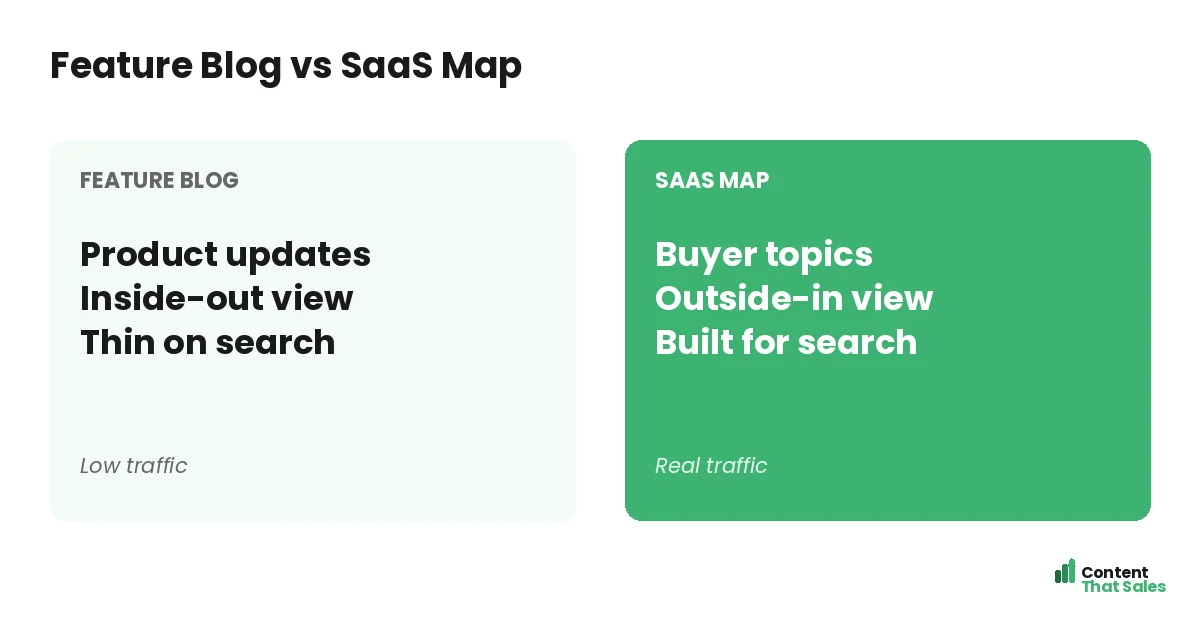
Feature-focused content alone does not cut it, because buyers search for problems and solutions, not your release notes. A map reorients your content around buyer needs. If you are new to the idea, see our guide on what a topical map is.
Start With Your Category
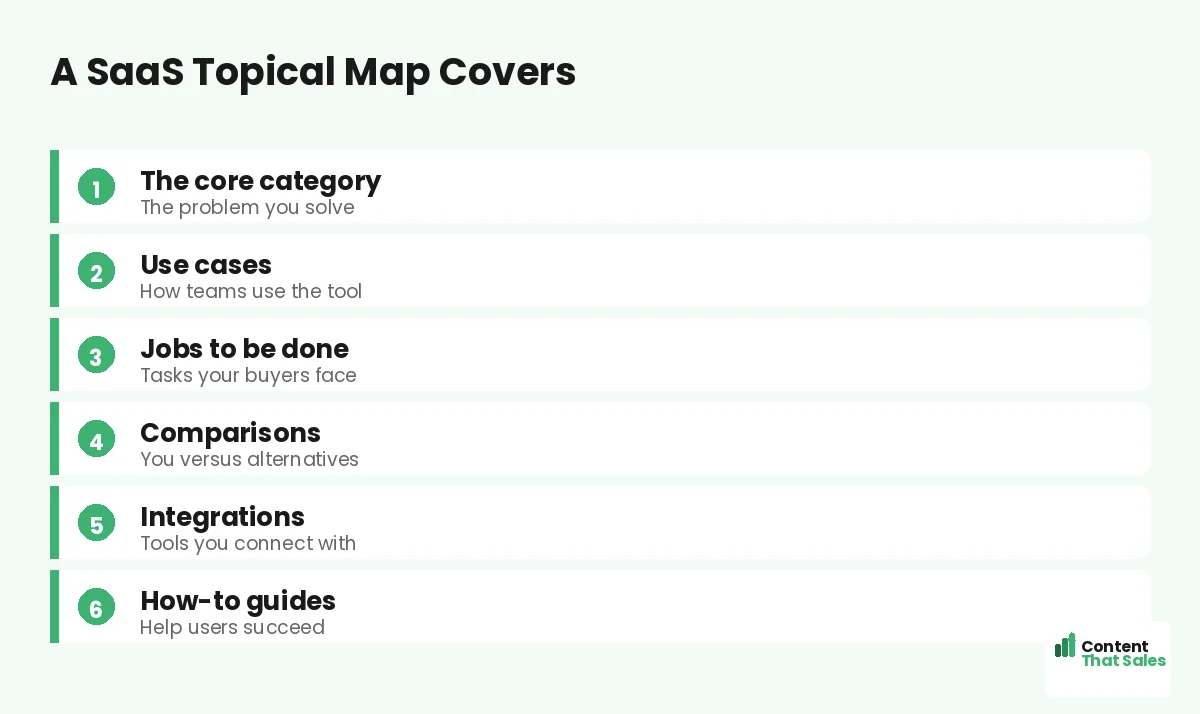
Your core topic is the category you want to own, the problem your software solves. If you make project management software, your core is project management. Everything else, use cases, comparisons, guides, branches from this central category.
Owning a category means covering it more completely than anyone else, which is the essence of topical authority. A focused core topic, tied to the problem you solve, anchors that effort. For help defining it, see our guide on choosing your core topic for a topical map.
Map the Jobs to Be Done
Buyers hire software to do a job. Map the jobs your customers are trying to accomplish, the tasks and goals they have, and create content around each. Job-focused pages match how buyers actually think and search for solutions.
For example, project management software helps teams “track project deadlines” or “manage remote teams.” Each job is a content opportunity. Mapping jobs to be done ensures your content speaks to real buyer goals, not abstract features.
Cover Every Use Case
SaaS tools serve many use cases and audiences. Map a page for each meaningful use case, how different teams, roles, or industries use your product. Use case content shows buyers that your tool fits their specific situation.
A buyer searching for software for their exact need converts far better when they find a page about that need. Since readers scan more than they read, make each use case page quickly show the buyer it was written for them.
Build Comparison Pages
SaaS buyers compare options before choosing, so comparison content is essential. Map pages comparing your product to alternatives and competitors. These bottom-funnel pages catch buyers who are close to deciding and looking for a reason to pick you.
Comparison pages are some of the highest-converting SaaS content, because the searcher is ready to buy. Be honest and helpful, and you earn trust at the decision point. Mapping these ensures you show up exactly when buyers are choosing.
Add Integration and Alternative Pages
Buyers search for tools that connect with their existing stack, so map integration pages for the tools you work with. Also consider “alternative to” pages targeting buyers leaving a competitor. Both capture high-intent searches specific to SaaS.
Integration pages reassure buyers your tool fits their workflow, while alternative pages catch dissatisfied users of other products. These pages target precise, valuable searches that broad content misses, deepening your category coverage.
Did you know?
Comparison and alternative pages are often the highest-converting SaaS content, because the searcher is at the decision stage and actively choosing a tool.
Cover the Full Funnel
Map content for every stage of the buyer journey. Top-funnel pages explain the problem and educate. Middle-funnel pages cover solutions and use cases. Bottom-funnel pages handle comparisons and pricing. Full-funnel coverage captures buyers wherever they are.
Many SaaS brands over-index on one stage and miss the others. A topical map ensures balance, so you attract early researchers, nurture them with solution content, and convert them with comparison and decision pages. The funnel stays full.
Include How-To and Help Content
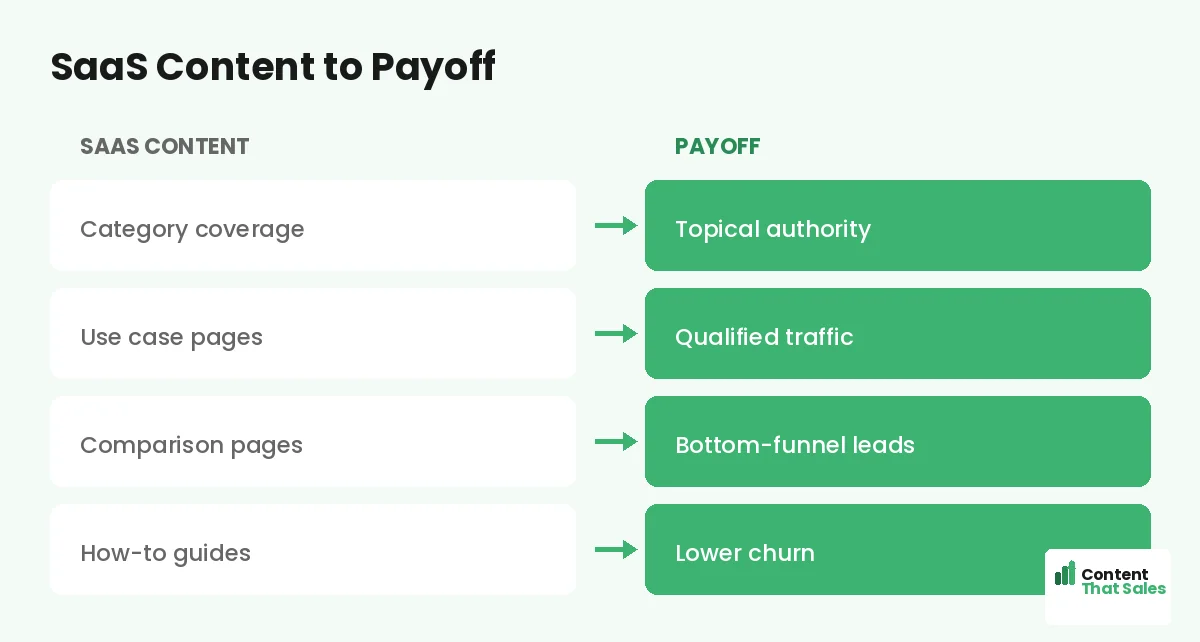
Authority is not only about winning new buyers; it is also about keeping them. Map how-to guides and help content that show users how to succeed with your product. This content lowers churn and reinforces your category authority.
How-to content also ranks for support searches and brings in users who then discover your product. Mapping it alongside your marketing content covers the full lifecycle, from discovery to mastery, which strengthens both growth and retention.
Structure and Link the Map
Organize your SaaS map into clusters: a category pillar, use case pages, comparison pages, integration pages, and guides, each cluster covering one area in depth. Link them so related pages support each other and guide buyers toward signup.
Strong internal linking spreads authority and moves buyers along the funnel, from a use case page to a comparison to a free trial. A well-linked SaaS map works as a connected system that both ranks and converts, the same payoff behind any strong topical map strategy.
Connect Content to Conversion
Every page should guide the reader toward your product. Use case pages link to relevant features and trials; comparison pages lead to signup; guides point to the tool. Coverage builds authority, but clear paths to conversion turn it into signups.
Simple, clear content keeps winning, since easy reading lifts engagement. Pair complete category coverage with clear conversion paths, and your SaaS content does double duty: it ranks for buyer searches and turns those buyers into trials.
Put It All Together
A topical map strategy for SaaS brands covers your category, jobs to be done, use cases, comparisons, integrations, full-funnel content, and how-to guides, all structured into clusters, linked, and pointed toward conversion. It shifts content from features to buyer needs.
Own your category by covering it more completely than anyone else, across the whole buyer journey. The map plans that coverage; strong, conversion-focused content delivers it. Do this, and your SaaS brand becomes the trusted authority that buyers find and choose.
How Content That Sales Helps
We map and write SaaS content that converts. That’s where we come in. At Content That Sales, we plan your category map, cover use cases and comparisons, and write the pages that rank for buyer searches and drive signups.
You share your product and your buyers. We map the full journey, write the use case, comparison, and guide pages, and link them toward conversion. The result is category authority that brings in qualified trials, not just traffic.
Ready to Own Your SaaS Category?
Now you have a topical map strategy for SaaS brands: cover your category, jobs, use cases, and comparisons across the full funnel, all pointed to signup. Buyers research deeply. So why not be the authority they find at every stage?
Let’s map your category and win it. Book your free consultation now. Call us at 8801631988589 or email service@contentthatsales.com. Let’s turn buyer searches into qualified signups.
Frequently Asked Questions About SaaS Topical Maps
Why do SaaS brands need a topical map?
SaaS is competitive and buyers research deeply. To win, you must be the authority across the buyer journey. A map plans the complete coverage that gets you there.
What should the core topic be?
The category you want to own, the problem your software solves. Everything else, use cases, comparisons, and guides, branches from this central category.
What are jobs to be done?
The tasks and goals buyers hire your software to accomplish. Mapping content around these jobs matches how buyers actually think and search for solutions.
Why are comparison pages important?
SaaS buyers compare options before choosing. Comparison pages catch buyers near the decision and are often the highest-converting SaaS content.
Should I cover the full funnel?
Yes. Map top-funnel education, middle-funnel solutions and use cases, and bottom-funnel comparisons and pricing, so you capture buyers at every stage.
Does how-to content help?
Yes. How-to and help content lowers churn, ranks for support searches, and reinforces authority, covering the full lifecycle from discovery to mastery.
How do I turn coverage into signups?
Point every page toward your product, use cases to trials, comparisons to signup, guides to the tool. Coverage builds authority; clear paths convert it.
Can Content That Sales help?
Yes. We map your category and write the use case, comparison, and guide pages that rank for buyer searches and drive signups. Reach out for a quick quote.