 Skip to content
The 4 Ps formula for landing pages, Promise, Picture, Proof, Push, is a clean four-step structure that makes a bold promise, paints the result, proves it is real, then pushes the reader to act. It is simple to remember and powerful to apply, giving any page a persuasive backbone. This guide explains what each P does, how it maps to your page elements, and how to apply the formula with a clear example flow.
The 4 Ps work because they follow the logic of a convincing argument: claim, illustrate, prove, ask. You promise a benefit, help the reader picture it, back it with proof, then push them over the line. Each P sets up the next.
Below, we break down all four Ps, show which page element delivers each, and walk through how to apply the formula to a real landing page.

What the 4 Ps Are
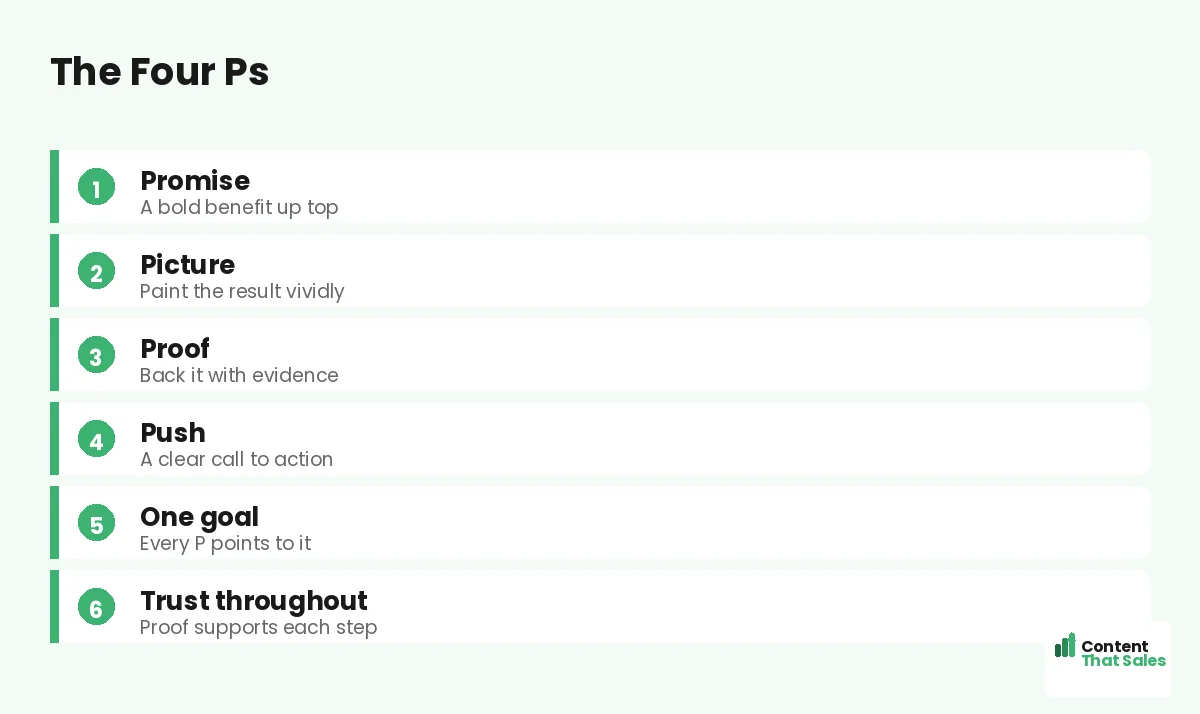
The 4 Ps stand for Promise, Picture, Proof, and Push. It is a copywriting framework that structures a page as a persuasive sequence: a bold promise, a vivid picture of the result, solid proof, and a clear push to act. Four steps, one flow.
On a landing page, the 4 Ps give you a memorable order for your content. They map neatly onto a strong landing page structure, turning sections into a deliberate argument that moves the reader from interest to action.
Step 1: Promise
Open with a promise, a bold statement of the main benefit. This is your headline. It tells the reader the single best outcome they get, grabbing attention and giving them a reason to keep reading. A strong promise hooks; a weak one loses.
Make it specific and valuable. “Cut your energy bill by 30% in one month” promises a clear result. The promise is the foundation of the page, so make it bold, believable, and centered on what the reader wants most.
Step 2: Picture
Next, paint a picture of what that promise looks like in the reader’s life. This is where benefits and vision live. Help them imagine enjoying the result, so the promise becomes real and desirable rather than an abstract claim.
Use vivid, concrete language. Describe the better day, the relief, the win. The picture turns a promise into a felt desire. Since readers scan more than they read, keep the picture sharp and easy to absorb at a glance.
Step 3: Proof
Now back the promise and picture with proof. Testimonials, results, data, reviews, and guarantees show that the promise is real and others have achieved it. Proof answers the skeptic in every reader and turns desire into belief.
Specific proof is strongest. A named customer with a concrete result beats a vague claim. Place your best proof where doubt peaks, near the push. Without proof, even a great promise and picture feel like empty marketing.
Step 4: Push
Finally, push the reader to act. This is your call to action, one clear, compelling next step. After the promise, picture, and proof, the reader is ready, so make the action obvious and easy. The push converts all that persuasion into a result.
Be direct and confident. Following solid landing page CTA best practices, ask plainly for the action and restate the value in the button. A strong push is the climax the first three Ps were building toward.
Map the 4 Ps to Your Page
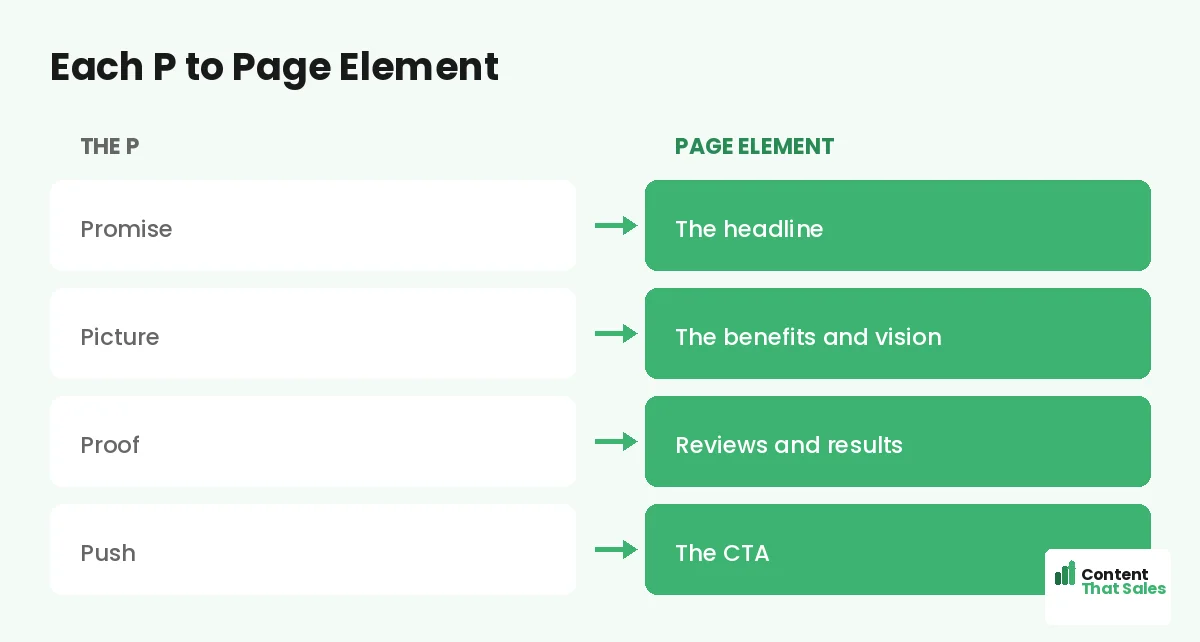
Each P maps to a page element. Promise is the headline. Picture is the benefits and vision section. Proof is the testimonials and results. Push is the CTA. Lay them in that order and your page follows the formula naturally.
This turns the 4 Ps into a build plan. Lead with a bold promise, paint the picture of the result, stack the proof, then push with a clear CTA. Each step earns the next, carrying the reader smoothly toward conversion.
Did you know?
The 4 Ps mirror how we judge any claim: we hear it, picture it, want proof, then decide. Following that order makes a page feel naturally convincing.
An Example 4 Ps Flow
Imagine a page for a productivity app. Promise: “Reclaim 10 hours a week.” Picture: “Imagine finishing work by 5, with time for family and rest, your tasks handled automatically.” That makes the benefit vivid and wanted.
Proof: user reviews and a stat like “users save 10 hours on average.” Push: “Start your free trial today.” The reader moves from a bold promise, through a clear picture and solid proof, to an easy action, all in one flow.
Why the 4 Ps Work
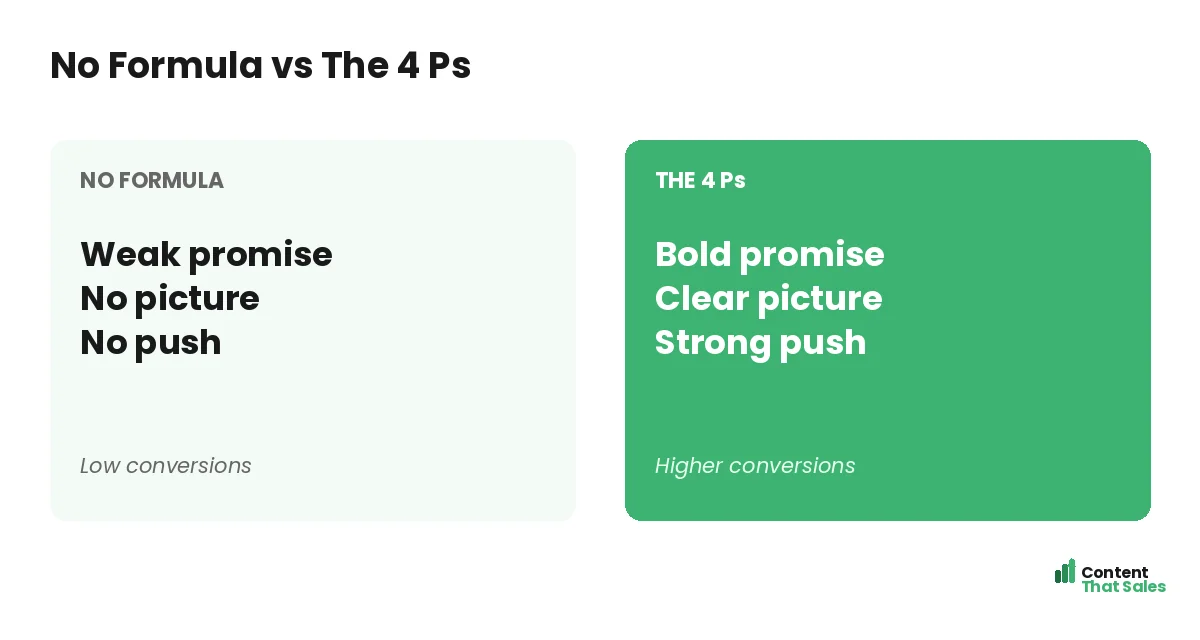
The 4 Ps work because they mirror how people evaluate any claim. We hear a promise, we want to picture it, we look for proof, and then we decide. By following that natural order, the page feels persuasive rather than pushy.
The framework also keeps every section purposeful. Each P has a job, and together they build a complete case. Nothing is filler. That clarity and momentum are what make the 4 Ps a reliable structure for high-converting pages.
Make the Promise Strong
The promise carries the most weight, so make it bold and specific. A vague promise like “improve your business” fails to grab. A sharp one like “double your leads in 60 days” stops the reader and sets up the rest of the page.
Center the promise on the reader’s biggest desire and keep it believable. Overpromising breaks trust; underpromising loses attention. The right promise is bold enough to excite and credible enough to trust, and it makes the picture and proof land harder.
When to Use the 4 Ps
The 4 Ps suit almost any landing page, which is why they are so popular. The structure is simple, flexible, and works across industries. Whenever you need a clear, persuasive flow and want an easy framework to follow, the 4 Ps fit.
They pair well with a ready landing page copy template, giving you both a structure and the prompts to fill it. For a dependable, easy-to-apply formula, the 4 Ps are a great default for most pages.
The 4 Ps vs Other Frameworks
The 4 Ps sit alongside formulas like AIDA, PAS, and BAB. They are benefit-led and proof-focused, great for a confident, claim-driven page. The AIDA formula flows from attention to action, while PAS and BAB lean on pain and transformation.
Choose the 4 Ps when you have a strong promise and good proof to lead with. Reach for a pain-led or story-led formula when those forces are stronger. Knowing several frameworks lets you pick the best flow for each page and audience.
Put It All Together
The 4 Ps formula gives your landing page a persuasive backbone: a bold Promise, a vivid Picture, solid Proof, and a clear Push. Following the natural order of a convincing argument, it carries the reader from interest to action.
Map the four Ps to your page, make the promise strong, and never skip the proof. Simple, clear copy keeps winning, since easy reading lifts conversions. Follow the 4 Ps and your page builds a complete, convincing case for action.
How Content That Sales Helps
We write pages with a persuasive backbone. That’s where we come in. At Content That Sales, we build landing pages on proven frameworks like the 4 Ps, so every section makes a clear claim, paints it, proves it, and pushes.
You share your offer and your proof. We craft the bold promise, the vivid picture, the convincing proof, and the push that converts. The result is a page that argues its case and turns readers into customers.
Ready to Apply the 4 Ps?
Now you know the 4 Ps formula for landing pages: Promise, Picture, Proof, Push. It mirrors how people judge any claim and carries them to action. So why leave your page without a persuasive backbone?
Let’s build a page that makes the case and converts. Book your free consultation now. Call us at 8801631988589 or email service@contentthatsales.com. Let’s turn your next visitor into your next customer.
Frequently Asked Questions About the 4 Ps Formula
What are the 4 Ps?
Promise, Picture, Proof, and Push. It is a copywriting framework that structures a page as a bold promise, a vivid picture of the result, solid proof, and a clear push to act.
How do the 4 Ps map to a page?
Promise is the headline, Picture is the benefits and vision, Proof is the testimonials and results, and Push is the CTA. Lay them in that order.
Why do the 4 Ps work?
They mirror how people judge any claim: hear it, picture it, want proof, then decide. Following that natural order makes the page feel convincing, not pushy.
Which P matters most?
The promise carries the most weight. A bold, specific promise grabs attention and sets up the picture and proof. A vague one loses the reader early.
Can I skip the proof?
No. A bold promise and vivid picture without evidence read as hype. Proof turns desire into belief, so place your strongest proof near the push.
When should I use the 4 Ps?
Almost any landing page. The structure is simple, flexible, and works across industries, making it a great default when you have a strong promise and proof.
How do the 4 Ps compare to AIDA?
Both are smooth, benefit-led flows. The 4 Ps emphasize claim and proof, while AIDA emphasizes attention through to action. Either suits most pages.
Can Content That Sales help?
Yes. We build pages on frameworks like the 4 Ps that promise, picture, prove, and push. Reach out for a quick quote.