 Skip to content
The PAS formula for landing pages, Problem, Agitate, Solve, is one of the most persuasive structures in copywriting because it leads with the reader’s pain instead of your product. You name the problem, deepen the reader’s awareness of its cost, then present your offer as the relief. This guide explains each step, how it maps to your page, and how to apply PAS with a clear example flow.
PAS works because people are moved more by avoiding pain than by chasing gain. By starting with the problem the reader feels, you earn their attention and trust before you ever pitch. The solution then lands as welcome relief, not an interruption.
Below, we break down the three PAS steps, show which page elements deliver them, and walk through how to apply the formula to a real landing page.

What PAS Is
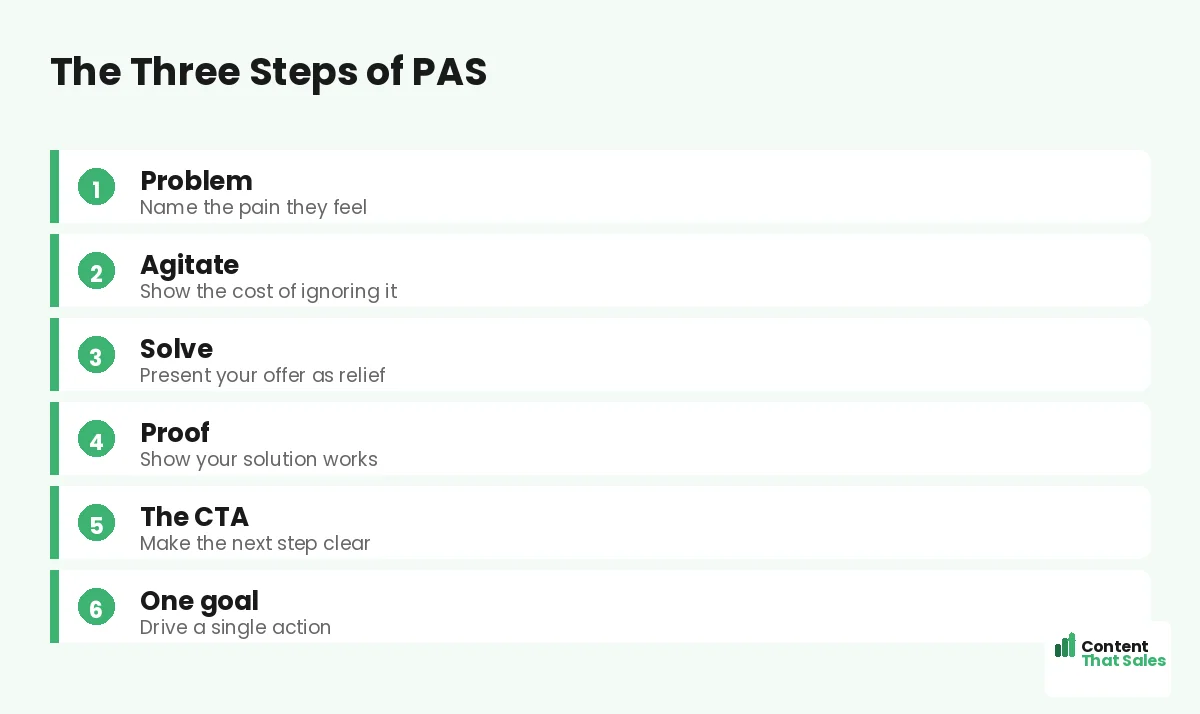
PAS stands for Problem, Agitate, Solve. It is a copywriting framework that structures your message around the reader’s pain. First you name the problem, then you agitate it by showing its consequences, then you solve it with your offer.
On a landing page, PAS gives you an emotionally compelling flow. It fits a strong landing page structure by leading with empathy rather than features, which hooks readers who feel the pain you describe and pulls them toward your solution.
Step 1: Problem
Start by naming the problem your reader faces, in their own words. This is your headline and opening. When you describe their pain accurately, the reader feels understood and thinks, “this is exactly my situation.” That recognition earns their attention.
Be specific. “Tired of ads that get clicks but no sales?” lands harder than a vague claim. The better you name the real problem, the more the reader leans in, trusting that you understand their world and might have the answer.
Step 2: Agitate
Next, agitate the problem. Show the reader the cost of leaving it unsolved, the frustration, the wasted money, the missed opportunities. This step deepens the emotion and creates urgency, making the reader want a solution now, not later.
Agitation is not manipulation; it is honest about consequences. Paint the picture of what continues to go wrong without a fix. By making the pain vivid and present, you turn a mild awareness into a real motivation to act.
Step 3: Solve
Finally, present your offer as the solution. After naming and agitating the problem, your product arrives as relief. Show how it removes the pain, back it with proof, and make the path to it clear. This is where desire meets the answer.
Frame the solution around the problem you just described, so it feels like a perfect fit. Add benefits and proof to show it works. Since readers scan more than they read, make the relief clear and quick to grasp.
Map PAS to Your Page
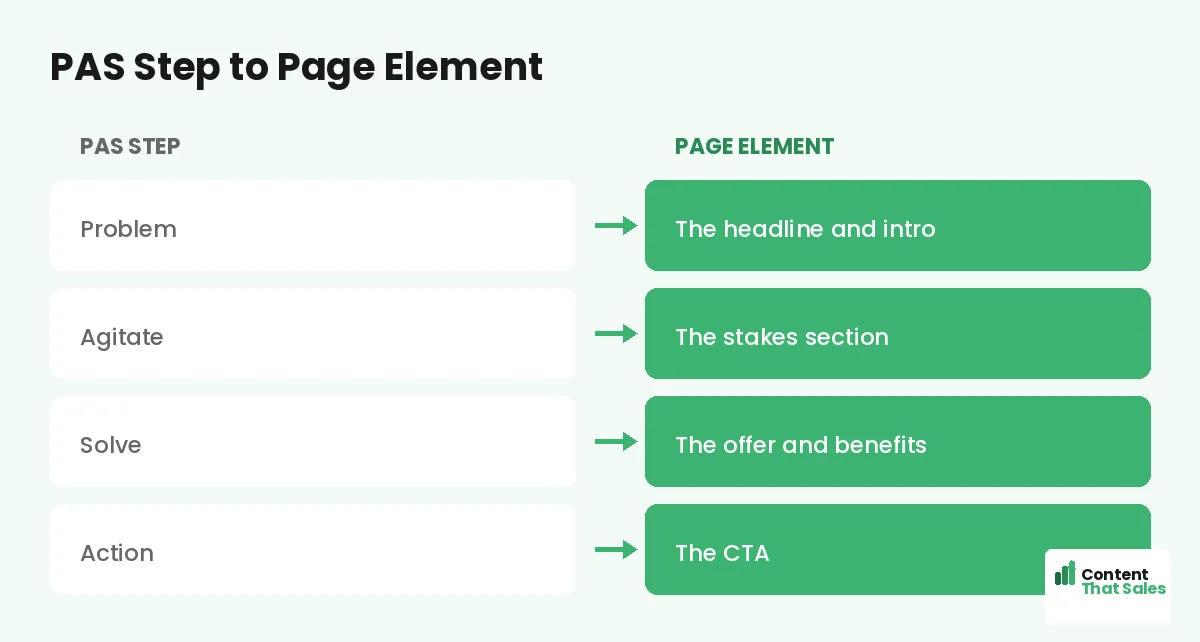
Each PAS step maps to part of your page. Problem is the headline and intro. Agitate is the section that explores the stakes. Solve is the offer, benefits, proof, and CTA. Lay them in that order and the page follows the formula naturally.
This gives you a clear build plan. Open by naming the pain, follow with the cost of inaction, then introduce your solution and ask for action. The emotional arc from problem to relief carries the reader to the CTA.
An Example PAS Flow
Imagine a page for accounting software. Problem: “Dreading tax season again?” Agitate: “Hours lost to spreadsheets, the fear of costly mistakes, and sleepless nights before the deadline.” That makes the reader feel the pain sharply.
Solve: “Our software automates your books, so taxes take minutes, not weeks,” backed by reviews and a free trial CTA. The reader moves from feeling the problem to seeing the relief, ready to act on a solution that fits.
Did you know?
PAS works because people are often moved more by avoiding pain than by chasing gain, so leading with the problem can be more persuasive than leading with benefits.
Why PAS Is So Persuasive
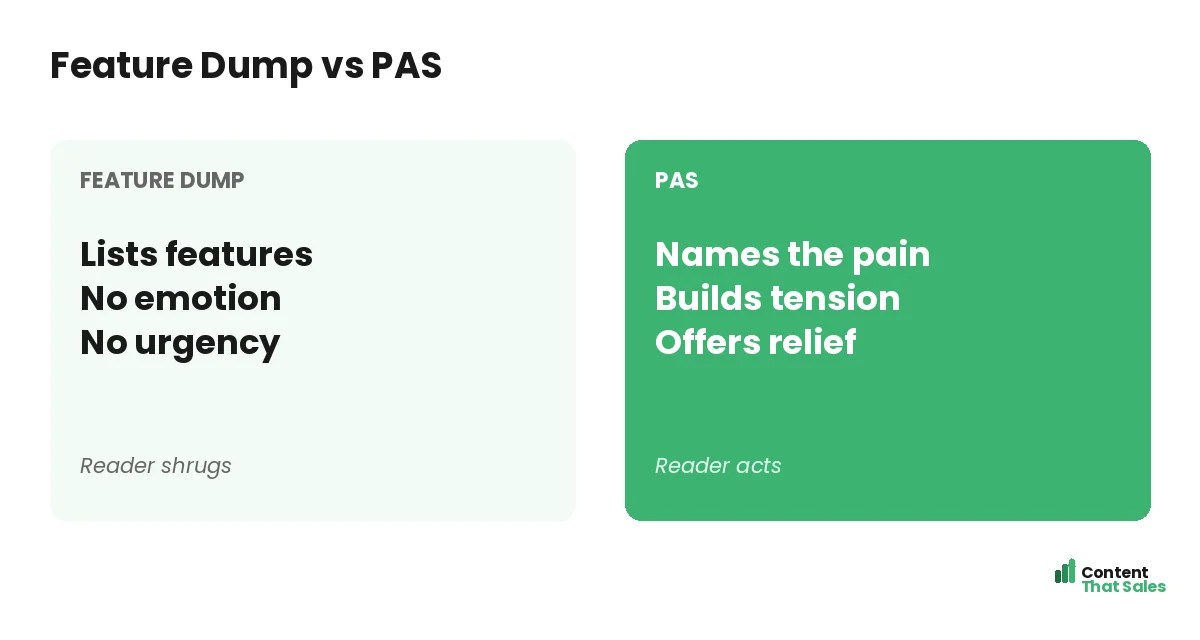
PAS taps a basic truth of human motivation: we act to escape pain. By starting with the problem and agitating it, you build genuine motivation before presenting the solution. The reader is primed to want what you offer.
It also builds trust through empathy. When you describe the reader’s pain better than they could, they believe you understand and can help. That trust, earned before the pitch, makes the solution far more convincing than a feature-led page.
Keep Agitation Honest
The agitate step is powerful, but use it responsibly. Highlight real consequences, not invented fears. Honest agitation respects the reader and builds trust; exaggerated scare tactics feel manipulative and can backfire, costing you the credibility you need.
Stick to true costs the reader actually experiences. The goal is to make a real problem feel urgent, not to frighten with fiction. Honest, accurate agitation is both more ethical and more effective, because readers sense when it rings true.
When to Use PAS
PAS shines when your audience has a clear, felt pain. It is ideal for products that solve a frustration, fix a problem, or remove a risk. If the reader is already aware they have a problem, leading with it grabs them instantly.
It is less suited to pure aspiration or impulse buys where there is no real pain to name. For those, a benefit-led flow may work better. A ready landing page copy template helps you slot PAS in where pain drives the decision.
PAS vs Other Frameworks
PAS is one of several proven formulas. It leans on pain, while AIDA leans on a smooth attention-to-action flow and PASTOR adds story and testimony. Each suits different pages, and knowing all three lets you pick the best fit.
Use PAS when the problem is the strongest hook. Reach for the AIDA formula when you want a balanced flow, or a story-driven framework when narrative builds trust. The right formula depends on your audience and offer, and a story-led PASTOR framework can win when narrative builds trust.
Put It All Together
The PAS formula gives your landing page a persuasive arc: name the Problem, Agitate its cost, then Solve it with your offer. Leading with pain earns attention and trust, so the solution lands as welcome relief rather than a pitch.
Map the steps to your page, keep the agitation honest, and use PAS when a real pain drives the decision. Simple, clear copy keeps winning, since easy reading lifts conversions. Follow PAS and your page turns felt problems into conversions.
How Content That Sales Helps
We write pages that move people to act. That’s where we come in. At Content That Sales, we build landing pages on persuasive frameworks like PAS, leading with your reader’s pain and presenting your offer as the relief.
You share your audience and their problem. We name the pain, agitate it honestly, and frame your solution to convert. The result is a page that connects emotionally and turns felt problems into customers.
Ready to Apply PAS to Your Page?
Now you know the PAS formula for landing pages: name the Problem, Agitate its cost, then Solve it with your offer. Leading with pain earns trust and drives action. So why open with features when the problem is what hooks?
Let’s build a page that turns pain into action. Book your free consultation now. Call us at 8801631988589 or email service@contentthatsales.com. Let’s turn your next visitor into your next customer.
Frequently Asked Questions About the PAS Formula
What does PAS stand for?
Problem, Agitate, Solve. It is a copywriting framework that structures your message around the reader’s pain, then presents your offer as the relief.
How does PAS map to a landing page?
Problem is the headline and intro, Agitate is the stakes section, and Solve is the offer, benefits, proof, and CTA. Lay them in that order.
Why is PAS so persuasive?
People are often moved more by avoiding pain than chasing gain. Leading with the problem builds motivation and trust before you present the solution.
What does the agitate step do?
It shows the cost of leaving the problem unsolved, deepening emotion and creating urgency, so the reader wants a solution now rather than later.
Is agitation manipulative?
Not when honest. Highlight real consequences, not invented fears. True agitation respects the reader and builds trust; exaggerated scare tactics backfire.
When should I use PAS?
When your audience has a clear, felt pain. It suits products that fix a frustration or remove a risk. It fits less for pure aspiration or impulse buys.
How does PAS compare to AIDA?
PAS leans on pain; AIDA on a smooth attention-to-action flow. Use PAS when the problem is the strongest hook, AIDA for a balanced flow.
Can Content That Sales help?
Yes. We build pages on persuasive frameworks like PAS that lead with the reader’s pain and convert. Reach out for a quick quote.