 Skip to content
The AIDA formula for landing pages gives you a proven four-step path, Attention, Interest, Desire, Action, that guides a visitor from the first glance to the final click. Instead of arranging your page by guesswork, AIDA walks the reader through the natural stages of a decision. This guide explains what each step does, how to map it to your page elements, and how to apply the formula with a clear example flow.
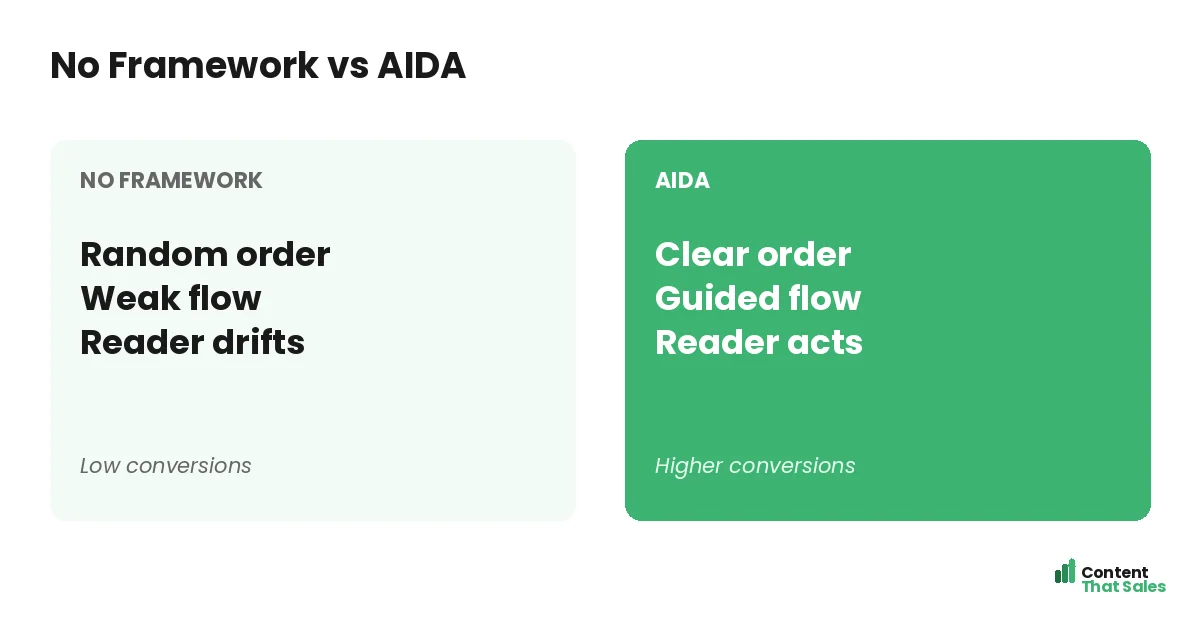
AIDA is one of the oldest and most reliable copywriting frameworks for a reason: it mirrors how people actually decide. They notice, they get curious, they want, then they act. Build your page in that order and you carry the reader smoothly toward conversion.
Below, we break down each AIDA step, show which page element delivers it, and walk through how to apply the formula to a real landing page.

What AIDA Is
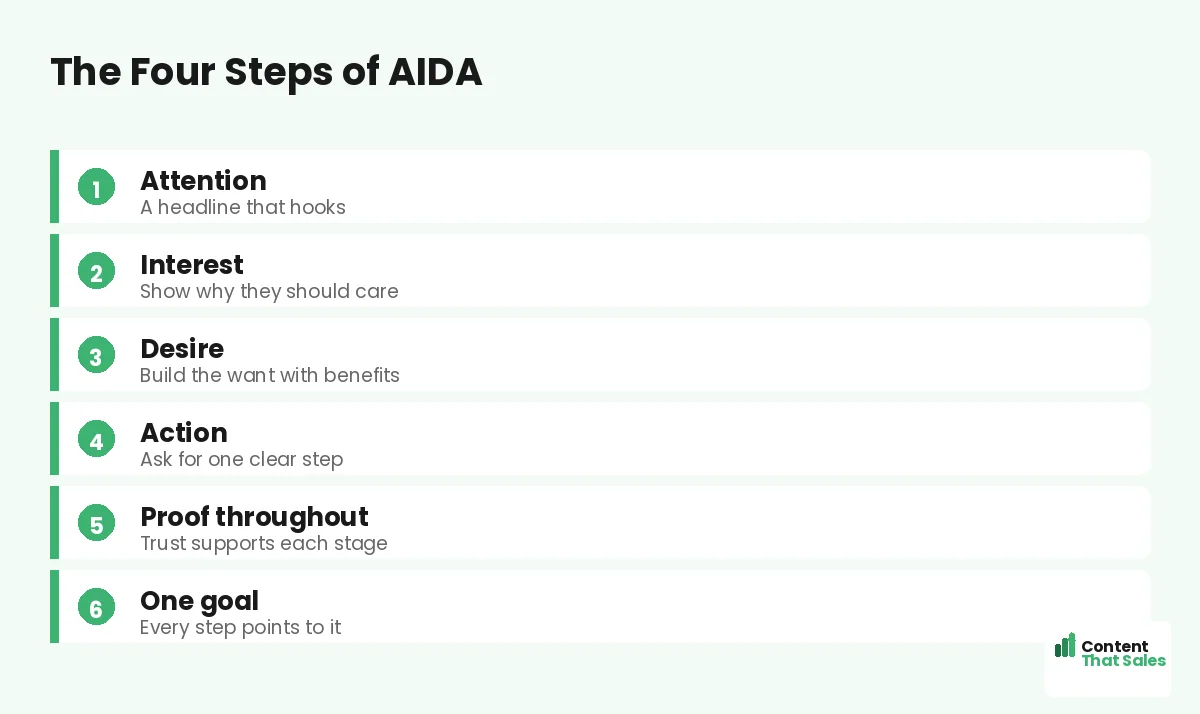
AIDA stands for Attention, Interest, Desire, and Action. It is a classic marketing framework that describes the stages a person moves through before buying. Each letter is a step, and the sequence matters: you cannot earn action before you have built desire.
On a landing page, AIDA gives you a clear order for your content. It pairs naturally with a solid landing page structure, turning a list of sections into a guided journey that moves the reader steadily toward the CTA.
Step 1: Attention
The first job is to grab attention. On a landing page, that is your headline and hero. In a world of distractions, you have seconds to make the visitor stop and look. A bold, benefit-led headline is how you capture that first moment.
Lead with the biggest promise or the sharpest pain. A headline like “Double Your Leads in 30 Days” stops the scroll. Without attention, nothing else on the page matters, so make this opening line work hardest of all.
Step 2: Interest
Once you have attention, build interest. This is where the subheadline and opening copy show the reader why they should care. Connect to their problem or goal so they feel the page is about them, and keep reading instead of bouncing.
Interest comes from relevance. Name the reader’s situation, hint at the solution, and make them curious about how you deliver. Since readers scan more than they read, keep this section sharp and skimmable to hold the attention you just earned.
Step 3: Desire
Now turn interest into desire. This is where benefits and proof do their work. Show the reader what life looks like with your solution, framing features as wins they want. Make them not just understand the offer, but crave it.
Desire is built with vivid benefits and backed by proof. Testimonials, results, and social proof make the want feel justified and safe. By the end of this stage, the reader should be thinking “I want this,” ready for the final step.
Step 4: Action
Finally, ask for action. This is your call to action, one clear, low-risk step. After building desire, make the next move obvious and easy. A strong, benefit-led button turns all that interest and desire into an actual conversion.
Do not be timid here. You earned the right to ask, so ask clearly. Following solid landing page CTA best practices, make the action the natural climax of the page, not a quiet afterthought.
Map AIDA to Your Page
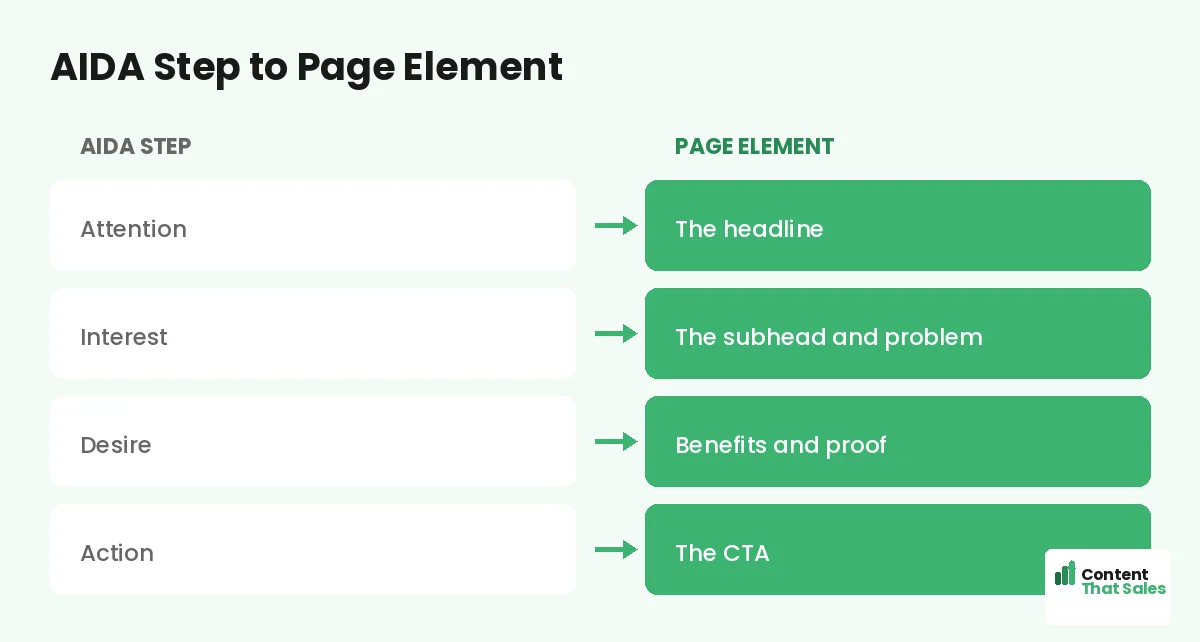
Each AIDA step maps to a page element. Attention is the headline and hero. Interest is the subhead and problem section. Desire is the benefits and proof. Action is the CTA. Lay them in that order and your page follows the formula naturally.
This mapping turns AIDA from theory into a build plan. Start with a gripping headline, follow with relevant interest-building copy, stack benefits and proof to create desire, then close with a clear CTA. The structure writes itself once you know the steps.
Did you know?
AIDA works because it mirrors how people actually decide: they notice, get curious, start to want, then act. Build the page in that order and you match the reader’s mind.
An Example AIDA Flow
Imagine a page for a fitness app. Attention: “Get Fit in 15 Minutes a Day.” Interest: “No gym, no equipment, just short workouts that fit your busy life.” That hooks the reader and shows the page understands their constraint.
Desire: benefits like “See results in 4 weeks” backed by before-and-after proof and reviews. Action: “Start your free trial today.” Each step builds on the last, carrying the reader from a glance to a signup in one smooth flow.
Weave Proof Through Every Step
While desire is the main home for proof, trust should support every stage. A trust badge near the headline, a stat in the interest section, and testimonials by the CTA all reinforce the journey. Proof keeps the reader moving with confidence.
Sprinkling credibility throughout means the reader never hits a moment of doubt that stalls them. AIDA gives the flow; proof gives the trust that lets the flow work. Together they turn a curious visitor into a convinced buyer.
Keep One Goal Through the Flow
AIDA works best when every step points to one action. Do not split the desire or scatter multiple CTAs for different things. The whole formula builds toward a single conversion, so keep the page focused on that one goal from start to finish.
A ready landing page copy template helps you keep the flow tight, with each section feeding the next. One attention grab, one thread of interest and desire, one clear action. That focus is what makes AIDA convert.
AIDA vs Other Frameworks
AIDA is one of several copywriting formulas. It is simple and versatile, great for most landing pages. Other frameworks like the PAS formula or PASTOR lean harder on problem and story, which can suit pages where pain or narrative drives the decision.
You do not have to pick just one forever. AIDA is a reliable default; reach for a problem-led formula when emotion or urgency leads. Knowing several frameworks lets you choose the right flow for each page and audience.
Put It All Together
The AIDA formula gives your landing page a proven flow: grab Attention with the headline, build Interest with relevant copy, create Desire with benefits and proof, and prompt Action with a clear CTA. Each step prepares the reader for the next.
Map the steps to your page elements, keep one goal throughout, and weave proof across the journey. Simple, clear copy keeps winning, since easy reading lifts conversions. Follow AIDA and your page guides visitors smoothly from glance to conversion.
How Content That Sales Helps
We write pages that flow and convert. That’s where we come in. At Content That Sales, we build landing pages on proven frameworks like AIDA, so every section carries the reader smoothly toward the action you want.
You share your offer and audience. We craft the attention-grabbing headline, the interest and desire that build the want, and the CTA that closes. The result is a page with a deliberate flow, not a random pile of sections.
Ready to Apply AIDA to Your Page?
Now you know the AIDA formula for landing pages: Attention, Interest, Desire, Action, mapped to your headline, copy, benefits, and CTA. The flow mirrors how people decide. So why leave your page order to guesswork?
Let’s build a page with a proven flow. Book your free consultation now. Call us at 8801631988589 or email service@contentthatsales.com. Let’s turn your next visitor into your next customer.
Frequently Asked Questions About the AIDA Formula
What does AIDA stand for?
Attention, Interest, Desire, and Action. It is a classic framework describing the stages a person moves through before buying, applied in order on a page.
How does AIDA map to a landing page?
Attention is the headline and hero, Interest is the subhead and problem, Desire is the benefits and proof, and Action is the CTA. Lay them in that order.
Why does the order matter?
Because you cannot earn action before building desire. AIDA mirrors how people decide, so following the sequence carries the reader smoothly to the CTA.
Where does proof fit in AIDA?
Mainly in the desire stage, but weave trust throughout, a badge near the headline, a stat in interest, testimonials by the CTA, so the reader never doubts.
Is AIDA better than PAS or PASTOR?
Not better, just different. AIDA is a versatile default. Problem-led formulas like PAS or PASTOR suit pages where pain or story drives the decision.
Can I use AIDA for any page?
Yes, it fits most landing pages. Keep one goal throughout and let each step build on the last for the formula to work its best.
What is the most common AIDA mistake?
Skipping from attention straight to action. Without interest and desire first, the reader is not ready, and the CTA falls flat.
Can Content That Sales help?
Yes. We build pages on proven frameworks like AIDA so each section flows toward the action. Reach out for a quick quote.