 Skip to content
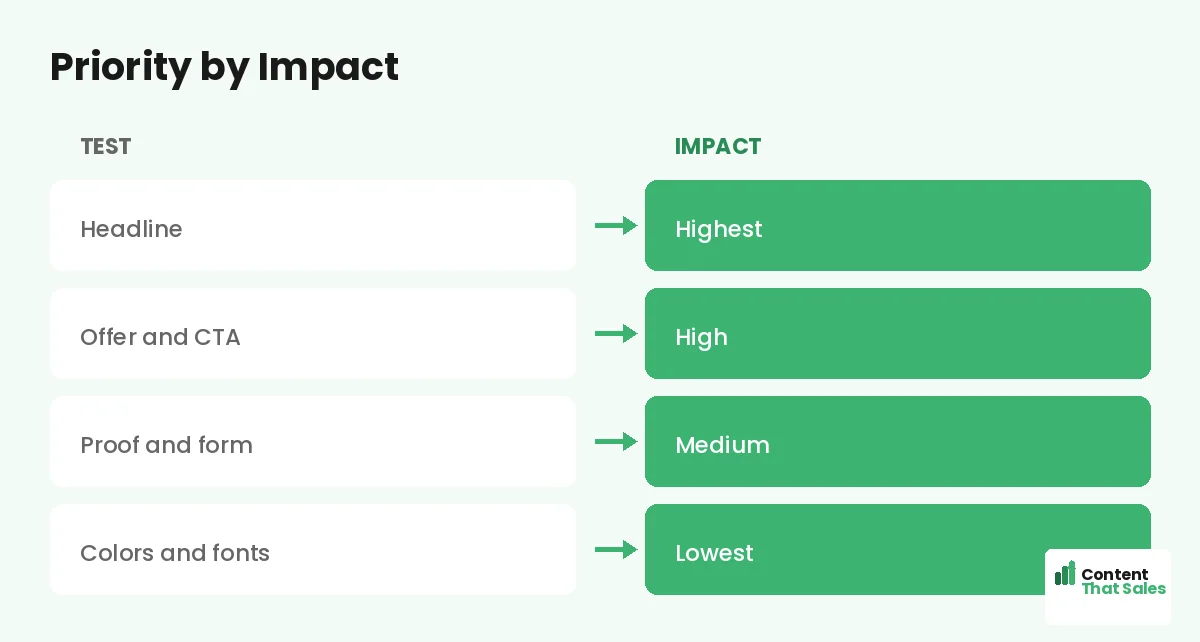
When you ask what to test first on a landing page, the answer is simple: start with the elements that carry the most weight, not the ones that are easiest to change. The headline, the offer, and the call to action move conversions far more than button colors or fonts. Testing in the right order means you capture the biggest gains first and waste less traffic on tiny tweaks. This guide gives you a clear priority order so you always know what to test next.
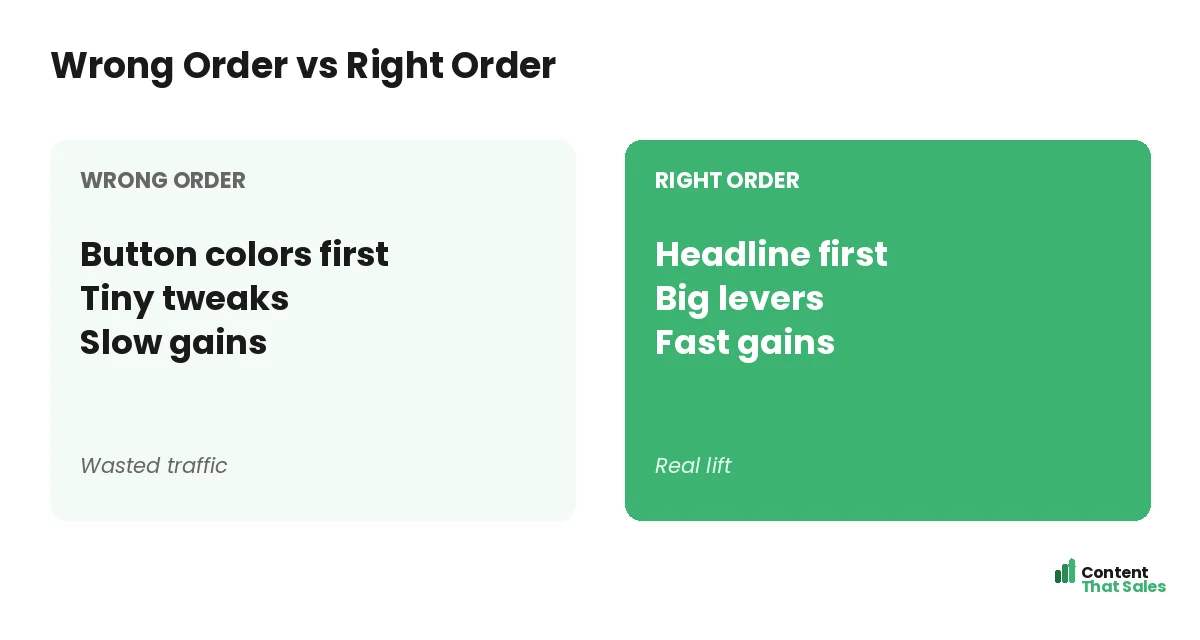
Most teams get this backwards. They start with cosmetic changes because they are easy, then wonder why the rate barely moves. The smarter path is to test the big levers early, where a single change can shift your whole conversion rate. Let’s walk through what to test first, second, and last, so your testing program actually pays off.
Below, we rank the elements by impact, explain why each sits where it does, and show how to sequence your tests. By the end, you will have a priority order you can follow on any page.

The Rule: Impact Before Effort
The guiding principle is simple. Test the change that could move conversions the most, not the one that is easiest to set up. A headline test might take ten minutes and lift the whole page. A font test might take an hour and change nothing. Always weigh impact first.
This keeps your testing focused and your traffic well spent. Each test costs visitors and time, so spend them where the payoff is biggest. Once the high-impact elements are dialed in, you can move to the smaller details. Order is everything in a smart testing program.
Test the Headline First
The headline is almost always the first thing to test. Most visitors read it and decide in a second whether to stay. A weak headline caps the whole page, so improving it can lift every number below. No other single element carries this much weight.
Test a specific, benefit-led headline against your current one. Try adding a number or a clear timeframe. For a proven method on this one element, see how to test landing page headlines with real visitors. Start here and you start with your biggest lever.
Test the Offer Next
If the headline is solid but the page still underperforms, look at the offer itself. Sometimes the issue is not the words but what you are asking the reader to do. A free trial may beat a demo. A free quote may beat “contact us.” Framing changes behavior.
Test how you present and frame the offer before you polish smaller details. The offer is the heart of the decision, so a better one can produce a big swing. Make sure every version stays honest and something you can actually deliver.
Test the Call to Action Third
The CTA is your next-biggest lever after the headline and offer. Test a specific, value-led label against a generic one. Try adding reassuring microcopy, or placing the button higher and repeating it. Each can shift click-through and conversions.
Keep every button pointing to one action, following solid landing page CTA best practices. The CTA is where interest becomes action, so small improvements here pay off directly. Once the headline, offer, and CTA are strong, the foundation is set.
Then Test Proof and Form
With the big three handled, move to proof and friction. Test moving a strong testimonial next to the button, or adding a rating near the top. Test a shorter form against your current one, since every field you remove can lift completions.
These elements matter, but they tend to move the rate less than the headline, offer, and CTA. People scan more than they read, so well-placed proof and a short form still help. Just test them after the bigger levers, not before.
Did you know?
Teams that test the headline and offer first usually see gains far sooner than teams that start with colors. Order changes how fast results come.
Save Cosmetic Tests for Last
Colors, fonts, and minor spacing are real, but they are last for a reason. They usually produce tiny gains compared to the message. Testing them first burns traffic you could spend on changes that actually move the needle. Patience here pays off.
Once your headline, offer, CTA, proof, and form are optimized, cosmetic tweaks can add a final polish. By then, a small lift is worth chasing because the big wins are already banked. Order your tests so the small stuff comes after the big stuff, never before.
Let Your Data Pick the Starting Point
The priority order is a default, not a law. Your own data may point somewhere specific. A high bounce on the first screen says test the headline. Lots of reads but few clicks says test the CTA or proof. Let the leak guide the first test.
This is the heart of conversion rate optimization: find the biggest leak, then test a fix. The general order helps when you have no clear signal. When you do have data, fix the weakest spot first, whatever it is.
Run Each Test Cleanly
Whatever you test first, run it properly. Change one element at a time, split traffic fairly, track one metric, and wait for enough data. A high-impact test ruined by sloppy setup teaches you nothing and wastes your best opportunity.
Write each challenger with care, grounded in how to write landing page copy that converts. Keep the wording simple, since easy reading lifts conversions. The right test, run cleanly, is what turns priority into real gains.
Build Your Testing Sequence
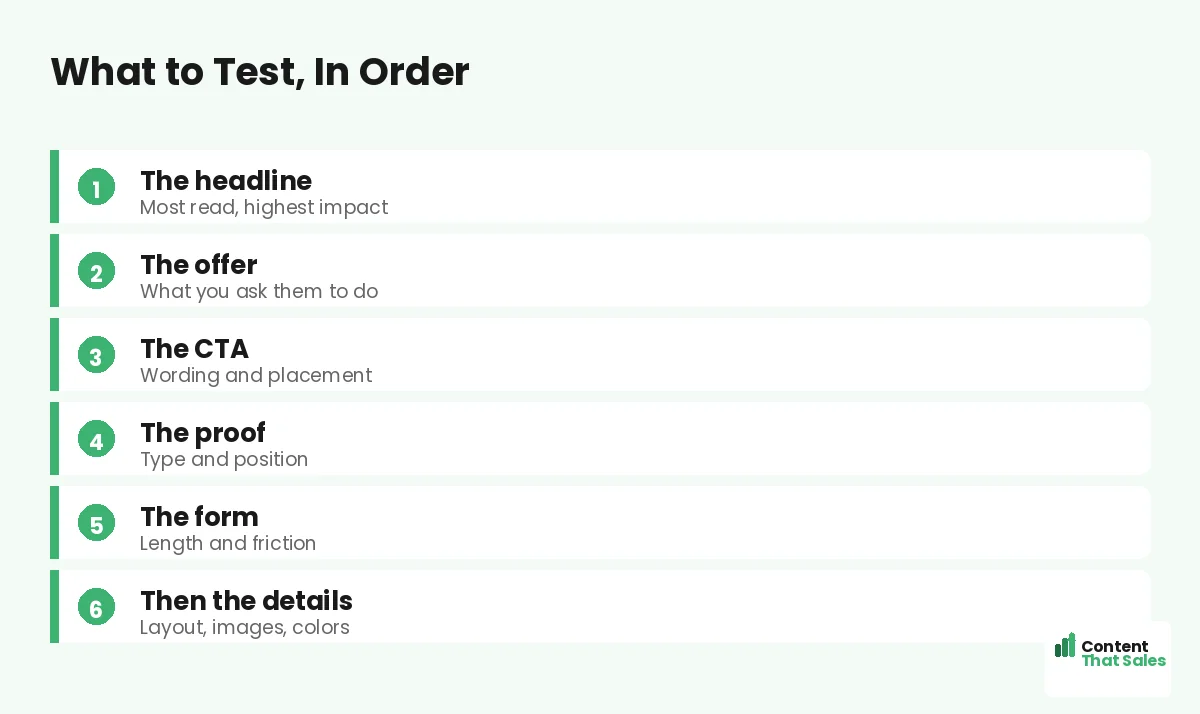
Put it all together into a sequence. Start with the headline. Then the offer. Then the CTA. Then proof and form. Then the small stuff. Adjust the order when your data points elsewhere, but keep impact as your north star.
Work through one clean test at a time and bank each win. This steady sequence beats a scramble of random tweaks. Over time, testing the right things in the right order compounds into a page that far outperforms where you began.
Common First-Test Mistakes
A few mistakes derail early testing. Starting with cosmetic tweaks. Testing many things at once. Picking a change with no clear hypothesis. Each one wastes traffic and teaches little. Avoid them and your first tests will actually move the rate.
The fix is discipline. Test the biggest lever first, change one thing, and base it on a real weakness. A focused first test sets the tone for a testing program that compounds wins instead of chasing its tail.
How Content That Sales Prioritizes Tests
Knowing what to test first takes experience across many pages. That’s where we come in. At Content That Sales, we audit your page, find the biggest lever, and write the high-impact challenger to test first.
You share the page and the goal. We build the priority order and the copy to run it. If you want done-for-you landing page copy, we make it effortless. The result is a testing program that captures the big wins first.
Ready to Turn Visitors Into Customers?
Now you know what to test first on a landing page. Start with the headline, then the offer, then the CTA, then proof and form, and save cosmetics for last. So why burn traffic on tiny tweaks when the big levers are waiting?
Let’s test the right things in the right order. Book your free consultation now. Call us at 8801631988589 or email service@contentthatsales.com. Let’s turn your next visitor into your next customer.
Frequently Asked Questions About What to Test First
What should I test first on a landing page?
The headline, since most visitors read it and decide fast. Improving it can lift the whole page, so it is almost always the highest-impact first test.
Why not test button colors first?
Cosmetic tests usually produce tiny gains. Testing them first burns traffic you could spend on the headline, offer, and CTA, where the real lift lives.
What is the right testing order?
Headline, then offer, then CTA, then proof and form, then cosmetic details. Adjust when your data points to a specific leak, but lead with impact.
How does my data change the order?
A high first-screen bounce says test the headline. Lots of reads but few clicks says test the CTA or proof. Fix the biggest leak first.
Should I test the offer or just the copy?
Both, but the offer can produce the biggest swings. If the headline is solid and results still lag, test how you frame and present the offer.
How many tests should I run at once?
One clean test at a time, changing a single element. Running several at once makes it impossible to know what caused a change.
When do cosmetic tests matter?
After the big levers are optimized. By then a small lift from colors or spacing is worth chasing, because the major wins are already banked.
Can you tell me what to test first?
Yes. Content That Sales audits your page and prioritizes the highest-impact test. Reach out for a quick quote.