 Skip to content
If you are comparing a content writing agency vs marketing agency, you are already asking the right question. The hard part is not hiring help. The hard part is hiring the right kind of help.
A lot of business owners mix these two up. I get why. Both talk about growth. Both talk about leads. Both may mention SEO, blogs, funnels, ads, and AI.
But they do not do the same job.
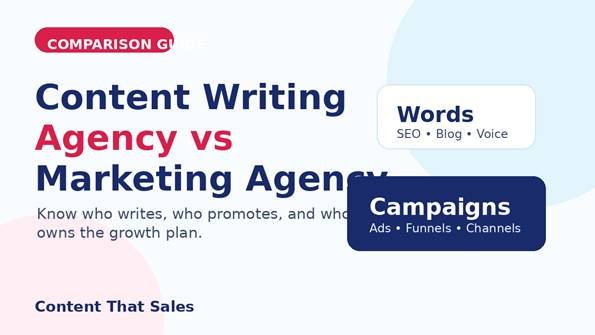
A content writing agency builds the words, ideas, structure, and search depth behind your site. A marketing agency usually builds the wider machine around those assets. Think campaigns, ads, email flows, social media, tracking, and offers.
So, do you need more words or more leads?
That question sounds simple. It is not. Because weak words make weak campaigns. And great content with no promotion can sit alone, like a shop with no road.
This guide breaks it down in plain English. No agency fluff. No shiny sales fog. Just the real difference, the cost traps, the SEO angle, and the AI search shift.
By the end, you will know which partner fits your stage.
The Quick Answer: What Is the Main Difference?
A content writing agency creates written content for your business. That includes blog posts, service pages, landing pages, topical maps, email copy, and SEO articles.
A marketing agency plans and runs broader marketing work. That can include paid ads, social media, email campaigns, brand strategy, analytics, creative design, and conversion funnels.
Here is the cleanest way to see it.
A content writing agency focuses on what your brand says.
A marketing agency focuses on where, when, and how that message gets pushed.
There is overlap, of course. Some content agencies offer strategy. Some marketing agencies offer writing. But the core skill is different.
It is like hiring a specialist chef versus hiring a full kitchen team. The chef may make the best dish. The kitchen team may manage the whole dinner service.
Both can be useful. But they are not the same hire.
What Is a Content Writing Agency?
A content writing agency is a team that plans, writes, edits, and formats business content.
The work often starts before writing. Good agencies study search intent. They check competitor pages. They map keywords. They review your brand voice. They ask what the reader needs before they ask what Google needs.
That matters.
Google says SEO helps when it supports people-first content, not search-first content. That is why a good writing team does not just place keywords. It answers real questions in a clear way.
A content writing agency usually helps with:
- Blog posts
- SEO articles
- Service pages
- Homepage copy
- Landing page copy
- Case studies
- Product descriptions
- Email sequences
- Content briefs
- Topic clusters
- Topical maps
- Internal linking
- Meta titles and descriptions
At Content That Sales, this kind of work is built around search, story, and conversion. The goal is not just pretty writing. The goal is content that earns trust and moves buyers.
If you want the deeper breakdown, read what a content writing agency does. It explains the role before you compare vendors.
What Is a Marketing Agency?
A marketing agency helps a business attract, convert, and retain customers across channels.
That means the scope is wider. A marketing agency may handle ads, funnels, design, automation, social media, reporting, and campaign planning.
The American Marketing Association defines marketing as creating, communicating, delivering, and exchanging offers that hold value. That is a big umbrella.
So a marketing agency often works across that umbrella.
A marketing agency may help with:
- Paid ads
- Social media campaigns
- Email marketing
- Brand positioning
- Conversion funnels
- Creative direction
- Analytics and tracking
- Lead generation campaigns
- Marketing automation
- Video campaigns
- PR support
- Sales enablement
Some marketing agencies write content too. But writing may be one task inside a bigger package.
That is where things get tricky.
If writing is only one small piece, the content can feel thin. It may support a campaign but fail as a long-term SEO asset. That hurts when your goal is organic traffic.
Content Writing Agency vs Marketing Agency: Side-by-Side
Here is the fast comparison.

Core Focus
A content writing agency focuses on written assets. It cares about search intent, depth, structure, tone, and readability.
A marketing agency focuses on business growth across channels. It cares about reach, leads, campaigns, tracking, and return.
Main Output
A content agency gives you publish-ready content.
A marketing agency gives you campaigns and systems.
That difference changes everything. It changes the team. It changes the price. It changes the process.
Best Use Case
Choose a content writing agency when you need better blogs, stronger pages, or a full SEO content plan.
Choose a marketing agency when you need ads, funnel setup, creative campaigns, and channel growth.
Team Structure
A content writing agency usually has writers, editors, SEO strategists, and content managers.
A marketing agency may have account managers, media buyers, designers, email experts, analysts, and strategists.
Success Metric
A content writing agency tracks rankings, clicks, engagement, leads, and content quality.
A marketing agency tracks leads, cost per lead, ad return, conversion rate, and campaign revenue.
Both should care about sales. They just reach sales from different roads.
How Each Team Handles SEO
SEO is where the line gets blurry.
A marketing agency may offer SEO as one service. It may do technical audits, link building, local SEO, or campaign reporting.
A content writing agency often handles the page-level SEO that makes content rank. That includes keywords, headings, search intent, topical depth, and internal links.
Google’s SEO Starter Guide says SEO helps search engines understand content and helps users decide if they should visit. That is exactly where writing quality matters.
A strong content agency asks these questions before drafting:
- What does the reader really want?
- What answer is missing from current results?
- What proof would build trust here?
- Which related pages should this post link to?
- What section order makes the page easy to scan?
- What CTA fits the reader stage?
That is not random writing. That is a search asset.
Need a full organic content system? A Topical Map service can help plan the pages before the writing starts.
Need deeper search targeting first? The Keyword Research service gives the map a clean base.
How Each Team Handles Content Strategy
A content writing agency sees content strategy as the plan behind the words.
It decides which topics matter. It builds clusters. It spots gaps. It connects blogs to money pages. It also makes sure each page has a clear job.
A marketing agency sees strategy across the whole funnel.
It may decide which channels matter. It may build an offer. It may create an ad plan. It may test landing pages. It may set up email flows.
Neither view is wrong.
They just solve different layers of the same growth puzzle.
A content strategy without promotion can move slowly. A promotion plan without strong content can burn cash fast.
As the old saying goes, a stitch in time saves nine. Fixing strategy early saves expensive cleanup later.
AI Overview, LLMs, and the New Search Game
AI changed this comparison.
Search is no longer only ten blue links. Google now has AI Overviews and AI Mode in many results. LLM tools also answer buyer questions before users click a website.
Google says AI features still rely on core SEO best practices. It also says there are no special tricks needed for AI Overviews. The foundation still matters.
That means content needs to be easy to understand, easy to verify, and useful enough to cite.

A content writing agency can help with that by writing clear answers. It can add examples, definitions, comparisons, and source-backed points.
A marketing agency can help by pushing that content across channels. It can turn one guide into ads, emails, short videos, and social posts.
So the AI search question is not, “Who knows the newest hack?”
The better question is, who can create content that deserves to be found?
Google’s guide to generative AI content warns against scaled pages that add no value. So raw AI spam is not a plan. It is a shortcut with a hole in the floor.
LLMs reward clarity. They pull from pages that explain things well. They also need facts, structure, and context.
That is why thin content feels weaker now. It does not just fail readers. It also gives AI systems little reason to trust it.
Content Quality, Voice, and E-E-A-T
Content quality is not only grammar.
Good content feels useful. It answers the question. It shows proof. It reads like a real person wrote it. It also respects the reader’s time.
Google talks about E-E-A-T, which means experience, expertise, authoritativeness, and trustworthiness. These signals help Google understand whether a page feels reliable.
A content writing agency should help you show those signals in the copy.
That can include:
- Real examples
- Clear author notes
- Updated facts
- Useful internal links
- Trusted external sources
- Specific buyer pain points
- Simple explanations
- Proof from your process
- Honest limits
A marketing agency may support this too. It may gather customer research, reviews, survey data, and campaign learnings.
But the writer still has to turn all that into clean content.
Bad writing is like muddy glass. The offer may be good, but nobody sees it clearly.
This is why content writing vs copywriting matters too. One builds trust over time. The other pushes action now. Strong brands need both.
Costs, Timelines, and What You Actually Pay For
A content writing agency usually charges by project, word count, package, or monthly retainer.
A marketing agency often charges a monthly retainer. It may also charge ad management fees, setup fees, creative fees, or a percentage of media spend.
That means marketing agencies often cost more each month. But they may cover more moving parts.
A content agency may cost less, but only if your needs are content-focused.
Here is the real test.
Do you need assets or operations?
If you need ten blog posts, hire a content team.
If you need ad creative, landing pages, tracking, email flows, and reporting, hire a marketing team.
Why pay for a full band when you only need one drummer?
This is where many businesses waste money. They hire a wide agency for a narrow writing problem. Or they hire writers when they really need campaign operations.
Both mistakes feel expensive.
Before you commit, read how to budget for content writing. It helps you judge price by outcome, not word count.
When a Content Writing Agency Is the Better Pick
A content writing agency is the better choice when your main problem is content quality, SEO depth, or publishing volume.
You should lean this way if your website has weak service pages. You should also lean this way if your blog gets little traffic.
Choose a content writing agency when:
- Your blog feels random
- Your pages do not rank
- Your content sounds generic
- Your team lacks writing time
- Your SEO pages need depth
- Your brand voice feels messy
- Your internal links are weak
- You need a topical map
- You need long-form guides
- You want human editing over raw AI text
This is also the right pick if you already have a marketing lead. Many teams know their offer but lack writing power.
In that case, a writing agency becomes the engine oil. It keeps the growth machine moving without burning out the team.
For direct help with this, the Blog Post Writing service is the cleanest fit.
When a Marketing Agency Is the Better Pick
A marketing agency is the better choice when your problem is bigger than content.
Maybe traffic is fine, but leads are weak. Maybe ads are messy. Maybe no one tracks conversions. Maybe your offer is unclear.
Choose a marketing agency when:
- You need paid ads
- You need campaign planning
- You need funnel setup
- You need brand strategy
- You need marketing automation
- You need email campaigns
- You need conversion tracking
- You need social media management
- You need creative testing
- You need full channel growth
A marketing agency can build the wider system.
Just make sure content quality does not become an afterthought. A great funnel with weak words still leaks.
That leak can be tiny at first. Then it grows. Soon you are paying for clicks that do not trust you.
When You Need Both Working Together
Some businesses need both.
This is common when the company is growing fast. The content team builds the assets. The marketing team promotes, tests, and measures them.
Here is a clean split:
The content writing agency owns:
- Search content
- Blog writing
- Service page copy
- Content briefs
- Topic clusters
- On-page SEO
- Voice consistency
- Editorial quality
The marketing agency owns:
- Paid traffic
- Channel strategy
- Funnel setup
- Retargeting
- Email automation
- Campaign reporting
- Offer testing
- Lead flow
This model works well because each team stays in its lane.
The content team feeds the machine. The marketing team drives the machine. Leadership watches the dashboard.
It feels clean when roles are clear. It becomes chaos when everyone edits everything.
How to Choose the Right Partner
Start with your bottleneck.
Do not start with agency labels. Start with the thing slowing growth.

If people cannot find you, you likely need SEO content.
If people find you but do not convert, you may need copy, offers, or funnel work.
If you have traffic but no tracking, you need marketing operations.
If you have ideas but no publishing system, you need a content agency.
Here is a simple scorecard.
Pick a content writing agency if most of these are true:
- We need better organic traffic
- We need blog posts or guides
- We need stronger service pages
- We already know our offer
- We need content every month
- We care about search rankings
- We need a human writing process
Pick a marketing agency if most of these are true:
- We need paid campaigns
- We need channel strategy
- We need lead tracking
- We need email automation
- We need funnel design
- We need offer testing
- We need full campaign support
Still unsure? Start with a small project.
Ask for one brief, one draft, and one revision. That small test tells you more than a polished sales call.
You can also use how to vet a content writing agency in 30 minutes before signing anything.
Common Mistakes to Avoid
The first mistake is hiring by name, not need.
A fancy marketing agency is not always better for writing. A strong writing agency is not always enough for ads.
The second mistake is buying content without strategy.
Random blogs rarely build authority. They look busy, but they do not connect. Like loose bricks without mortar, they never become a wall.
The third mistake is ignoring internal links.
Google says internal links help make content findable. Readers need those links too. New content needs older pages pointing to it.
The fourth mistake is treating AI as the whole team.
AI helps with research, outlines, and rough ideas. But someone still needs judgment. Someone needs to check facts, tone, examples, and trust.
The fifth mistake is chasing volume only.
More content is not always better. Better content is better. Then more of that is better.
What Should Be in the Brief?
A good brief makes both partners better.
For a content writing agency, the brief should include the keyword, search intent, audience, offer, examples, voice notes, internal links, and CTA.
For a marketing agency, the brief should include goals, audience, budget, channels, offer, tracking setup, sales cycle, and target cost per lead.
The brief is the map. Without it, the team drives in circles.
Want a stronger briefing process? Use how to brief a content writer for best results before your next project.
A clear brief does not kill creativity. It protects it.
Writers can move faster when the road is marked. Marketers can test better when the goal is clear.
The Best Choice by Business Stage
Your stage matters.
A new business often needs core pages first. That means homepage content, service pages, and a few trust-building guides.
A growing business may need blog clusters, case studies, and lead magnets. A content writing agency fits well here.
A scaling business may need a full marketing system. That includes paid traffic, email, retargeting, and analytics.
An established brand may need both. It may need deep content for authority and campaigns for demand.
Here is the simple version.
Startups need clarity.
Growing teams need consistency.
Scaling teams need systems.
Mature brands need coordination.
Your partner should fit the stage, not just the budget.
How to Measure Results After You Hire
Hiring the right partner is only step one.
You still need a simple way to judge the work. Otherwise, every report feels like smoke.
For a content writing agency, measure content by growth and usefulness.
Track these numbers:
- Impressions in search
- Clicks from search
- Keyword movement
- Time on page
- Internal link clicks
- Leads from content
- Assisted conversions
- Content refresh wins
Do not judge a new blog after one week. Organic content needs time. Most pages need a few months before the pattern is clear.
But you can judge the quality right away.
Ask yourself this:
Does the post answer the searcher better than the current top results?
If the answer is no, fix the content before you blame Google.
For a marketing agency, measure campaign movement.
Track these numbers:
- Cost per lead
- Lead quality
- Conversion rate
- Ad spend return
- Email opens
- Email clicks
- Landing page conversions
- Sales pipeline value
A good marketing report should not bury you in charts. It should show what worked, what failed, and what changes next.
That is the whole point of reporting.
Pretty dashboards do not pay bills. Clear decisions do.
The best teams connect both sides. They check if content brings better traffic. Then they check if campaigns turn that traffic into sales.
This keeps everyone honest.
If rankings rise but leads stay flat, the offer may be weak. If ads get clicks but nobody buys, the landing page may need better copy.
If content gets traffic but no calls, add stronger CTAs. If campaigns bring leads but sales hates them, sharpen the audience.
Growth is not one lever. It is a control panel.
Measure the right part before you twist the wrong knob.
How Content That Sales Fits This Gap
Content That Sales sits closer to the content writing agency side.
The focus is written content that ranks, teaches, and converts. That includes blog posts, service pages, landing pages, topical maps, and keyword research.
The process is built for businesses that need stronger organic growth. It also fits teams that want content that sounds human, not machine-made.
The work can support a marketing agency too.
A marketing agency can run the campaigns. Content That Sales can build the pages and posts those campaigns need.
That way, your ads and emails do not point to thin pages. They point to useful pages that earn trust.
Need stronger service pages? The Service Page Content service is built for that.
Need homepage clarity first? The Homepage Content service can tighten your first impression.
Need landing pages for campaigns? The Landing Page Copy service can support paid traffic.
FAQ: Content Writing Agency vs Marketing Agency
What is the difference between a content writing agency vs marketing agency?
A content writing agency creates written content. A marketing agency runs broader growth work across channels, campaigns, ads, funnels, and tracking.
Is a content writing agency cheaper than a marketing agency?
Usually, yes. A writing agency has a narrower scope. A marketing agency often covers more people, tools, and channels.
Can a marketing agency write blog posts?
Yes, many can. But writing may not be their deepest skill. Check samples before you trust them with SEO content.
Can a content writing agency handle marketing strategy?
Some can handle content strategy. That is not the same as full marketing strategy. Ask where their scope ends.
Which one is better for SEO?
A content writing agency is often better for SEO content. A marketing agency may be better for technical SEO, campaigns, and tracking.
Which one is better for AI Overviews and LLM visibility?
Strong content helps most. You need clear answers, original value, proof, structure, and trusted sources. Promotion can support that reach.
Should I hire both agencies?
Hire both when you need content and campaign execution. Keep roles clear so the work does not overlap or slow down.
What should I ask before hiring either one?
Ask for samples, process, timelines, revisions, reporting, ownership rights, and who does the actual work.
Final Thought: Pick the Partner That Solves the Real Problem
The content writing agency vs marketing agency choice is not about which one sounds bigger.
It is about the problem in front of you.
If your words are weak, fix the words.
If your channels are messy, fix the channels.
If both are broken, build the content first. Then promote it with care.
That order matters.
Great marketing can bring people to the door. Great content gives them a reason to stay.
If you want content that does that job, contact Content That Sales.
Call: 8801631988589
Email: service@contentthatsales.com