 Skip to content
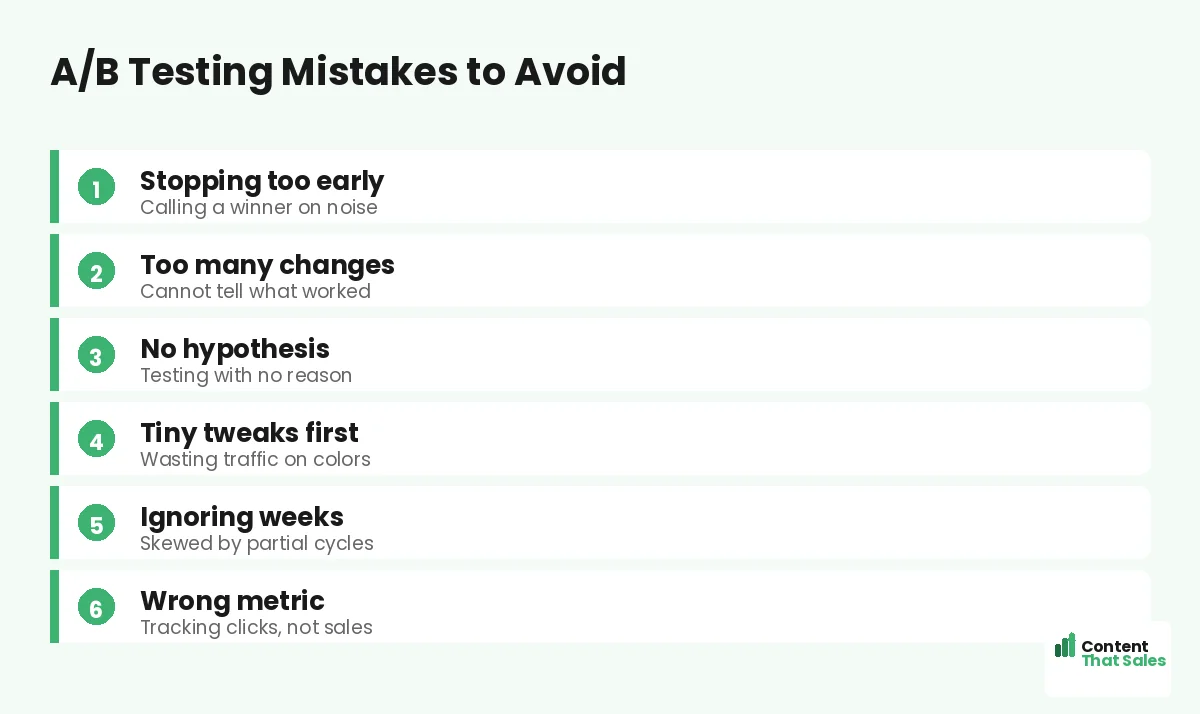
Most failed experiments come down to a handful of common A/B testing mistakes on landing pages, not bad luck. Teams stop tests too early, change five things at once, test with no hypothesis, or chase button colors while ignoring the headline. Each mistake produces a result you cannot trust, which is worse than no test at all, because it leads you to ship the wrong thing with false confidence. This guide names the biggest mistakes and the simple fix for each, so your tests actually teach you something.
A/B testing is powerful, but only when it is done cleanly. A sloppy test feels like progress while quietly leading you astray. The good news is that the mistakes are predictable, which means they are avoidable. Learn to spot them and your testing program becomes a reliable engine for growth. Let’s go through the traps one by one.
Below, we cover the most common testing mistakes, why each one ruins your results, and how to avoid it. By the end, you will run tests you can actually believe.

Mistake 1: Stopping the Test Too Early
This is the most common and most costly mistake. A version pulls ahead on day two, the team gets excited, and they call it a winner. But early leads are noise. With more data, that lead often vanishes or flips entirely.
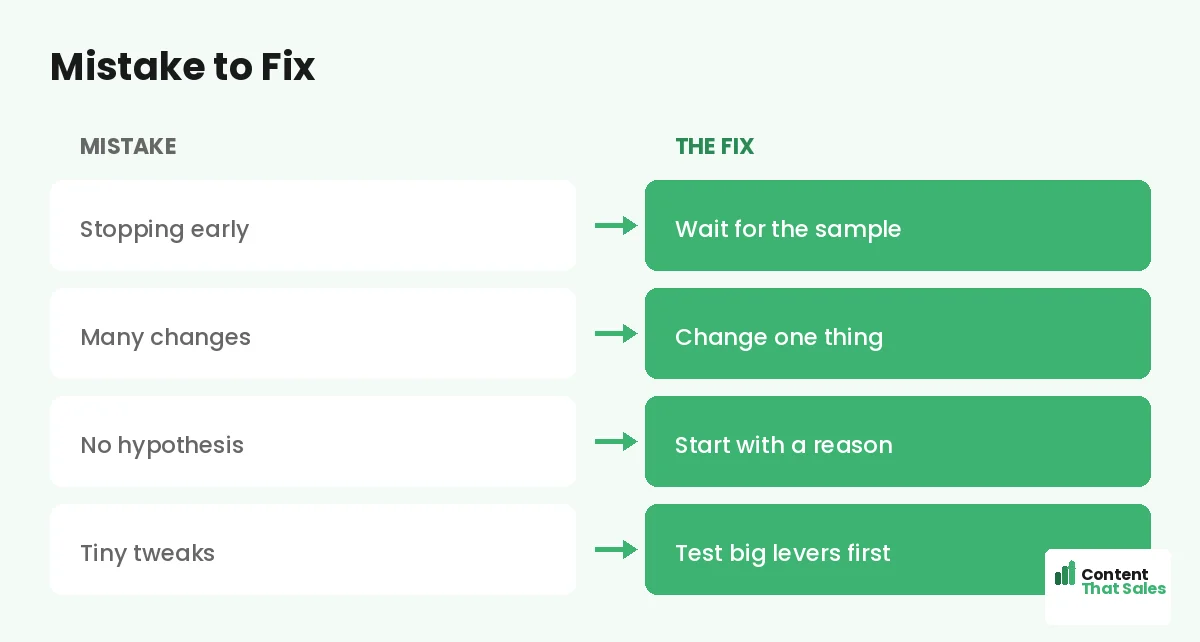
The fix is patience. Decide your sample size and minimum duration before you start, then hold to it. Wait for a result that is both significant and stable. For the full method, see how long to run a landing page A/B test. Never call a winner on a hunch.
Mistake 2: Changing Too Many Things at Once
If you change the headline, the button, and the proof all in one version, a win tells you nothing. You cannot know which change caused it. The test becomes a mystery, and you learn nothing you can reuse on the next page.
Change one element at a time. Yes, it is slower, but it is the only way to get a clean, reusable lesson. One variable per test means one clear answer. If you want to test many ideas, run them in sequence, not all jammed into a single version.
Mistake 3: Testing Without a Hypothesis
Testing random ideas wastes traffic. Without a reason, a win is just luck and a loss teaches nothing. A hypothesis turns a test into a lesson by stating the problem, the change, and the expected result before you begin.
Base your hypothesis on a real weakness in the page. If your headline is vague, test a specific one and expect more reads. Grounded tests, like the ones in a good A/B test ideas backlog, produce knowledge whether they win or lose.
Mistake 4: Starting With Tiny Tweaks
Many teams begin with button colors or font sizes because they are easy. These cosmetic tests usually produce tiny gains, if any, and burn traffic you could spend on bigger levers. You end up busy but barely moving the rate.
Start with the elements that carry the most weight: the headline, the offer, and the CTA. Save the small stuff for after the big wins are banked. For the right order, see what to test first. Impact should always beat ease.
Mistake 5: Ignoring Full Weeks
Running a test for three or four days skews the result. Weekday and weekend behavior differ, so a partial week captures only part of the picture. You might crown a winner that only wins on Tuesdays. That is not a real result.
Run tests in full seven-day blocks, ideally one to two weeks. People behave differently across the week, so a full cycle gives a fair comparison. Stopping mid-week is just a quieter version of stopping too early.
Did you know?
A large share of declared A/B test winners do not hold up, usually because the test was stopped too early. Patience is the cheapest way to better results.
Mistake 6: Tracking the Wrong Metric
A test that optimizes clicks but ignores sales can mislead you. A flashy button might win more clicks while attracting the wrong people, so conversions fall. If you measure the wrong thing, you can win the test and lose the business.
Track the conversion that maps to revenue: a booked call, a signup, or a sale. Pick one primary metric and judge the test by it. Vanity metrics like clicks or time on page feel good but do not pay the bills. Measure what matters.
Mistake 7: Peeking and Reacting
Checking a test every hour and reacting to swings is a trap. Early data jumps around, and reacting to it tempts you into stopping early or making changes mid-test. Both ruin the result. A test in progress should be left alone.
Set your finish line in advance, then resist the urge to peek and pounce. Look at the result when the test is done, not while it is running. Discipline here protects you from the false confidence that sinks so many testing programs.
Mistake 8: Not Running Enough Traffic
Testing on a trickle of visitors produces noise dressed up as signal. A handful of conversions cannot prove a difference. If your traffic is thin, a small change will never reach a reliable result, no matter how long you wait.
For low-traffic pages, test bolder changes that produce bigger lifts, since those reach significance faster. Focus on your highest-traffic pages first. And lean on proven landing page copy principles while you gather enough data to test confidently.
Mistake 9: Ignoring Losing Tests
A losing test is not a failure. It is a lesson. Many teams toss the result and move on, missing the insight. If a version lost, ask why. That answer often points you toward a better hypothesis for the next test.
Keep a log of every test, win or lose. Over time, the losses teach you as much as the wins about what your audience wants. Treating every result as data, not just the happy ones, is what makes a testing program get smarter.
Mistake 10: Never Acting on Results
The final mistake is testing for its own sake and never shipping the winner. A proven improvement that sits unused is wasted work. The whole point of testing is to keep the wins and build on them, round after round.
When a version wins, make it the new control and test again. This loop is the heart of steady growth, the same discipline behind clear conversion-focused copy. Act on every real result, and your page improves month after month.
How Content That Sales Tests the Right Way
Avoiding these mistakes takes discipline and experience. That’s where we come in. At Content That Sales, we design clean tests, write strong challengers, and read results honestly, so your wins are real and your traffic is well spent.
You share the page and the goal. We build the test plan and the copy to run it. The result is a testing program free of the mistakes that sink most experiments, and a conversion rate that climbs steadily because every win is one you can trust.
Ready to Turn Visitors Into Customers?
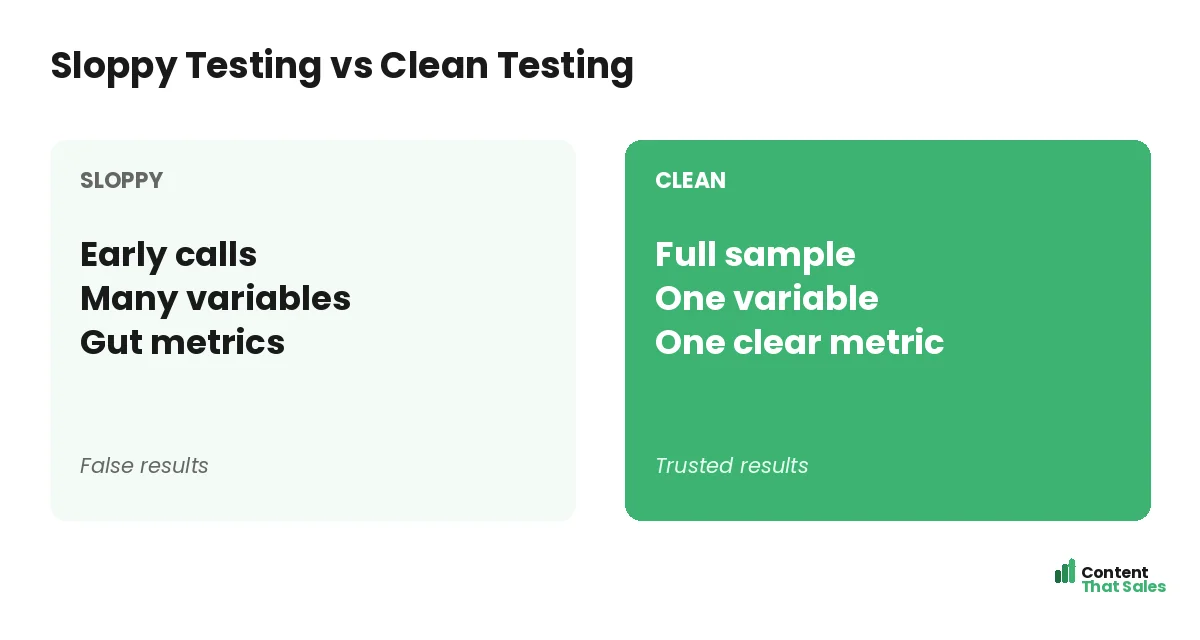
Now you know the common A/B testing mistakes on landing pages and how to avoid each one. Do not stop early. Change one thing. Start with a hypothesis. Test big levers, run full weeks, and act on results. So why let a sloppy test fool you into the wrong move?
Let’s run tests you can trust. Book your free consultation now. Call us at 8801631988589 or email service@contentthatsales.com. Let’s turn your next visitor into your next customer.
Frequently Asked Questions About A/B Testing Mistakes
What is the most common A/B testing mistake?
Stopping the test too early. Early leads are noise and often flip with more data, so calling a winner too soon ships changes that do nothing.
Why is changing many things at once a problem?
If a version wins, you cannot tell which change caused it. One variable per test gives one clear, reusable answer.
Do I really need a hypothesis?
Yes. Without one, a win is luck and a loss teaches nothing. A hypothesis names the problem, the change, and the expected result, turning a test into a lesson.
Why not start with button colors?
Cosmetic tests produce tiny gains and waste traffic. Start with the headline, offer, and CTA, where the real lift lives.
Why run full weeks?
Weekday and weekend behavior differ. A partial week skews the result, so run full seven-day blocks for a fair comparison.
What metric should I track?
The conversion tied to revenue, like a booked call or sale. Vanity metrics like clicks can mislead you into the wrong decision.
Is a losing test a waste?
No. A loss is a lesson. Ask why it lost and log it. Over time, losses teach you as much as wins about your audience.
Can you run clean tests for me?
Yes. Content That Sales designs and reads tests free of these mistakes. Reach out for a quick quote.