 Skip to content
The Before, After, Bridge formula for landing pages, often shortened to BAB, is a simple three-step structure that paints the reader’s life with the problem, shows their life once it is solved, then positions your offer as the bridge between the two. It is one of the easiest persuasive frameworks to apply and one of the most effective, because it sells a transformation, not just features. This guide explains each step, how it maps to your page, and how to apply BAB with a clear example flow.
BAB works because people buy outcomes, not products. By vividly contrasting the painful before with the desirable after, you create a gap the reader wants to close. Your offer then becomes the obvious bridge across it. The structure practically writes the persuasion for you.
Below, we break down the three BAB steps, show which page elements deliver them, and walk through how to apply the formula to a real landing page.

What Before, After, Bridge Is
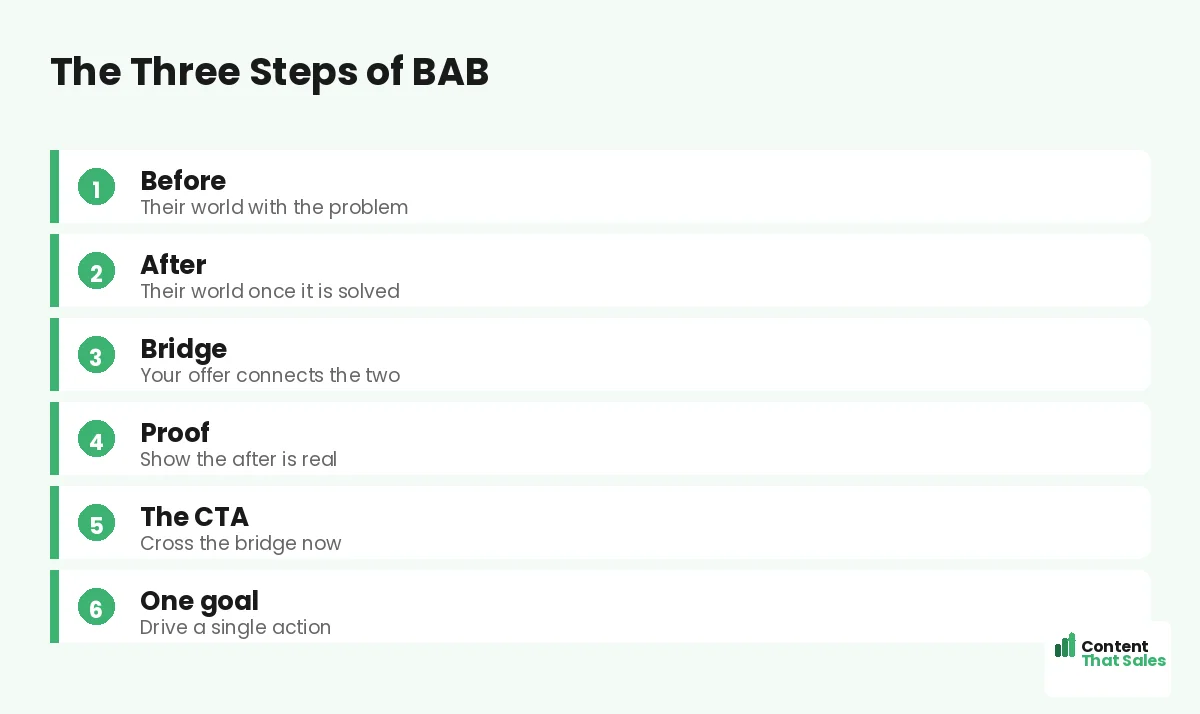
BAB is a copywriting framework built on contrast. First you describe the reader’s current world with the problem, the before. Then you paint the better world once the problem is gone, the after. Finally, you present your offer as the bridge that gets them there.
On a landing page, BAB gives you a clear, motivating flow. It fits a strong landing page structure by selling a transformation. The reader sees where they are, where they could be, and exactly how to cross over.
Step 1: Before
Start with the before, the reader’s current reality with the problem. Describe their frustration, the struggle, the daily friction. When you capture their present pain accurately, they feel understood and recognize themselves in your words.
Be specific and relatable. “Right now, every campaign feels like guesswork and your budget disappears with little to show.” The clearer you make the before, the more the reader feels the weight of the problem and wants something better.
Step 2: After
Next, paint the after, the reader’s world once the problem is solved. This is the aspirational vision: what life looks like, feels like, and achieves without the pain. Make it vivid and desirable so the reader genuinely wants it.
Show the transformation clearly. “Imagine campaigns that convert predictably, a budget that pays off, and the calm of knowing it works.” The contrast with the before creates a gap, and that gap is what motivates the reader to act.
Step 3: Bridge
Finally, present the bridge, your offer as the way from before to after. Now that the reader wants the after, show them exactly how your product or service takes them there. The bridge connects their desire to your solution.
Make the bridge clear and credible. Explain how the offer delivers the after, back it with proof, and point to the next step. Since readers scan more than they read, make the bridge easy to grasp at a glance.
Map BAB to Your Page
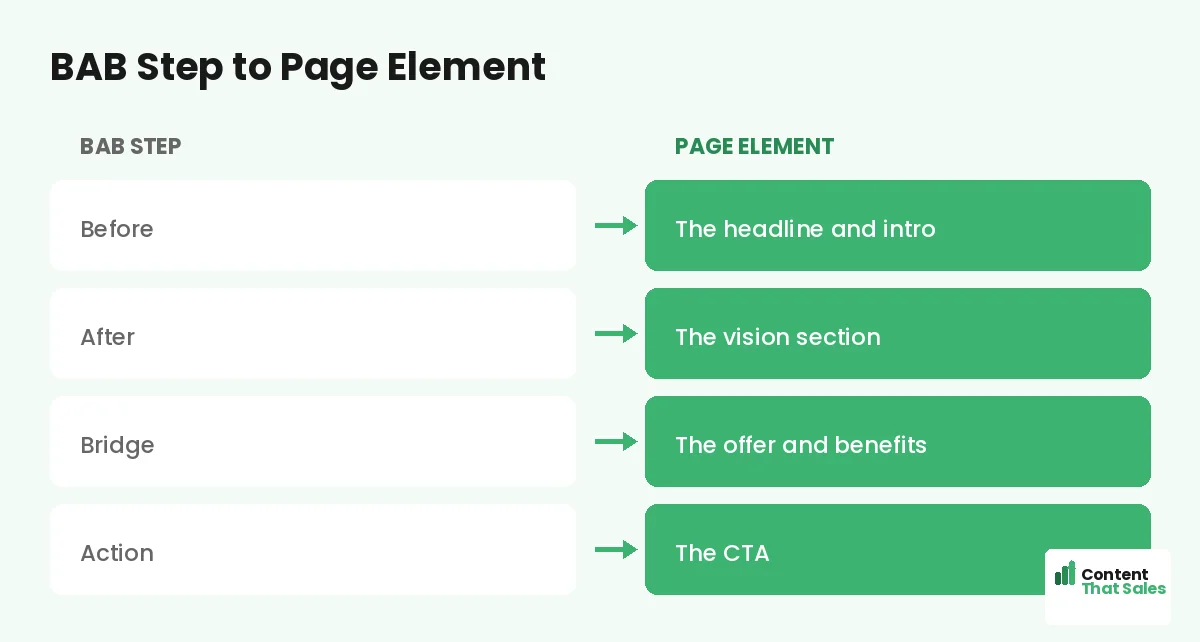
Each step maps to part of your page. Before is the headline and intro that name the pain. After is the vision section that paints the better future. Bridge is the offer, benefits, proof, and CTA. Lay them in order and the page flows.
This gives you a simple build plan: open with the painful before, lift the reader into the desirable after, then bridge to your offer and ask for action. The emotional arc from problem to vision to solution carries them to the CTA.
An Example BAB Flow
Imagine a page for a meal-kit service. Before: “Exhausted by the nightly what’s-for-dinner scramble?” After: “Picture fresh, healthy dinners on the table in 20 minutes, no planning, no stress.” The contrast makes the reader want the after.
Bridge: “Our meal kits deliver everything pre-portioned to your door,” with reviews and a first-box CTA. The reader moves from the painful before, through the appealing after, to your offer as the bridge, ready to try it.
Did you know?
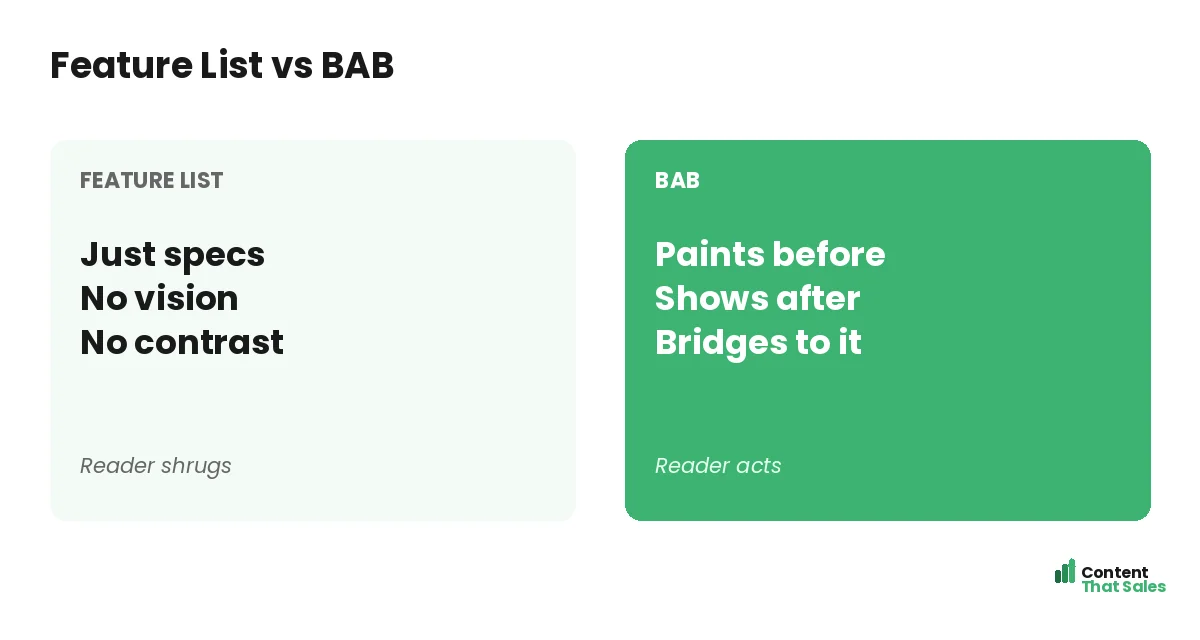
BAB sells the transformation, not the product, which is why painting a vivid after often converts better than simply listing what your offer includes.
Why BAB Converts
BAB works because contrast creates desire. Showing the gap between a painful present and a better future makes the reader want to close it. The after gives them something to move toward, and the bridge makes the path feel achievable.
It also keeps the focus on the reader’s outcome, not your features. People buy the after, the result they want, not the product itself. By leading with transformation, BAB speaks to what the reader actually cares about.
Make the After Vivid
The after is the heart of BAB, so make it real and specific. Vague promises like “be more successful” fall flat. Concrete, sensory pictures of the better life make the reader feel it and want it. The more vivid the after, the stronger the pull.
Tie the after directly to the reader’s deepest desire around the problem. When they can clearly imagine that better world, the motivation to cross your bridge becomes powerful. A vivid after is what turns the formula from words into wanting.
Keep the Bridge Clear
A common BAB mistake is a weak or vague bridge. After building desire with the after, the reader needs an obvious, credible path. Spell out how your offer delivers the after and make the next step easy with a clear CTA.
Back the bridge with proof so it feels reliable, and follow solid landing page CTA best practices. A strong bridge turns the desire you created into action. Without it, the reader wants the after but does not know how to reach it.
When to Use BAB
BAB suits offers with a clear before-and-after transformation, which is most of them. It works especially well when the result is emotionally meaningful and easy to picture. If your product changes the reader’s situation, BAB fits naturally.
It is one of the simplest frameworks to apply, making it a great default. For pages where pain leads, the PAS formula is close kin, while BAB leans more on the hopeful vision. Both sell change rather than features.
BAB vs Other Frameworks
BAB is one of several proven formulas. It leans on the contrast between problem and vision. The AIDA formula offers a smooth attention-to-action flow, while PAS and PASTOR lean harder on pain and story. Each fits different pages.
Choose BAB when a clear transformation drives the decision and you want a simple, uplifting structure. Reach for a pain-led or story-led formula when those forces are stronger. Knowing several lets you match the framework to your offer and audience.
Put It All Together
The Before, After, Bridge formula gives your landing page a motivating arc: paint the painful Before, show the desirable After, then present your offer as the Bridge between them. Selling the transformation, not just features, is what makes it convert.
Map the steps to your page, make the after vivid, and keep the bridge clear and credible. Simple, clear copy keeps winning, since easy reading lifts conversions. Follow BAB and your page turns a desired transformation into action.
How Content That Sales Helps
We write pages that sell transformation. That’s where we come in. At Content That Sales, we build landing pages on frameworks like BAB, painting the before and after and bridging the reader to your offer.
You share your offer and the change it creates. We craft the painful before, the vivid after, and the clear bridge that converts. The result is a page that sells the outcome your customers truly want, not just a list of features.
Ready to Apply BAB to Your Page?
Now you know the Before, After, Bridge formula: paint the Before, show the After, and present your offer as the Bridge. Selling the transformation converts. So why list features when a vivid after is what makes people act?
Let’s build a page that sells the transformation. Book your free consultation now. Call us at 8801631988589 or email service@contentthatsales.com. Let’s turn your next visitor into your next customer.
Frequently Asked Questions About the BAB Formula
What does Before, After, Bridge mean?
It is a copywriting framework: describe the reader’s life with the problem (before), the life once it is solved (after), then your offer as the bridge between them.
How does BAB map to a landing page?
Before is the headline and intro, After is the vision section, and Bridge is the offer, benefits, proof, and CTA. Lay them in that order.
Why does BAB convert?
Contrast creates desire. Showing the gap between a painful present and a better future makes the reader want to close it, and your offer is the path.
What is the most important step?
The after. A vivid, specific picture of the better life creates the desire that motivates action. Vague promises fall flat and fail to pull.
How is BAB different from PAS?
PAS leans on pain and agitation, while BAB leans on the hopeful contrast between before and after. Both sell change rather than features.
When should I use BAB?
When your offer creates a clear before-and-after transformation, especially one that is emotionally meaningful and easy to picture. It suits most offers.
What is the common BAB mistake?
A vague after or a weak bridge. A fuzzy vision fails to motivate, and an unclear bridge leaves the reader wanting the after with no way to reach it.
Can Content That Sales help?
Yes. We build pages on frameworks like BAB that sell the transformation and convert. Reach out for a quick quote.