 Skip to content
The honest answer to how long to run a landing page A/B test is this: long enough to gather a reliable sample, usually at least one to two full weeks, and never less than the time it takes to reach a clear, steady result. There is no fixed number of days that fits every page. A high-traffic page can finish in days, while a low-traffic page may need weeks. Stopping too early is the most common testing mistake, and it leads to false winners. This guide shows you how to judge the right length.
Here is why duration matters so much. Early in a test, results swing wildly. A version can lead by a mile on day one and lose by day five. Only with enough data does the true winner emerge. Run too short and you ship a change that does nothing, or even hurts. Let’s get the timing right.
Below, we cover what decides test length, why full weeks matter, how to know when to stop, and the traps to avoid. By the end, you will know exactly how long to let your tests run.

Why There Is No Fixed Number of Days
People want a tidy answer like “run it for seven days.” The truth is that time is not the real measure. What matters is the sample, meaning enough visitors and enough conversions to trust the result. Time is just a rough proxy for reaching that sample.
A page with heavy traffic might hit a reliable sample in a few days. A page with light traffic might need several weeks for the same confidence. So the question is never just “how many days.” It is “have I collected enough data to believe the winner.”
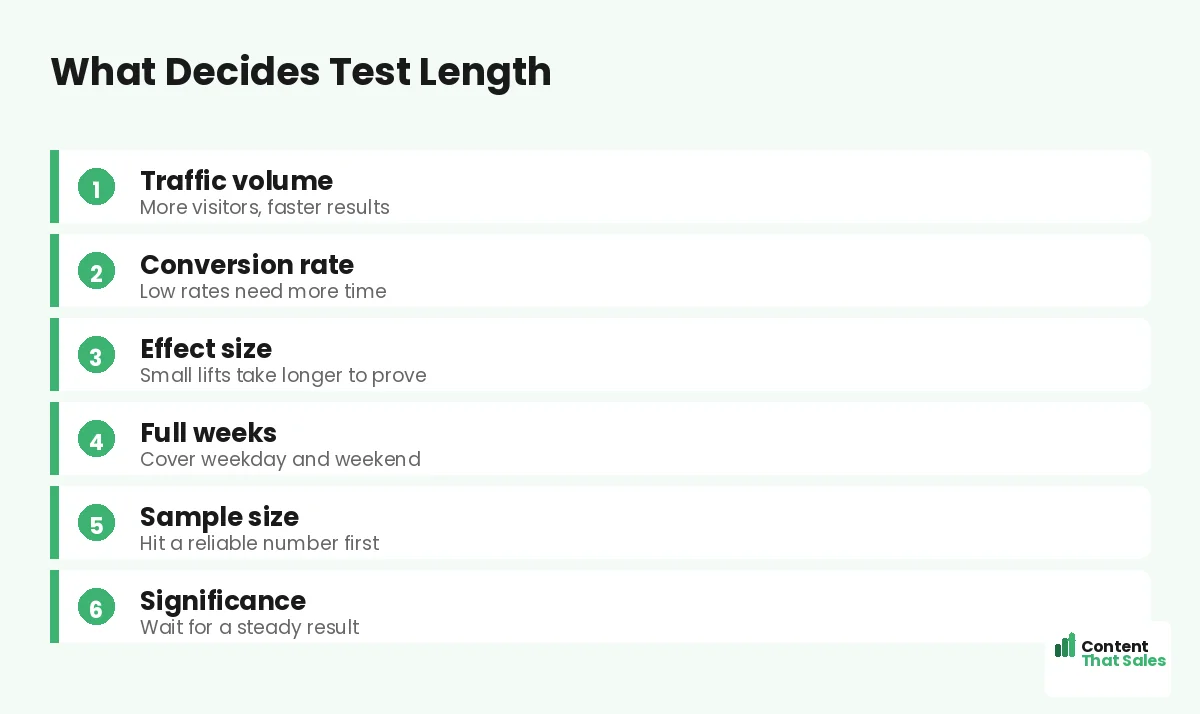
The Three Big Factors
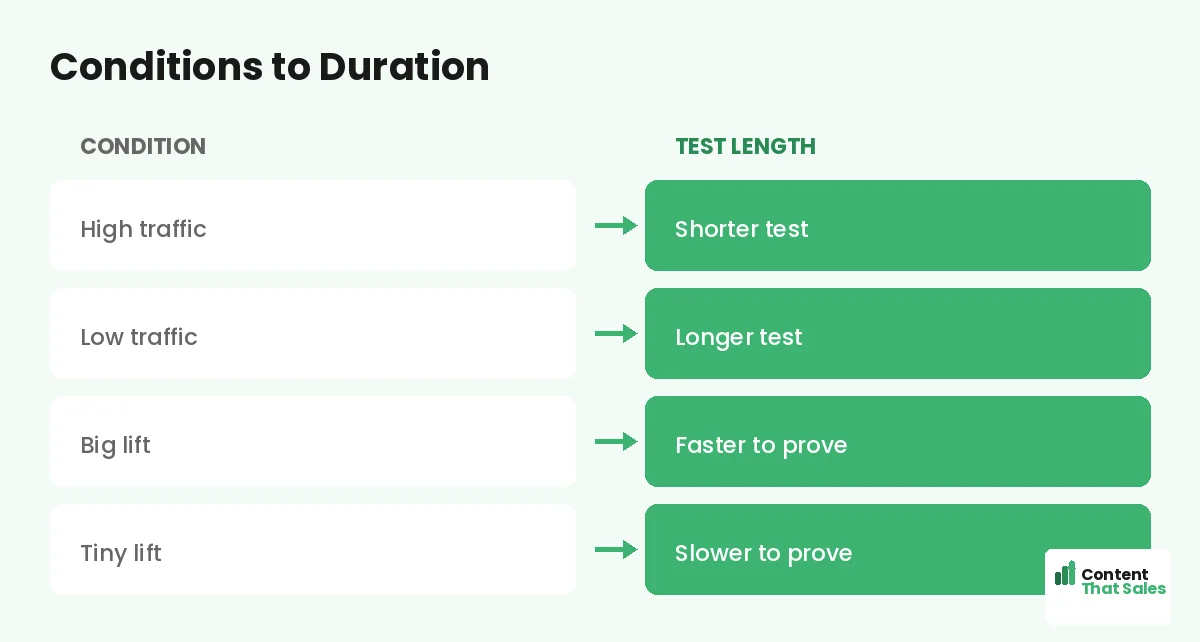
Three things drive how long your test must run. First, traffic volume: more visitors mean faster results. Second, your conversion rate: lower rates need far more traffic to prove a difference. Third, the size of the lift: a big improvement shows up fast, while a tiny one takes ages.
Weigh these together before you start. A high-traffic page with a strong conversion rate testing a bold change might finish quickly. A low-traffic page with a small rate testing a subtle tweak could run for weeks. Set your expectation up front so you do not stop early out of impatience.
Always Run Full Weeks
Behavior changes by day of the week. Weekday visitors often act differently from weekend ones. If you run a test for four days, you may capture only part of that pattern and skew the result. Run in full seven-day blocks to cover the whole cycle.
One full week is a sensible minimum for most pages, and two weeks is safer. Full weeks smooth out daily swings and seasonal noise. People scan and behave differently at different times, so a full cycle gives a fairer comparison than a handful of random days.
Reach a Reliable Sample Size
Before you launch, estimate the sample you need. A sample size calculator asks for your current rate and the lift you hope to detect, then tells you how many visitors per version you need. That number, not a date, is your real finish line.
Hitting the sample is what makes a result trustworthy. A tiny sample produces noise that looks like signal. A proper sample produces a result you can act on with confidence. Plan for the sample first, then let the calendar follow from your traffic.
Wait for Statistical Significance
Significance is a way of saying the result is unlikely to be random chance. Most tools report it as a confidence level, and 95% is a common bar. Below that, the difference might just be luck. Above it, you can reasonably trust the winner.
But significance alone is not enough. A test can hit 95% briefly, then fall back as more data arrives. Wait until the result is both significant and stable, holding steady across several days. That combination is what tells you the test is truly done.
Did you know?
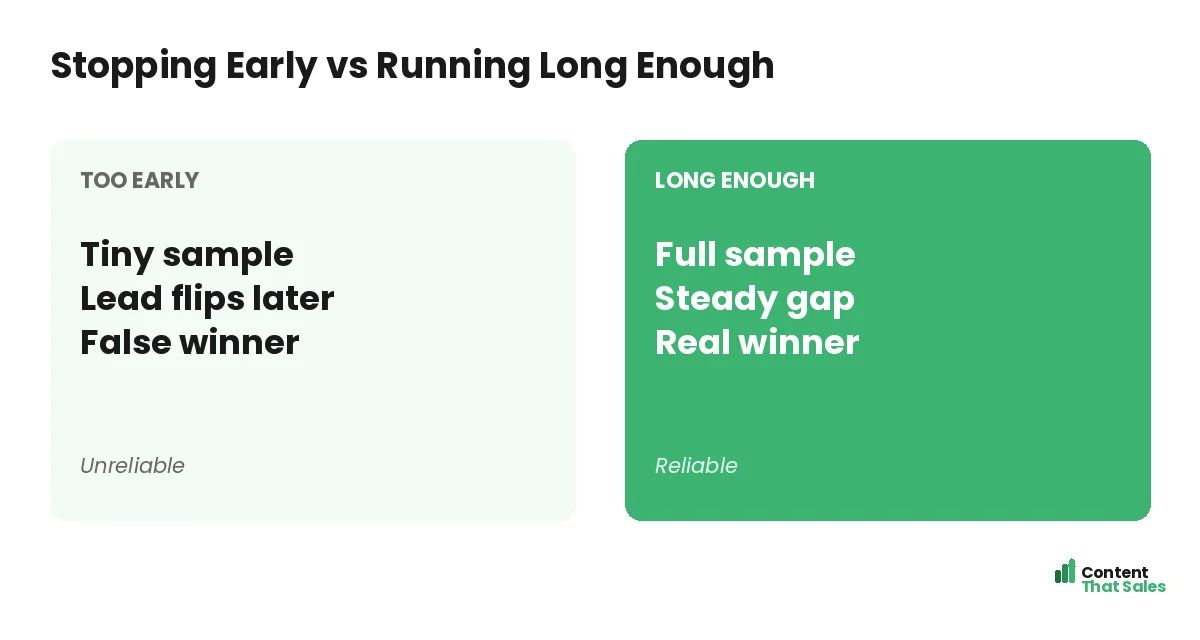
Early test leads flip surprisingly often. A version winning on day two can lose by day ten. Patience is what separates real winners from random noise.
Do Not Stop the Moment You See a Winner
The biggest mistake is calling a test the instant one version pulls ahead. Early leads are unstable and flip all the time. Stopping then means you might ship a change that does nothing, fooled by a few lucky conversions.
Resist the urge to peek and pounce. Decide your sample and minimum duration before you start, then hold to it. This discipline is the same one behind good A/B test landing page copy practice. Let the data mature before you trust it.
Do Not Run a Test Forever, Either
The opposite trap is letting a test run endlessly. If your traffic is low and the effect is small, a test can drag for months with no clear answer. At some point, the cost of waiting outweighs the value of certainty.
If a test cannot reach significance in a reasonable window, that itself is a finding. The change probably is not big enough to matter. Move on to a bolder test with a higher chance of a clear result, the kind you plan in your what to test first priority list.
What to Do With Low Traffic
If your traffic is too thin for quick tests, you have options. Test bigger, bolder changes that produce larger lifts, since those reach significance faster. Pull from proven landing page A/B test ideas aimed at the biggest levers. Focus only on your highest-traffic pages. Or accept longer test windows and run fewer, more important tests.
You can also rely more on proven best practices while you gather data, drawing from solid landing page copy principles. Low traffic does not mean you cannot improve. It means you test the big stuff, patiently, and lean on known wins in the meantime.
Keep a Simple Test Log
Track each test’s start date, sample target, and result. A simple log keeps you honest about duration and stops you from peeking and stopping early. It also builds a record of what worked, so your future tests get smarter over time.
Over months, this log becomes a map of your audience. You learn how long your typical test takes and which changes tend to win. That knowledge makes every future test faster to plan and easier to call. Discipline today pays off in speed tomorrow.
A Simple Rule of Thumb
When in doubt, run your test for at least one to two full weeks, reach your calculated sample size, and confirm the result is significant and stable. Hit all three and you can trust the winner. Miss any one and you should keep the test running.
This rule keeps you from both traps: stopping too early and running forever. It is not glamorous, but it is what makes testing reliable. Patience and a clear finish line, set in advance, are the real secret to A/B tests you can act on, and clear copy helps too, since easy reading lifts conversions.
How Content That Sales Runs Reliable Tests
Knowing when to stop a test is as important as the test itself. That’s where we come in. At Content That Sales, we plan sample sizes, set durations, and read results so your winners are real, not noise.
You share your page and traffic. We design tests that reach a trustworthy result and write the challengers worth running. The outcome is a testing program that lifts conversions on a foundation you can believe.
Ready to Turn Visitors Into Customers?
Now you know how long to run a landing page A/B test. Reach your sample, run full weeks, wait for a stable significant result, and avoid early calls. So why risk a false winner when a little patience gives you a real one?
Let’s run tests you can actually trust. Book your free consultation now. Call us at 8801631988589 or email service@contentthatsales.com. Let’s turn your next visitor into your next customer.
Frequently Asked Questions About A/B Test Duration
How long should I run a landing page A/B test?
Long enough to reach a reliable sample, usually at least one to two full weeks, and until the result is significant and stable. Traffic and effect size decide the exact length.
Is there a fixed number of days?
No. Time is just a proxy for sample size. A high-traffic page may finish in days, while a low-traffic page may need weeks for the same confidence.
Why run full weeks?
Behavior differs on weekdays and weekends. Full seven-day blocks capture the whole cycle, so your result is not skewed by a partial week.
What is statistical significance?
It means the difference is unlikely to be random chance, often measured at 95% confidence. Wait until the result is both significant and steady.
Can I stop as soon as one version wins?
No. Early leads flip often. Decide your sample and minimum duration in advance, then hold to it so you do not ship a false winner.
What if my traffic is too low?
Test bolder changes that produce bigger lifts, focus on high-traffic pages, or accept longer windows. Lean on proven best practices while you gather data.
Can a test run too long?
Yes. If it cannot reach significance in a reasonable window, the change likely is not big enough to matter. Move on to a bolder test.
Can you run reliable tests for me?
Yes. Content That Sales plans, runs, and reads tests so the winners are real. Reach out for a quick quote.