 Skip to content
Trust signals on landing pages are the proof elements that tell a wary stranger your business is real, capable, and safe to buy from. Visitors arrive skeptical, and skepticism kills conversions. Testimonials, reviews, client logos, guarantees, and security badges all answer the silent question every reader asks: can I believe you? When you stack the right trust signals in the right spots, doubt fades and action rises. This guide shows you which signals matter most and where to place them.
Here is the reality of online buying. The reader has never met you and cannot shake your hand. They have only your page to judge you by. Trust signals stand in for that handshake. They borrow credibility from real customers, real results, and real safeguards, so a first-time visitor feels safe acting. Let’s build that trust into your page.
Below, we cover why trust signals work, the most effective types, where to place them, and the mistakes that backfire. By the end, you will know how to make your page believable enough to convert.

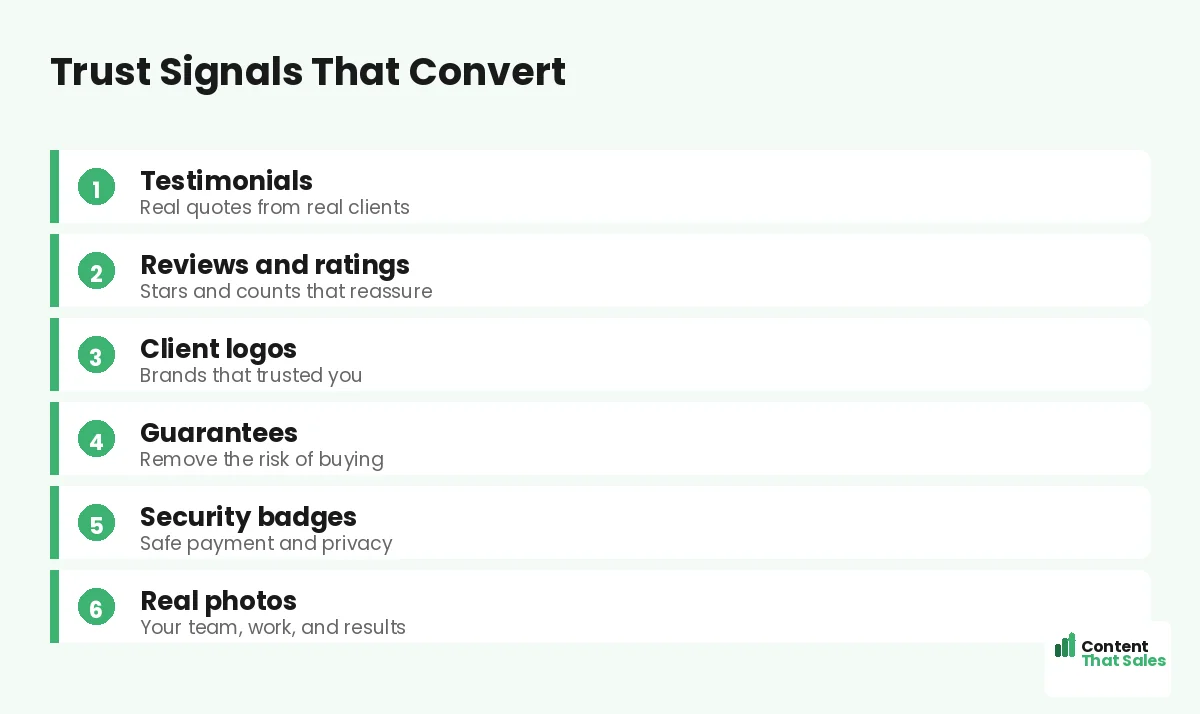
Why Trust Signals Decide Conversions
People do not buy from businesses they do not trust, no matter how good the offer sounds. Online, that trust has to be earned in seconds, by strangers, without a conversation. Trust signals do that heavy lifting. They prove that others took the leap and came out happy.
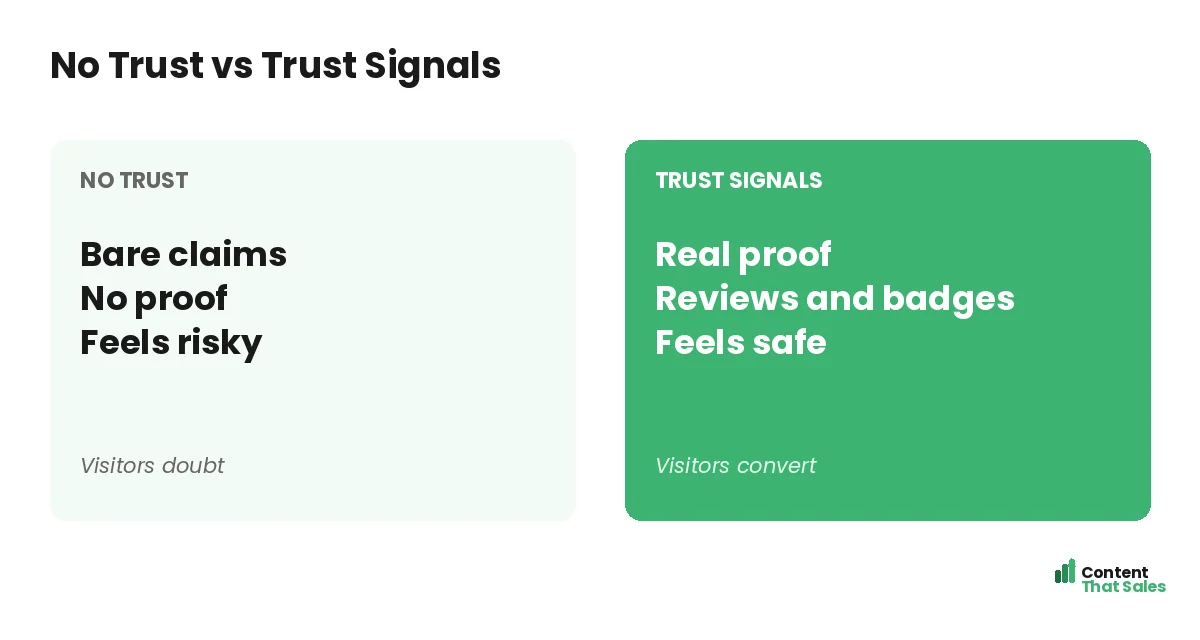
Doubt is the silent killer on most landing pages. The reader wants the result but fears being burned. Trust signals answer that fear with evidence. When the page shows real proof at the right moments, the reader’s guard drops and the path to yes opens up.
Testimonials and Reviews
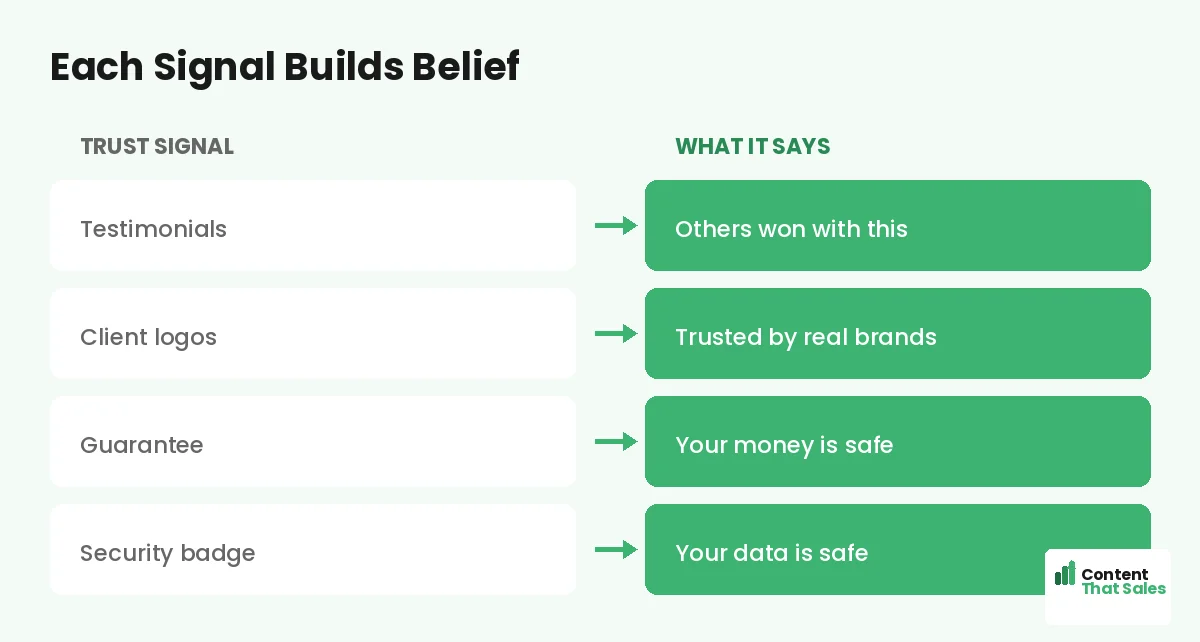
Testimonials are among the strongest trust signals you can use. A short, specific quote from a real customer beats any claim you make about yourself. It is one human telling another that your offer delivered. That carries weight no marketing line can match.
Make them real and detailed. A name, a photo, and a concrete result lift credibility. Star ratings and review counts add quick, scannable proof. This kind of social proof tells the reader they are not the first to trust you, and they will not be the last.
Client Logos and Numbers
If recognizable brands or many customers have used you, show it. A row of client logos borrows their credibility for your page. A simple count like “trusted by 200 owners” turns your track record into instant proof. Numbers make trust concrete.
Keep these signals honest and current. Real logos you have permission to show, and real counts you can stand behind. People scan more than they read, so logos and numbers are perfect, since they prove credibility at a glance without a single word.
Guarantees and Risk Reversal
A guarantee is a trust signal and a risk reducer in one. It tells the reader you stand behind your offer enough to protect their money. A bold “30-day money-back guarantee” near the button can tip a hesitant buyer over the line.
This overlaps with strong risk reversal copy, which takes the fear out of buying. The more confident your guarantee, the more it signals belief in your own work. Just make sure you honor it, because a broken guarantee destroys trust fast.
Security and Privacy Signals
When you ask for payment or personal details, safety fears spike. Security signals calm them. A padlock on the form, trusted payment icons, and a short “your data is safe, no spam” line all reassure the reader at the moment of risk.
These signals matter most right at the form and the button. A visitor about to type an email or card number wants to know they are protected. A small badge or a clear privacy promise there can be the difference between a completed form and an abandoned one.
Did you know?
A single strong testimonial placed beside the button can lift conversions more than a wall of star ratings buried at the bottom of the page.
Real Photos Over Stock
Authentic photos build trust that stock images cannot. Show your real team, your real workspace, and real results. A genuine photo says there are real people behind this offer. A polished stock photo of strangers says the opposite, and readers can tell.
For local and service businesses especially, real photos of your work and crew add huge credibility. They prove you exist and do the job. Swap generic stock for the real thing wherever you can. Authenticity is one of the most underused trust signals.
Where to Place Trust Signals
Placement matters as much as the signal itself. Put your strongest proof near the call to action, where doubt peaks. A testimonial or guarantee beside the button answers the last hesitation right when it strikes. That spot earns the most lift.
Seed trust earlier too. A rating or a logo bar near the top builds early confidence. Then reinforce it at each CTA down the page. Weave trust signals through the whole page, the way good persuasion frameworks for landing pages weave proof into every step.
Keep Trust Signals Honest
Fake trust signals are worse than none. Invented reviews, borrowed logos you have no right to, or made-up numbers will eventually be exposed. The moment a reader smells a fake, every real signal on the page loses its power too. Honesty protects all of it.
Use only proof you can back up. Real quotes, true counts, genuine badges. If you are short on testimonials, ask happy customers for them. Authentic, modest proof beats impressive fakes every time, and it keeps your reputation intact for the long run.
Match Trust Signals to the Buyer’s Fear
Different offers trigger different fears, so choose signals that answer the right one. A high price calls for guarantees and results proof. A data request calls for security badges. A new brand calls for reviews and real photos. Aim each signal at a specific doubt.
Think about what would make your own reader nervous, then place a signal that calms it. When each fear has a matching proof point nearby, the reader runs out of reasons to hesitate. That targeted reassurance is what turns a skeptic into a buyer.
Test Which Trust Signals Work
Not every signal lifts every page, so test. Try adding a testimonial near the CTA, or a guarantee, or a logo bar, and watch the conversion rate. Some signals move the needle hard, others barely register. The data shows you which ones earn their space.
Change one signal at a time so the result stays clean, the same care behind any strong page, and keep the wording simple, since easy reading lifts conversions. Keep the signals that win and drop the ones that do not. Tested trust beats assumed trust.
How Content That Sales Builds Trust
Knowing which trust signals to use and how to word them is a craft. That’s where we come in. At Content That Sales, we gather your proof, frame your testimonials, and place trust signals where they melt doubt and lift conversions.
You share your results, reviews, and guarantees. We turn them into believable, well-placed trust signals. If you want done-for-you landing page copy, we make it effortless. The result is a page a first-time visitor feels safe to act on.
Ready to Turn Visitors Into Customers?
Now you know which trust signals on landing pages boost conversions. Testimonials, reviews, logos, guarantees, security badges, and real photos. Place them where doubt peaks and keep them honest. So why let skepticism cost you sales when proof can win them?
Let’s build a page strangers believe. Book your free consultation now. Call us at 8801631988589 or email service@contentthatsales.com. Let’s turn your next visitor into your next customer.
Frequently Asked Questions About Trust Signals on Landing Pages
What are trust signals on a landing page?
Trust signals are proof elements like testimonials, reviews, client logos, guarantees, and security badges that show a stranger your business is real and safe to buy from.
Which trust signal is most powerful?
Often a real, specific testimonial placed near the call to action. One human vouching for your result beats any claim you make about yourself.
Where should I place trust signals?
Put your strongest proof near the CTA, where doubt peaks, and seed lighter signals like ratings or logos near the top. Reinforce at each CTA down the page.
Do security badges really help?
Yes, especially at the form and button, where safety fears spike. A padlock, payment icons, or a privacy line reassures readers about their data.
Are stock photos a trust signal?
Usually the opposite. Generic stock photos can feel fake. Real photos of your team, work, and results build far more credibility.
Can I have too many trust signals?
Yes. A wall of badges looks desperate and cluttered. A few strong, relevant signals placed well beat a page crammed with seals.
What makes a testimonial credible?
A real name, a photo, and a concrete result. Specific, verifiable details make a testimonial believable, while vague praise feels invented.
Can you add trust signals to my page?
Yes. Content That Sales gathers and frames your proof for maximum impact. Reach out for a quick quote.