 Skip to content
Let’s be honest. The in-house vs outsourced content writing debate keeps a lot of marketing folks up at night. You want great content. You want it fast. And you really don’t want to burn cash on the wrong setup. So which way should you go?
Here’s the thing. There’s no single right answer. There’s only the right answer for your team, your budget, and your goals this year.
We’ve helped brands scale content both ways. Some kept it inside. Some handed it off. Most ended up somewhere in the middle. This guide walks you through all of it. No fluff. No sales pitch dressed up as advice.
By the end, you’ll know which model fits you. You’ll also know how to make the call without second-guessing it for six months. Ready? Let’s get into it.
First, a quick gut check. Most teams ask the wrong question. They ask which model is better. The better question is which model fits their stage.
A five-person startup has different needs than a 200-person brand. A media company is not a SaaS tool. Context changes everything here.
So as you read, keep your own setup in mind. Your budget. Your team size. Your content goals for the next twelve months. That lens makes this guide far more useful.
We’ll cover cost, speed, quality, and hidden traps. We’ll also tackle AI and the new search reality. That part trips up a lot of teams right now.
What Does In-House Content Writing Actually Mean?
In-house content means your own people write your content. They’re on payroll. They sit in your meetings. They know your product like the back of their hand.
Think of it like having a chef who lives in your house. They know your fridge. They know your taste. They cook every day, no briefing needed.
An in-house team usually includes writers, an editor, and maybe an SEO lead. Sometimes it’s just one busy marketer wearing five hats. We’ve seen both. Both can work.
The core trait? Control. You own the voice. You own the calendar. You own every word. Nobody else touches it. For some brands, that’s everything.
In-house also means context lives in the building. Your writer hears the sales calls. They see the support tickets. They catch hallway chatter about new features.
That context is gold for content. It shows up as real examples and sharp angles. Outsiders work hard to get this. Insiders soak it up daily.
But context alone does not equal output. A writer with deep context who can’t ship fast still leaves you stuck. Skill and speed still matter just as much.
If you’re weighing a first content hire, our breakdown of what does a content writing agency do is worth a read first. It shows the gap between one hire and a full team.
What Does Outsourced Content Writing Mean?
Outsourced content means you hire outside help. That could be a freelancer, an agency, or a managed content team. They write. You review. You publish.
It’s like ordering from a great kitchen instead of cooking. You skip the prep, the cleanup, and the hiring. You still pick the menu. A good content writing agency handles the heavy lifting so your team stays focused.
Outsourcing is not just cheap labor. The best partners bring strategy, SEO skill, and a process you don’t have to build. That’s a big deal when you’re moving fast.
Not sure how outside help is structured? Our breakdown of what a content writing agency does clears up the common confusion before you commit.
Outsourcing comes in flavors. A solo freelancer is one option. A boutique agency is another. A managed content team is a third. Each fits a different need.
Freelancers cost less but cap out fast. One person can only write so much. A vacation or illness can stall your whole pipeline overnight.
Agencies bring a bench of writers, editors, and SEO leads. You trade a little cost for a lot of stability. Output keeps flowing even when one person is out.
Managed services go further still. They handle strategy, briefs, and delivery for you. Our look at managed content writing services and how they work explains why busy teams lean this way.
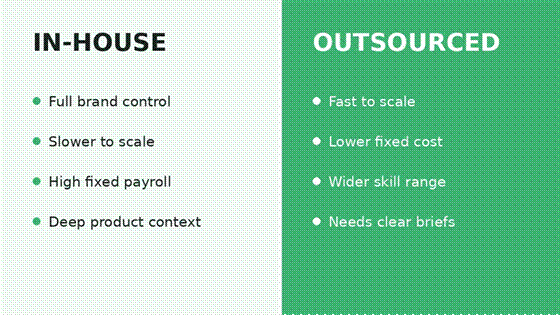
In-House vs Outsourced Content Writing: The Honest Comparison
Let’s put them head to head. No spin. Here’s how the two models really stack up across the things that matter most.
Cost and Budget
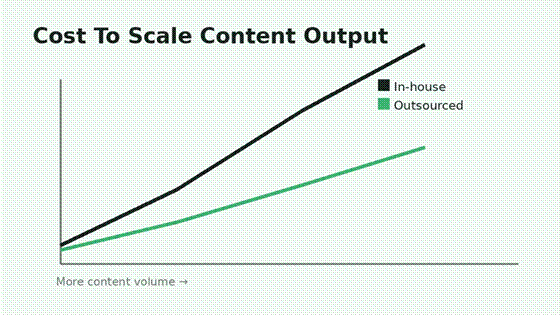
In-house looks cheaper per article. It rarely is. You pay salary, benefits, tools, training, and management time. That adds up fast.
Outsourcing has a clear price tag. You pay for output, not overhead. No payroll tax. No empty seats on a slow month.
Want the real math? Read our guide on how to budget for content writing before you lock in either path.
Run a simple test. Add up a writer’s salary, benefits, and tools. Divide by the posts they ship in a year. The cost per piece often shocks people.
A mid-level writer might cost six figures all-in. If they ship 60 solid posts a year, that’s steep per post. Outsourcing the same volume often costs far less.
That said, in-house cost drops at very high volume. A full team writing daily can hit a good rate. The break-even point sits higher than most teams expect.
Speed and Scale
Need ten blog posts next month? An in-house writer might choke on that. They can only type so fast.
An outsourced team flexes. They scale up when you need more. They scale down when you don’t. Your output bends without breaking.
Speed also means recovery speed. An in-house writer quits and your pipeline stalls for months. A partner just reassigns the work and keeps moving.
Think of it like a delivery fleet versus one car. One car breaks down and you’re stranded. A fleet just sends another van. The package still arrives.
Quality and Brand Voice
In-house teams know your brand cold. That’s their edge. The voice feels native because it is.
Good outsourced partners learn your voice fast. They use style guides, samples, and feedback loops. Within weeks, most readers can’t tell the difference.
Quality is really a process, not a person. A strong partner has editing layers built in. A lone in-house writer often edits their own work, which is risky.
Worried about losing quality when you hand off? Our guide on how to outsource content writing without losing quality walks through the safeguards that actually work.
Expertise and Range
One in-house writer has one skill set. Great for some topics. Thin for others.
An agency brings many writers. Need a technical piece today and a fun social post tomorrow? They’ve got people for both.
Range matters more as you grow. Your content needs widen over time. Blogs, landing pages, emails, and guides each need a slightly different touch.
This is why content type matters so much. Our overview of long-form content writing shows why deep pieces need a different skill than quick social posts.
The Hidden Costs Nobody Talks About
Most teams only count the obvious costs. That’s a trap. The hidden ones hurt more.
In-house hidden costs:
- Recruiting and onboarding time, often months per hire
- Software, SEO tools, and content platforms
- Manager hours spent reviewing and coaching
- Downtime when a key writer quits or goes on leave
Outsourcing hidden costs:
- Briefing time, which shrinks once a process clicks
- Revisions if expectations aren’t clear upfront
- Onboarding a partner to your voice in the first month
The lesson? Both models cost more than the sticker price. But knowing the full picture stops nasty surprises. Our piece on why content writing services cost what they do digs deeper here.
There’s one more hidden cost people miss. It’s opportunity cost. Every hour spent managing writers is an hour not spent on strategy.
Your time has a price too. If you’re knee-deep in edits, you’re not growing the business. That trade rarely shows up on a spreadsheet, but it’s real.
Outsourcing buys back that time. A good partner runs the process so you don’t have to. You review and approve. You skip the daily grind of production.
When In-House Content Writing Makes Sense
In-house is not dead. Far from it. For some brands, it’s the smart play.
Pick in-house if your product is deeply technical. Think complex software or regulated finance. Writers who live in it just get it faster.
Pick in-house if content is your core product. Media brands and publishers fit here. The newsroom is the business.
Pick in-house if you publish daily and never stop. A steady, heavy drumbeat sometimes needs a dedicated team on call.
But be real. In-house only works if you can hire well, manage well, and keep good writers happy. That’s harder than it sounds. Many teams underestimate it.
When Outsourcing Content Writing Wins
Now flip it. Outsourcing shines in more cases than people expect.
Choose outsourcing if you need to scale fast without a long hiring cycle. You get output this month, not next quarter.
Choose outsourcing if SEO is your growth engine. Specialist teams live and breathe search. That focus pays off.
Choose outsourcing if your topics shift often. A flexible partner covers many niches. Our overview of types of content writing services shows just how wide that range can be.
Choose outsourcing if budget is tight. You swap fixed payroll for flexible spend. That breathing room matters for lean teams.
As an old saying goes, don’t put all your eggs in one basket. Outsourcing spreads your risk across a whole team, not one hire.
The Hybrid Model: Why Smart Brands Mix Both
Here’s a secret. The best teams rarely pick one side. They blend.
They keep strategy and brand voice in-house. They outsource the heavy production. Best of both worlds, minus the burnout.
Picture a head chef who designs the menu. A trained kitchen cooks it at scale. The vision stays yours. The volume isn’t your problem.
This model is growing fast. It’s why white label content writing services exist. You get expert output under your own name, with full control kept inside.
A hybrid setup also future-proofs you. One writer leaves? Your content doesn’t stop. The partner picks up the slack.
Here’s how a clean hybrid runs in practice. Your team owns the content strategy and topical map. The partner handles research, drafting, and SEO formatting.
Your in-house lead reviews for voice and accuracy. The partner handles revisions fast. You get scale without losing the final say. That balance is hard to beat.
Subscription models make this even smoother. A steady monthly setup keeps output predictable. Our look at subscription-based content writing services shows why many growing brands prefer this rhythm.
The hybrid model is not a compromise. It’s often the smartest design. You keep the parts that need control. You hand off the parts that need scale.
How AI Changes the In-House vs Outsourced Debate
AI flipped this whole question on its head. Let’s talk about it honestly.
AI tools can draft fast. Really fast. So some teams think they can skip both in-house writers and agencies. Not so fast.
AI drafts. Humans decide. Raw AI text is generic, often wrong, and easy to spot. It needs a skilled editor to shape it into something that ranks and converts.
So the new question is not just in-house or outsourced. It’s who runs your AI workflow with real editorial skill on top.
In-house teams can use AI to move faster. Agencies can too, often with tighter quality checks built in. The tool helps both. It replaces neither.
What AI Cannot Do Alone
- Understand your customer’s real pain in context
- Build genuine topical authority across a content silo
- Add first-hand experience that signals E-E-A-T
- Make brand voice feel human, warm, and trusted
So treat AI as a power tool. A power tool still needs a skilled hand. That hand is your team, inside or out.
Here’s a real risk with AI-only content. Search engines are getting sharp at spotting it. Thin AI pages can tank your rankings, not lift them.
There’s also a trust cost. Readers feel generic content. It reads flat. It doesn’t build the connection that turns a visitor into a customer.
The smart move is AI plus expert editing. Drafts get faster. Quality stays high. The model that does this well, in-house or outsourced, is the one that wins.
AI Overviews and LLMs: The New SEO Reality
Search changed again. Google now shows AI Overviews at the top. Tools like ChatGPT answer questions directly. This matters a lot for content.
These systems pull from content that is clear, structured, and trustworthy. Thin, fluffy posts get ignored. Deep, helpful ones get cited.
So which model wins here? The one that produces real depth and clear structure at scale. AI Overviews favor sources that answer fully and earn trust.
In-house teams can do this if they have SEO depth. Many don’t. Outsourced specialists often do, because search is their full-time job.
To get cited by LLMs, your content needs strong signals. Clear headings. Honest answers. Real expertise. A scattered solo writer struggles to hit all three at volume.
This is exactly where structured content strategy matters. Our work on SEO content writing explains how to build content that both Google and AI engines actually surface.
Bottom line. AI Overviews reward authority. Authority comes from consistent, expert, well-structured content. Pick the model that delivers that reliably.
How LLMs Pick What to Cite
Large language models scan for clear, factual, well-organized answers. They favor pages that solve the query fully. Vague filler gets skipped every time.
Structure helps a lot here. Clear headings act like signposts. Short, direct answers near each heading get pulled into AI responses more often.
Topical depth matters too. One thin post rarely earns trust. A full content silo on a subject signals real expertise to both Google and LLMs.
Building that depth needs a plan, not random posts. Our work on building a topical map shows how to structure content so AI engines see you as the authority.
Why This Favors Specialist Teams
Hitting all these signals at volume is hard. It needs SEO skill, structure discipline, and steady output. Few solo in-house writers manage all three.
Specialist outsourced teams do this daily. Search is their core job. They build structure and depth into every piece by default, not as an afterthought.
How to Switch Models Without Losing Momentum
Maybe you already picked a model and it’s not working. Switching is fine. But do it without tanking your content output.
Moving from in-house to outsourced? Document everything first. Your voice, your style, your past wins. Hand the partner a clear playbook on day one.
Moving from outsourced to in-house? Hire before you cut ties. Overlap the two for a month. Let the new hire learn from the existing work.
The biggest switch mistake is going cold turkey. Output drops. Rankings slip. Then panic sets in. A smooth handover protects all the ground you gained.
Before any switch, get your asks straight. Our list of questions to ask before hiring a content writer helps you vet the next setup properly.
One more tip. Keep your content calendar live during the move. A shared calendar keeps both sides aligned. Nothing falls through the cracks that way.
Red Flags to Watch in Either Model
Both models can go wrong. The warning signs show up early if you watch for them. Catch these before they cost you months.
In-House Warning Signs
- Output keeps slipping and deadlines keep moving
- One writer is a single point of failure for everything
- Content gets written but never actually ranks
Outsourcing Warning Signs
- Drafts feel generic and miss your real audience
- Communication is slow and briefs get ignored
- Quality swings wildly from one piece to the next
Spotting these early saves real money. Our guide on red flags when hiring content writing services lists the deal-breakers worth walking away from.
What a Strong Content Setup Actually Looks Like
Picking a model is step one. Building the setup right is step two. Both models need clear roles to work well.
A solid setup has four jobs covered. Strategy, writing, editing, and SEO. Skip any one and quality drops. This is true in-house and outsourced.
The Strategy Role
Someone must own the plan. What topics? What order? What goal per piece? Without this, content becomes random and weak.
This role usually stays in-house, even in a hybrid. It’s your brand and your market. You know it best. Keep the wheel in your hands.
The Writing Role
This is the heavy lifting. Research, drafting, structure, and flow. It eats the most hours by far. It’s also the easiest part to outsource well.
Different content needs different writing skills. A snappy social post is not a deep guide. Our piece on short-form content writing shows why one writer rarely nails every format.
The Editing Role
Editing is where good becomes great. A second set of eyes catches weak spots. It also locks in a consistent voice across every piece.
Solo in-house writers often skip this. They edit their own work. That’s like grading your own exam. Bias sneaks in every time.
The SEO Role
Great writing that nobody finds is wasted. SEO turns content into traffic. Keywords, structure, internal links, and search intent all live here.
This role needs specialist skill. It changes fast. A partner who lives in search often beats a generalist hire at this one job.
How to Decide: A Simple Framework
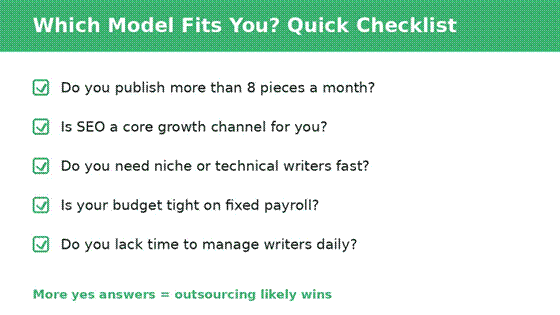
Feeling stuck? Use this quick framework. Answer four questions honestly. The pattern will point you the right way.
- 1. Volume. Do you need lots of content fast? Lean outsourced.
- 2. Complexity. Is your topic deeply technical and niche? Lean in-house.
- 3. Budget. Is fixed payroll risky for you right now? Lean outsourced.
- 4. Control. Must every word stay inside your walls? Lean in-house or hybrid.
More answers pointing outward? Outsourcing likely wins. Mixed signals? A hybrid model is probably your sweet spot.
Still weighing it up? The questions in our hiring a content writing service guide help you pressure-test any partner before you sign.
Common Mistakes Teams Make With Both Models
Plenty of teams pick the right model and still fail. Why? They trip over the same mistakes. Dodge these.
In-House Mistakes
- Hiring one writer and expecting agency-level range
- No clear process, so output stays slow and patchy
- No SEO support, so great writing never ranks
Outsourcing Mistakes
- Vague briefs that set everyone up to fail
- Picking the cheapest option and hoping for quality
- No feedback loop, so voice never gets dialed in
That last point matters most. Cheap rarely means good. Our take on cheap vs premium content writing services shows the true cost of going bargain-bin.
Real Talk: What We’d Recommend
You asked for honesty, so here it is. For most growing brands, a hybrid model wins. Strategy in-house. Production outsourced.
Pure in-house fits media brands and deeply technical products with the budget to staff it well. That’s a smaller club than people think.
Pure outsourcing fits lean teams that need speed, SEO depth, and flexible spend. That’s a big club, and it keeps growing.
Whatever you choose, commit fully. Half-built in-house teams fail. So do badly briefed agency setups. The model matters less than the effort behind it.
Pride in your content is earned, not bought. Pick the path you can run with real focus. Then run it hard.
One last thought. Your model is not forever. Review it once a year. As your team and budget shift, the right answer can shift too.
Many brands start outsourced for speed. They add in-house roles as they grow. Then they settle into a hybrid that fits. That path is normal and smart.
Don’t chase the perfect setup. Chase the one that ships great content this quarter. Momentum beats perfection every single time in content.
Frequently Asked Questions
Is in-house vs outsourced content writing really an either-or choice?
No. Most successful brands blend both. They keep strategy inside and outsource production. This hybrid model gives you control plus the speed to scale.
Which is cheaper, in-house or outsourced content?
Outsourcing is usually cheaper overall. In-house looks cheaper per article but adds salary, tools, and management costs. Total cost favors outsourcing for most small and mid teams.
Can outsourced writers really match our brand voice?
Yes, with the right process. Good partners use style guides, samples, and feedback. Within a few weeks, most readers cannot tell the work was outsourced.
Does AI make both models pointless?
No. AI drafts fast but needs skilled human editing to rank and convert. You still need a team, inside or out, to add strategy, voice, and real expertise.
How do AI Overviews affect my content choice?
AI Overviews reward deep, structured, trustworthy content. Pick the model that delivers that consistently at scale. Specialist outsourced teams often handle this best.
When should a startup choose in-house writing?
Rarely at the early stage. Startups usually need speed and flexible spend. Outsourcing or a hybrid model fits better until content volume and budget are stable.
Final Thoughts: Make the Call With Confidence
The in-house vs outsourced content writing question has no universal winner. It has a winner for you. Use the framework. Count the hidden costs. Factor in AI and search shifts. Then decide.
Need expert content without the hiring headache? That’s exactly what we do. We help brands scale content that ranks, reads well, and sells.
Let’s talk. Reach the Content That Sales team at service@contentthatsales.com or call 8801631988589. Visit contentthatsales.com to see how we can build your content engine the smart way.