 Skip to content
Most people sign content writing service contracts without reading them properly. Then something goes wrong, and suddenly everyone’s checking the fine print.
A missed deadline. An ownership dispute. A client who wants 20 revisions on a 500-word post. These aren’t horror stories. They’re Tuesday.
Content writing service contracts exist for one reason: to make sure both sides know the rules before the game starts. Whether you’re the buyer or the provider, a solid agreement saves money, time, and headaches.
This guide covers everything that belongs in a content writing contract. We’ll break down scope of work, payment terms, revision policies, IP ownership, AI content clauses, and what Google’s AI overviews mean for how contracts are written today.
By the end, you’ll know exactly what to look for, what to ask for, and what to walk away from.
What Is a Content Writing Service Contract?
A content writing service contract is a formal agreement between a content buyer and a content provider. It spells out exactly what work gets done, how much it costs, when it’s due, and who owns it after delivery.
Think of it like a map. Without one, everyone’s guessing which road to take. With a clear map, you reach the destination faster and without wrong turns.
The contract applies whether you’re working with a freelance writer, a boutique content agency, or a full managed content writing service. It applies whether you need one blog post or 50 pieces a month.
A contract doesn’t mean distrust. It means professionalism.
Most content disputes, delays, and falling-outs happen not because people are dishonest, but because expectations weren’t set clearly. A contract fixes that at the start, not after everything falls apart.
If you’re still figuring out what model fits your brand, start by understanding the types of content writing services available before drafting any agreement.
Why You Need More Than a Handshake Deal
“We’ve worked together for months, we don’t need a contract” is something people say right before needing a contract.
Good relationships are built on trust. Good business is built on documentation.
Here’s a common scenario. A brand hires a writer for eight blog posts. The writer delivers five, then stops responding. The client has no contract. No clear deliverables. No payment terms tied to delivery. Nothing.
Now what?
Without a written agreement, you have no legal ground. You can’t prove what was promised. You can’t demand a refund. You can’t demand anything. You’re just stuck.
That’s the thing about content work. It involves deadlines, money, intellectual property, and often sensitive business information. A handshake doesn’t protect any of that.
Even if you trust the person completely, a contract protects the relationship itself. It removes ambiguity. It answers the “but I thought…” questions before they come up.
Before you think about strategy or execution, make sure you know the right questions to ask before hiring a content writer and whether a contract is part of their standard process.
Core Elements Every Content Writing Contract Must Have
Not all contracts look the same. But every good one covers the same basics. These aren’t optional extras. They’re the foundation.
Scope of Work
The scope of work is where most vague agreements go wrong.
“Content writing services” means almost nothing without specifics. Are we talking blog posts? Landing pages? Social captions? A combination?
Your scope section should answer:
- What type of content is being produced (blog posts, service pages, email newsletters, etc.)
- How many pieces per month or per project
- The word count range for each piece
- The topic source (who decides the topics, and how are they approved)
- Whether the content includes SEO keyword integration
- What research is expected from the writer
The more specific the scope, the fewer surprises you’ll deal with. Vague scope is the number one cause of scope creep. And scope creep kills projects and relationships.
Ask yourself: if someone read this scope section cold, would they know exactly what to produce? If not, keep rewriting until they would.
Deliverables and Deadlines
Deliverables are the specific outputs. Deadlines are when they arrive.
A contract should say: “Four 1,500-word SEO blog posts delivered in a Google Doc by the 25th of each month.” Not “monthly blog content.”
Include:
- Number and type of deliverables
- Delivery format (Google Doc, Word file, WordPress draft, etc.)
- Deadline for each phase (first draft, revised draft, final approval)
- What happens if a deadline is missed
Vague deadlines are almost as bad as no deadlines. “ASAP” is not a deadline. “By Friday, 5pm” is.
Once the contract is clear, the next step is the actual brief. Learn how to brief a content writer for best results so your first draft lands closer to what you need.
Payment Terms and Pricing Structure
Money is where most content writing disputes begin. A strong contract closes that gap before it opens.
Your payment section needs to cover: total cost, how it’s billed, when it’s due, and what happens if payment is late or a project is cancelled.
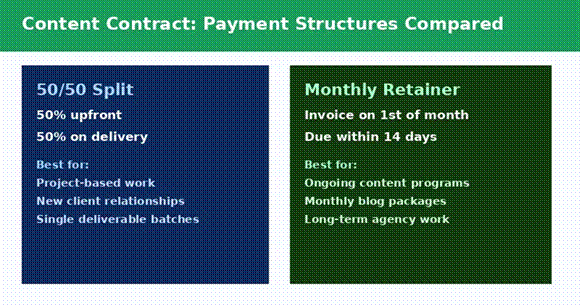
Milestone Payments vs. Upfront Payment
Different agencies and freelancers handle payment differently. Some charge full upfront. Some use a 50/50 split. Some invoice at the end of the month.
All of these are valid. What’s not valid is leaving it undefined.
A common and fair structure is 50% upfront before work begins, and 50% on final delivery. For monthly retainers, the contract should state the invoice date, the payment due date, and the accepted payment methods.
For a full breakdown of how retainer pricing works, read content writing retainer pricing explained before locking in your payment structure.
For project-based contracts, milestone payments work well. You pay a portion when the first draft arrives, and the balance when the final version is approved.
Late Payment and Kill Fee Clauses
Late payment clauses protect the provider. They define what happens when payment doesn’t arrive on time.
A standard clause might read: “Invoices unpaid within 14 days of the due date will accrue a 1.5% monthly interest charge.”
Clients sometimes push back on this. Don’t let them. Late payments disrupt cash flow. The clause exists to ensure timely payment, not to punish anyone.
A kill fee is a separate clause that protects the writer or agency if a client cancels mid-project. It’s typically 25-50% of the total project value.
Think of it this way: if a writer has spent three days drafting a set of articles and the client pulls out, the writer has still done that work. The kill fee compensates for that.
Both clauses are fair. Both should be in every contract.
Revision Policy: Set the Limit Early
Revisions are where content work becomes painful without a clear policy.
One client might give clean, actionable feedback. Another might send 12 rounds of changes, each one contradicting the last. Without a revision limit in the contract, the writer has no protection.
Your revision policy should cover:
- How many revision rounds are included in the price
- What counts as a “revision” versus a completely new piece
- How revision requests should be submitted (in writing, within how many days of delivery)
- What additional revisions cost if the limit is exceeded
Two revision rounds is the industry standard. One round is on the low end. More than three rounds typically signals either unclear briefing or scope creep.
Here’s something most people don’t think about: revisions should be based on the original brief. If the client changes direction mid-project, that’s not a revision. That’s a new project. The contract should say so.
Intellectual Property and Content Ownership Rights
This is the section most people skip. That’s a mistake.
After the content is delivered and paid for, who owns it? That question seems simple. But without a contract, it’s not.
Work-for-Hire vs. Licensing
“Work for hire” means the client takes full ownership of the content upon payment. The writer has no claim to it. No right to republish it. No right to use it in a portfolio without permission.
This is the standard arrangement for most professional content writing services. The client pays. The client owns.
Licensing is different. The writer retains the copyright and grants the client a license to use the content. That license might be limited by duration, platform, or geography.
For most brand content, work-for-hire is what you want. Confirm it explicitly. “Upon receipt of full payment, all intellectual property rights in the delivered content transfer to the client.” That’s the language you need.
AI-Generated Content Ownership
Here’s where things get complicated in 2025.
Many writers and agencies now use AI tools. ChatGPT, Claude, Gemini, and others are common in content workflows. That raises a real question: who owns AI-assisted content?
The U.S. Copyright Office has stated that works produced entirely by AI without human creative input may not qualify for copyright protection. If the content is primarily AI-generated, ownership can be legally murky.
Your contract should address this directly:
- Whether AI tools are used in the content creation process
- The extent of AI involvement (fully AI, AI-assisted, or human-only)
- Who takes responsibility for the originality and accuracy of the content
If a client requires fully human-written content, state that in the contract. If AI-assisted is acceptable, define what that means. Clarity here avoids a lot of future problems.
Confidentiality and NDA Clauses
Content writers often learn a lot about the brands they work with. Product roadmaps. Business strategies. Customer personas. Internal processes.
If you’re sharing any of that, a confidentiality clause protects you.
An NDA (non-disclosure agreement) is the formal version. It says: what you hear, see, or access while working with us stays with us.
A basic confidentiality clause should cover:
- What counts as confidential information
- Who it applies to (the writer, the agency, and their subcontractors)
- How long the obligation lasts (usually two to five years, sometimes indefinitely)
- What happens if there is a breach
This is especially important if you’re working with an agency that uses multiple writers. You want to know your information doesn’t reach someone who shouldn’t have it.
When you decide to outsource content writing without losing quality, make sure confidentiality protection extends to every person who touches your content.
Termination and Exit Clauses
Every professional relationship eventually ends. The contract should make that exit clean.
A termination clause should define:
- How much notice is required to end the contract (typically 30 days)
- Whether either side can terminate without cause
- What happens to work already completed at the point of termination
- Whether the client still owes payment for work in progress
- How intellectual property is handled if the contract ends early
Without this clause, ending a content arrangement can become a legal mess. Who owns the half-finished blog post? Does the client owe the full invoice for the month?
A good exit clause answers all of this in advance. It makes endings professional, not personal.
AI Content Disclosure in Your Contract
Artificial intelligence is reshaping the content industry fast. What was science fiction five years ago is now standard workflow for many writers and agencies.
More clients now ask upfront: “Is this content written by a human or an AI?” That’s a fair question. And the answer belongs in the contract.
Some brands have strict no-AI policies. They pay for human expertise, human voice, human storytelling. If a writer uses AI tools without disclosing it, that could be grounds for a contract breach.
Others are fine with AI-assisted drafts, provided a human editor reviews, refines, and takes responsibility for the final piece.
Your contract should state this clearly. For example:
“All content is drafted with the assistance of AI writing tools and reviewed, edited, and optimized by a human content strategist before delivery.”
Or, for fully human-written work:
“All deliverables are written entirely by human writers without the use of AI language generation tools.”
Get this in writing. It protects the client’s expectations. It protects the agency’s process. And it builds trust that keeps clients coming back.
What Google’s AI Overviews and LLMs Mean for Content Contracts
There’s a newer dimension to content writing contracts that most people haven’t thought about yet.
Google now shows AI-generated summaries, called AI overviews, at the top of many search results. These summaries scan and synthesize content from across the web. Including your blog posts.
Large language models like GPT, Claude, and Gemini are also trained on publicly available web content. That includes content you’ve paid to have written and published.
So what does this mean for your contract?
First, your content might be used to train AI systems without your explicit permission. Some contracts are now including anti-scraping and anti-training clauses. These restrict the use of content for AI training purposes.
Second, if SEO performance is part of your content agreement, AI overviews change how traffic flows. A piece that ranks first might generate fewer clicks because the AI overview answers the question before the user reaches your site.
Third, the type of content that performs well in AI overviews is different from traditional SEO content. It tends to be structured, factual, specific, and written with clear authority signals.
If your contract includes a commitment to E-E-A-T principles (Experience, Expertise, Authoritativeness, Trustworthiness), that aligns well with what AI systems prefer.
The content industry is still catching up to these changes. But being aware of them puts you ahead of most brands out there.
Red Flags to Watch for in Any Content Writing Contract
Not every contract protects both sides equally. Some are written almost entirely to protect the provider. Others leave the writer dangerously exposed.
Here’s what to watch for before you sign:
- No revision limit. If there’s no cap on revisions, the writer’s time is unlimited. That’s not fair to anyone.
- No kill fee. If a client can cancel at any moment with zero cost, all the risk sits on the writer.
- Vague ownership language. If the contract says “the client may use the content” rather than “full ownership transfers to the client,” that’s a red flag.
- Auto-renewal without notice. Some contracts renew automatically unless cancelled a certain number of days in advance. Read this carefully.
- Guaranteed results clauses. No legitimate content agency guarantees specific rankings or traffic. If they do, be skeptical.
- No dispute resolution clause. What happens if the two sides disagree? Mediation? Arbitration? Which jurisdiction governs?
- No confidentiality protection. If you’re sharing sensitive information and the contract has no NDA clause, you’re exposed.
Read every line. Ask about anything unclear. A professional agency will welcome the questions.
How to Negotiate Better Contract Terms
Contracts are starting points. Most agencies and freelancers expect some back-and-forth.
You don’t need a lawyer to negotiate a content contract. You need clarity on what matters to you.
- Start with scope. If the scope is vague, ask for specific numbers. Word counts. Piece counts. Topic approval timelines.
- Push for a fair revision policy. If one revision round isn’t enough for your workflow, ask for two. Most providers will agree.
- Negotiate the payment schedule. If full upfront payment makes you uncomfortable, propose a milestone structure.
- Confirm IP ownership in plain language. If the contract uses licensing language but you need full ownership, ask for work-for-hire language specifically.
- Add an AI disclosure clause if it’s missing. If AI content matters to you in either direction, add a clause before signing.
- Request a termination clause if one isn’t there. Know how to end the arrangement cleanly if you ever need to.
Negotiation isn’t confrontation. It’s communication. Any agency worth working with will respect you for asking.
If you’re about to bring a content agency on board and want a quick way to vet them, our guide on how to vet a content writing agency in 30 minutes gives you a practical framework to use before any contract is even on the table.
Pre-Signing Checklist: 10 Contract Clauses to Confirm
Let’s make this practical. Before signing any content writing service contract, run through this:
- Is the scope of work specific, with word counts and piece counts?
- Are deliverables and deadlines clearly stated?
- Is there a revision policy with a clear limit?
- Are payment terms (total cost, schedule, due date) spelled out?
- Does it include a kill fee for mid-project cancellations?
- Is intellectual property ownership clearly assigned (work-for-hire)?
- Is there an AI content disclosure clause?
- Is there a confidentiality or NDA clause?
- Is there a clean termination policy with a notice period?
- Is there a dispute resolution clause?
Ten items. Check all ten, and you’re in good shape. Miss even one, and you’re leaving something open to interpretation.
How Content That Sales Handles Contracts
At Content That Sales, every project starts with a clear agreement. We don’t do vague scopes or fuzzy ownership terms.
Our blog post writing service covers everything from SEO blog posts to full content programs. And every engagement is backed by a contract that protects both sides.
We believe in transparent pricing, clear deliverables, and content that actually performs. And we’re happy to walk through any contract clause before you sign.
Get in touch:
- Email: service@contentthatsales.com
- Phone: +8801631988589
- Website: contentthatsales.com
Frequently Asked Questions About Content Writing Service Contracts
What should be in a content writing service contract?
A complete content writing service contract should include scope of work, deliverables and deadlines, payment terms, revision policy, intellectual property rights, confidentiality clauses, termination terms, and a dispute resolution process. Skipping any of these creates gaps that cause problems later.
Who owns the content after I pay for it?
That depends on your contract. With a work-for-hire clause, you own the content fully after payment. With a licensing arrangement, the writer retains copyright and grants you usage rights. For business content, always push for work-for-hire language.
Do I need an NDA with a content writing service?
If you’re sharing business strategies, product plans, customer data, or any other sensitive information, yes. An NDA protects you by legally binding the provider to keep your information confidential.
How many revision rounds should a content contract include?
Two revision rounds is the industry standard. One round is acceptable for simple content. More than three rounds without an extra charge starts to signal unclear briefing or unrealistic expectations.
How do AI tools affect content writing contracts?
AI is now common in content workflows. Your contract should clearly state whether AI is used, to what extent, and who is responsible for quality and originality. If you want fully human-written content, state that explicitly.
Can a content writing contract include SEO guarantees?
No responsible agency guarantees specific rankings or traffic. They can commit to SEO best practices, E-E-A-T alignment, keyword optimization, and content structure. But rankings depend on factors far beyond the content itself.
What is a kill fee and when does it apply?
A kill fee is a partial payment owed when a client cancels a project mid-way. It compensates the writer for work already done. It’s typically 25-50% of the total project value and applies when the cancellation comes from the client’s side.
What is a content writing SLA?
A service level agreement (SLA) in a content writing contract defines quality and performance standards. It might cover turnaround times, content quality benchmarks, revision response windows, and communication response times.
Conclusion
A content writing service contract isn’t a legal formality. It’s the foundation of a working relationship.
It protects you when things go well. It protects everyone when they don’t. And in 2025, with AI tools, LLMs, and Google’s AI overviews reshaping the content landscape, contracts need to cover more ground than ever before.
As the old saying goes: measure twice, cut once. In content work, a good contract is that first measurement.
Get the scope right. Lock in ownership terms. Define your revision policy. Address the AI question directly. And never sign something without reading it fully.
At Content That Sales, we take all of this seriously. Every client engagement starts with a clear agreement and ends with content that ranks, converts, and delivers real value.
Visit contentthatsales.com, email us at service@contentthatsales.com, or call +8801631988589 to get started.