 Skip to content
Generalist vs niche content writing agencies is not a cute debate. It shapes your rank, voice, cost, speed, and trust. Pick wrong, and content starts feeling like a borrowed shirt. It fits, but not really.
Some brands need a wide team. Some need deep subject skill. Some need both, but at different times. The hard part is knowing which season you are in.
At Content That Sales, we see this choice often. A founder wants more traffic. A marketing lead wants better leads. A sales team wants content that explains the offer without sounding stiff.
Then the same question pops up. Should we hire a generalist agency or a niche agency?
Here is the clean answer. Hire the agency that understands the buyer, not just the topic. That sounds simple. But it saves a lot of pain.
The Quick Answer For Busy Buyers
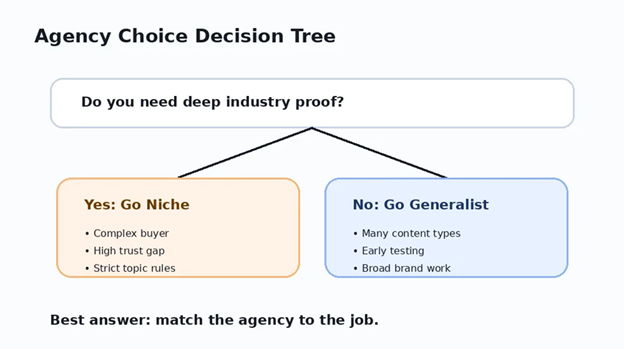
A generalist agency writes across many industries. It may cover SaaS, ecommerce, local services, finance, health, travel, and more. Think of it like a Swiss Army knife. Handy, flexible, and useful in many spots.
A niche agency focuses on one industry or a tight set of industries. It knows the buyer, terms, objections, and sales path. Think of it like a surgical tool. Less flashy, but sharper for one job.
Choose a generalist agency when:
- You need many content types.
- Your industry is easy to learn.
- You need fast testing.
- You want one team for many projects.
- Your brand voice matters more than deep topic depth.
Choose a niche agency when:
- Your product needs trust fast.
- Your market has complex terms.
- Your buyer knows the topic well.
- Wrong details can hurt sales.
- You need strong topical authority.
Neither model is always better. That is the trap. The better choice depends on your content goal.
If you want basic awareness content, a generalist may work fine. If you sell legal software, medical tools, tax help, or B2B tech, niche skill matters more.
Good content is not just writing. It is judgment. It knows what to explain, what to skip, and what to prove.
What Generalist Content Writing Agencies Usually Do Well
Generalist agencies are built for range. They can jump from a blog post to landing page copy. Then they can write emails, case studies, and social posts.
That makes them useful for growing brands. Many teams do not need one deep expert yet. They need consistent output across the funnel.
A good generalist agency brings process. It has briefs, editors, SEO checks, and a content calendar. It can handle messy requests without slowing down.
Need a product launch email today? Need a blog next week? Need a homepage rewrite after that? A generalist team can usually flex.
This is where blog post writing and web copy often overlap. One buyer may read a blog first. Then they land on a service page. The voice should feel connected.
Generalist teams also bring fresh angles. They are not trapped inside one industry bubble. Sometimes that helps.
A niche writer may know every acronym. But a generalist may explain the idea better. That matters when your buyer is not an expert yet.
The big win is speed and flexibility. You get one team that can touch many parts of your content engine.
But there is a catch. Broad skill can turn thin fast. If the agency does weak research, your content will sound polite but empty.
It may pass grammar checks. It may even look polished. But buyers can smell surface-level writing.
That is where many brands get stuck. The content is not bad enough to reject. It is not good enough to win.
What Niche Content Writing Agencies Usually Do Well
Niche agencies win with depth. They know the market before the brief starts. They understand buyer fears, product details, and competitor claims.
That saves time. It also reduces the risk of wrong details. In high-trust markets, that risk matters a lot.
A niche agency usually asks better questions. It knows where buyers get confused. It knows which claims need proof. It also knows which words feel natural.
What happens when your writer can explain the product, but not the buyer? The content may rank, but still fail to sell.
That is why niche work often feels stronger. It can sound like it came from inside the industry.
This helps with service page content too. Service pages need trust fast. They do not have time to warm readers slowly.
A niche agency can often write sharper examples. It can add real use cases. It can compare options with more confidence.
This is useful for topics like:
- SaaS content
- Legal content
- Finance content
- Healthcare content
- Cybersecurity content
- Industrial content
- Real estate content
- Local service content
That said, niche agencies can have blind spots. Some write for insiders only. They may use heavy terms. They may forget that buyers need plain English.
A good niche agency translates. It does not show off. It makes the hard thing feel simple.
That is the sweet spot. Deep enough to be trusted. Clear enough to be read.
Why This Choice Matters More In AI Search

Search is no longer just ten blue links. Google now includes AI features in Search. Google says existing SEO basics still matter for AI Overviews and AI Mode. It also says pages need to be eligible for normal Search first.
That changes how brands should think about agency choice. AI search favors clear, useful, well-structured answers. It also needs content that gives more than common tips.
Google says generative AI search rewards unique, expert-led content over common, thin content. That is a big hint.
Niche agencies can help here. They often bring sharper details, expert framing, and better examples. That makes content easier to cite, summarize, and trust.
But generalist agencies can still win. They need strong briefs and real research. They also need editors who know when content sounds generic.
The old game was simple. Find a keyword. Write a post. Add headings. Hope it ranks.
The new game is heavier. Your page needs to answer the main query. It also needs to cover follow-up questions. It needs clean sections. It needs enough proof to feel safe.
That is why a topical map matters. One post rarely carries the whole topic. Search engines and LLMs look for patterns across many pages.
Think of your content like a neighborhood. One nice house helps. A whole clean street sends a stronger signal.
AI search does not need magic files. It needs useful pages with clear answers.
So the agency you choose should know how to build depth. It should also write in plain language.
That mix is rare. But it is where rankings, trust, and leads start to meet.
How Search Intent Changes The Right Choice
Search intent is the real boss. Keywords matter, sure. But intent decides the format, depth, tone, and proof.
A person searching “what is content writing” wants clarity. A person searching “best content writing agency for SaaS” wants comparison and trust.
Those are different jobs. One needs simple teaching. The other needs buyer support.
Generalist agencies can handle broad learning intent well. They can explain a topic from zero. They can shape clean beginner guides.
Niche agencies often win with commercial intent. They know what buyers compare. They know what objections block the sale.
For example, a generalist can write a good post on content planning. But a niche B2B SaaS agency may write better about product-led growth content.
That does not mean generalists cannot learn. It means the brief must carry more weight.
This is why keyword research should come before writing. A keyword list alone is not enough. You need to know why that search happens.
Intent asks one quiet question. What job does this page need to do?
If the job is education, pick clarity. If the job is sales support, pick proof. If the job is authority, pick depth.
Would you trust a doctor who treats every problem the same way? Content works like that too.
The wrong agency may use one writing style for every page. That creates flat content. It looks organized, but it does not move people.
The right agency reads the search like a room. It knows when to teach. It knows when to compare. It knows when to ask for action.
When A Generalist Agency Makes The Most Sense
A generalist agency makes sense when your content needs range. This is common for startups, small brands, and growing service companies.
You may not need deep niche authority yet. You may need a working content engine first.
That engine may include:
- Blog posts
- Landing pages
- Homepage copy
- Email flows
- Social captions
- Sales enablement copy
- Basic case studies
- Lead magnets
In this stage, speed matters. Clean workflow matters. Brand voice matters.
A generalist agency can also help when your offer is still changing. Early brands pivot often. A niche agency may be too narrow for that stage.
For example, a startup may test three audiences in six months. It may need pages for founders, marketers, and agencies. A generalist team can move across those angles.
This is also useful when you already have subject experts inside your team. Your experts can provide the raw insight. The agency can shape it into readable content.
That setup works well. The expert brings the meat. The writer cooks it clean.
Pick a generalist agency when your main gap is production. Pick one when you need smart hands and steady output.
Still, do not settle for a content mill. A generalist agency should still ask sharp questions. It should still care about your buyers.
Ask for samples across formats. Ask how they edit. Ask how they prevent generic writing.
If they say, “we can write anything,” slow down. Confidence is good. Careless confidence is not.
When A Niche Agency Makes The Most Sense
A niche agency makes sense when the cost of shallow content is high. That cost may show up as lost trust, poor rankings, or wrong leads.
This often happens in complex markets. Your buyers know the terms. They compare vendors carefully. They have real risk.
A niche agency can help when:
- Buyers need proof before they trust you.
- Topics need expert review.
- Your sales cycle is long.
- Your market has strict language.
- Competitors already publish deep content.
- You need thought leadership.
- You need strong bottom-funnel pages.
Niche writers also help with content gaps. They can spot missing subtopics faster. They can see where your competitors are weak.
That makes them useful for authority building. They do not just write one page. They help plan the next ten.
This connects with content writing services as a bigger system. The page is not the whole game. The system behind it matters.
A niche agency is not always slower. Sometimes it is faster because less teaching is needed.
You do not need to explain basic terms. You do not need to correct every draft. You spend less time playing teacher.
That creates relief. Your team can breathe. The content starts feeling less like homework.
There is one warning. Some niche agencies sound stiff. They may write like a whitepaper when you need a blog.
So look for niche skill plus plain speech. That combo is gold.
Quality, Research, And Brand Voice
Quality has layers. Most people only judge the surface. They look at grammar, flow, and headings.
That is not enough. Quality also means accurate claims, clear logic, strong examples, and useful next steps.
Google pushes creators toward helpful, reliable, people-first content. That means content should help readers first. It should not exist only to game rankings.
Research is the base layer. Without it, the writing floats. It may sound nice, but it has no floor.
A good agency should research:
- Search intent
- Audience pain
- Competitor pages
- Product details
- Sales objections
- Internal links
- External sources
- Expert notes
Brand voice comes next. This is where many agencies trip.
They write in their voice, not yours. Or worse, they write in no voice at all.
Your content should feel like a person from your team spoke clearly. Not like a robot wearing a blazer.
Generalist agencies can be strong at voice. They often work across many brands. That trains their ear.
Niche agencies can be strong at detail. They know what sounds true in the market.
The best agency has both. It can carry your voice and protect the facts.
This is why how to brief a content writer matters so much. A great brief turns vague taste into clear direction.
Jemon kormo temon fol. As the work, so the result. A lazy brief brings lazy output.
Cost, Speed, And Team Fit
Generalist agencies often cost less than high-end niche agencies. That is not always true, but it is common.
They also tend to offer broader packages. You may get blogs, emails, and landing pages in one retainer.
Niche agencies often charge more. You pay for market knowledge, expert editors, and less hand-holding.
The real question is not which is cheaper. The real question is which cost creates less waste.
Cheap content can become expensive fast. You pay once to write it. Then you pay again to fix it. Then you pay again through lost leads.
Speed works the same way. Fast is useful only when the draft is close.
A niche agency may take longer on each page. But if the first draft is stronger, the project may move faster overall.
A generalist agency may move fast at first. But if it misses key details, your team gets dragged into revisions.
Team fit matters more than pricing tables. You want a team that feels easy to work with.
Look at how they talk during sales. Do they listen? Do they push a package before they understand the problem?
Ask who edits the work. Ask who handles strategy. Ask if the writer gets access to your team.
Also ask how they handle feedback. Good agencies welcome clear feedback. Weak agencies defend every line.
Pride matters here. You should feel proud to publish the work. Not just relieved that the task is done.
Topic Authority And Content Silos

Topical authority is where niche agencies often shine. They can map the topic with more care.
But generalist agencies can build authority too. They just need a strong strategy layer.
A content silo is a group of related pages. One main guide covers the broad topic. Supporting posts answer smaller questions.
For this article, the silo may include:
- What content writing agencies do
- How to hire one
- How to vet one fast
- Freelancer vs agency content writing
- In-house vs outsourced content writing
- Content writing pricing
- Content writing contracts
- Briefing writers
- Niche content writing agencies
- Generalist content writing agencies
That cluster helps Google understand your depth. It also helps readers move through the decision path.
Internal links connect the pages. Without them, your content becomes a box of loose papers.
Google’s Search Essentials also points to crawlable links and clear words in key places. That includes title, headings, alt text, and link text.
This is why anchor text matters. A link that says “click here” wastes context. A link that says “how to hire a content writing agency” explains the next step.
A strong agency should plan links before writing. It should not bolt them on at the end.
Your content should feel like a guided path. Each page should answer one need and offer the next useful move.
That is how authority compounds. One page supports another. The whole site starts pulling more weight.
Generalist vs Niche Agencies For LLM Visibility
LLMs look for clear patterns. They also need clean facts, useful summaries, and strong entity links.
This does not mean you should write for bots. It means your content should be easy to understand and reuse.
A good page for LLM visibility has:
- Direct answers
- Clear headings
- Simple wording
- Original examples
- Named entities
- Helpful comparisons
- Trusted links
- Consistent topic coverage
Niche agencies can help because they know which entities matter. They may know the tools, job roles, pain points, and product categories.
Generalist agencies can help because they often write cleaner for broad readers. They may avoid heavy terms that confuse people.
The best LLM content sits between both. It is specific, but not dense. It is simple, but not shallow.
Google also says people scan online content. That old behavior still matters. Readers want fast meaning.
So structure matters. Put the answer near the top. Use short sections. Use bullets when they help.
Do not hide the useful part under five warm-up paragraphs. Nobody has time for that.
Think of each heading like a street sign. The reader should know where they are going before they step in.
How To Vet Both Types Before You Hire
Do not hire based on the sales page alone. Sales pages are polished. Delivery is where truth shows up.
Start with samples. Ask for live URLs. Then read them like a buyer, not a marketer.
Look for these signs:
- Does the intro answer fast?
- Does the page match search intent?
- Are claims supported?
- Do examples feel real?
- Is the voice clear?
- Are headings useful?
- Are internal links natural?
- Does the CTA fit the page?
Then ask about process. A strong agency can explain its workflow without making it weird.
Ask how they brief writers. Ask how they use AI. Ask how they fact-check. Ask how they handle expert input.
You can also use how to hire a content writing agency as a checklist. Hiring is easier when you compare the same things.
If you want a fast audit, use a sample test. Give both agencies the same brief. Ask for an outline, not a full article.
An outline shows thinking. It shows if they understand intent, structure, and buyer pain.
Bad agencies hide behind pretty sentences. Good agencies show the bones.
Also check communication. Do they reply clearly? Do they ask sharp questions? Do they admit limits?
Trust starts before the contract. It starts in the first few messages.
The Hybrid Model Often Wins
Some brands do not need one model forever. They need a hybrid.
A hybrid model means one team owns strategy. Another team helps with expert input or niche review.
For example, you can use a generalist agency for steady production. Then bring in subject experts for outlines, quotes, and final checks.
Or you can use a niche agency for pillar pages. Then use a generalist team for repurposing, emails, and social posts.
This works well for growing companies. You get depth where it matters and speed where it helps.
The hybrid model also reduces risk. You do not depend on one writer for everything.
It can look like this:
- Strategy: senior SEO lead
- Topic review: niche expert
- Drafting: trained content writer
- Editing: brand editor
- SEO checks: content strategist
- Publishing: marketing assistant
That sounds like a lot. But it can be simple with the right process.
At Content That Sales, we like this model for many brands. It gives you the kitchen crew, not one tired cook.
Everyone has a role. The work moves cleaner. The final piece has more flavor.
Our Take At Content That Sales
Our take is simple. Do not buy “generalist” or “niche” as a label. Buy fit.
A strong generalist agency with great research can beat a lazy niche agency. A sharp niche agency can beat a broad team when trust matters most.
The label does not write the article. The process does.
At Content That Sales, we build content around the goal first. Then we choose the right depth, structure, and voice.
Some projects need a full content silo. Some need one strong service page. Some need a blog that turns a confused reader into a warm lead.
That is why we do not start with word count. We start with the buyer.
Who are they? What do they fear? What do they already believe? What would make them trust you?
Then we build the page around that answer.
If you need help choosing the right content model, reach out. Call 8801631988589 or email service@contentthatsales.com.
No pressure. Just a clear look at what your content needs next.
Final Decision Checklist
Use this checklist before you sign with any agency.
Choose a generalist agency if:
- You need many content formats.
- Your product is easy to explain.
- You have internal experts.
- You need faster production.
- Your brand voice is still forming.
Choose a niche agency if:
- Your topic is complex.
- Your buyers are experts.
- Trust is hard to earn.
- Your competitors publish deep content.
- You need authority content.
Choose a hybrid if:
- You need both speed and depth.
- You have many content types.
- You want expert review.
- You are scaling a content silo.
- You need support across the full funnel.
The best choice should create relief. Your team should not dread the next draft.
Good content partners make work feel lighter. They bring order, care, and clear thinking.
FAQ About Generalist vs Niche Content Writing Agencies
What are generalist vs niche content writing agencies?
Generalist vs niche content writing agencies are two agency models. Generalist agencies write across many industries. Niche agencies focus on one field or a small group of fields.
Are niche content writing agencies better for SEO?
Niche agencies can be better for SEO when the topic needs deep trust. They often understand subtopics, buyer intent, and expert language faster.
Are generalist agencies cheaper than niche agencies?
Generalist agencies are often cheaper, but not always. Price depends on team skill, process, editing depth, and project scope.
Can a generalist agency write expert content?
Yes, if it has strong briefs, expert interviews, and careful editors. Without that support, expert content can become thin.
Which agency type is better for AI Overview visibility?
The better agency is the one that creates specific, helpful, trusted content. Niche depth helps, but clear writing still matters.
Should startups choose a generalist or niche agency?
Many startups should start with a strong generalist agency. They can switch to niche support when the offer and audience become clearer.
When should I switch from generalist to niche writers?
Switch when revisions get too heavy. Also switch when your content needs deeper proof than your current team can provide.
Can Content That Sales help with both models?
Yes. Content That Sales can build strategy, blogs, service pages, topical maps, and briefs based on your stage.